
This page is about Visual Arts Class 8 — Chapter 15 of the NCERT Kriti textbook for Class 8 Arts. The official chapter PDF is right here, and below it the chapter’s elements, Shadanga and principles are explained in plain words.
Use this page to get the PDF fast, then to read what each activity asks you to do and how to look at the artworks with a trained eye. Everything here follows the NCERT chapter itself.
Download the Visual Arts Class 8 Chapter 15 PDF
The Visual Arts Class 8 Chapter 15 PDF (NCERT Kriti) on the official NCERT site contains the complete printed chapter — the opening Chitrasutra verse, every artwork plate, all four activities and the closing learning outcomes table — so open it whenever you want the book exactly as NCERT published it.
What is inside NCERT Class 8 Visual Arts Chapter 15
This is an activity-based chapter, not a theory chapter with solved examples. It is designed for a real classroom — one with space, light, stored materials and room to display finished work — and its pedagogy section explains how a teacher should run it.
In the chapter’s own order, it contains:
- a Sanskrit verse from the Chitrasutra of the Vishnudharmottara Purana, naming the five basic colours — white, yellow, red, blue and black — and saying that hundreds, even thousands, more can be made by combining them;
- a note to teachers on the visual arts classroom and pedagogy, including the middle-stage competencies that visual arts assessment is based on;
- the seven elements of visual art and design;
- Shadanga, the six limbs of Indian art;
- the six principles of visual art and design;
- four activities, 15.1 to 15.4, that take you from identifying elements to journalling to analysing principles to designing your own motif;
- a closing learning outcomes table with Teacher and Self columns and an overall participation row.
The chapter belongs to Kriti, the NCERT Arts book for Class 8, and its artist studies are three modern Indians who drew on their own traditions: Jamini Roy, Meera Mukherjee and Syed Haider Raza.
What Visual Arts Class 8 Chapter 15 teaches and why
One idea runs through the whole chapter: a visual is built from a few ingredients, arranged by a few rules.
The book’s own comparison is cooking — the elements are like the ingredients of halwa, and Shadanga and the principles are how you combine them so the result is tasteful, just as food tastes good when ingredients meet in the right proportions and at the right temperature.
Because the chapter wants you to make original art, its pedagogy asks you to draw from your own observations of everyday life and experiences rather than copy images from other sources.
The three artists it studies experimented freely with the elements while staying rooted in Indian traditions. Jamini Roy drew on East Asian calligraphy, terracotta temple friezes and folk arts and crafts; Meera Mukherjee on Dhokra metal work; Syed Haider Raza on Indian forest landscapes and the idea of the Bindu, the point or dot.
Key concepts: elements, Shadanga and principles
These three sets of terms are the vocabulary every activity uses. Learn them in this order — elements first, Shadanga next, principles last — and the activities become a matter of naming what you see.
| Set | Role in a visual | Members |
|---|---|---|
| The seven elements | The raw material, like the ingredients of a recipe | point, line, shape and form, texture, colour, value or tone, space |
| The six principles | The arrangement that makes the visual communicate | unity and harmony, balance, rhythm and movement, emphasis, proportion, hierarchy |
The seven elements: the ingredients of a visual
These are the raw materials of any artwork. The chapter defines each one as follows.
| Element | What it means in practice |
|---|---|
| Point | A dot — the smallest element in any visual. |
| Line | The visible path joining any two points; horizontal, vertical, diagonal, dashed, wavy or zig-zag, and variable in thickness. |
| Shape and form | Shape is a flat, two-dimensional area enclosed by a line, geometric or organic; form is a three-dimensional shape that occupies space and has depth. |
| Texture | Sensed by touch (soft, rough, grainy, silky, prickly) or perceived visually through patterns of lines and dots. |
| Colour | Visible when light is reflected and perceived by the eyes; extracted from nature or manufactured synthetically. |
| Value or tone | The lightness or darkness of a colour; tints add white, shades add black, creating gradations. |
| Space | Where elements are organised and composed; includes positive and negative space, foreground and background. |
Notice how each element is tied to an artwork in the book. Form is what you see in the lion of the Mauryan Lion Capital; colour makes you guess which natural materials made the dyes; and value or tone is what you observe in the colour gradations of the Ajanta mural in Cave 1.
Shadanga: the six limbs of Indian art
Shadanga means “six limbs”. It is a codified guide, from the ancient Indian text Vishnudharmottara Purana, on how to combine the visual elements in an aesthetic or tasteful way.
| Sanskrit term | Plain meaning |
|---|---|
| Roopabhedah | Difference between forms |
| Pramanani | Measurement and structure |
| Bhava | Expression and emotion |
| Lavanya Yojanam | Aesthetic composition and grace in art |
| Sadrishyam | Similitude and resemblance |
| Varnikabhangam | Use of tools and colours |
The book keeps the food analogy here: taste comes from correct proportions and the right cooking temperature — art comes from combining the elements well. Shadanga is that ancient recipe for tasteful combining.
The six principles: how the elements are arranged
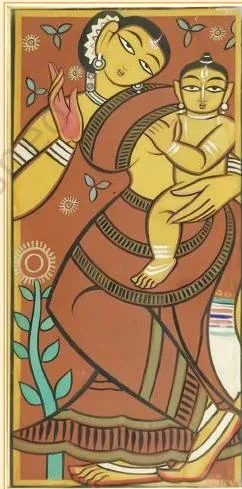
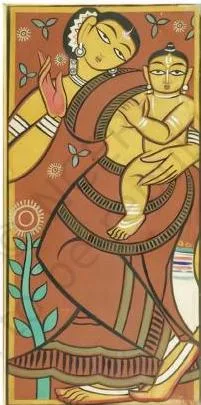
Well-composed visuals communicate ideas and emotions effectively because they follow these principles. The chapter ties each of the six to Jamini Roy’s painting Mother and Child.
- Unity and harmony — elements brought together in a way that is pleasing to the eye; notice the combination and distribution of colours.
- Balance — visual stability, achieved symmetrically (a similar large image in the other half) or asymmetrically (many small images); in the painting, the mother’s tribhanga posture and the position of the child balance it.
- Rhythm and movement — pattern and repetition guide the eye from one part to another; in the painting, the plant stem next to the mother and the lines on her clothes.
- Emphasis — making one visual element stand out; the coloured palm of the mother’s hand holding the flower.
- Proportion — the relationship between the sizes of different elements; the baby is small in relation to the mother.
- Hierarchy — the order of importance in a visual; the mother is given the maximum space, then the child, then the surrounding details.
Activities 15.1 to 15.4: what each activity practises
The four activities move from looking, to recording, to analysing, to making. The table maps each one to the concept it practises.
| Activity | What it practises |
|---|---|
| 15.1 Identify the Visual Elements | Naming elements in folk art (a wall maandana, a Thanjavur-style plate, an embroidered tapestry) and in three modern Indian artworks. |
| 15.2 Make a Journal of Visual Elements ★ | A week-long sketchbook journal of objects, plants, textiles and architectural details from your surroundings, with the elements noted down. The star means it can run with limited resources. |
| 15.3 Identify the Principles | Analysing artworks for the principles, with a worked example for the Ganga sculpture and for Jyoti Bhatt’s Devi. |
| 15.4 Apply the Principles | Designing a simple personal symbol or motif that represents you, then making multiple iterations of it. |
A worked motif exercise: the principles applied to a leaf
Before you design your own motif for Activity 15.4, see the method applied to a new symbol — a leaf. This exercise is original: it follows the chapter’s steps but uses a subject of its own.
- Draw the leaf outline once — that single shape is your base.
- Balance: make the central vein the axis so the two halves roughly mirror each other. That is symmetrical balance.
- Rhythm and movement: repeat the side veins at even spacing, so the repetition leads the eye from base to tip.
- Emphasis: thicken or darken the central vein so one part of the motif stands out.
- Proportion: keep the side veins about a third of the leaf’s width, so every part feels in scale with the whole.
- Hierarchy: order the parts by importance — central vein first, side veins second, fine details last — using size, thickness and tonality.
- Harmony: colour the whole leaf in one hue with tints and shades, so the parts unite into a single pleasing design.
Figure walkthrough: reading the artworks in Chapter 15
Every plate the chapter asks you to study is reproduced here. Read the caption, then use the notes to name what you see — that naming is exactly what Activities 15.1 and 15.3 train.
The Activity 15.1 plates: maandana, Thanjavur plate and tapestry
The plate that opens Activity 15.1 groups the artworks you have to examine — the wall maandana, the Thanjavur-style plate and the embroidered tapestry — so you can note down your observations of the visual elements in each.
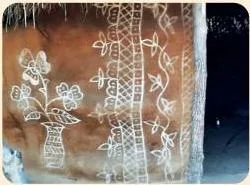
Now take the maandana on its own. A worked reading names four elements at once:
- Line — the painted outlines tracing the pattern across the hut wall;
- Shape — the flat, two-dimensional areas those lines enclose, repeating as a motif;
- Colour — the pigments painted over the wall;
- Space — the pattern forms the positive space, while the plain wall behind it is negative space and background.
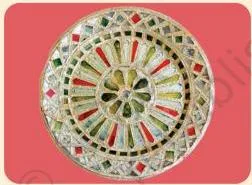
The other two works are questions the chapter poses. The Thanjavur-style plate asks what kind of lines and texture it has, and which other element you would associate with it. The embroidered tapestry asks which visual elements are prominent in it. Answering those questions is Activity 15.1.
The modern artist studies: tempera, bronze and aquatint
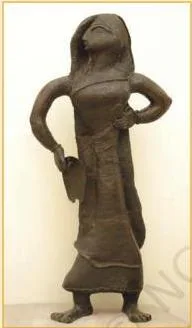
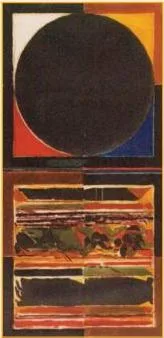
The chapter studies three modern Indian artists, each in a different medium. Jamini Roy’s Mother and Child is tempera on canvas; Meera Mukherjee’s Spirit of Daily Work is bronze, inspired by Dhokra metal work; Syed Haider Raza’s work is an aquatint, inspired by Indian forest landscapes and the concept of Bindu, the point or dot.
Beside the studies is a note to the teacher: research each medium, and introduce students to its techniques and processes.
The two plates below carry the heading “Visual Elements in this Artwork” with blank lines underneath — your job is to fill them. They accompany the bronze sculpture and the aquatint: in the bronze, look for form, since sculpture occupies space and has depth, and for texture; in the aquatint, look for point, line and colour.
The journal plate and the Shadanga diagram
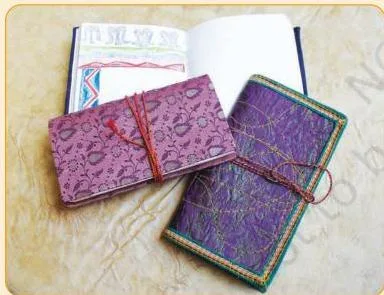
The plate beside Activity 15.2 shows the kind of page your journal should become — drawings of objects, plants, textiles and architectural details, with the visual elements noted next to each. You fill pages every day for a week, then share them with friends and discuss your observations with the teacher.
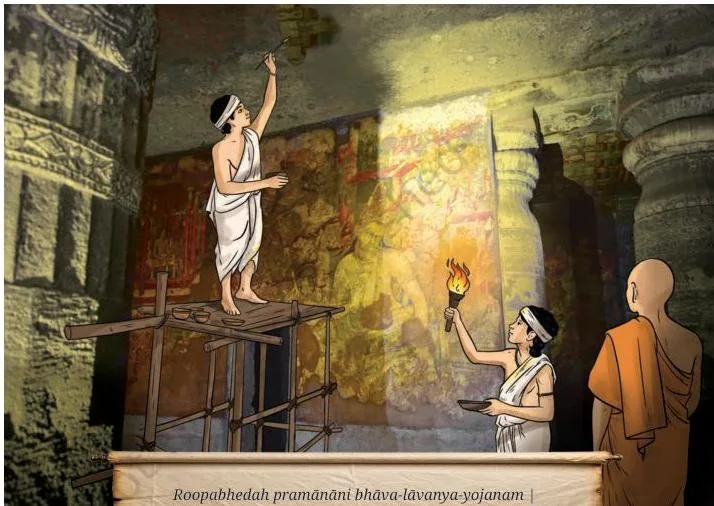
The diagram beside the Shadanga section shows the six limbs as six boxes connected into one scheme, making the point that all six work together. Reading across them: Roopabhedah, Pramanani, Bhava, Lavanya Yojanam, Sadrishyam and Varnikabhangam.
Mother and Child: a walkthrough using all six principles
Jamini Roy’s painting is the chapter’s worked example for the principles. Read it in six steps:
- Unity and harmony — the combination and distribution of colours is pleasing to the eye.
- Balance — the mother’s tribhanga posture and the position of the child give the painting visual stability.
- Rhythm and movement — the plant stem next to the mother and the lines on her clothes repeat, guiding the eye around the painting.
- Emphasis — the coloured palm of the mother’s hand holding the flower stands out.
- Proportion — the baby is small in relation to the mother, and that size relationship carries beauty and emotion.
- Hierarchy — the mother is given the maximum space, then the child, then the details of the surroundings.
The Activity 15.3 and 15.4 plates
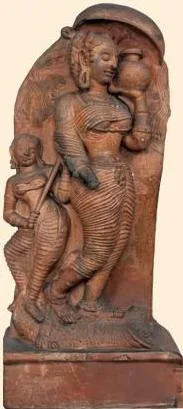
Activity 15.3 gives two worked analyses before you write your own. The Ganga sculpture, a 5th-century terracotta, shows rhythm and movement through the position of the legs and the patterns on the cloth, which resemble water. In Jyoti Bhatt’s etching Devi, emphasis is created by the red bindi on the forehead.
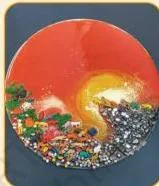
The plate for Activity 15.4 shows a motif brought together by the principles. The caption is the instruction: bring it all together to create harmony — after you have used symmetry for balance, repeated an element for movement, kept the proportions of small parts to the whole, emphasised one part and built a hierarchy by size, thickness, colour and tonality.
Visual arts definitions at a glance
One lookup table with every term the chapter introduces. This is the table to scan the night before.
| Term | One-line definition |
|---|---|
| Point | The smallest element in any visual — a dot. |
| Line | The visible path that joins any two points; can be horizontal, vertical, diagonal, dashed, wavy or zig-zag, and varies in thickness. |
| Shape | A flat, two-dimensional area enclosed by a line; geometric or organic. |
| Form | A three-dimensional shape; occupies space and has depth; can be built by joining two-dimensional shapes. |
| Texture | Surface quality sensed by touch, or perceived visually through patterns of lines and dots. |
| Colour | Visible when light is reflected and perceived by the eyes; from natural or synthetic dyes and pigments. |
| Value or tone | Lightness or darkness of a colour; tints add white, shades add black, creating gradations. |
| Space | Where elements are organised and composed; includes positive and negative space, foreground and background. |
| Unity and harmony | Elements brought together in a way that is pleasing to the eye. |
| Balance | Visual stability; can be symmetrical or asymmetrical. |
| Rhythm and movement | Pattern and repetition that guide the eye from one part to another. |
| Emphasis | Making one visual element stand out. |
| Proportion | The relationship between the sizes of different elements. |
| Hierarchy | The order of importance in a visual. |
| Roopabhedah | Difference between forms. |
| Pramanani | Measurement and structure. |
| Bhava | Expression and emotion. |
| Lavanya Yojanam | Aesthetic composition and grace in art. |
| Sadrishyam | Similitude and resemblance. |
| Varnikabhangam | Use of tools and colours. |
Common mistakes in Visual Arts Class 8 Chapter 15
These are the errors students actually make in this chapter. Each row names the mistake, the correct rule and a quick way to check yourself.
| Mistake | Correct rule | How to check your answer |
|---|---|---|
| Copying a picture from a screen | The chapter’s pedagogy asks for original work inspired by your observations of everyday life, not copies of other images | Ask: did I draw from something I actually saw? |
| Confusing shape with form | Shape is flat and two-dimensional; form occupies space and has depth | Ask: does it have volume you could walk around? |
| Confusing tint with shade | Tints add white and make a colour lighter; shades add black and make it darker | Ask: did I lighten the colour or darken it? |
| Treating negative space as emptiness | Negative space is part of the composition, along with positive space, foreground and background | Ask: did I compose the empty areas too? |
| Assuming only one analysis is right | Activity 15.3 says different observations can all be valid | Ask: can I defend my reading with what I see? |
How teachers assess Visual Arts Class 8 Chapter 15
This is an activity-based chapter, so your progress is recorded through competencies and participation, not through a printed question paper. The note to teachers lists middle-stage competencies that the whole section assesses — among them expressing personal experiences through visual art, challenging stereotypes you notice in your surroundings, using materials with care, and becoming familiar with local art forms.
The chapter closes with a learning outcomes table that has Teacher and Self columns and a row for overall participation. For Chapter 15 the outcomes are: observing visual elements around you and recording them in a journal, identifying and applying the visual principles in artworks, and using a variety of materials for journalling.
Textbook contents and the examinable syllabus are not always identical — check the current official CBSE syllabus for what is assessed this session.
Visual Arts Class 8: the chapter in one paragraph
The chapter builds every artwork from seven elements — point, line, shape and form, texture, colour, value or tone, and space — the ingredients of a visual.
Shadanga, codified in the Vishnudharmottara Purana, is the ancient Indian guide to combining those ingredients: difference between forms, measurement and structure, expression and emotion, aesthetic composition and grace, similitude, and the use of tools and colours.
Six principles — unity and harmony, balance, rhythm and movement, emphasis, proportion and hierarchy — describe how the elements are arranged so a visual communicates. Four activities move you from noticing elements in folk and modern art, to keeping a week-long visual journal, to analysing principles in given artworks, to designing a personal motif through multiple iterations.
Keep five things in mind:
- the seven elements: point, line, shape and form, colour, value, texture, space;
- the six principles: unity, balance, rhythm, emphasis, proportion, hierarchy;
- Shadanga’s six limbs, with their Sanskrit names;
- original observation beats copying — the chapter says so explicitly;
- different readings of an artwork can all be valid.
Related resources for Class 8 Arts
This listing is maintained for the 2026-27 academic session using the NCERT textbook information available to us. NCERT remains the authority for confirming the latest edition.
This chapter sits in Kriti, the NCERT Arts book for Class 8. For the other chapters and practice material, start at the Class 8 Arts notes page, or browse the Class 8 hub for every subject.
Two chapters in the same book build this same visual vocabulary — the chapter on the presentation of dance and choreography and the still life chapter. The full CBSE notes index holds the rest of the site.
Kriti is published by NCERT. The official NCERT website holds every textbook edition, and the chapter PDF linked at the top of this page is that file, unmodified.
Sources and data verification
| What the chapter holds | Count | Where it is used |
|---|---|---|
| Printed pages | 15 | |
| Figures with NCERT captions | 10 | |
| Tables | 2 | |
| Official NCERT PDF | Download the chapter PDF | the chapter exactly as NCERT publishes it |
Reference: NCERT Class 8 Arts (Kriti) textbook, chapter 15, Visual Arts, official edition on ncert.nic.in.
The facts on this page describe the NCERT textbook as NCERT publishes it. NCERT settles textbook editions and official PDFs; CBSE settles the examinable syllabus and examinations. This page claims no review beyond checking the chapter itself — it is a plain description of one textbook chapter, maintained for the current session from the NCERT edition.
Frequently asked questions about Visual Arts Class 8 Chapter 15
What are the seven elements of visual art in Class 8 Kriti Chapter 15?
The seven elements are point, line, shape and form, texture, colour, value or tone, and space.
Point is the smallest dot; line is the path joining two points; shape is flat and two-dimensional while form has depth; texture can be physical or visual; colour is light reflected and perceived by the eye; value or tone is the lightness or darkness of a colour; space holds positive and negative areas, foreground and background.
What is Shadanga in visual arts and what are its six limbs?
Shadanga means “six limbs” and is codified in the Vishnudharmottara Purana. The six limbs are: Roopabhedah (difference between forms), Pramanani (measurement and structure), Bhava (expression and emotion), Lavanya Yojanam (aesthetic composition and grace), Sadrishyam (similitude and resemblance) and Varnikabhangam (use of tools and colours).
What is the difference between shape and form in visual art?
Shape is a flat, two-dimensional area enclosed by a line. Form is a three-dimensional shape — it occupies space and has depth. The lion of the Lion Capital is a form, while the outlines in a maandana are shapes.
Which activities are in NCERT Class 8 Visual Arts Chapter 15?
There are four. Activity 15.1 asks you to identify visual elements in folk and modern artworks; Activity 15.2 (marked with a star) is a week-long journal of visual elements from your surroundings; Activity 15.3 asks you to identify the principles in given artworks; Activity 15.4 asks you to design a personal motif and make multiple iterations.
Why can my analysis of an artwork be different from my friend’s answer?
Because the chapter says so. Activity 15.3 states that your observations may be different from your friends’ and they can all be valid — what matters is that you can support your reading with what you actually see in the artwork.
How is Class 8 Visual Arts assessed at school?
Through competencies and participation rather than a printed question paper. The chapter closes with a learning outcomes table with Teacher and Self columns and an overall participation row, covering observing and recording visual elements in a journal, identifying and applying visual principles, and using a variety of materials for journalling.
Textbook contents and the examinable syllabus are not always identical — check the current official CBSE syllabus.
Explore Class 8 Arts Books
Related chapters: