
Chapter 14 of the NCERT Class 8 Arts textbook Kriti is A Presentation of Dance and Choreography, a project-based chapter that carries a class from the legend of dance’s origins to a fully staged performance.
The official A Presentation of Dance and Choreography Class 8 PDF from the NCERT portal is right here, and this page maps what the chapter contains — the origin legend, the six-question production brief, the three production phases, and the closing assessment grids — so you can plan your production tonight.
Download A Presentation of Dance and Choreography Class 8 PDF
This is the chapter exactly as NCERT printed it, illustrations included, available free on the official NCERT textbook portal.
Open the Class 8 Arts Kriti Chapter 14 A Presentation of Dance and Choreography PDF on the NCERT textbook portal to read the full chapter with its original illustrations and the closing assessment grids in a print-friendly layout.
Chapter 14 at a glance
| What the chapter holds | Count |
|---|---|
| Sections | 14 |
| Figures | 6 |
| Worked examples | 0 |
| Exercise questions | 0 |
This is a project-based closing chapter: it opens with an origin legend, hands you a production brief built from six brainstorming questions, and closes with learning outcomes and summative assessment grids.
What Chapter 14 covers: from legend to curtain call
Before the close reading, here is the chapter’s map. It moves in four movements:
- Legend — how dance came to the earth, told through Brahma Deva, Bharata Muni, Mahadeva and Parvati.
- Brief — a six-question brainstorming list that frames the whole production: theme, style, music, roles, cross-subject learning, venue and dates.
- Production — three phases, from choreography and rehearsals through production design to performance.
- Assessment — closing grids for learning outcomes and summative assessment, individual and group.
Each movement is short, but together they turn a class into a production team.
The origin legend: how dance reached the earth
The chapter opens with a question — “Have you ever wondered how dance originated?” — and answers it with a legend drawn from the Abhinaya Darpaṇam. One sentence sets the vocabulary first: in ancient times, dance was usually called nṛtta and nṛitya, or nartana, while dance-drama was called nāṭya.
- Brahma Deva, drawing from all four Vedas, created the Nāṭya Veda — often called the fifth Veda — and gave it to the sage Bharata Muni.
- Bharata Muni studied and mastered all three aspects, nṛtta, nṛitya and nāṭya, and performed with the Gandharvas (heavenly musicians) and Apsarās (heavenly dancers).
- Mahadeva, the great dancer, was in the audience. Pleased, he offered Bharata Muni special lessons in the rigorous form of dancing called tandava, taught through his gana (attendant) Tandu; Tandu taught the sages, who taught humans.
- Devi Parvati trained Bharata Muni in the more graceful form called lasya, and also taught it to Usha, daughter of King Bana. Usha taught the gopis (milkmaids) of Dwarka, who taught the women of Saurashtra.
The pairing of forms is the legend’s structure: Mahadeva’s tandava is the vigorous side of dance, Parvati’s lasya the graceful side — dance arrives on earth with both moods already in it.
And so, more and more people learnt dance, and that is how dance reached the earth. From that point the chapter makes its real point: legends are a rich source for storytelling in Indian dance forms.
Stories from the Puranas, Jataka Tales and Panchatantra offer narratives that make beautiful visual spectacles with a deep moral message, and they stay relevant when interpreted for today.
Its own example is the Descent of Ganga, which you have already met in Visual Arts. Read closely, the chapter says, the tale carries values: the strength and resolve of Devi Ganga, and how gods and elements of nature had to work together to make good things happen.
Mahadeva helped Ganga control her force before she descended; King Bhagirath stands as an example of unwavering faith and perseverance; and the tale ends with a present-day point — rivers are polluted, and they must be respected and kept clean.
The chapter’s closing question is the whole project in one line: what if you were to bring this story into a dance production?
If you need to refresh the Ganga story, the Class 8 Visual Arts notes retell the same tale with its images.
Reading the chapter’s images
The images in this chapter each do a job: the story images follow the legend from heaven to earth, and the closing images end the production journey. Here is what each one shows and why it is there.
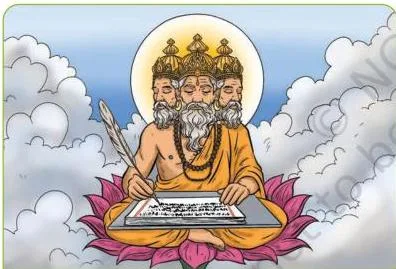
The opening image reaches back to the story of the birth of the performing arts that you met in the Grade 6 Theatre textbook. The chapter uses it as a bridge: you already know that story, and now you will learn dance’s parallel origin from the Abhinaya Darpaṇam.
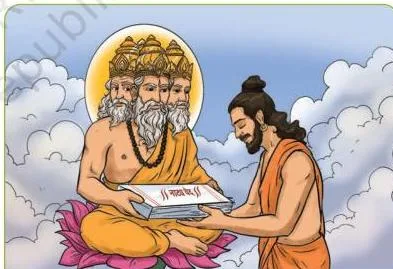
This is the origin moment: Brahma Deva creates the fifth Veda and hands it to Bharata Muni. Keep this image in mind — the chapter later assesses whether you understood the mythological narratives around the origin of dance.
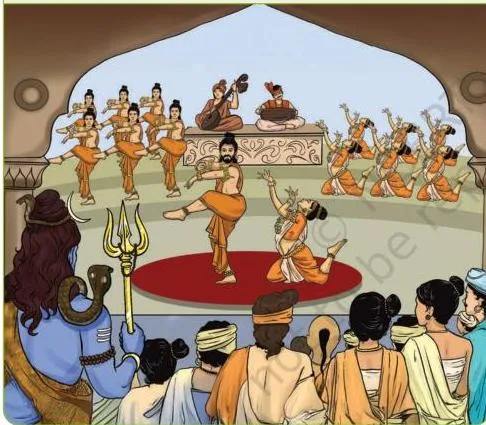
The great dancer Mahadeva is in the audience of the first performance. His pleasure is the story’s turning point: he offers Bharata Muni special lessons in tandava, the vigorous form, taught through his gana Tandu, and the sages then passed it to humans.
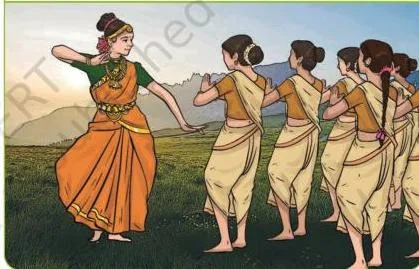
This image completes the chain from heaven to earth. Through Usha, the gopis of Dwarka and the women of Saurashtra, more and more people learnt dance — and that is how dance reached the earth. After this point the chapter turns from legend to the present, and the production work begins.
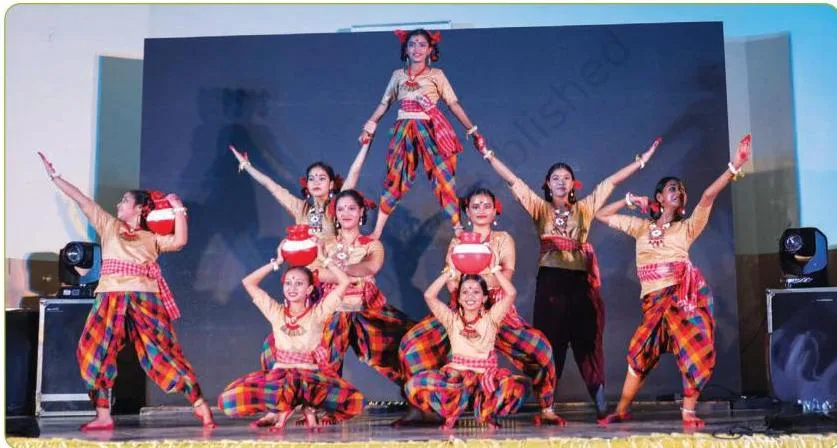
The chapter’s closing image is a bow: after the grand rehearsal, the final performance and the post-show reflections, it is time to take a bow, smile brightly and let your heart dance on. It marks the end of the production journey — and a reminder that the performance is also a celebration.
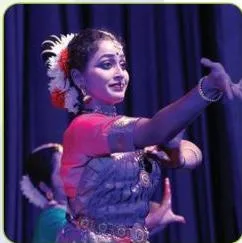
Dollu kunitha is the chapter’s captioned example of a folk form — a drum dance from Karnataka. The closing gallery places it alongside Kathak and Santhali from Jharkhand, a reminder that the style question in your brief can be answered with classical, folk or innovative choreography.
Key dance terms and definitions used in the chapter
The chapter assumes you know the vocabulary of Indian dance from earlier classes. Here is the set it actually uses, with the meaning the chapter gives each term.
| Term | What it means in this chapter |
|---|---|
| Nāṭya Veda | The fifth Veda, created by Brahma Deva by drawing from all four Vedas and given to Bharata Muni. |
| nṛtta (also spelt nṛitta) | Pure dance — movement and rhythm, no story. |
| nṛitya | Expressive storytelling dance. |
| nāṭya | Dance-drama. |
| tandava | The vigorous, rigorous form of dance taught through Mahadeva’s gana Tandu. |
| lasya | The graceful form of dance taught by Devi Parvati. |
| sthānas, chāris, hastas | Elements of the dance form that the choreographic stages tell you to use. |
| bhāvas | Emotions; the assessment asks you to express two bhāvas using appropriate hastas. |
Spelling note: this chapter writes pure dance as nṛtta; some editions write nṛitta. Both are the same word — knowing this saves confusion when you meet both in different books.
The production brief: six questions to answer before you begin
Before any choreography, the chapter runs a brainstorming session: six questions that decide the whole production. Work through them in order — they are the foundation everything else stands on.
- Theme and storyline — What is your production about? Choose a myth, legend or historical story and give it a twist to fit today’s world. Will you write a script or use an existing one? Does each dance tell part of the story, and how many dances will you include?
- Style of dance and groups — Which style or styles fit the theme? How many groups, and how many people per group? Would you like to use any props?
- Music selection — Pick music that suits your theme and dance styles. You can use recorded tracks, compose your own, or include live music performed by students.
- Roles and responsibilities — Assign the production roles; the next section lists them.
- Use your learning from other subjects — Theatre, Visual Arts, Music, Maths and Computing each feed one part of the production; the map is below.
- Venue and dates — Where will the show be — school hall, stage or outdoors? Set the rehearsal schedule and the performance date.
The chapter is direct about why this list comes first: planning and pre-production are crucial before any creation. It compares the plan to a construction site — you dig a deep foundation first, then build; once the foundation is set, you can work on the raw materials at different times before assembling them.
Reader aid — ours, not the textbook’s: the six S’s — story (theme and storyline), style (dance style and groups), sound (music selection), staff (roles and responsibilities), space (venue) and schedule (dates). The one brainstorm question without an S — using your learning from other subjects — is the one that feeds all the others.
Roles and responsibilities: who does what in a dance production
The brief names nine jobs. In a smaller class, some students double up; in a larger group, one job can go to a small team.
| Role | Responsibility |
|---|---|
| Choreographer | Designs the dances and leads the rehearsals. |
| Performers | The dancers and actors. |
| Director or Co-ordinator | Keeps everything running smoothly. |
| Script writer | Writes dialogues and narration. |
| Music Director | Creates or chooses the music and effects. |
| Set and Prop Designer | Designs backdrops and props. |
| Lighting and Tech Crew | Manages lights, sound and tech. |
| Costume and Make-Up Designer | Plans the look of the characters. |
| Marketing Team | Spreads the word about the show. |
Use your learning from other subjects
Every school subject has a seat on the production team, the chapter says:
- Theatre — scriptwriting, acting and dialogue.
- Visual Arts — set design, costume, make-up and props.
- Music — live instruments, songs and background score.
- Maths and Computing — planning budgets, timing or lighting cues.
Phase by phase: from choreography to curtain call
The production path runs in three phases. Phase 1 sets the foundation; Phase 2 builds the show; Phase 3 performs it.
Phase 1 — Planning and pre-production
Work through the six brainstorming questions above. The chapter compares this to digging a foundation — nothing gets built well, or on time, without it.
Phase 2 — Choreography, rehearsals and production design
Break the story into scenes or moments, and explore movements and emotions for each character or scene. Use the elements of your dance form — sthānas, chāris, hastas — and add creative touches of your own.
Breath, rhythm and silence are all part of the story, the chapter reminds you. Teach the dances group by group, try interesting formations and group patterns, and keep entrances and exits smooth and connected.
Watch, review and tweak the dances as needed. Then finalise props, costumes, lights and sound, and run a dress rehearsal in full costume and music plus a technical rehearsal to practise all the backstage elements.
Much of Phase 2 can happen simultaneously — but the Phase 1 foundation has to be set first.
Phase 3 — Performance
Run the grand rehearsal like the real show on the main stage — the chapter calls it a critical rehearsal — and invite a few people to give feedback; by this point there should be no mistakes. Then comes the final performance, and afterwards reflections and post-show feedback.
A worked example: staging the Descent of Ganga
Here is a concrete way to apply the chapter’s brief — our worked plan, not a plan printed in NCERT. It uses the Ganga story the chapter itself suggests, and you can shrink or expand it to fit your class.
Cast and structure: twelve performers in three groups, one group per sequence.
- Sequence 1 — nṛtta (pure dance): the river’s flow; a continuous group dance showing motion and rhythm.
- Sequence 2 — nṛitya (expressive storytelling): Bhagirath’s penance; a small group telling the story through emotion and hastas.
- Sequence 3 — nāṭya (dance-drama): the descent of Ganga; the full cast, with Mahadeva controlling her force as the dramatic high point.
The production runs on a four-week schedule. Week 1 is the planning phase; Weeks 2 and 3 build the show; Week 4 performs it.
| Week | Work | Phase |
|---|---|---|
| Week 1 | Brainstorm the six questions, settle the script, choose the music. | 1 — Planning and pre-production |
| Week 2 | Choreograph the three scenes, group by group. | 2 — Choreography |
| Week 3 | Formations, entrances and exits; dress and technical rehearsals with full costume, lights and sound. | 2 — Production design |
| Week 4 | Grand rehearsal, final performance, reflections. | 3 — Performance |
Role cards for this production: choreographer, director or co-ordinator, script writer, music director, set designer, lighting and tech crew, and marketing — someone has to invite the audience.
The three-sequence structure is deliberate: the nṛtta shows the river’s motion, the nṛitya carries Bhagirath’s emotion, and the nāṭya gives the full cast its dramatic climax when Mahadeva controls Ganga’s force.
Mistakes to avoid when planning a dance production
Student productions usually come unstuck before opening night, not on it. The chapter’s guidance — its brainstorming questions, rehearsal notes and production design steps — points to five failure points. Plan for them from Week 1.
| Mistake | Correct rule | How to check your plan |
|---|---|---|
| Creating before planning | Answer all six brainstorm questions first — planning and pre-production are crucial, like a foundation. | Can you write a one-line answer for every question before the first rehearsal? |
| Weak or forgotten entrances and exits | Keep entrances and exits smooth and connected to the choreography. | At a run-through, does every dancer know where to enter and leave? |
| Treating the grand rehearsal as optional | Run it like the real show on the main stage, with an invited audience. | Did the show run start to finish without stopping? |
| Music that fights the theme | Choose music that suits the theme and the dance styles. | Ask a friend who has not seen rehearsals: does the music fit the story? |
| No one marketing the show | Assign the Marketing Team early — they spread the word about the show. | Has the audience been invited before the final week? |
How this chapter is assessed: learning outcomes and summative assessment
The chapter closes with two grids. The first lists learning outcomes — what you should be able to do by the end; the second is a summative assessment with tasks and criteria, marked by the teacher or by yourself. The outcome grid even prints columns for teacher and self to tick as each point is met.
Learning outcomes the chapter lists
- Engage in collaborative work with enthusiasm, sharing ideas and supporting peers throughout the creative process.
- Participate in all stages of a dance production — planning and pre-production, choreography and rehearsals, final performance.
- Demonstrate understanding of the mythological and cultural narratives surrounding the origin of dance.
- Apply imagination and creativity to all elements of performance: movement, music, costume, space and expression.
Summative assessment: tasks and criteria
| Who | What you demonstrate | Criteria that are checked |
|---|---|---|
| Individual | A movement sequence with posture (sthiti), movement (gati) and breath integration; one nṛtta sequence and one nṛitya sequence; two emotions (bhāvas) with appropriate hastas and an explanation of the thought process; a dance-related project. | Clarity and awareness in movement, posture and mindful breath; sequencing, rhythm and expressive storytelling; comfort and fluency in expressing emotions with accurate hastas; depth, creativity and relevance of the project. |
| Group of 3 or 4 | Collaboratively choreograph a dance sequence on a current social issue; develop and present a story-based performance as a group. | Originality and creativity in concept, choreography and presentation; evidence of effective collaboration and teamwork. |
The pairing of one nṛtta and one nṛitya is the point. nṛtta tests pure technique — movement, rhythm and control with no story to hide behind; nṛitya tests expression — telling a story through emotion and gesture. Asking for one of each checks both abilities separately.
These grids are the textbook’s own closing self- and teacher-assessment tools. They are not an announcement of board exam weightage — textbook contents and the examinable syllabus are not always identical.
What to remember from Chapter 14
If you are revising this chapter the night before, hold on to these:
- The legend’s chain: Brahma Deva created the Nāṭya Veda → Bharata Muni performed → Mahadeva offered tandava and Parvati taught lasya → Usha, the gopis of Dwarka and the women of Saurashtra spread dance to the earth.
- The vocabulary: nṛtta is pure dance, nṛitya is expressive storytelling dance, nāṭya is dance-drama.
- The brief: six brainstorming questions — theme and storyline, style and groups, music, roles, cross-subject learning, venue and dates.
- The phases: planning and pre-production, then choreography with rehearsals and production design, then performance (grand rehearsal, final show, reflections).
- The team: nine roles from choreographer to marketing, with every school subject contributing.
- The assessment: one pure dance sequence, one expressive sequence, two bhāvas with hastas, and collaborative group choreography.
Related chapters and resources around Chapter 14
This listing is maintained for the 2026-27 academic session using the NCERT textbook information available to us. NCERT remains the authority for confirming the latest edition.
Chapter 14 is the closing project chapter of Kriti: it assumes you have already met the Nāṭyaśhāstra and the Abhinaya Darpaṇam in earlier chapters. For quick revision, the Class 8 Arts notes hub covers the book chapter by chapter, and the Class 8 notes index lists every subject.
The Visual Arts notes carry the Ganga story this chapter builds on, and the arts notes on innovation and inclusivity connect directly to the collaborative teamwork this production asks for. From there you can go up to the CBSE notes home or open the Kriti textbook page to reach every chapter PDF.
The Class 8 Arts hub lists the whole book if you need any other chapter.
Sources and data verification
This page describes Chapter 14 of the NCERT Kriti textbook for Class 8 Arts (English medium), as published on ncert.nic.in; it does not cover other chapters of the book or other class books. The listing is maintained for the current NCERT edition in this directory.
NCERT settles textbook editions, chapters and PDFs; CBSE settles curriculum and examinations. Textbook contents and the examinable syllabus are not always identical — check the current official syllabus.
| What the chapter holds | Count | Where it is used |
|---|---|---|
| Printed pages | 10 | |
| Figures with NCERT captions | 6 | |
| Tables | 2 | |
| Official NCERT PDF | Download the chapter PDF | the chapter exactly as NCERT publishes it |
Reference: NCERT Class 8 Arts (Kriti) textbook, chapter 14, official edition on ncert.nic.in.
Frequently asked questions about Chapter 14
What is the difference between nṛtta, nṛitya and nāṭya in Class 8 Arts Chapter 14?
nṛtta is pure dance — movement and rhythm with no story. nṛitya is expressive storytelling dance, where the dancer communicates an emotion or a tale. nāṭya is dance-drama. The chapter says that in ancient times dance was usually called nṛtta and nṛitya, or nartana, while dance-drama was called nāṭya.
What are the stages of creating a dance production in this chapter?
Three phases. Phase 1 is planning and pre-production: the six brainstorming questions on theme, style and groups, music, roles, cross-subject learning, and venue and dates. Phase 2 covers choreography (breaking the story into scenes, using sthānas, chāris and hastas), rehearsals (group by group, formations, smooth entrances and exits) and production design (props, costumes, lights, sound, dress and technical rehearsals).
Phase 3 is performance: grand rehearsal, final performance and reflections.
What does the summative assessment for Chapter 14 ask a student to do?
Individually: demonstrate a movement sequence with posture (sthiti), movement (gati) and breath; perform one nṛtta sequence and one nṛitya sequence; express two bhāvas with appropriate hastas and explain the thought process; and complete a dance-related project. In a group of three or four: choreograph a sequence on a current social issue and present a story-based performance.
The criteria check clarity, rhythm, expressive storytelling, fluency with hastas, depth, creativity, originality and collaboration.
Which folk and classical dance forms appear in this chapter?
The closing gallery shows Kathak, Dollu kunitha from Karnataka, Santhali from Jharkhand and a category labelled innovative choreography. Dollu kunitha is the chapter’s captioned folk example — a drum dance from Karnataka. The origin legend also introduces the vigorous tandava and the graceful lasya as the two moods of dance.
How can other school subjects help in the dance production?
The chapter maps each subject to a job: Theatre for scriptwriting, acting and dialogue; Visual Arts for set design, costume, make-up and props; Music for live instruments, songs and background score; and Maths and Computing for planning budgets, timing and lighting cues.
Explore Class 8 Arts Books
Related chapters: