
This page is for Arts of the People, with the People, for the People Class 8 — Chapter 18 of Kriti, the NCERT Class 8 Arts textbook. The chapter is built around three hands-on activities using thread, cloth and paper: knotting natural fibre, patchworking old fabric, and making papier-mâché from newspaper.
The official NCERT PDF is right here, and below it is a plain guide to what the chapter teaches and what each activity asks you to do.
Download the Arts of the People, with the People, for the People Class 8 PDF
The official file is published on the NCERT textbook portal. Open the NCERT Class 8 Kriti Arts Chapter 18 — Arts of the People, with the People, for the People PDF to read the chapter exactly as printed, with all three activities, the figures and the closing learning-outcomes table.
Chapter at a glance
The chapter table on this page lists how much Chapter 18 holds — its sections, figures and activities — so you can see its size in one look. In terms of content, the chapter is arranged in three activity blocks:
- Tie and Link — learn the art of knotting, working with ropes of natural fibre.
- Patch and Match — learn to sew patches, turning old fabric into a quilt.
- Pulp and Paint — learn to make papier-mâché from newspaper, water and glue.
The chapter closes with a learning-outcomes checklist rather than exercise questions. The final page is a table asking the teacher and the student to grade the activities, so treat the craft work itself as the chapter’s real task.
What this chapter covers: three crafts and one big idea
The big idea is simple: art is everyday making. The objects we use daily — the clothes we wear, the plate we eat from, baskets, fans, quilts — are pieces of art made by ordinary people for their own use. Each activity below turns a cheap, familiar material into something useful and beautiful.
Activity 18.1 — Tie and Link: living roots, ropes and knots
Knotting is the oldest way to join fibre: you twist, loop and tie strands so they hold together without glue or nails. The chapter opens with a striking example — the living root bridges of Meghalaya, where the strong secondary roots of the Indian rubber tree are trained across streams and rivers.
The roots are gently twisted onto one another and tied in places for support. Because they are alive, the bridges grow stronger over time as the roots grow.
The same family of skills — twisting, knotting, crocheting, knitting and weaving — appears across India in baskets, handloom fabric, fans and even the charpoy. These are everyday objects created for daily use by the people, for the people.
The activity itself: collect ropes of cotton, jute or any other natural fibre available in your region. Work in small groups, because knots can be confusing — look around and help one another as you go.
- Steps 1 to 6 produce a small piece: a friendship band, wrist band or rakhi, which the chapter suggests sending to our soldiers as a gesture of appreciation. You can add coloured beads or make it in tricolour.
- Continuing through Step 11 produces larger pieces — wall hangings, torans and similar decorations.
Activity 18.2 — Patch and Match: old fabric into quilts
Patchwork answers a practical question: what happens to clothes we stop using? Instead of throwing them away, you join small pieces of fabric into one large piece. Patchwork is used in many parts of the world, and the chapter lists what it becomes: blankets, cradles, bags, cushion covers, table mats and dhurries.
In many parts of India, women bring fragments of old fabric that each of them collects and quilt them together. That is why the chapter calls patchwork quilts symbols of shared memories — every fragment in the quilt belonged to someone’s life.
The idea then turns social: imagine our society as a patchwork quilt. Each person plays an equally important role in the overall picture, and anything one person does can change the picture of the entire society.
The making is a group task in seven steps:
- Collect old fabric from your homes and around the school.
- Find a base piece of at least 30 cm by 30 cm.
- Cut the collected pieces into squares or rectangles of roughly 5–6 cm.
- Spread the base and arrange the small pieces over it in a visually interesting pattern.
- Join the pieces along their edges on the reverse side, so the stitches stay hidden when you flip the quilt over.
- Place the patchwork on the base cloth and sew lines of running stitches over the patches, with coloured thread if you like.
- Complete the quilt by closing up the edges with another piece of cloth, or by folding and stitching.
The chapter adds a safety note: scissors and needles are sharp, so store needles in a sponge or a dedicated thick cloth where they cannot get misplaced and harm someone.
Activity 18.3 — Pulp and Paint: newspaper into papier-mâché
Papier-mâché starts with an unusual fact: soft paper such as newspaper and tissue, mixed with water and glue, becomes very strong. This mixture can be moulded into a three-dimensional form and painted once dry — that is the whole technique.
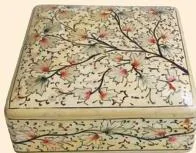
The chapter’s named example is a Kashmiri papier-mâché box with the Chinar tree motif. The point: artists across India use the same papier-mâché base, yet the motifs and patterns vary from region to region, because the forms are inspired by the artist’s environment and culture and painted with pigments available locally.
The chapter leaves an open question — how do you think these practices travelled from one part of the country to another?
The process runs in eight steps, done in groups:
- Cut old newspapers into small pieces or thin strips and soak them in water for a few days.
- Squeeze out the excess water.
- Crush, mash or grind the paper into a pulp; a mortar and pestle works by hand.
- Add a little glue and mix it well.
- Coat the outer surface of a small bowl — your mould — with a greasy substance like petroleum jelly or a thick oil.
- Turn the bowl upside down, overlap thin strips of damp newspaper evenly over the whole surface, apply the pulp thickly, and let it dry completely for a few days.
- When dry, turn it over and gently release the mould.
- Neaten the form with fine sandpaper, then add colour and decorations.
The book’s note to the teacher adds that making pulp needs careful observation of the material’s consistency at every stage — a link to science, because water and glue genuinely change the paper’s properties.
Key concepts in the chapter
Beyond the steps, the chapter wants you to carry away six ideas:
- Art is part of everyday life. From the clothes we wear to the plate we eat from, daily objects are art — not something kept only in museums.
- Artefacts connect people across time. An artefact is any object made by human hands, and every artefact carries the voice and touch of its maker, forging a connection between them and us.
- Materials and values shape expression. New materials, tools and technology influence art processes, just as changes in social values, ideas and behaviour influence creative thoughts and expressions.
- Sustainability is built into craft. Living root bridges grow stronger over time, and old fabric and old newspapers are reused instead of discarded.
- Making is collective. All three activities are group tasks, and patchwork quilts are described as shared memories — creating together is itself a value.
- Technique is shared, motifs are local. The same papier-mâché base carries different regional designs, like the Kashmiri Chinar tree.
That is what the title means by Arts of the People, with the People, for the People: everyday objects created by ordinary people, made together, for everyone’s daily use.
Figure walkthrough: reading the images in Chapter 18
The chapter is rich in photographs that show each craft at different stages. Reading them in order is the fastest way to understand the three activities, so here is each image with what it shows, grouped by activity.
Opening and knotting figures
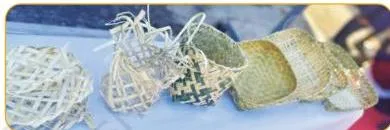
The opening image sets the chapter’s theme before any activity begins: the objects we use daily are pieces of art. It introduces the idea that craft and daily life are the same thing.
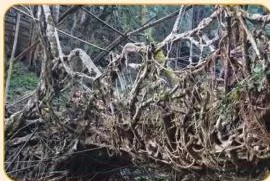
This is the living root bridge. The photograph shows the roots growing above the ground; the chapter adds that people train these roots, twisting and tying them so they form a bridge that strengthens as the roots grow. Nature is a collaborator in this craft.
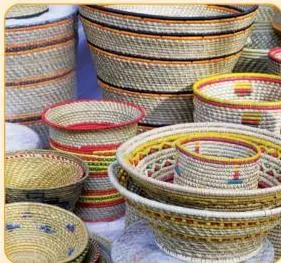
Here is the raw material for Activity 18.1. The image shows the natural fibre rope the activity asks you to collect — the same kind of material behind the jute baskets also pictured in the chapter.
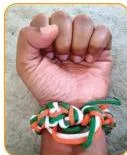
This is the product of the first half of the knotting activity: a small knotted band. The image shows what a careful sequence of knots produces, so you know the target before you start.
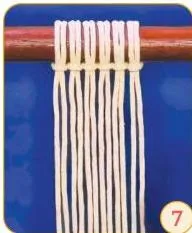
The same knotting skills scale up. The image shows the larger decorative pieces — wall hangings and torans — that a group can finish by taking the steps further, which is why the activity is done in groups.
Patchwork figures
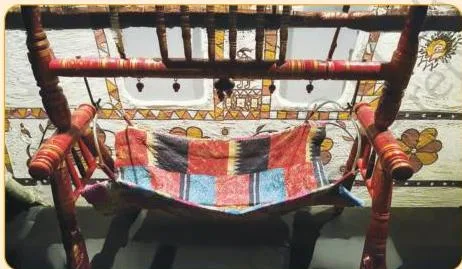
This image introduces the material for Activity 18.2. Fabric outlives any single use, so old clothes become the raw material for something new — the starting point of patchwork.
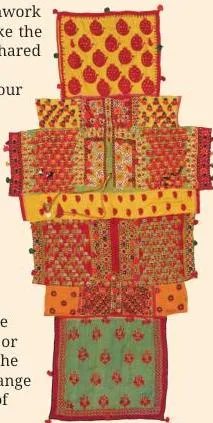
This is the chapter’s central metaphor made visual. Every patch is one person’s contribution; together the patches make the whole picture, and changing one patch changes the quilt. The image lets you see why the chapter calls these quilts symbols of shared memories.
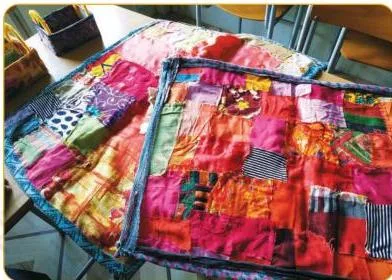
The final step of the patchwork activity, shown in the book: a student quilt with its edges finished. Photographs of real student work appear throughout the chapter so you can compare your own result with the expected one.
Papier-mâché figures
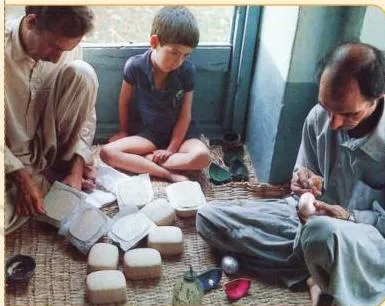
This image captures the material science behind Activity 18.3: wet newspaper and tissue, once mixed with glue, hold together strongly. That strength is what allows the paper to take a three-dimensional form.
The finished products. The image shows the range of objects and regional motifs that papier-mâché can carry — the same technique, different local designs. The Kashmiri box with the Chinar tree motif is the chapter’s named example.

Midway through the process: the pulp stage. The image accompanies the chapter’s advice to watch the material’s consistency as you crush and mash the paper — which is why Step 2 squeezes the excess water out first.
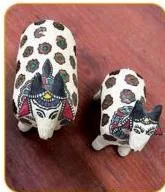
The last photograph in the chapter: the released form being cleaned up and decorated. Sanding smooths the surface first; colour and decorations come after, which is the correct order from Step 8.
Definitions: craft terms used in the chapter
These are the craft terms Chapter 18 uses, each explained in plain words. Every term appears in the chapter text, so you can find it in context as you read.
| Term | Meaning in this chapter |
|---|---|
| Artefact | An object made by human hands; every artefact carries the voice and touch of its maker across time. |
| Living root bridge | A bridge formed by training the living roots of the Indian rubber tree across streams; it grows stronger as the roots grow. |
| Patchwork | Joining small pieces of fabric together to create one large piece, such as a quilt or dhurrie. |
| Running stitch | A simple sewing stitch made by passing the needle in and out of the fabric in lines over the patches. |
| Pulp | Soft paper crushed, mashed or ground with water into a thick mixture, ready to be mixed with glue. |
| Mould | The object whose shape the papier-mâché takes — in the activity, a small bowl coated with a greasy substance. |
| Papier-mâché | A technique for moulding a mixture of paper, water and glue into a three-dimensional form. |
| Toran | A decorative hanging for a doorway, listed with wall hangings as a larger piece from the knotting activity. |
| Rakhi | A wrist band made by knotting fibre, one of the small pieces produced in Steps 1 to 6. |
| Charpoy | A traditional woven cot, given in the chapter as an example of weaving and knotting in daily life. |
| Chinar tree motif | The chinar design painted on the Kashmiri papier-mâché box — a regional motif on a shared technique. |
| Pigment | The colouring material available in a region, used to paint finished papier-mâché forms. |
Common mistakes in the three activities
The chapter names its own cautions in advance. Here they are as a mistakes-and-fixes table, so you know what to check before you start.
| Mistake | Correct rule | How to check your work |
|---|---|---|
| Getting tangled when knots go wrong | Work in a small group and help one another — the chapter says knots can be confusing. | Pause after each knot and let a group member confirm it before you move on. |
| Stitches showing on the front of the quilt | Sew the small pieces together on the reverse side of the fabric. | Flip the patchwork over — the visible side must show no joining stitches. |
| Leaving needles where they can harm someone | Store needles in a sponge or a dedicated thick cloth. | At the end of the session, every needle is back in the sponge or cloth. |
| Releasing papier-mâché before it is dry | Wait until the form dries completely for a few days. | The surface feels dry and firm before you turn the object over to release it. |
Papier-mâché troubleshooting: four problems and the chapter’s fixes
If your papier-mâché misbehaves, the fix is almost always in one of the eight steps. Match the problem to the step:
| Problem | Fix from the chapter | Step |
|---|---|---|
| Pulp too watery | Squeeze the excess water out of the soaked paper before mashing it. | Step 2 |
| Form sticks to the bowl | Coat the mould’s outer surface with petroleum jelly or a thick oil before layering the paper. | Step 5 |
| Form tears when removed | Let it dry completely for a few days before releasing the mould. | Steps 6–7 |
| Rough, uneven surface | Neaten the form with fine sandpaper before adding colour and decorations. | Step 8 |
Exam notes: how this chapter is assessed
Chapter 18 is a practical chapter, and the book itself shows how it is checked: it ends with a learning-outcomes table rather than printed exercise questions. There are no question sets to solve; instead, the teacher scores the activities and the student scores themselves.
The closing table has four rows:
- CG 1.2 — creates artworks in groups and recognises the value of making collectively.
- CG 4.1 — demonstrates awareness of everyday materials used in art practices from different parts of India.
- CG 4.2 — demonstrates familiarity with artists and art practices of their region.
- Overall Participation — a row with Teacher and Self columns for the final assessment.
So for this chapter, preparing means being able to say what you made, how you made it, and why the craft matters — not memorising facts in isolation. The CG codes are the book’s own labels for its learning outcomes.
Textbook contents and the examinable syllabus are not always identical, so check the current official syllabus for how Class 8 Arts is assessed this session.
Quick recap: the chapter in short form
This is this page’s own recap, not the chapter’s summary — a night-before version of Chapter 18:
- Art is part of everyday life — clothes, plates, baskets and quilts are all art.
- Three techniques turn ordinary materials into useful objects: knotting rope and fibre (Tie and Link), patchworking old cloth (Patch and Match), and making papier-mâché from newspaper (Pulp and Paint).
- The techniques are shared across India; the motifs vary by region, like the Kashmiri Chinar tree box.
- The making is collective (group activities) and sustainable (roots grow stronger, fabric and paper are reused).
Keep one image in your head: society as a patchwork quilt — every person’s contribution changes the whole picture.
Related resources
This listing is maintained for the 2026-27 academic session using the NCERT textbook information available to us. NCERT remains the authority for confirming the latest edition.
Two chapters in the same book sit around this one: People in Places and Campaign for Art Awareness. For the full picture, browse the Class 8 Arts notes, the wider Class 8 study resources, or the CBSE notes hub.
| What the chapter holds | Count | Where it is used |
|---|---|---|
| Printed pages | 9 | |
| Figures with NCERT captions | 12 | |
| Tables | 1 | |
| Official NCERT PDF | Download the chapter PDF | the chapter exactly as NCERT publishes it |
Reference: NCERT Class 8 Arts textbook (Kriti), chapter 18, official edition on ncert.nic.in.
Sources and data verification
- This page describes NCERT’s Class 8 Arts textbook Kriti, Chapter 18, Arts of the People, with the People, for the People (English edition). The description is maintained for the current session using the NCERT information available to us.
- NCERT settles textbook editions, titles and official PDFs. CBSE settles curriculum, syllabus and examinations.
- Textbook contents and the examinable syllabus are not always identical — check the current official syllabus before planning exam preparation.
Frequently asked questions
Does Chapter 18 of Kriti, Arts of the People, with the People, for the People, have exercise questions?
No. The chapter ends with a learning-outcomes checklist instead of exercise questions. The closing table lists outcomes CG 1.2, CG 4.1 and CG 4.2, plus an Overall Participation row with Teacher and Self columns, so the chapter is assessed through the activities rather than through written answers.
What materials do I need for the three activities in Chapter 18?
Three sets of materials, one per activity. For Tie and Link: ropes of cotton, jute or any other natural fibre. For Patch and Match: old fabric you no longer use, a base piece at least 30 cm by 30 cm, scraps cut to about 5–6 cm, and needle and thread.
For Pulp and Paint: old newspapers or tissue, water, glue, a small bowl as a mould, petroleum jelly or a thick oil, fine sandpaper and colours.
How do I stop papier-mâché from sticking to the mould?
Coat the outer surface of the mould with petroleum jelly or a thick oil before you start layering the damp paper strips — that is Step 5 of the activity. Also wait until the form is completely dry before releasing it, because removing it too early tears the paper.
What is a living root bridge and where is it found?
A living root bridge is a bridge formed by training the strong secondary roots of the Indian rubber tree to grow across streams and rivers. It is found in Meghalaya, where local people gently twist the roots onto one another and tie them for support; the bridge gets stronger over time as the roots keep growing.
What does the title Arts of the People, with the People, for the People mean in this chapter?
It describes everyday objects created by ordinary people for their own daily use — baskets, quilts, fans, charpoy. The phrase signals that these crafts are made collectively and belong to everyone, rather than to a single artist.
How is Chapter 18 assessed in Class 8 Arts?
Through the learning-outcomes table at the end of the chapter, with rows for CG 1.2 (creating artworks in groups and valuing collective making), CG 4.1 (awareness of everyday materials used in art practices from different parts of India) and CG 4.2 (familiarity with artists and art practices of your region). A final Overall Participation row has both Teacher and Self columns.
Check the current official syllabus for how this is applied in your school.
Reference: NCERT Class 8 Arts textbook (Kriti), chapter 18, official edition on ncert.nic.in.
Explore Class 8 Arts Books
Related chapters: