
This is the Theatre Class 8 chapter — Chapter 1 of the NCERT Kriti (Arts) textbook, the play-reading chapter built around the section “Bringing Words Alive”. The official NCERT chapter PDF is right here, and below it you will find what the file actually holds: rehearsed reading, the three voice subsystems, volume and pitch, the key activities, and the book’s assessment model.
The NCERT edition described on this page is the one reprinted for the 2026-27 session.
You can download the official Theatre Class 8 NCERT Kriti chapter PDF directly from ncert.nic.in — it is the same chapter your school follows. Keep the file on your phone and you can practise the tongue twisters and voice activities anywhere, even without the printed book.
Theatre Chapter 1 at a glance
The table below lists how much this chapter holds — its sections, figures, tables, activities and page length — so you can see the shape of the file before you read it. Theatre is an activity-based chapter: expect classroom speaking games and discussion questions rather than a long written exercise set.
What “Bringing Words Alive” teaches
This section is the chapter’s opening argument: a play script can be a finished performance on its own. The chapter begins with the 10th–11th century Kashmiri scholar Abhinava Gupta, whose commentary on the Nāṭyaśhāstra compares a well-knit performance — script, acting and music churned together — to a beautiful garland of flowers.
Then comes the main question: reading a script is normally the first step towards a production, but can that first step itself be the final performance? The chapter’s answer is yes — this is rehearsed reading (NCERT, p. 4).
Rehearsed reading is performed without any set, props, costumes or make-up: actors in regular clothes sit on chairs on the stage and read their character’s lines aloud (NCERT, p. 4).
The chapter warns this is not ordinary reading aloud: actors stay in character throughout, emote through the voice, and give every word, pause and expression equal importance. This sharpens the imagination and connects the text directly to the audience without visual enhancements (NCERT, p. 4).
To fix the idea, the book places play reading against its opposite (NCERT, p. 6):
- Mime — a performance with no voice, only action.
- Play reading — a performance with only voice, no action.
Rehearsed reading belongs to the play-reading side. Its close relatives are radio plays, voice acting and dubbing — the same idea, performed off stage (NCERT, p. 5).
What the chapter sets out to teach: play reading as a performing art, voice training, and impactful speaking (NCERT, p. 4). The book compares the training to a singing practice — both work on the vocal cords, pitch, volume and the emotion the voice evokes (NCERT, p. 5).
For scenes to perform, the book recommends the plays below (NCERT, p. 14). You can also use the play script in Chapter 3, “One Stage Many Scripts”, of the same textbook.
| Name of the play | Playwright |
|---|---|
| Comedy of Errors | Shakespeare |
| Alice in Wonderland | Lewis Carroll |
| Say the Right Thing | G C Thornley (Kriti, Grade 7 textbook) |
| rāmatapovanābhigamanām | Dr. Vishvasa |
| gurudakṣiṇā | Shri Ma. Ra. Kumaraswami |
| dānāsya mahimā | Dr. Vishvasa |
| bālaçaritam | Bhāsa |
The first three plays are English; the Sanskrit plays below them have their scripts available in the QR code printed in the book. Pick one scene, read it as a group, and perform it for the class when you are confident.
The chapter’s closing thought comes from the Nāṭyaśhāstra (Chapter 15, Stanza 2): words are the body of the dramatic art, while gestures, costumes, make-up and the acting of sattva only clarify their meaning (NCERT, p. 15). Speech, in other words, is the core of theatre — and the whole chapter trains it.
Key ideas: how the voice works, and what volume and pitch are
This section explains the raw material of play reading — the voice — before the practice begins. The reason is practical: a rehearsed reader cannot use a microphone or any equipment, so all voice control has to come from the body (NCERT, p. 5).
Most people assume the voice is made by the vocal cords alone. The chapter corrects that picture: the vocal cords are one part of a three-subsystem machine that makes and shapes every sound you speak (NCERT, p. 6).
| Subsystem | Body parts involved | What it does |
|---|---|---|
| Air pressure system | Diaphragm, chest muscles, ribs, abdominal muscles, lungs | Supplies and regulates the air that makes the vocal cords vibrate |
| Vibratory system | Voice box (larynx), vocal folds (vocal cords) | The vibrating folds turn air pressure into sound waves — the raw sound of the voice |
| Resonating system | Vocal tract: throat (pharynx), oral cavity, nasal cavities | Shapes the buzzy raw sound into the recognisable voice people hear |
Pitch, volume and the ability to emote all originate in these parts of the body (NCERT, p. 6). In practical terms, the voice is a whole-body instrument: the air pressure system drives the vibratory system, and the resonating system shapes what finally reaches the audience.
Two words from the chapter do most of the acting work and are easy to confuse (NCERT, p. 9): volume is how loud or soft a sound is; pitch is how high or low it is.
Loud volume suits strong emotions like anger or joy, while soft volume suits sadness, fear or kindness. High pitch often shows excitement, fear or playfulness, and low pitch suggests seriousness, calmness or anger. That is how an actor builds character — a childlike part speaks high, a wise old king speaks in a deep, low tone.
The animal examples on page 9 make the volume–pitch–emotion link easy to remember, and they double as warm-up sounds for Activity 1.3 (NCERT, p. 9).
Two patterns stand out: the lion and the bear pair loud volume with low pitch for power and aggression, while fear takes two different forms — soft and high for the mouse, loud and high for the horse.
| Animal sound | Volume | Pitch | Emotion it communicates |
|---|---|---|---|
| Lion — roar | Very loud | Low | Power, dominance |
| Mouse — squeak | Soft | High | Fear, excitement |
| Owl — hoot | Soft | Low | Wisdom, calmness |
| Snake — hiss | Soft | Medium-high | Threat, fear |
| Horse — neigh | Loud | High | Alarm, fear |
| Bear — growl | Loud | Low | Aggression, threat |
What each activity in the chapter trains
Four numbered activities and one word-game carry the practice in this chapter. Each one trains a different speech skill, and the table below maps them.
| Activity | What you do | Speech skill it trains |
|---|---|---|
| Activity 1.1 — Clarity in Speech (NCERT, p. 7) | Say tongue twisters — slow at first, speeding up until flawless; restart when you fumble | Clear, distinct pronunciation of every syllable |
| Activity 1.2 — Diction (NCERT, p. 8) | Speak slowly, pause between ideas, vary speed, and stress different words | Speed control, pauses and intonation for emphasis |
| Activity 1.3 — Guess the Animal Emotion (NCERT, p. 10) | Make an animal sound carrying a secretly chosen emotion; the class guesses animal and emotion from volume and pitch alone | Control of volume and pitch to express emotion without visual cues |
| Activity 1.4 — If You Are an Actor (NCERT, p. 11) | Fill in the right volume and pitch for the three script lines | Choosing volume and pitch to suit a line’s emotion |
| Speaking Without Language (NCERT, p. 12) | Invent gibberish sentences, deliver them in an emotion, then hold a 4–5 line gibberish conversation | Communicating through tone, expression and context when words carry no meaning |
Word Impact (NCERT, p. 8) is the chapter’s simplest proof that emphasis changes meaning. The book’s model sentence is “I didn’t go to school today.”
Here is the same exercise on a new sentence: “I never said you ate my lunch.” Say it seven times, stressing a different word each time, and watch the meaning flip:
| Word stressed | What the sentence now implies |
|---|---|
| I | Someone else said it, not me. |
| never | I did not say it at all. |
| said | I hinted or wrote it, but did not say it. |
| you | I said someone else ate it. |
| ate | I said you did something else with it. |
| my | I said you ate someone else’s lunch. |
| lunch | I said you ate my breakfast or dinner. |
Take turns stressing the highlighted word and discuss what the sentence now means. Once one-word emphasis is easy, the book suggests stressing several words together and watching the meaning shift again (NCERT, p. 8).
The gibberish activities (NCERT, p. 12) start from a real observation: communication depends not just on what we say but how we say it. Even when you do not know a language, your brain picks up meaning from tone, facial expression, body language and context.
In the basic round, you invent sentences from random sounds and deliver them in a clearly chosen emotion — annoyance at a friend who keeps disturbing your study, for example — while the class guesses what you “said”. In the advanced round, two students hold a four-to-five line conversation in gibberish, then reveal what they actually meant (NCERT, p. 12).
Theatre chapter figures, explained
The illustrations in this chapter are tied to specific activities and notes; working through them below makes the activities clearer when you reach them in the PDF.
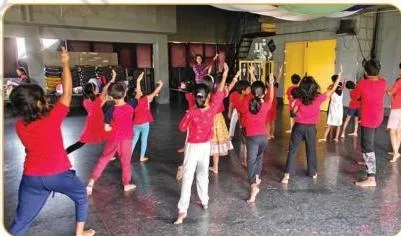
The assessment image belongs to the note at the start of the book: theatre is tested by doing, not by a written paper — the year-end check is an activity-based test at individual and group level (NCERT, p. 3).
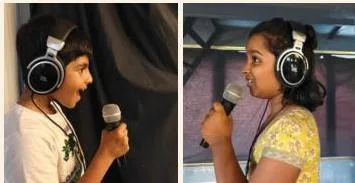
The singing-practice image sits beside the book’s analogy: training for play reading works like training for singing, because both polish the vocal cords, pitch, volume and the emotion the voice carries (NCERT, p. 5).

The radio image lists rehearsed reading’s off-stage cousins: radio plays, voice acting and dubbing use the same voice-first concept, only not on a stage (NCERT, p. 5).

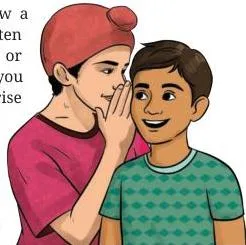
The tongue-twisters image carries Activity 1.1’s side instruction: tongue twisters exist in every language, so share the ones you know in your local language and learn new ones from your classmates (NCERT, p. 7).
The animal image introduces the volume–pitch table: animals communicate feelings through sound, from a lion’s territorial roar to a cat’s soft meow, and actors do the same with their voices (NCERT, p. 9).
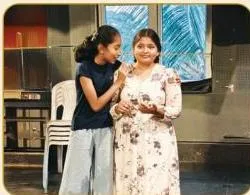
The actor image opens Activity 1.4: imagine you are on stage reading the script, and fill in the right volume and pitch for three given lines — a secret about someone who is unwell, a rousing call to brave soldiers, and a weak, painful cry (NCERT, p. 11).
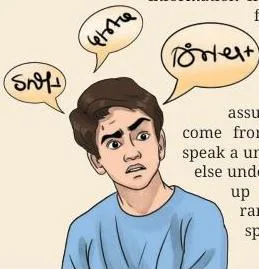
The gibberish image sets up the experiment: assume you come from another planet speaking a language nobody understands, then make up sentences from random sounds and let tone, expression and context carry the meaning (NCERT, p. 12).
The last image marks the note to teachers inside the gibberish activities: push past simple gibberish towards complex gibberish — many combinations of syllables, with a changing rhythm — because richer sound patterns carry more expression (NCERT, p. 13).
Key terms in Theatre Chapter 1
The chapter’s vocabulary is small but specific, and two pairs are easy to swap: mime versus play reading, and volume versus pitch. Use this list to keep the terms straight.
| Term | What it means | Where it appears |
|---|---|---|
| Rehearsed reading | A stage form performed without set, props, costumes or make-up; actors sit in regular clothes and read their character’s lines, staying in character and emoting through the voice | NCERT, p. 4 |
| Mime | A performance with no voice, only action | NCERT, p. 6 |
| Play reading | A performance with only voice, no action | NCERT, p. 6 |
| Vāchika abhinaya | Speech-based acting from the Nāṭyaśhāstra; any performance using speech or language — even songs in dance — counts as Vāchika abhinaya | NCERT, p. 7 |
| Tongue twister | A phrase with similar sounds that is hard to pronounce; practising them improves clarity | NCERT, p. 7 |
| Diction | Clarity and articulation in speech, improved by speaking slowly and pausing between ideas | NCERT, p. 8 |
| Speed | The pace of speech and of the pauses between words | NCERT, p. 8 |
| Intonation | The stress and emphasis placed on specific words to add importance | NCERT, p. 8 |
| Volume | How loud or soft a sound is | NCERT, p. 9 |
| Pitch | How high or low a sound is | NCERT, p. 9 |
| Gibberish | Speech built from random, meaningless sounds; meaning is carried by tone, expression and context | NCERT, p. 12 |
Common mistakes in Theatre Chapter 1 (and how to fix them)
The chapter’s own instructions warn against a handful of slips well before you make them in class. The table names each mistake, the rule that fixes it, and a quick self-check.
| Mistake | Correct rule | How to check your answer |
|---|---|---|
| Treating rehearsed reading as ordinary reading aloud, with a flat voice | It is a performance: stay in character throughout and emote through the voice, giving every word, pause and expression equal weight (NCERT, p. 4) | Ask: could a listener who cannot see me tell what my character feels? |
| Thinking the voice comes only from the vocal cords | Three subsystems work together — air pressure, vibration and resonance — and all three shape the voice (NCERT, p. 6) | Feel the diaphragm, ribs and chest working as you speak, and notice the mouth and nose shaping the sound |
| Confusing volume with pitch | Volume is loudness or softness; pitch is highness or lowness. They are independent settings (NCERT, p. 9) | Produce a loud low sound (bear growl), then a soft high sound (mouse squeak) — two different combinations |
| Using facial expressions or body language in Guess the Animal Emotion | This activity is voice-only by design — expressions and body language would give the emotion away (NCERT, p. 10) | Have a partner watch you: if the emotion is visible on your face, restart the sound without the face |
| Carrying the “voice-only” rule into every activity | Only Guess the Animal Emotion is strictly voice-only; the gibberish activity asks you to use voice, action and expression together (NCERT, pp. 10, 12) | Re-read the instruction line of each activity before you start — they are different on purpose |
| Stressing the wrong word in Word Impact so the meaning flips | Stress the word you want to make important; each stressed word creates a different sentence meaning (NCERT, p. 8) | Say the sentence stressing each word in turn and state what changes each time |
| Falling back on simple gibberish, repeating the same syllables over and over | Complex gibberish — many syllable combinations with a changing rhythm — communicates far better (NCERT, p. 13) | If the same syllable keeps repeating, build a longer, varied combination instead |
How Theatre is assessed: circle time, rubrics and the year-end test
Because Theatre is an activity subject, students and parents often ask how it is graded. The book’s answer is direct: marks matter, but theatre must not be reduced to a pen-and-paper exam with a question paper (NCERT, p. 2).
The final presentation is not the only benchmark — the thought and process behind each activity count too, judged on four criteria (NCERT, p. 2):
- Knowledge application
- Effort and participation
- Creativity and presentation
- Teamwork and collaboration
Formative assessment happens in class at two levels (NCERT, pp. 2–3):
- Circle time — after every class and every activity, the teacher sits with students informally, asks what they did and how it felt, and makes notes on each response. The chapter’s own circle-time questions (NCERT, p. 14) ask which play you would choose for a play-reading performance, which is harder — acting with the voice and no action, or acting without the voice — and where this chapter’s speech training will be useful to you.
- Rubrics — after each chapter, the teacher marks the desired learning outcomes, and the student grades their own performance too; that self-analysis is itself feedback for the teacher.
Summative assessment is an activity-based test at the end of the year, combining the lessons learnt through the year, conducted at individual and group level to assess different skills (NCERT, p. 3). The book points to its opening “time allocation and assessments” section for the fuller scheme, with sample activities given at the end of that section.
The competency chart on the last page (NCERT, p. 16) lists what a successful student takes from the chapter: understanding the shift from enacting a script to reading it; working on diction, clarity and intonation; applying voice skills to other languages; using the skills in everyday conversation with friends, teachers and parents; and overall participation in class.
One honest caution: textbook contents and the examinable syllabus are not always identical. For how Theatre is examined in your session, check the current official syllabus — this page reports what the NCERT book itself says.
Theatre Chapter 1: what to remember
Five points hold the whole chapter together:
- A play script can be performed through voice alone — rehearsed reading is a legitimate final performance, not a warm-up for one (NCERT, p. 4).
- The voice is produced by three body subsystems — air pressure, vibration and resonance — and the actor controls all three (NCERT, p. 6).
- Emotion in acting is carried mainly by volume (loud or soft) and pitch (high or low), sharpened by diction, speed and intonation (NCERT, pp. 8–9).
- Gibberish proves that how we speak communicates even when the words mean nothing (NCERT, p. 12).
- The chapter closes with the Nāṭyaśhāstra’s teaching that words are the body of dramatic art — gestures, costumes and make-up only clarify them — and good speech is a life skill that helps people understand you, avoids misunderstandings, and keeps you calm and confident in tricky situations (NCERT, p. 15).
Related pages and sources
Move on to the rest of the book from here: the Class 8 Kriti Arts chapter list opens every chapter of this textbook, and the Class 8 hub collects study material across subjects. The CBSE notes home page is the starting point for every class.
To verify the current edition directly, the NCERT portal at ncert.nic.in hosts the official textbooks and chapter PDFs.
Sources and data verification
This page describes NCERT Class 8 Kriti (Arts), Chapter 1: Theatre, in the NCERT edition whose imprint appears on the first page of the chapter PDF. It covers this book’s chapter, not every Class 8 subject.
NCERT settles textbooks, editions and official PDFs; CBSE settles curriculum, syllabus and examinations. A chapter appearing in a textbook does not prove every part of it is examinable this session — textbook contents and the examinable syllabus are not always identical, so check the current official syllabus. This page is maintained for the current academic session.
Theatre Class 8 — questions students ask
What is rehearsed reading in Theatre Class 8?
Rehearsed reading is a theatre form performed without set, props, costumes or make-up: actors in regular clothes sit on chairs and read their character’s lines aloud, staying in character and emoting through the voice. It is a finished performance, not a rehearsal (NCERT, p. 4).
How is volume different from pitch?
Volume is how loud or soft a sound is; pitch is how high or low it is. A lion’s roar is very loud with a low pitch (power, dominance), while a mouse’s squeak is soft with a high pitch (fear, excitement) (NCERT, p. 9).
What are the three voice subsystems in Kriti Chapter 1?
The air pressure system (diaphragm, chest muscles, ribs, abdominal muscles, lungs) supplies and regulates the air; the vibratory system (voice box or larynx, with the vocal folds) turns the air pressure into sound waves; and the resonating system (throat, oral cavity, nasal cavities) shapes the raw sound into a recognisable voice (NCERT, p. 6).
How is Theatre assessed in Class 8 according to this chapter?
Through formative assessment — circle time after every class and activity, plus a per-chapter rubric that both teacher and student grade — and a summative activity-based test at the end of the year, at individual and group level (NCERT, pp. 2–3).
The book insists the process — knowledge application, effort, creativity and teamwork — matters as much as the final presentation, and that Theatre should never become a written question-paper exam (NCERT, p. 2).
What does Vachika abhinaya mean?
Vāchika abhinaya is speech-based acting, a term from the Nāṭyaśhāstra. Vāchika means speech or language, so any performance that uses speech or language — even songs in a dance — counts as Vāchika abhinaya (NCERT, p. 7).
Where can I download the official Theatre Class 8 chapter PDF?
From ncert.nic.in: the official Theatre Class 8 NCERT Kriti chapter PDF is the file offered at the top of this page, and the NCERT portal at ncert.nic.in lets you verify the current edition of any textbook.
| What the chapter holds | Count | Where it is used |
|---|---|---|
| Printed pages | 16 | |
| Figures with NCERT captions | 8 | |
| Tables | 5 | |
| Official NCERT PDF | Download the chapter PDF | the chapter exactly as NCERT publishes it |
Reference: NCERT Class 8 Kriti textbook, chapter 1, official edition on ncert.nic.in.
Explore Class 8 Arts Books
- Next: One Stage, Many Scripts
Related chapters:
- From Page to Stage
- Applause and Advice
- Music