
Dance cannot exist without emotion — and neither, the opening verse of this chapter insists, can poetry, aesthetic essence or the world itself. That verse, shloka no. 8 from Sangita Damodara by Pandit Shubhankara, is the first thing you meet in Dance and Movement, Chapter 10 of the NCERT Class 8 Arts book Kriti.
This is a practical chapter: it builds the body foundations of Indian dance through movement activities, not written questions. The official Dance and Movement Class 8 NCERT Chapter 10 PDF from the Kriti book is right below.
Download the Dance and Movement Class 8 NCERT Chapter 10 PDF
The NCERT textbook portal (ncert.nic.in) hosts the Kriti book for Class 8 Arts, and you can open the official Dance and Movement Class 8 NCERT Chapter 10 PDF there to follow every figure, activity and QR-code video in the chapter.
Chapter at a Glance: contents, figures and activities in Dance and Movement
The table below lists what the chapter file holds — its sections, figures, worked examples and exercise questions — so you can see at a glance how the chapter is built.
- Opens with shloka no. 8 from Sangita Damodara on emotion and dance.
- A note to teachers on space, light and teamwork, followed by the pedagogy principles.
- Concept sections in order: Breath in Dance, Elements of Dance, Postures in Dance, Motion in Dance, and Combination of Postures and Movements.
- Movement activities (Activity 10.1, 10.2, 10.3, 10.4 and 10.5) spread through the chapter.
- A History Trivia box on the three classical dance texts.
- QR codes and internet references for watching movements.
- A closing learning-outcomes table headed “Chapter 10: Inner Dynamics of Dance”.
The chapter is built for the practitioner: it has no written exercise block, and its pages teach you to move and observe rather than to memorise answers.
What This Chapter Covers: the inner dynamics of dance
Before any Sanskrit terms, one big idea: this chapter is not about learning a named dance style. It is about the common foundations of Indian dance — how the body breathes, holds still, moves, and joins those states into a phrase.
The opening shloka states the belief underneath the whole chapter: dance cannot exist without emotion, and rasa (aesthetic essence) cannot arise without it. Everything that follows is technique meant to carry feeling.
The Elements of Dance section then adds the structural idea: dance is both static and dynamic. Postures give moments of stillness, movement gives the motion between them, and every movement begins and ends in stillness.
The chapter’s vocabulary comes from ancient treatises that Indian dance still uses. The History Trivia box dates them, the concept sections borrow their terms, and regional forms from across India show the same principles working differently.
Key Concepts in Dance and Movement Chapter 10
The chapter develops its ideas in a strict order — breath first, because it fuels everything that follows. Each idea below builds on the one before it, exactly as the book does.
Breath is the fuel of dance
The Breath in Dance section begins with yogic philosophy: prāna is the vital breath of life, and prāṇāyama is the flow of breath during inhalation and exhalation. Dance, the book says, is fuelled by this life force.
The usable rule is simple and symmetric:
- Inhale — helps the body stretch, bend and expand, as in yoga āsanās.
- Exhale — helps the body contract, as when crouching the body in fear or nervousness.
- Relaxed breath — helps you hold a static posture longer by relaxing the spine.
Why breath first? Because dance movements begin with an equipoise — a relaxed spine. Breathing relaxes the spine, and a relaxed spine lets the body move with maximum agility and stability. Breath also forms the link between two seamless dance movements, and it carries emotion while you perform.
Activity 10.1 asks you to test this: hold a posture, then move into an expansion (arms outstretched, body bending), then a contraction, then a new stillness — noticing how breathing in and out drives each change.
Stillness and motion: the Point A to Point B idea
The Elements of Dance section makes the observation the whole chapter rests on: a posture is not the opposite of movement — it is movement’s beginning and end.
The book’s example is walking from Point A to Point B. Before you set off from Point A, there is a moment of stillness; between the two points is the movement; after you land at Point B, stillness returns. So any movement starts and ends with a static posture.
This is why dance is described as a combination of being static and dynamic. The same rhythm appears in daily life — and that is why later activities ask you to observe everyday postures.
Postures: sthāna and its three forms
The Postures in Dance section gives the first formal term. According to the Nāṭyaśhāstra, sthānas (postures) are of three kinds — standing, sitting and reclining.
The book also notes that in many dance forms there are definite male and female postures; in Sattriya from Assam, these are the purusha and prakriti pāk. Hold that point lightly — an activity later in the chapter asks you to question such labels.
To show that a posture lives differently in different regions, the book prints Naurata from Madhya Pradesh, Kathak from North India, Perini Natyam from Andhra Pradesh and Kud dance from Jammu, along with bronze sculptures of dancers. One sthāna idea, many bodies, many styles.
Motion: chāri, gati and mandala
The Motion in Dance section separates two ideas students often merge: how you move, and which character’s walk you take on.
Chāri means ways of moving or displacing yourself. The Nāṭyaśhāstra divides chāris into bhaumi chāris — earthly movements where the feet stay on the ground, like dragging your feet — and ākāshi chāris — aerial movements where the feet leave the ground, like leaps and jumps. A combination of chāris makes a mandala.
Gati is a characteristic gait, in practice often an animal’s: the dancer embodies the way the animal would move. Think of a soldier versus a baby versus a bear, the book suggests — every character walks differently.
The Abhinaya Darpanam names four chāris, and each one is an everyday movement:
- Chalana — simple walking steps.
- Veginī — quick steps.
- Saraṇam — wide steps.
- Kuṭṭanam — thumping steps.
The same text names four gatis, each changing the dancer’s body in a different way:
- Deer — quick, high-leaping movement: the body becomes light and fast.
- Monkey — strong steps and jumps: power replaces lightness.
- Tiger — powerful, weighted: every step lands heavy.
- Garuda (bird) — light and airy jump: the body floats.
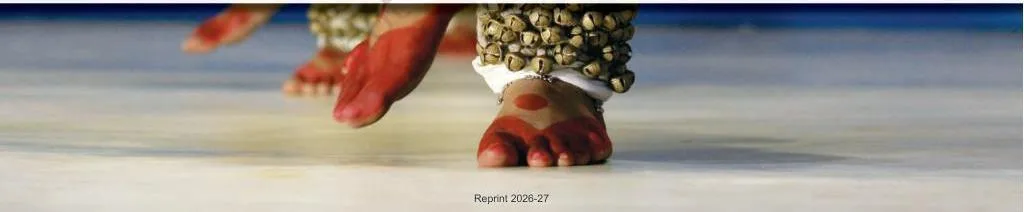
Regional examples close the section: Kathakali from Kerala uses the sides of the feet in a thumping chāri, and Seraikella Chhau from Jharkhand has many walks inspired by animals — lion, peacock, duck, deer, bear, goat and crocodile.
The karaṇa: joining posture, movement and hand gestures
The Combination of Postures and Movements section is where the separate pieces come together. A complete dance movement phrase is created from postures and movements combined with movements of the arms and hand gestures.
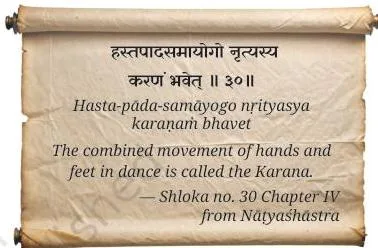
The Nātyashāstra names this coordinated movement of hands and feet a karaṇa and describes 108 such karaṇas. A karaṇa is not just a pose — it is a movement unit that includes posture, travel and gesture together.
The famous bronze statues of dancing Shiva show exactly this. The book identifies the image as a moment from Bhujaṅgatrasita karaṇa no. 24 of the Nātyashāstra.
The classical texts behind the terms
The History Trivia box keeps the three dance texts straight. Each is a real book with its own author, and each uses its own vocabulary.
| Text | Author and time | Posture | Movement | Special |
|---|---|---|---|---|
| Nātyaśhāstra | Bharata Muni, 5th century BCE | sthāna (standing, sitting, reclining) | chāri, gati, mandala | Oldest text on dance and dance-drama; covers all aspects of performing arts; in the UNESCO Memory of the World Register (2025) |
| Sangita Ratnākara | Sharangadeva, around the 12th century CE | follows the Nātyaśhāstra‘s stylisations (mārgī) | more variations of the same | One of the first texts with an independent chapter on dance; adds regional variations, deshi |
| Abhinaya Darpanam | Nandikeshwara, around the same time as the Ratnākara | sthānaka and mandala | chāri and gati | First book exclusively on dance; many dance styles still refer to it today |
A quick memory hook: the birth order is B-S-N — Broad, then Specific, then Narrow. Bharata’s Nātyaśhāstra is the broadest, discussing all aspects of performing arts; Sharangadeva’s Sangita Ratnākara narrows to music and dance; Nandikeshwara’s Abhinaya Darpanam narrows to dance alone.
Figure Walkthrough: reading the chapter’s dance images
The figures in this chapter carry the argument — they are not decoration. Reading them in order shows the chapter moving from breath to stillness to motion to the karaṇa.
Breath and the yoga connection
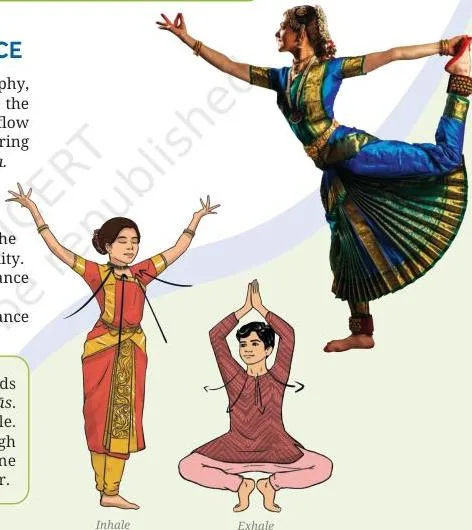
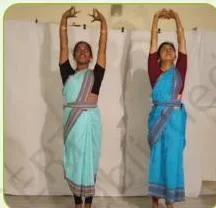
This figure pairs a dance expansion with a yoga āsana. The caption states the rule directly: the body stretches, bends and expands better with an inhale. When you see any reaching or opening movement in the book, connect it to the inhale.
Stillness frames every movement
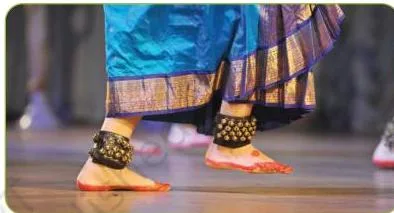
This is the chapter’s core diagram: stillness, then motion repeated, then stillness again. It is the Point A to Point B idea drawn out — every movement emerges from stillness and returns to it. It is the answer to why dance is both static and dynamic.
Three kinds of sthāna
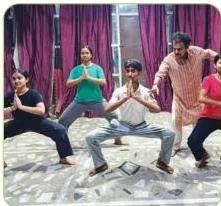
The three postures shown are the three sthānas: standing, sitting and reclining. All three are still — the variety is in what the body does while staying in place. These are the starting and ending points of every later movement.
One posture idea, four regional forms
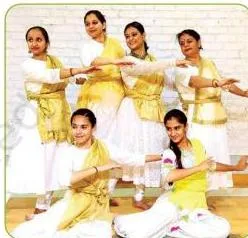
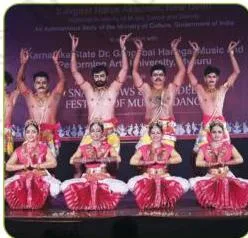
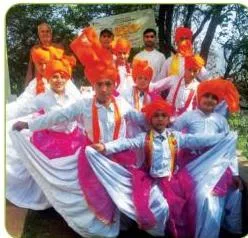
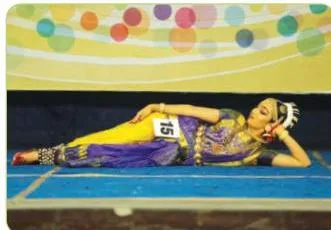
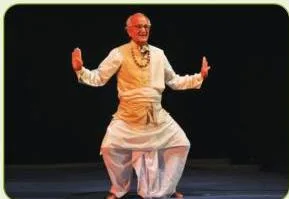
The book prints a regional gallery to show one idea in many bodies. Naurata, Kathak and Perini Natyam all hold clear dance postures, each in the grammar of its own style (Kud from Jammu is named in the same passage). The instruction printed beside them is to observe the different postures in different dance forms.
Dance in bronze
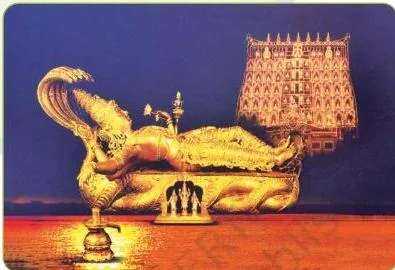
The chapter pauses on bronze sculptures after the regional gallery. It is one of the book’s quiet lessons: the principles of dance appear across the arts, and sculpture can preserve a dancer’s moment.
Whole group in motion: tippani
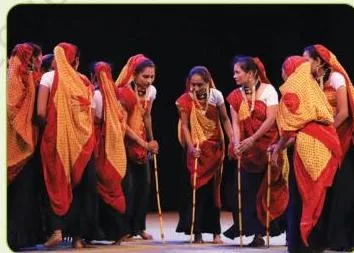
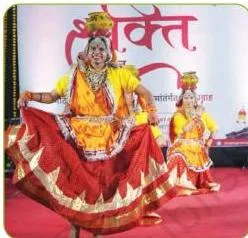
The tippani from Gujarat is the chapter’s example of patterned movement with a prop. The dancers pound spices with sticks as they move with small jumps in circular or linear patterns — and the interesting part is that the group, the sticks and the song all move together, the music starting slowly and gradually becoming faster.
What a gati changes in the body
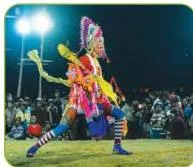
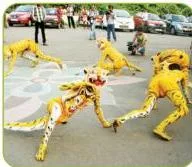
The two gati figures show what a gait does to a body. The deer step is quick and high-leaping — the dancer becomes light and fast. The monkey step is strong steps and jumps — power replaces lightness. Tiger (powerful, weighted) and garuda (light and airy) complete the set from the Abhinaya Darpanam.
A karaṇa frozen in bronze
This Nataraja is not just a famous statue — the book identifies it as a frozen moment of a choreographed unit, Bhujaṅgatrasita karaṇa no. 24. Arms, legs and gesture together make the karaṇa: coordinated movement of hands and feet, not a static pose.
Breath-guided stillness to close
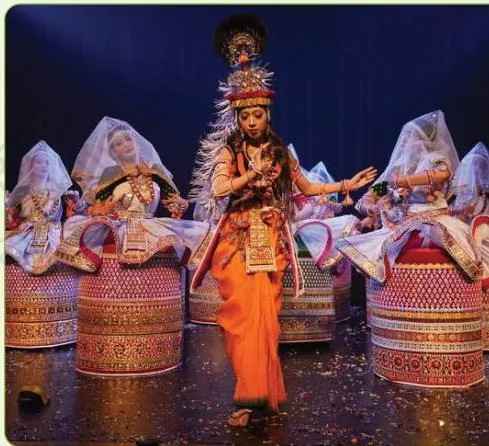
The final activity’s image carries the closing instruction: let your breath guide the rhythm of your movement and return to stillness. It closes the loop — the chapter started with breath and stillness, and it ends there too.
Dance Terms Defined: the vocabulary of Chapter 10
One lookup table for the chapter’s Sanskrit vocabulary, in the sense the book uses it. Where a term appears differently in different texts, the table says so — the chapter itself points out that each text has its own terminology.
| Term | Meaning in this chapter |
|---|---|
| prāna | The vital breath of life, which fuels dance. |
| prāṇāyama | The flow of breath during inhalation and exhalation. |
| sthāna | Posture; the Nāṭyaśhāstra groups these as standing, sitting and reclining. |
| sthānaka | The Abhinaya Darpanam‘s word for posture. |
| mandala | In the Nāṭyaśhāstra, a combination of chāris; the Abhinaya Darpanam also uses it for postures. |
| chāri | Ways of moving or displacing yourself. |
| bhaumi chāri | Earthly movement; the feet stay on the ground. |
| ākāshi chāri | Aerial movement; the feet leave the ground, in leaps and jumps. |
| gati | A characteristic gait, often of an animal, which the dancer embodies. |
| karaṇa | The coordinated movement of hands and feet; the Nātyashāstra describes 108. |
| mārgī | The uniform stylisation that follows the Nātyaśhāstra. |
| deshi | Regional variations, added by the Sangita Ratnākara. |
| purusha pāk | The male posture set in Sattriya. |
| prakriti pāk | The female posture set in Sattriya. |
| hastas | Hand gestures, combined with postures and movements in Activity 10.5. |
Common Mistakes in Dance and Movement Chapter 10
This chapter has no calculations to slip on, but its vocabulary trips students exactly where the terms look similar. Each row names the confusion and the correction the book gives.
| Mistake | Correct rule | How to check your answer |
|---|---|---|
| Using chāri and gati as if they mean the same thing. | chāri is any way of moving or displacing yourself; gati is a characteristic gait — often an animal’s — that the dancer embodies. | Ask: is this about how the dancer travels, or about whose nature the dancer is showing? |
| Assuming a chāri always leaves the ground. | The Nāṭyaśhāstra divides chāris into bhaumi (feet stay on the ground) and ākāshi (feet leave the ground, as in leaps and jumps). | For any movement, ask whether the feet leave the floor. |
| Treating breath as optional while dancing. | Breathing links two seamless dance movements and carries emotion; inhale on expansion, exhale on contraction, relaxed breath in stillness. | In Activity 10.5, the sequence is finished only when you return to stillness with settled breath. |
| Reading purusha and prakriti pāk as fixed gender roles. | The book notes some forms have definite male and female postures, but Activity 10.2 asks which postures feel masculine, feminine or both, and the chapter’s goals include challenging gender stereotypes. | Notice the activity frames the question as open — your task is to question the labels, not to accept them silently. |
| Treating the three texts as one identical system. | They share core ideas, but each has its own terms, and the Sangita Ratnākara adds regional variations (deshi). | When a term differs (sthāna vs sthānaka), note which text it comes from. |
Activities 10.1 to 10.5: what each one is for
The activity pages turn the chapter’s ideas into body practice. Below is what the main activity tasks ask, and the skill each one trains.
| Activity | What you do | What it trains |
|---|---|---|
| 10.1 Breathing in Stillness and Motion | In four groups, hold a dance posture; move into an expanding movement (arms outstretched, body bending); shift into a contracting movement (crouching, as in fear); end in a static posture with relaxed breath; discuss how breathing worked. | Breath awareness in stillness and motion — the chapter’s core rule felt in the body. |
| 10.2 Pose the Postures | Try the sthānas from the reference image; identify which postures feel masculine, feminine or both; observe postures from regional and traditional dance forms. | Reading postures and questioning gendered assumptions about movement. |
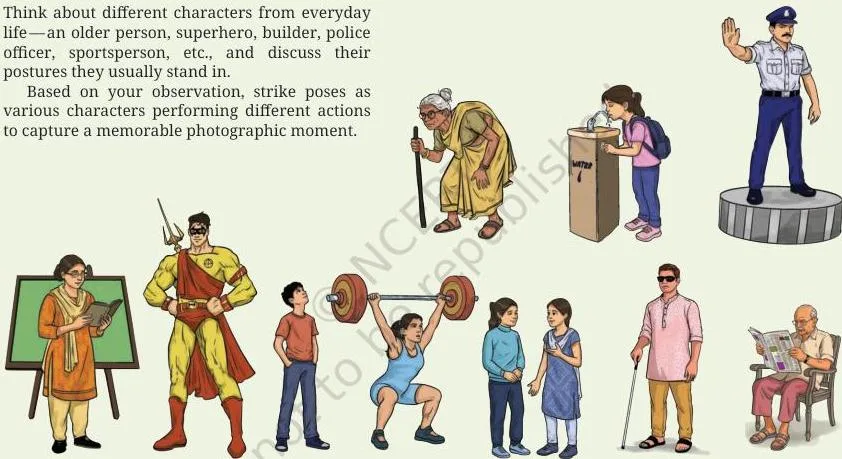
| 10.3 Picture Perfect | Choose everyday characters — an older person, superhero, builder, police officer, sportsperson — discuss their typical postures, and strike poses for a photographic moment. | Observing everyday life and turning it into stylised poses. |
| 10.4 Spirit of Movements | In two groups, take human characters (king, queen, hunter, soldiers, villagers) and animal characters (lion, elephant, deer, peacock, snake); build a dance scene of their interaction with speed and levels of emotion; perform it, with the teacher adding background music. | Movement vocabulary for human and animal characters — chāri and gati in action. |
| 10.5 Dancing from Head to Toe | In four groups, create a short sequence: one sthāna, one chāri or gati, arm movements and hastas (optionally hips, neck, sides, head); conclude by returning to stillness; let your breath guide the rhythm. | Combining posture, movement and gesture into a complete phrase — the chapter’s final goal. |
None of these are written exercises. The opening note to teachers asks for a spacious, well-ventilated hall, group formation and teamwork — the activities are performed and observed, not answered on paper.
What Teachers Assess in This Chapter
Dance and Movement is a school-level practical Arts chapter rather than a board-examination theory chapter. The book itself prints the assessment framework: Curricular Goals CG-1 to CG-4 with competencies C-1.1 to C-4.2 open the chapter, and a closing learning-outcomes table closes it.
The goals ask for confidence in expressing everyday experiences through dance (CG-1); creativity that challenges gender stereotypes and connects gestures with emotions (CG-2); understanding of artistic technique, stage etiquette and care for props and costumes (CG-3); and familiarity with regional dance forms and local dancers (CG-4).
The closing table turns those into outcomes a student can check with a teacher or on their own:
- Recognises the importance of breath control in both stillness and movement.
- Demonstrates sthāna (stance), chāri (leg movement) and gati (gait).
- Connects sthānas or dance postures with stylised movements observed in everyday life.
- Identifies and differentiates various types of chāris and gatis and applies them in choreographic sequences.
- Choreographs a composition using a range of postures and movements, with enthusiasm.
One honest note: textbook contents and the examinable syllabus are not always identical. For the official position on what is assessable this session, check the current CBSE syllabus — this page makes no mark or question guarantees.
Dance and Movement Chapter 10 in One Flow
The chapter works in one straight line. If you can say each step below in order, you have the chapter’s argument:
- Emotion fuels dance — the opening shloka’s claim that dance, rasa and poetry all need emotion.
- Breath fuels the body — inhale expands, exhale contracts, relaxed breath holds stillness.
- Stillness frames every movement — every motion begins and ends in a static posture.
- Posture is sthāna — standing, sitting and reclining, shown across India’s regional forms.
- Movement is chāri and gati — ways of moving, and animal-like gaits the dancer embodies.
- Postures and movements join with hand gestures into a karaṇa — 108 described in the Nātyashāstra.
- The chapter is complete when you can perform a short sequence from stillness back to stillness, breath-guided throughout.
That last point is the chapter’s own target: the learning-outcomes table ends on choreography that uses this dance vocabulary with understanding.
Related Resources: where Dance and Movement fits in the Class 8 Arts book
This listing is maintained for the 2026-27 academic session using the NCERT textbook information available to us. NCERT remains the authority for confirming the latest edition.
Dance and Movement is Chapter 10 of Kriti, the NCERT Class 8 Arts textbook. The NCERT Class 8 Arts Kriti book page is the place to move around the book, and the Class 8 hub gathers study resources across subjects.
Other chapters in the same book — including My World and the Pan-Indian chapters — have their own notes pages under the same arts hub, and the CBSE notes library covers the other classes as well.
Sources and data verification
This page describes the NCERT Kriti textbook for Class 8 Arts, Chapter 10 (Dance and Movement), official edition on ncert.nic.in. It covers this chapter only, not the full book or the full syllabus.
It is maintained for the current session using the NCERT information available to us. NCERT settles textbook editions and PDFs; CBSE settles curriculum, syllabus and examinations. Textbook contents and the examinable syllabus are not always identical — check the current official syllabus.
| What the chapter holds | Count | Where it is used |
|---|---|---|
| Printed pages | 18 | |
| Figures with NCERT captions | 23 | |
| Tables | 1 | |
| Official NCERT PDF | Download the chapter PDF | the chapter exactly as NCERT publishes it |
Reference: NCERT Class 8 Arts (Kriti) textbook, chapter 10, official edition on ncert.nic.in.
Frequently Asked Questions
Is Dance and Movement a practical chapter or does it have written questions?
It is a practical chapter. The task pages between the Breath and Combination sections are movement activities (Activity 10.1 to Activity 10.5) done in groups in an open hall, and the chapter closes with a learning-outcomes checklist rather than a question set. There is no written exercise block.
What is the difference between chāri and gati?
chāri is any way of moving or displacing yourself — simple walking, quick steps, wide steps, thumping steps. gati is a characteristic gait the dancer embodies, usually of an animal — deer, monkey, tiger, garuda. Chāri answers “how do I travel?”; gati answers “whose nature am I showing?”
Which dance text describes 108 karaṇas?
The Nātyashāstra, by Bharata Muni. It names the coordinated movement of hands and feet a karaṇa and describes 108 of them; the Nataraja bronze in the chapter shows a moment from Bhujaṅgatrasita karaṇa no. 24.
Why does the chapter start with breath instead of dance steps?
Because breath is what makes the body safe and expressive. Relaxed breathing relaxes the spine, and a relaxed spine gives maximum agility and stability; breath also links two seamless movements and carries emotion. The chapter’s rule — inhale on expansion, exhale on contraction, relaxed breath in stillness — has to be in the body before any step is learned.
Which regional dance forms are mentioned in this chapter?
Naurata (Madhya Pradesh), Kathak (North India), Perini Natyam (Andhra Pradesh), Kud (Jammu), tippani (Gujarat), Kathakali (Kerala), Seraikella Chhau (Jharkhand) and Manipuri (Manipur). Each one shows the same principles of posture and movement working in a different regional grammar.
What should I do with the QR codes in this chapter?
Scan them to watch the movements they point to — the book labels some “Movements to be watched on QR Code”, for instance next to the Kathakali foot movement. Activity 10.2 similarly suggests watching postures through QR codes and websites. Still photographs cannot show a chāri or gati in motion; the videos do.
Explore Class 8 Arts Books
Related chapters: