
This page has the official NCERT Indian Class 8 arts Kriti Chapter 7 PDF — the chapter titled Indian Classical Music — straight from ncert.nic.in, along with a walkthrough of what the chapter teaches: Carnatic talas and alankaras, a complete kriti, Raga Asavari with two Hindustani compositions, and a closing section on Bhakti and Sufi devotional songs.
The chapter is practice-based — you sing it, count it and play it — so the guide below explains the notation and the pieces rather than marking written answers.
Get the publisher’s own file — the NCERT Class 8 arts Kriti Chapter 7 Indian Classical Music PDF — from the official ncert.nic.in textbook portal: select the Class 8 arts book Kriti, then Chapter 7, to reach the current English-edition chapter.
Indian Class 8 Kriti Chapter 7: Indian Classical Music at a Glance
The count table on this page gives the chapter’s section, figure and exercise totals. What the numbers cannot show is that this is a singing chapter — nearly every page is notation to be sung, clapped and played, not a list of written questions.
Here are the pieces the chapter actually contains:
- The four Grade 8 Carnatic alankaras — mishra jathi jhampa (10 beats), thrisra jathi triputa (7 beats), khanda jathi ata (14 beats) and chatushra jathi eka (4 beats).
- ‘Sri Gananatham Bhajare’ — a complete kriti in Raga Ishamanohari, Rupaka tala, composed by Muthuswami Dikshitar.
- Raga Asavari, explained in full and then set in two compositions: a Teentaal lakshan geet and a Jhaptal sargam geet.
- Two devotional songs to close the chapter — the bhajan ‘Thumak Chalat Ram Chandra’ and the qawwali ‘Duma Dum Mast Kalandar’.
What This Chapter Covers: Carnatic, Hindustani and Devotional Music
This chapter takes a beginner through both great traditions of Indian classical music — Carnatic and Hindustani — and then the devotional music that grew beside them.
| Part of the chapter | What it teaches | Where it appears |
|---|---|---|
| Carnatic section | Seven talas, three angas, the sapta-tala alankaras and the kriti ‘Sri Gananatham Bhajare’ | The opening section |
| Raga Asavari section | One Hindustani raga in full detail, set in a Teentaal lakshan geet and a Jhaptal sargam geet | The middle section |
| Bhakti-Sufi section | The Bhakti movement, Sufism, and one devotional song from each tradition | The closing section |
Carnatic Music: Seven Talas, Three Angas and the Idea of Jathi
A tala is the rhythm cycle that organises Carnatic singing. The singer keeps it with claps and finger counts while the melody continues on top.
Every Carnatic tala is built from three angas (parts):
| Anga | How you keep it | Notation |
|---|---|---|
| Laghu | Clap, then count fingers | I |
| Drutam | Clap, then wave | O |
| Anudrutam | One beat | U |
The seven main talas of Carnatic music are:
- Dhruva
- Matya
- Rupaka
- Jhampa
- Triputa
- Ata
- Eka
A laghu is not fixed in length: it can carry different numbers of beats, and the jathi name tells you which. The four jathis this chapter uses are thrisra (3 beats), chatushra (4), khanda (5) and mishra (7).
Two points the chapter makes up front: not every tala contains every anga, and a tala keeps its name even when its jathi changes its length. The seven talas built from these angas give the sapta-tala alankaras — vocal exercises that build vocal strength and tala understanding. Three were learnt in Grade 7; Grade 8 adds the remaining four.
The Four Grade 8 Alankaras and Their Beat Counts
An alankara is a vocal exercise: you sing a swara pattern — a short tune built on note names — while keeping the tala, so the voice and the rhythm train together. The chapter’s four Grade 8 alankaras, with their anga patterns and beat counts:
| Alankara | Jathi | Anga pattern (Carnatic notation) | Beats |
|---|---|---|---|
| Mishra jathi jhampa | Mishra | \( \text{I U O} = 7+1+2 \) | 10 |
| Thrisra jathi triputa | Thrisra | \( \text{I}_3\ \text{O O} = 3+2+2 \) | 7 |
| Khanda jathi ata | Khanda | \( \text{I}_5\ \text{I}_5\ \text{O O} = 5+5+2+2 \) | 14 |
| Chatushra jathi eka | Chatushra | \( \text{I}_4 = 4 \) | 4 |
Read \( \text{I}_3\ \text{O O} \) as three pieces: a thrisra laghu of 3 beats, then two drutams of 2 beats each. Adding them gives \( 3 + 2 + 2 = 7 \) beats in one cycle. The letters name the angas, the subscript gives the laghu’s jathi, and the sum is the tala’s length.
Check the system yourself: a chatushra jathi eka runs 4 beats. The same tala with a khanda jathi laghu would run 5 — the tala keeps its name, the jathi changes its length.
The note grids behind all four alankaras share one climbing shape: start on S and climb three notes — S R G — then shift up one note — R G M, G M P — and so on up to the upper octave, then mirror the same three-note climb on the way down.
The tala and jathi change between grids; the shape does not.
‘Sri Gananatham Bhajare’: A Kriti by Muthuswami Dikshitar
A kriti is the major composed form of Carnatic music — a complete song with a fixed raga and tala. This chapter’s kriti, ‘Sri Gananatham Bhajare’, is set in Raga Ishamanohari and Rupaka tala (6 beats), composed by Muthuswami Dikshitar.
The kriti has three main parts. The pallavi is the opening line, the anupallavi is the second section, and the charanam closes the song. After the anupallavi you return to the pallavi line; after the charanam you return to the pallavi again. This kriti also carries a madhyama kala — an extra portion sung twice as fast as the rest.
The chapter asks you to sing the arohana and avarohana — the raga’s scale — before the song, and to keep the tala while singing. The scale of Ishamanohari, exactly as printed, is:
\[ \text{Arohanam: } S\ R_2\ G_3\ M_1\ P\ D_2\ N_2\ \dot{S} \]
\[ \text{Avarohanam: } \dot{S}\ N_2\ D_2\ P\ M_1\ G_3\ M_1\ R_2\ S \]
The subscript numbers are part of the raga’s identity: they fix the exact variant of each swara — R2, G3 and M1 tell you which of the available positions of those notes Ishamanohari uses. Sing them exactly as written. The diagram of the kriti’s three parts is in the figure walkthrough below.
Raga Asavari: Swaras, Vadi-Samvadi and the Two Compositions That Use It
A raga is a melody framework built on a fixed set of notes: some notes are strong (vadi), some support them (samvadi), and some are left out of the ascent (varjit swar). Raga Asavari is the chapter’s Hindustani showcase — one raga explained in full, then used in two compositions.
The chapter’s text places Asavari in the Asavari thaat, the parent scale it originates from. Here is the raga’s identity card as the chapter gives it:
| Feature | Asavari |
|---|---|
| Aroh (ascent) | \( S\ R\ M\ P\ D\ \dot{S} \) |
| Avroh (descent) | \( \dot{S}\ N\ D\ P\ M\ G\ R\ S \) |
| Pakad (characteristic phrase) | \( R\ M\ P\ N\ D\ P \) |
| Varjit swar in the ascent | G and N |
| Jathi | Audav-sampoorna — five notes up, seven down |
| Komal swars | G, D, N |
| Vadi | Dhaivat |
| Samvadi | Gandhar |
| Singing time | Second quarter of the day — 11 a.m. to 1 p.m. |
| Similar raga | Jaunpuri |
The pattern behind the table: G and N are varjit — missing — in the ascent, so the climb runs on five notes (audav) while the descent uses all seven (sampoorna). G, D and N are the komal (lowered) notes; the rest are shudh. Dhaivat leads the raga as vadi; Gandhar answers as samvadi.
Both compositions sit on this raga but on different rhythm cycles. The first is a lakshan geet — a song that describes the raga’s features — set to Teentaal. The second is a sargam geet — a melody sung on swara syllables — set to Jhaptal.
| Tala | Matras per cycle | Bol pattern | Section marks |
|---|---|---|---|
| Teentaal (lakshan geet) | 16 | Dha Dhin Dhin Dha · Dha Dhin Dhin Dhin · Dha Tin Tin Ta · Ta Dhin Dhin Dha | X at matra 1, 2 at 5, 0 at 9, 3 at 13 |
| Jhaptal (sargam geet) | 10 | Dhi Na Dhi Dhi Na · Ti Na Dhi Dhi Na | X at matra 1, 2 at 3, 0 at 6, 3 at 8 |
Each composition has two named parts: the sthayi opens it, and the antara follows. The book adds a listening suggestion after these songs: the programme Sangita Sarita shows how music connects with different aspects of life, and hearing the same raga performed by different artists reveals the depth inside it.
Bhakti Sangeet and Sufi Qawwali: The Devotional Song Section
The closing song section shows how religion shaped Indian music: the Bhakti movement produced the bhajan and the kirtana, and Sufism produced the qawwali.
| Tradition | When it grew | Musical forms it created | Names the chapter gives |
|---|---|---|---|
| Bhakti movement | From the 6th century CE, peaking in the 15th–17th century | Kirtanas and bhajans | Mirabai, Tulsidas (north); Purandara Dasa, Kanakadasa (south) |
| Sufism | Around the medieval period in India | Qawwali | Khwaja Moinuddin Chishti, Baba Farid |
The first song is the bhajan ‘Thumak Chalat Ram Chandra’, by Tulsidas, whom the chapter credits as an Awadhi poet. It opens with the line ‘Thumak Chalat Ram Chandra Baajat Pajaniya’.
The second is the qawwali ‘Duma Dum Mast Kalandar’, sung in both traditional and contemporary styles; its refrain repeats ‘Duma dum mast kalandar’. Both photographs belonging to this section — the Warkari pilgrims and the dervish — are explained in the figure walkthrough below.
The Four Figures in This Chapter, Explained
The chapter’s illustrations are a photograph of instruments, a diagram of the kriti, and two photographs of devotional traditions. Each one marks a place in the text.
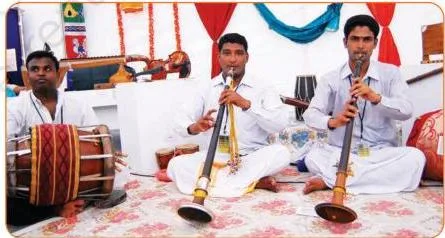
The ensemble photo sits among the alankara pages. From left to right it shows the mridangam, morsing, violin and ghatam — the instruments of a South Indian ensemble, placed right where the alankara notation begins so you can picture the sound while you count the tala.
This diagram belongs to the ‘Sri Gananatham Bhajare’ pages. It marks the three parts of the kriti — pallavi, anupallavi and charanam — and the order the chapter explains: pallavi, anupallavi, then back to the pallavi; charanam, then back to the pallavi again.
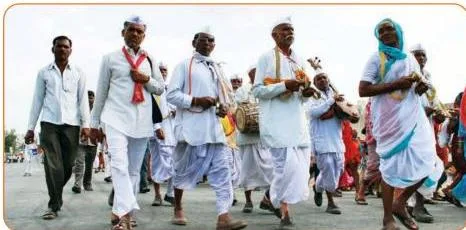
The Warkari photo illustrates the Bhakti section: pilgrims singing bhajans. It shows the living practice behind the text’s claim that the Bhakti movement created new musical forms like kirtanas and bhajans.
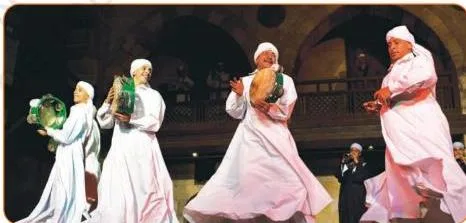
The dervish photo pairs with the Sufi paragraph; the chapter’s caption names it a Sufi whirling dervish performance. It joins the Warkari photo to show the living devotional traditions behind the two closing songs.
Key Terms in This Chapter: A Mini Glossary
This chapter uses a compact vocabulary of Indian music, and the same terms carry across both traditions — a tala in the Carnatic half and a tala in the Hindustani half are close cousins.
| Term | Meaning |
|---|---|
| tala | The rhythm cycle that organises a composition; in the Carnatic half, kept with claps and finger counts. |
| laghu | A tala anga — a clap followed by finger counts; notated I. |
| drutam | A tala anga — a clap followed by a wave; notated O. |
| anudrutam | A tala anga — a single beat; notated U. |
| jathi | The length a laghu carries (thrisra 3, chatushra 4, khanda 5, mishra 7); also the note count of a raga’s ascent and descent (audav-sampoorna). |
| alankara / alankaram | A vocal exercise that builds voice and tala skill by singing a swara pattern while keeping the tala. |
| kriti | The major composed form of Carnatic music, built from pallavi, anupallavi and charanam. |
| pallavi | The opening section of a kriti; you return to it after each later section. |
| anupallavi | The second section of a kriti; after it, back to the pallavi. |
| charanam | The closing section of a kriti; after it, back to the pallavi again. |
| madhyama kala | A portion of ‘Sri Gananatham Bhajare’ sung twice as fast as the rest. |
| raga | A melody framework on a fixed set of notes, with vadi, samvadi and varjit swaras defining its character. |
| thaat | The parent scale a raga originates from; the chapter places Asavari in the Asavari thaat. |
| aroha / arohana | The ascending scale of a raga. |
| avarohana / avroh | The descending scale of a raga. |
| vadi | The main note of a raga; in Asavari, Dhaivat. |
| samvadi | The supporting note of a raga; in Asavari, Gandhar. |
| komal | Lowered notes; in Asavari, G, D and N. |
| shudh | Natural notes — in Asavari, everything that is not komal. |
| varjit swar | A note left out of a raga’s ascent; in Asavari, G and N. |
| pakad | The short phrase that identifies a raga; Asavari’s pakad is \( R\ M\ P\ N\ D\ P \). |
| sargam | A melody sung on swara syllables; the Jhaptal piece is a sargam geet. |
| lakshan geet | A song describing a raga’s features; the Teentaal piece is a lakshan geet. |
| sthayi | The first part of a Hindustani composition. |
| antara | The second part of a Hindustani composition. |
| bhajan | A devotional song of the Bhakti tradition, such as ‘Thumak Chalat Ram Chandra’. |
| kirtana | A devotional musical form created by the Bhakti movement. |
| qawwali | A Sufi devotional genre, such as ‘Duma Dum Mast Kalandar’. |
One spelling note: the chapter uses both spellings side by side — alankara and alankaram, aroha and arohana. They are the same ideas in the two traditions’ vocabularies.
Common Mistakes in This Chapter (and How to Avoid Them)
The mistakes in this chapter are counting errors, note-choice errors and vocabulary errors — and each one is easy to catch before it happens.
| Mistake | Correct rule | How to check your answer |
|---|---|---|
| Counting mishra jathi jhampa as 8 beats because a laghu is usually 4 | The mishra laghu carries 7 beats, so the cycle is \( 7+1+2 = 10 \) beats | Write the anga string first — I U O — then add their values 7, 1 and 2 |
| Singing G or N in the ascent of Asavari | G and N are varjit (missing) in the aroh, so the ascent runs \( S\ R\ M\ P\ D\ \dot{S} \) | Count the ascent notes: five, not seven — which is why the jathi is audav-sampoorna |
| Swapping vadi and samvadi | In Asavari the vadi is Dhaivat and the samvadi is Gandhar | Re-read the raga table before singing: vadi Dhaivat, samvadi Gandhar |
| Mixing the Carnatic and Hindustani notation | I, O, U are the anga units a Carnatic tala is built from; X, 2, 0, 3 mark where the sections of a Hindustani tala begin | Ask which system the page uses: the symbols either build a cycle (I, O, U) or divide it (X, 2, 0, 3) |
| Singing the madhyama kala at normal speed | The madhyama kala is sung twice as fast as the rest of the kriti | The chapter states this before the song notation — treat this section at double speed |
What You Should Be Able to Do After This Chapter
The chapter closes by stating its own learning outcomes — the abilities you should have when you finish. In plain words, they are three things:
- Sing basic songs in Carnatic and Hindustani music.
- Keep tala while singing or listening to a composition.
- Understand the importance of the Bhakti movement, and sing a devotional song.
The chapter’s activities practise exactly these abilities:
- ACTIVITY 7.1 — the chapter’s first numbered activity.
- ACCOMPANIMENT — play any musical instrument you know to accompany one of the compositions you have learnt.
- TEMPO CHANGES — sing a piece at a lower tempo, then at a higher tempo, and notice how the mood changes.
One honest note: textbook contents and the examinable syllabus are not always identical — check the current official CBSE syllabus on cbse.gov.in before deciding what to revise.
Chapter 7 Quick Recap
This recap condenses what the chapter teaches into the facts worth carrying into the exam room.
- Carnatic rhythm: seven talas (Dhruva, Matya, Rupaka, Jhampa, Triputa, Ata, Eka) built from three angas — laghu I, drutam O, anudrutam U.
- The four Grade 8 alankaras run 10, 7, 14 and 4 beats: mishra jathi jhampa (\( \text{I U O} \)), thrisra jathi triputa (\( \text{I}_3\ \text{O O} \)), khanda jathi ata (\( \text{I}_5\ \text{I}_5\ \text{O O} \)), chatushra jathi eka (\( \text{I}_4 \)).
- The kriti: ‘Sri Gananatham Bhajare’ — Raga Ishamanohari, Rupaka tala (6 beats), by Muthuswami Dikshitar; parts pallavi, anupallavi, charanam, plus a madhyama kala twice as fast.
- Raga Asavari: komal G, D, N; varjit G and N in the ascent (so audav-sampoorna); vadi Dhaivat; samvadi Gandhar; singing time 11 a.m. to 1 p.m.; similar to Jaunpuri.
- The two Hindustani sets: Teentaal lakshan geet (16 matras) and Jhaptal sargam geet (10 matras), each marked X, 2, 0, 3.
- Devotional music: Bhakti movement (from the 6th century CE, peaking 15th–17th century) with Mirabai, Tulsidas, Purandara Dasa, Kanakadasa; Sufism with Khwaja Moinuddin Chishti and Baba Farid.
- The two closing songs: the bhajan ‘Thumak Chalat Ram Chandra’ and the qawwali ‘Duma Dum Mast Kalandar’.
Related Resources for Chapter 7
This listing is maintained for the 2026-27 academic session using the NCERT textbook information available to us. NCERT remains the authority for confirming the latest edition.
This page covers only Chapter 7 of Kriti for Class 8 arts. From here you can reach the rest of the book and the class:
- The Class 8 arts hub — Kriti and the other Class 8 arts books
- The Class 8 hub on this site
- All CBSE notes by class
- The previous chapter of Kriti — musical instruments
- The next chapter of Kriti — inspiration and imagination
- The official NCERT textbook portal — the authoritative source for every Kriti chapter PDF
| What the chapter holds | Count | Where it is used |
|---|---|---|
| Printed pages | 13 | |
| Figures with NCERT captions | 4 | |
| Tables | 20 | |
| Activities | 1 | |
| Official NCERT PDF | Download the chapter PDF | the chapter exactly as NCERT publishes it |
Reference: NCERT Class 8 arts Kriti textbook, chapter 7, official edition on ncert.nic.in.
Sources and Data Verification
The contents and figures described on this page come from the NCERT Kriti textbook for Class 8 arts, English edition, as published on ncert.nic.in.
This page covers Chapter 7 (Indian Classical Music) of that book only — not other arts textbooks, and not other chapters of Kriti.
The listing is maintained for the current academic session using the NCERT information available to us.
NCERT settles textbooks, editions and official PDFs; CBSE settles the curriculum, syllabus and examinations. For the chapter file, follow NCERT; for what is examinable, follow the current CBSE syllabus.
FAQs: Indian Classical Music, Chapter 7
How do you count the beats of mishra jathi jhampa tala?
Mishra jathi jhampa is the anga string I U O: a mishra laghu of 7 beats, an anudrutam of 1 beat, and a drutam of 2 beats. The count is \( 7+1+2 = 10 \) beats. The trap is treating the laghu as 4 — the mishra jathi is what makes it 7.
What are the three parts of a kriti and in what order are they sung?
In order: pallavi (opening line), anupallavi (second section), charanam (closing section). After the anupallavi you return to the pallavi line, and after the charanam you return to the pallavi line again. ‘Sri Gananatham Bhajare’ also includes a madhyama kala portion, sung twice as fast as the rest.
Which swaras are komal in Raga Asavari, and why is its jathi called audav-sampoorna?
The komal (lowered) swaras are G, D and N; the rest are shudh. The jathi is audav-sampoorna because G and N are varjit — missing — from the ascent, so the climb carries five notes (\( S\ R\ M\ P\ D\ \dot{S} \)) while the descent uses all seven (\( \dot{S}\ N\ D\ P\ M\ G\ R\ S \)).
Audav means five; sampoorna means complete (seven).
What is the difference between a bhajan and a qawwali?
A bhajan is a devotional song of the Bhakti movement, like Tulsidas’s ‘Thumak Chalat Ram Chandra’. A qawwali is a Sufi devotional genre that grew from Sufism’s mystical tradition and is still performed widely, especially in Punjab and western India — like ‘Duma Dum Mast Kalandar’.
Why does the chapter say to sing the arohana and avarohana before the kriti?
The arohana and avarohana are the raga’s scale — the exact notes, with their positions, that the song will use. Singing the scale first fixes those notes in the voice before the melody starts, and keeping the tala while singing ties the scale into the rhythm cycle. The chapter asks for both before the song.
What is the difference between the Carnatic tala symbols (I, O, U) and the Hindustani symbols (X, 2, 0, 3)?
The symbols do different jobs. I, O, U are the anga units a Carnatic tala is built from — laghu (clap and finger counts), drutam (clap and wave), anudrutam (single beat) — and the formula string adds them into the cycle’s beat count.
X, 2, 0, 3 mark where each section of a Hindustani tala cycle begins: X sits on the first matra, and 2, 0, 3 sit at the other section starts — in Teentaal at matras 1, 5, 9 and 13, and in Jhaptal at 1, 3, 6 and 8. One system builds the cycle; the other divides it.
Explore Class 8 Arts Books
Related chapters: