
This page gives you the official NCERT Class 8 Kriti (Arts) chapter on musical instruments — the downloadable chapter PDF is right below, followed by a plain-language walkthrough of everything the book teaches. If you searched for the musical instruments class 8 chapter PDF, you have reached the right page.
Download the Musical Instruments Class 8 Chapter PDF
The official musical instruments class 8 chapter PDF is published by NCERT on its free textbook portal, where you can open or download Chapter 6 of the Kriti book for Class 8 Arts without any login or payment.
Read it on any phone, print it for the classroom, or keep it open beside you while you work through the explanations below.
Chapter 6 Musical Instruments at a Glance
The table below lists what the chapter contains — its sections, figures, worked examples and exercise questions — so you know the size of the file and where each activity sits before you begin.
What This Chapter Covers in Kriti
Chapter 6 moves through five blocks. Knowing where each idea sits makes it faster to revise.
- The science of sound — the chapter opens with four ideas connecting sound to instrument design: vibration, resonance, frequency and timbre.
- Making musical instruments — a drum maker’s process, from a log of wood to a tuned drum.
- Musicians and their instruments — profiles of Annapurna Devi, Pannalal Ghosh and Mysore Doraiswamy Iyengar.
- Activities — a word search (6.1), a percussion map (6.2) and a crossword that test the same vocabulary.
- A closing learning-outcomes table — the chapter’s own checklist of what a student should take away.
The Science of Sound: Vibration, Resonance, Frequency and Timbre
The chapter starts by answering a simple question: why do objects make sound? The answer is vibration, and the other three terms build on it.
Vibration. Sound is produced because objects vibrate. When an object vibrates, it creates sound waves that travel through a medium — air, water, anything — to reach our ears.
Resonance. Resonance is what makes sound louder. In a percussion instrument, the hollow body or cavity vibrates along with the sound and amplifies it.
Frequency. Frequency is the number of vibrations per second. The faster an object vibrates, the higher its frequency and the higher the pitch of the sound. The chapter’s example is the sitar: tightening the tuning peg increases tension, which raises the vibrating frequency and so raises the pitch.
Timbre. Timbre is the tone or ‘colour’ of the sound. It changes with the material of the instrument, the way the instrument is built, and the playing technique — which is why different instruments have varied timbre even when they play the same note.
Worked example. Put numbers to frequency. A drum skin that vibrates 120 times in 2 seconds has a frequency of \(120 \div 2 = 60\) vibrations per second.
If the same skin vibrates 180 times in 2 seconds, the frequency rises to \(180 \div 2 = 90\) vibrations per second — the pitch is higher. Faster vibration, higher frequency, higher pitch: one idea, three words.
The chapter then turns the question back on you: do you think music is both an art and a science? Discuss in class. The science is the vibration, resonance, frequency and timbre above; the art is what musicians create with them.
Figure Walkthrough: Reading the Chapter’s Diagrams
The diagrams below carry most of the chapter’s meaning. Read each caption, then look for the detail this section points out.
The Frequency Diagram
The first diagram is a definition in picture form: it pairs the term frequency with the phrase ‘the number of vibrations per second’, so the word and its meaning are stored together in memory.
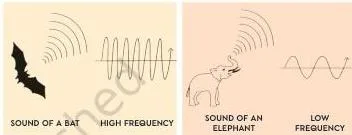
Connect the diagram to the chapter’s sitar example: tightening the tuning peg raises the tension, which raises the frequency, which raises the pitch. The diagram gives you the definition; the sitar gives you the cause.
A Drum Maker at Work
These five images are one sequence. Read them in order and you have the whole drum-making process in your head.
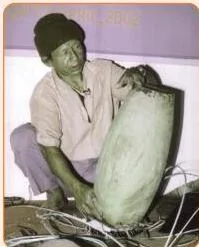
The sequence opens with the maker. The chapter’s point is direct: instrument makers are essential for the survival of traditional art forms, because the craft itself is part of our musical heritage.
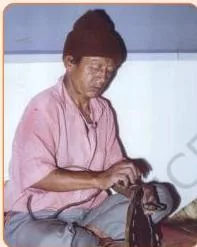
Stage one of the drum: the maker works a log of wood into a cylindrical shape. This cylinder becomes the drum’s body, which will later act as the resonating cavity.
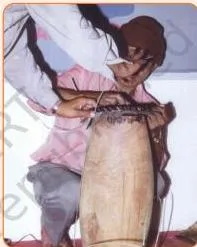
Stage two: the head of the drum is created. This is the part that vibrates when struck — the source of the sound, in the language of the first section.
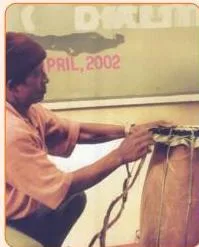
Stage three: the head is fixed onto the wooden drum. Now the vibrating skin sits over the hollow body, so the drum has both a source of vibration and a cavity to resonate.

Stage four: straps are tied to help with tuning. Pulling the straps changes the tension of the head — and tension controls frequency and pitch, exactly as the sitar tuning peg does.
Musician Portraits and the Percussion Map
Two portraits and one map plate complete the chapter’s visuals.
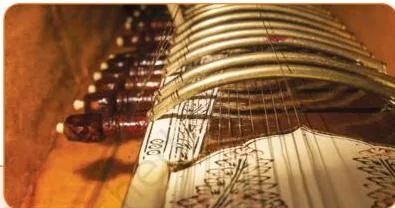
The caption gives the essentials. The portrait sits beside the chapter’s account of a woman who mastered the physically demanding surbahar, was considered her father’s finest student, and never performed publicly — yet shaped two generations of musicians through teaching.
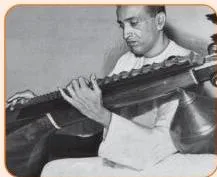
The second portrait pairs the face with the veena. Iyengar’s style of playing became known as the Mysore Bani, and the chapter records honours from the University of Mysore, the President of India and the Madras Music Academy.
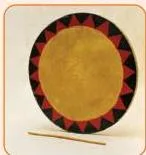
This plate is not decoration — it is the equipment for Activity 6.2. The activity asks you to print an outline map of India and mark where each instrument is found and played. Study the plate first, then do the map.
Definitions: The Four Sound Terms in Plain Words
The four terms are the chapter’s core vocabulary. Learn them so you can write them without pausing.
| Term | Plain definition | Example from the chapter |
|---|---|---|
| Vibration | An object moving back and forth; the movement creates sound waves that travel through a medium such as air or water to reach our ears. | A drum skin or sitar string moving when struck or plucked. |
| Resonance | The hollow body or cavity of an instrument vibrating along with the sound and making it louder. | The hollow body of a percussion instrument amplifying its sound. |
| Frequency | The number of vibrations per second; faster vibration gives higher frequency and higher pitch. | Tightening the tuning peg of a sitar raises tension, frequency and pitch. |
| Timbre | The tone or ‘colour’ of a sound — the quality that lets you tell one instrument from another. | Different instruments have varied timbre because of material, construction and playing technique. |
Making Musical Instruments: A Drum Maker at Work
The chapter honours instrument makers because without them no instrument would exist to play — and their work is craft and science at the same time. The drum-making sequence in the walkthrough above shows the four stages as images; here they are as text.
- The maker works with a log of wood to create a cylindrical shape — the drum’s body.
- The head of the drum is created — the surface that will vibrate.
- The head is fixed onto the wooden drum, so the vibrating skin sits over the resonating cavity.
- Straps are tied to help with tuning — tension controls frequency and pitch.
The chapter ends this part with a note to the teacher: find an instrument maker in your community and invite them to school for a live demonstration. If your class does that, you will watch these four stages happen in real time.
Musicians and Their Instruments
The chapter chooses three musicians who became synonymous with their instruments — each name is now inseparable from the instrument it made famous.
| Musician | Instrument | Musical tradition | Why they matter |
|---|---|---|---|
| Annapurna Devi (1927–2018) | Surbahar — the bass sitar | Hindustani classical | Mastered a physically demanding instrument; her students Hariprasad Chaurasia and Nikhil Banerjee became acclaimed musicians. |
| Pannalal Ghosh (1911–1960) | Flute (bansuri) | Hindustani classical | Popularised the flute as a concert instrument and introduced the seven-hole flute. |
| Mysore Doraiswamy Iyengar (born 1920) | Veena | Carnatic | Developed the distinctive Mysore Bani style; received the Padma Bhushan in 1983. |
The chapter adds an ‘About the Surbahar’ box next to Annapurna Devi: the surbahar is a plucked string instrument often called the bass sitar, with a deeper and lower tonal range than the sitar, which makes it suitable for elaborate alaap sections.
For Iyengar it records an Honorary Doctorate (1975), the Padma Bhushan (1983) and the Sangeetha Kalanidhi (1984) among his honours. For Ghosh, it notes that he settled on a 32-inch bamboo flute after experimenting with metal and different types of wood.
Activities 6.1 and 6.2: Word Search and Map Work
The chapter sets its questions as activities rather than textbook problems. Both test the same vocabulary by making you hunt for it.
Activity 6.1 — find the names of the musical instrument. A word grid hides twelve instrument names. The chapter’s note says words can go in any direction and can share letters where they cross over each other. The twelve names are:
- Bansuri
- Clarinet
- Dholak
- Ektara
- Flute
- Ghatam
- Guitar
- Morsing
- Sarod
- Saxophone
- Shehnai
- Sitar
Below the grid, the chapter shows traditional instruments such as the dhol and kanshi being played.
Activity 6.2 — map the instrument. This activity gives ten percussion instruments (or families of instruments) and the regions where they are found and played.
| Instrument | Region |
|---|---|
| Halge | Gujarat and Karnataka |
| Udukkai | Tamil Nadu |
| Madal / Mandar | Bihar and Jharkhand |
| Tumbaknaari | Jammu and Kashmir |
| Chenda | Kerala |
| Nagara | Rajasthan |
| Pung | Manipur |
| Khol | East and North East India |
| Panchmukh vadya | Haryana and Southern States |
| Anand Lahiri / Gopi Jantra / Gapchu | Assam, West Bengal, Odisha |
The chapter also closes its activities with a crossword of Across and Down clues — the first Across clue describes a string instrument with more than a hundred strings, for instance. Most of the answers are the same instrument names listed above, and the clues are printed in the chapter for you to solve.
Common Mistakes in This Chapter
The four science terms sound alike, so students mix them up in four predictable ways. Mark these before you revise.
| Mistake | Correct rule | How to check your answer |
|---|---|---|
| Resonance and vibration are the same thing. | Vibration creates the sound; resonance amplifies it — the hollow body vibrates along and makes the sound louder. | Ask which job the term does: making the sound, or making it louder? |
| Frequency is how fast sound travels. | Frequency is the number of vibrations per second. Faster vibration means higher frequency and higher pitch. | Count the vibrations in one second — that number is the frequency. |
| Timbre means high or low pitch. | Timbre is the tone or ‘colour’ of the sound — what distinguishes one instrument from another at the same pitch. | Two instruments play the same note yet sound different — you are hearing timbre. |
| The surbahar is an ordinary sitar. | The surbahar is the bass sitar — deeper and lower in tonal range, suited to elaborate alaap sections. | Remember the word ‘bass’: deeper tonal range than the sitar. |
Exam Notes: What to Revise From Musical Instruments
The chapter ends with an official learning-outcomes table, and that table is the best revision checklist the book gives you.
- Demonstrates awareness about musical instruments and their origin. You should be able to name an instrument, say where it comes from and what it is made of.
- Understands the basic scientific principles of sound and music. Vibration, resonance, frequency and timbre — each in one sentence, each with an example.
- Is aware of the life and contributions of legendary musicians. Connect each musician to an instrument and to one lasting contribution.
Notice what the list does not ask for: no instrument classifications to recite. The chapter’s own tasks are the two activities, the crossword and the class-discussion question on music as art and science — a full answer uses the vocabulary correctly and ties it to a real instrument or musician.
One honest caution: textbook contents and the examinable syllabus are not always identical, so check the current official syllabus before deciding what to prioritise.
Revision Summary: Musical Instruments in One Page
Six lines cover the whole chapter.
- Sound is produced by vibration, and the sound waves travel through a medium such as air or water to reach our ears.
- Resonance makes sound louder when the hollow body or cavity of an instrument vibrates along with it.
- Frequency is the number of vibrations per second; it controls pitch — faster vibration, higher pitch.
- Timbre is the tone or colour of sound, set by material, construction and playing technique.
- Instrument makers use scientific principles to build instruments, as the drum-making sequence shows.
- The chapter profiles three musicians: Annapurna Devi (surbahar), Pannalal Ghosh (flute) and Mysore Doraiswamy Iyengar (veena).
Related Resources: Other NCERT Class 8 Arts Pages
This listing is maintained for the 2026-27 academic session using the NCERT textbook information available to us. NCERT remains the authority for confirming the latest edition.
If you need the rest of the book, the Class 8 Arts book page lists every chapter of Kriti, and the Class 8 hub links to all Class 8 subjects. The NCERT books index covers every class, and the Class 8 Arts notes page packs the same chapters into quick revision form.
Sources and Data Verification
The contents described on this page come from NCERT’s Kriti textbook for Class 8 Arts, Chapter 6, ‘Musical Instruments’, as published on ncert.nic.in. This page covers one chapter of that book, not the full CBSE arts scheme — the other chapters of Kriti are on the Class 8 Arts book page.
The page is maintained for the current academic session using the NCERT information available to us. NCERT settles textbook editions and PDFs; CBSE settles the curriculum and examinations. Where the two differ — for example, what is examinable this session — the official CBSE syllabus is the authority.
| What the chapter holds | Count | Where it is used |
|---|---|---|
| Printed pages | 9 | |
| Figures with NCERT captions | 9 | |
| Tables | 2 | |
| Official NCERT PDF | Download the chapter PDF | the chapter exactly as NCERT publishes it |
FAQ: Musical Instruments Class 8 Questions
What is the difference between frequency and pitch in this chapter?
Frequency is a measurable number: how many vibrations occur per second. Pitch is what you hear. Faster vibration produces higher frequency, and higher frequency results in a higher pitch — which is why tightening the tuning peg of a sitar raises both.
Who played the surbahar, and what is a surbahar?
Annapurna Devi played the surbahar. It is a plucked string instrument often called the ‘bass sitar’, used in Hindustani classical music. It has a deeper and lower tonal range than the sitar, which makes it suitable for elaborate alaap sections, and the chapter notes it was considered physically demanding — an uncommon choice for women at the time.
Which percussion instruments are listed in Activity 6.2 of this chapter?
Ten: Halge (Gujarat and Karnataka), Udukkai (Tamil Nadu), Madal/Mandar (Bihar and Jharkhand), Tumbaknaari (Jammu and Kashmir), Chenda (Kerala), Nagara (Rajasthan), Pung (Manipur), Khol (East and North East India), Panchmukh vadya (Haryana and Southern States), and Anand Lahiri / Gopi Jantra / Gapchu (Assam, West Bengal, Odisha).
What instruments are hidden in the Activity 6.1 word search?
Bansuri, Clarinet, Dholak, Ektara, Flute, Ghatam, Guitar, Morsing, Sarod, Saxophone, Shehnai and Sitar. Words can run in any direction and can share letters where they cross over each other.
Who was Pannalal Ghosh, and what did he change about the flute?
He was a bansuri player and composer (1911–1960), a disciple of Baba Allauddin Khan. He is credited with popularising the flute as a concert instrument in Hindustani classical music. After experimenting with metal and different woods he settled on a 32-inch bamboo flute, and he was the first to introduce the seven-hole flute.
Does the chapter say music is an art or a science?
The chapter asks you to decide: ‘Do you think that music is both an art and a science? Discuss in class.’ It sets up both sides — sound follows the scientific principles of vibration, resonance, frequency and timbre, while the musicians it profiles turn those principles into art.
Reference: NCERT Class 8 Kriti textbook, chapter 6, official edition on ncert.nic.in.
Explore Class 8 Arts Books
Related chapters: