
This page covers Chapter 5, Music, of the NCERT Class 8 arts textbook Kriti — a 12-page practical chapter that builds on melody (raga), rhythm (tala) and lyrics (sahitya). The official Music Class 8 chapter PDF from ncert.nic.in is right below, with a guided walkthrough of the chapter’s activities after it.
Download the NCERT Music Class 8 chapter PDF
NCERT publishes the entire Kriti arts book for Class 8 on its official website. Chapter 5 is issued as its own PDF file, hekr105.pdf, so you can open just the music chapter without the whole book.
Download the official Music Class 8 chapter PDF from ncert.nic.in — this is the same file schools use, with the full text, the rhythm tables and the singing activities inside.
Prefer the complete book? The Class 8 arts (Kriti) book page on this site groups all the arts chapters together.
What is inside the Music chapter: chapter at a glance
The table below maps what the chapter file holds before you open it.
| Chapter feature | Count |
|---|---|
| Printed pages | 12 |
| Sections and headings | 24 |
| Practice activities | 9 |
| Tables | 7 |
| Illustrations | 6 |
| Numbered exercise questions | 0 — practice happens through the activities |
This is a practical, activity-led chapter — most of its pages are rhythm and notation tables and singing exercises, not dense reading text.
What the Music chapter covers: from a raga sloka to a group ensemble
This is the music section of Kriti, and it is built as a sequence of activities. Each activity adds one skill, and later activities reuse what earlier ones practised, so the order matters.
- Opening verse — what is a raga? The chapter opens with Matanga’s Brihaddeshi sloka (Chapter 3, verse 264), which defines raga as a sound pleasant to the ear and aesthetically structured with swar and varna.
- Note to the teachers. The competencies the activities target (CG1–CG4) and the assessment guidance sit right after the verse.
- Introduction. Names the three elements — melody (raga), rhythm (tala), lyrics (sahitya) — that the whole chapter practises.
- Vocal exercises. Activity 5.1 (Range) practises the lower register, mandra saptak; Activity 5.2 (Flexibility) sings sargam note patterns inside teentala.
- Warmups in harmony. Activity 5.3 splits the class into two groups singing different notes at the same time — the Warmup in Thirds.
- Sanskrit verses and rhythm. Activity 5.4 recites the Omkaaram shloka (from Rudra Yamala) in anushtup chhand, whose syllables fall into a pattern of four.
- Tala, konnakkol and swaras. Activity 5.5 recites the eight-akshara phrase ThaKaDhiMi ThaKaJhaNu in adi tala at three speeds; Activity 5.6 repeats the same frame using swaras.
- Tabla patterns in Hindustani music. After recalling the bols of Ektaal, Activity 5.7 recites the Saraswati Paran across 12 matras; Activity 5.8 practises the four taal speeds — ek gun, dugun, tigun and chaugun.
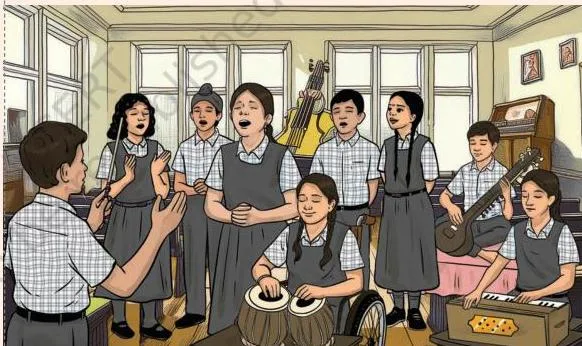
- Leading and participating in an ensemble. Activity 5.9 stages a group song with defined roles, using the Maihar Band as its model.
- Closing song and outcomes. The chapter ends with the song Jayati Jayati Bharata Mata and a table of learning outcomes for rhythm, singing and harmony.
Key concepts: the ideas behind every activity
Every activity in this chapter is a way to practise one of three elements — melody (raga), rhythm (tala) or lyrics (sahitya). Knowing what each concept means before you sing makes the tables and activities far easier to read.
Vocal range: mandra saptak and tara saptak
Vocal range is the span from the lowest note you can sing comfortably to the highest. The lower part of that span is the mandra saptak (lower register); the upper part is the tara saptak (higher register).
Activity 5.1 gives a pattern that starts on S and, line by line, steps into the lower-register notes — S, then S Ṇ S, then S Ṇ Ḍ Ṇ S, and so on. The book then asks you to create a similar pattern that extends your range into the tara saptak.
The physical rule matters: keep your head and neck in a neutral position while practising, so you extend the range without straining your voice or throat muscles.
Sargam and teentala
Sargam means singing swaras by their syllable names — S, R, G, M, P, D, N and Ś. The sargam exercise in Activity 5.2 is a grid of four-note patterns sung inside teentala, the rhythm frame marked x, 2, 0, 3. The rhythm keeps rolling while the notes change — that is where the flexibility comes from.
Harmony
Harmony is what you get when different notes are sung at the same time to produce a pleasant effect. In the Warmup in Thirds, Group 1 sings S R G while Group 2 sings G M P, and the two parts sound together as one.
The chapter calls singing in harmony a wonderful example of collaboration — a duet or jugalbandi works the same way.
Chhandas, adi tala and konnakkol
Chhandas is the Sanskrit word for metre — the pattern a verse is set in. The Omkaaram shloka of Activity 5.4 follows anushtup chhand, where the syllables naturally arrange themselves in groups of four, so you can clap the rhythm while reciting.
Adi tala is the eight-beat frame used in Activities 5.5 and 5.6: clap, little finger, ring finger, middle finger, clap, wave, clap, wave. Konnakkol is the rhythm language of Carnatic music, and an akshara is one syllable of a rhythm phrase. The phrase for Activity 5.5 is ThaKaDhiMi ThaKaJhaNu — four plus four, eight aksharas.
Konnakkol and swaras side by side
The two adi tala tables are the same exercise with different material — put them side by side and only the syllables change.
| Speed | Activity 5.5 — Konnakkol | Activity 5.6 — Swaras |
|---|---|---|
| 1st speed (1 count per beat) | Tha Ka Dhi Mi Tha Ka Jha Nu | S R G M P D N Ś |
| 2nd speed (2 counts per beat) | ThaKa DhiMi ThaKa JhaNu, twice | S R G M P D N Ś Ś N D P M G R S |
| 3rd speed (4 counts per beat) | ThaKaDhiMi ThaKaJhaNu, repeated four times | S R G M P D N Ś Ś N D P M G R S, repeated twice |
Reading the two tables side by side, only the material changes: rhythm syllables in Activity 5.5, note names in Activity 5.6. The hand pattern, the eight beats and the three speeds are identical — the tala is the frame, and the syllables are whatever fits into it.
The speeds: doubling, not adding
The konnakkol activity runs at three speeds, and the numbers are easy to misread. First speed is 1 count per beat, second speed is 2 counts per beat and third speed is 4 counts per beat — each speed doubles the previous one. So third speed means four counts in every beat, not three.
The tabla activity uses the same idea with different names. Ek gun is 1 bol per beat, dugun is 2 bols per beat, tigun is 3 bols per beat and chaugun is 4 bols per beat.
| Speed | Bols per beat | Total bols over a four-beat phrase |
|---|---|---|
| Ek gun | 1 | \(4 \times 1 = 4\) |
| Dugun | 2 | \(4 \times 2 = 8\) |
| Tigun | 3 | \(4 \times 3 = 12\) |
| Chaugun | 4 | \(4 \times 4 = 16\) |
Keep the same four-beat phrase in mind: at ek gun it carries 4 bols, at dugun 8, at tigun 12 and at chaugun 16 — the same span fills with 4, 8, 12 and 16 bols. Konnakkol speeds double (1, 2, 4) while taal speeds add one bol (1, 2, 3, 4); the chapter asks you to notice the mathematics of that doubling.
Bols and the ensemble
Bols are the spoken syllables of the tabla — Dhin, Naa, Kat, Taa and the rest. They stand for drum strokes, so reciting a paran means reciting a drum pattern with your voice.
An ensemble is a music group working like a team. Activity 5.9 lists five ensemble roles: conductor, lead singer, chorus singers, instrument players, and support through clapping or body percussion. The chapter’s point is that every member matters — a successful performance needs all five.
Definitions: music terms used in Chapter 5
A quick glossary of the terms Chapter 5 uses, written the way the book uses them. Where the chapter names a term without explaining it further, the definition below stays at the level of the chapter.
| Term | Meaning | Where it appears |
|---|---|---|
| raga | The melody of a composition — as the opening sloka puts it, a sound pleasant to the ear and aesthetically structured with swar and varna | Opening sloka; Introduction |
| tala | The rhythm of a composition | Introduction |
| sahitya | The lyrics of a composition | Introduction |
| vocal range | The span from the lowest to the highest note you can sing comfortably | Activity 5.1 |
| mandra saptak | The lower register of the voice | Activity 5.1 |
| tara saptak | The higher register of the voice | Activity 5.1 |
| sargam | Singing swaras by their syllable names, S R G M P D N Ś | Activity 5.2 |
| teentala | The rhythm frame of the sargam table, marked in four sections x, 2, 0, 3 | Activity 5.2 |
| harmony | Different notes sung at the same time to produce a pleasant effect | Activity 5.3 |
| chhandas | Sanskrit metre — the pattern a verse is set in | Activity 5.4 |
| anushtup chhand | A metre whose syllables fall into a pattern of four | Activity 5.4 |
| konnakkol | The rhythm language of Carnatic music | Activity 5.5 |
| adi tala | An eight-beat frame: clap, little finger, ring finger, middle finger, clap, wave, clap, wave | Activity 5.5 |
| akshara | One syllable of a rhythm phrase; the Activity 5.5 phrase has eight | Activity 5.5 |
| bol | A spoken tabla syllable, such as Dhin, Naa or Kat | Activity 5.7 |
| Ektaal | The tala whose bols are recollected before the Saraswati Paran | Activity 5.7 |
| paran | A composed tabla pattern; the chapter’s example is the Saraswati Paran | Activity 5.7 |
| chakradhaar | A type of tabla pattern named in the chapter; no further detail is given | Tabla patterns section |
| uthaan | A type of tabla pattern named in the chapter; no further detail is given | Tabla patterns section |
| fard | A type of tabla pattern named in the chapter; no further detail is given | Tabla patterns section |
| palta | A type of tabla pattern named in the chapter; no further detail is given | Tabla patterns section |
| ek gun | One bol per beat | Activity 5.8 |
| dugun | Two bols per beat | Activity 5.8 |
| tigun | Three bols per beat | Activity 5.8 |
| chaugun | Four bols per beat | Activity 5.8 |
| ensemble | A music group performing together, like a team with many different roles | Activity 5.9 |
| conductor | The member who ensures the whole performance is synchronised | Activity 5.9 |
Reading the chapter’s figures
Each illustration in the chapter sits beside the activity it supports. Walking through them in order is a fast way to see how the chapter is built.
The three elements of music
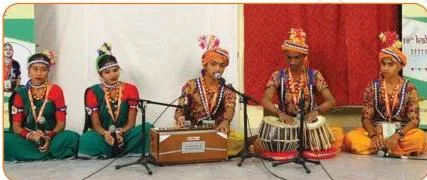
This illustration opens the Introduction. The children are performing as a group, and the caption is the chapter’s whole plan: every composition is built from melody, rhythm and lyrics. As you practise any activity, ask which of the three elements it is training.
Clapping while reciting the shloka
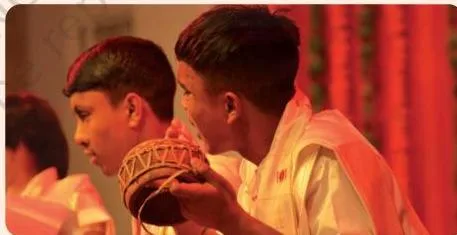
This figure belongs to Activity 5.4. The shloka’s syllables fall into a pattern of four, and clapping turns that hidden metre into something you can hear and feel. No instrument is needed — the body is the percussion.
The eight-akshara phrase ThaKaDhiMi ThaKaJhaNu
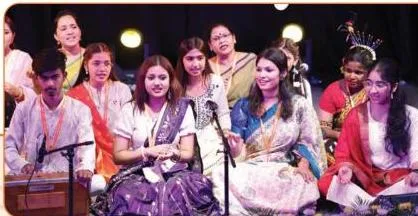
This sits at the top of Activity 5.5 with a school choir — the phrase is meant to be recited together. ThaKaDhiMi is four syllables and ThaKaJhaNu is four more, so the whole phrase carries eight aksharas across the eight beats of adi tala. The same phrase is the material for all three speeds.
The tabla and the bols of Ektaal
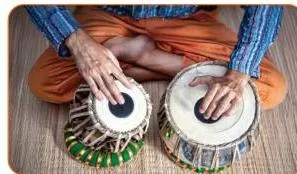
This photograph introduces the tabla patterns section. It shows close-up hands on the tabla, and the caption sets the method: recollect the bols of Ektaal first, then recite the Saraswati Paran. Because bols are spoken syllables for drum strokes, a vocal recitation can carry a drum composition.
Chaugun: four bols per beat
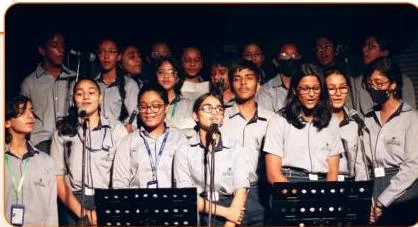
This figure belongs to Activity 5.8 and shows school students singing together. Its caption names the fastest of the four speeds: chaugun, four bols in every beat. After ek gun, dugun and tigun, the group speeds up until each beat is filled with four syllables.
The Maihar Band as a model ensemble
The photograph shows a concert by the Maihar Band of Madhya Pradesh, an orchestra founded by Ustad Allauddin Khan and known for blending many instruments in harmony. It closes Activity 5.9 with a reminder from the caption: repeat the activity by shuffling the roles, so each member learns every part of the ensemble.
Common mistakes in this chapter and how to avoid them
Most mistakes in this chapter are not about singing wrong notes — they are about reading the rhythm tables wrong or straining the voice. Name the error before you make it:
| Mistake | Correct rule | How to check your answer |
|---|---|---|
| Forcing the voice down in mandra saptak practice | Keep the head and neck in a neutral position; low notes come from relaxed support, not pressure (Activity 5.1) | Sing the S – Ṇ S – Ṇ Ḍ Ṇ S pattern facing forward; stop if your throat feels tight |
| Reading “3rd speed” as 3 counts per beat | The konnakkol speeds double: 1, 2, then 4 counts per beat | Clap each beat and fit four syllables (ThaKaDhiMi) into one clap; if you fit three, slow down |
| Thinking each speed adds one syllable per beat | The pattern doubles — 1 to 2 to 4 — it never adds one | Compare the same beat column across the three speed rows of the Activity 5.5 table |
| Mixing konnakkol syllables into the swara exercise | Activity 5.5 uses rhythm syllables; Activity 5.6 uses swaras (S R G M P D N Ś) on the same beat frame | Check the row: vowel-ending syllable chains are konnakkol; single note letters are swaras |
| Singing the signs x, 0, 2, 3 and 4 as lyrics | The signs mark the section boundaries of the 12-matra cycle; they are not sung | Recite only the Bol/Syllable rows of the Saraswati Paran table; let the signs guide your hand, not your voice |
| Assuming only the lead singer matters in the ensemble | The chapter says every member matters — conductor, chorus, instruments and body percussion included | Test: if one member stopped, would the performance change? If yes, the role matters |
Assessment expectations: what the chapter asks students to do
The teacher note tells teachers what to look for, and a student can read it the same way. The competencies below are the chapter’s targets; the assessment method is observation, not a written test.
- CG1 — Explore and express: express personal and everyday experiences confidently through musical activities, and stay flexible while developing music with others.
- CG2 — Imagine and create: compose and perform songs that challenge stereotypes (such as gender roles), and connect elements of music — lyrics, ragas, rhythms, volume, tempo, patterns — with your own experiences and emotions.
- CG3 — Apply technique: show stage etiquette and care for instruments, choose resources sensibly, and refine a piece from planning through to the final performance.
- CG4 — Know regional music: be familiar with local and regional forms of music, and describe the life and work of a few local musicians and performers in your region and across India.
The teacher note recommends formative assessment conducted mainly through classroom observation, in a relaxed and engaged manner, with qualitative feedback given at regular intervals. Summative assessment suggestions appear at the end of the music section.
The chapter’s own learning outcomes, in its closing table, are: understanding rhythm and metre well enough to recite konnakkol, shlokas and bols; singing a patriotic or folk song individually or in a group; and singing note patterns in harmony.
One honest caution: textbook contents and the examinable syllabus are not always identical — check the current official CBSE syllabus for what is assessed.
Revision summary: Chapter 5 in two minutes
If you have one night, run through this list. You should be able to do each item without the book open.
- Name the three elements of music: melody (raga), rhythm (tala) and lyrics (sahitya).
- Explain that mandra saptak is the lower register and tara saptak is the higher register, and that the head and neck stay neutral during the mandra practice.
- Sing the sargam pattern in teentala from the Activity 5.2 grid.
- Clap the pattern of four while reciting the Omkaaram shloka (anushtup chhand).
- Recite ThaKaDhiMi ThaKaJhaNu in adi tala at first, second and third speeds — 1, 2 and 4 counts per beat.
- Keep konnakkol (rhythm syllables) separate from swaras (note names) when switching between Activity 5.5 and Activity 5.6.
- Recognise the bols of the Saraswati Paran — Dhin, Dhin, Dhage, Tirakita, Tu, Naa, Kat, Taa and the rest.
- Define ek gun, dugun, tigun and chaugun as 1, 2, 3 and 4 bols per beat.
- Take one role in a group song — conductor, lead singer, chorus, instrument player or body percussion — knowing every role matters.
Keep the closing idea: melody, rhythm and lyrics are not separate subjects — every song brings all three together, and this chapter is the practice for doing that.
Related resources: Class 8 arts on this site
This listing is maintained for the 2026-27 academic session using the NCERT textbook information available to us. NCERT remains the authority for confirming the latest edition.
Continue with the rest of the Class 8 arts material on this site:
- Class 8 arts (Kriti) book page — the arts chapters grouped together.
- Class 8 notes hub for the rest of Class 8.
- CBSE notes home page to find any class or subject.
- Related arts pages from the same book: Musical Instruments and Applause and Advice.
Sources and data verification
- The figure captions and activity descriptions on this page come from the NCERT Class 8 Kriti textbook, Chapter 5 (Music), official edition on ncert.nic.in.
- This page indexes the NCERT textbook, not the full CBSE syllabus; optional and skill subjects are not covered here.
- The listing is maintained for the current academic session using the NCERT information available to us.
- NCERT settles textbook editions and PDFs; CBSE settles curriculum, syllabus and examinations. For a textbook edition or PDF, use ncert.nic.in; for the examinable syllabus, use the official CBSE documents.
| What the chapter holds | Count | Where it is used |
|---|---|---|
| Printed pages | 12 | |
| Figures with NCERT captions | 6 | |
| Tables | 7 | |
| Official NCERT PDF | Download the chapter PDF | the chapter exactly as NCERT publishes it |
Frequently asked questions about the Class 8 Music chapter
Where is the official Music Class 8 chapter PDF from NCERT?
NCERT publishes every chapter of Class 8 Kriti separately on ncert.nic.in; Chapter 5 (Music) is the file hekr105.pdf. The official Music Class 8 chapter PDF link is in the download section at the top of this page.
What is the difference between mandra saptak and tara saptak?
Mandra saptak is the lower register of your voice and tara saptak is the higher register. Activity 5.1 practises the lower register with a pattern that steps into the lower notes, then asks you to build a matching pattern for the higher one. During the mandra practice, keep your head and neck neutral to avoid straining.
What does 3rd speed mean in the adi tala konnakkol activity?
Third speed means 4 counts per beat, not 3. First speed is 1 count per beat, second speed is 2, so the pattern doubles at each step: 1, 2, 4. At third speed, four syllables — one full ThaKaDhiMi — fit into each beat.
What is the difference between konnakkol syllables and swaras in the adi tala activities?
The two activities use the same eight-beat adi tala frame and the same three speeds, but different material. Activity 5.5 recites konnakkol rhythm syllables — Tha, Ka, Dhi, Mi, Jha, Nu. Activity 5.6 sings swaras — S, R, G, M, P, D, N, Ś — in the same pattern of speeds.
What do the signs x, 0, 2, 3 and 4 mean in the Saraswati Paran table?
They are the section signs of the 12-matra tala table, not words to sing. In the Saraswati Paran table, x sits on matra 1, 0 on matras 3 and 7, and 2, 3 and 4 on matras 5, 9 and 11. They mark where each section of the cycle begins; the singing uses only the Bol/Syllable rows.
Is the whole Music chapter examinable in CBSE Class 8?
Textbook contents and the examinable syllabus are not always identical — check the current official CBSE syllabus to see what is assessed from this chapter. The book itself recommends formative assessment through classroom observation with qualitative feedback, and gives summative assessment suggestions at the end of the music section.
Reference: NCERT Class 8 Arts (Kriti) textbook, chapter 5, official edition on ncert.nic.in.
Explore Class 8 Arts Books
Related chapters: