
Looking for “From Page to Stage Class 8”? This is Chapter 3 of the NCERT Class 8 Arts textbook Kriti (Art Education) — the official chapter PDF is free right here. The chapter teaches theatre-making by writing the whole process as a play script, so every dialogue and stage instruction is also an example of how a script works.
From Page to Stage Class 8: Download the Official Chapter PDF
Open the NCERT Class 8 Arts Kriti From Page to Stage Chapter 3 PDF whenever you need the chapter in front of you — it is the exact textbook file your teacher follows in class, published free on ncert.nic.in, and it opens on any phone or computer.
This chapter comes from Kriti, the NCERT Class 8 Arts (Art Education) textbook. The whole book can also be browsed chapter by chapter on the NCERT e-textbook portal.
What This Chapter Contains at a Glance
Before you read, here is the shape of the chapter — what kind of text it is and what you will meet inside it.
- The whole chapter is written as a play script: a Grade 8 class prepares a 30 to 40 minute school show within a six-week countdown.
- It has five scenes: Brainstorming, Work Begins, Rehearsals and Preparation, The First Run-Through, and Showtime.
- It includes a scene-by-scene table listing the steps of preparation and the lessons learnt in each scene.
- Two activities — Thought Splash and Quiz Time — plus a Circle Time self-review.
- A suggested prayer, the motto “The show must go on” with a real-life story from 1995, and a closing competencies grid for teacher and self assessment.
Because the process is a play about making a play, you follow two stories at once: the Himalayan folktale the class performs, and the class’s own story of planning, rehearsing and staging it.
What “From Page to Stage” Teaches: A Play About Making a Play
This section explains the chapter’s unusual form and the three goals it sets before the script begins.
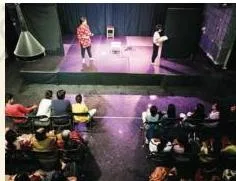
The chapter opens with the illustration “The spirit of theatre!” — the energy and teamwork that theatre-making promises. What follows is not a set of instructions but a script, so you watch theatre being made rather than being told about it.
The “You Will Learn” box names three goals: the process of presenting a drama performance, the elements of a script, and the spirit of theatre.
- The show is set for six weeks away and must run 30 to 40 minutes.
- The chapter promises that facilities and material resources are not a necessity — theatre can be performed anywhere with whatever you have; dedication and enthusiasm are what matter.
- The script doubles as an example for the Play Reading exercise in Chapter 1.
The Journey Scene by Scene: From Brainstorming to Showtime
This is the heart of the chapter — five scenes, each completing one production step and teaching one lesson. Skim the route here, then read the scenes with this map in mind.
Scene 1: Brainstorming — Story, Conflict and Teams
The class has nothing yet, not even a story. The circular from the principal announces the show; Ananya, the class representative, sets the frame: six weeks, 30 to 40 minutes.
- The story debate: a Panchatantra or Hitopadesha tale? Savitri and Satyavan, Tenali Rama and Monkey and Crocodile are all floated. The class votes for Karan’s Himalayan folktale — it has a clear beginning, middle and end, and an interesting conflict, and it can blend dance, puppetry and folk music.
- The teams: script, set and props, makeup and costume, puppetry, music, dance, and documentation. The chapter’s point: every student joins at least one team, because backstage work is the foundation of a good performance — a lesson the class first learnt in Grade 7.
- The conflict of the scene: everyone wants to act, nobody wants backstage. The teacher settles it — you may act once the script is ready, but first every student picks a team.
- Karan takes ownership of the script and promises the final draft in three days.
Scene 2: Work Begins — the Script and How to Give Feedback
Three days later Karan’s team reads its draft: Scene 1, an old house on the Himalayan slopes, a granny and grandson — and then a spaceship landing on the mountain. The class objects on four grounds: the opening is boring, a spaceship cannot be staged, it is not a folk story, and it leaves no room for dance or puppetry.
Karan walks out in anger.
Ananya brings him back and sets the feedback rule: listen to the whole script, make notes, and share the feedback at the end — respect each other’s work. The class does, Karan revises, and everyone is satisfied.
The stagecraft lesson hidden in the scene is the chapter’s own example of writing for the stage: the mountain and the spaceship are shown through the characters’ conversation, not built as sets.
Scene 3: Rehearsals and Preparation — Hitting the Wall
A week into practice, chaos. Nikhil’s costume corner is a dumping ground, Anita needs space to dry a wet crocodile puppet, the script team cannot concentrate, dancers do not show up, and Anil’s three songs are rejected.
The teacher’s answer surprises everyone: “that means you’re right on track.” Every team hits a wall — it is part of the creative process. The fixes are practical:
- A common storyboard chart so all departments stay aligned.
- Separate working spaces — empty rooms, the playground.
- A combined check-in every two days, where each scene is acted out briefly so every team can visualise what is needed.
- Music must be coordinated with dance and puppetry separately — and no film-music remixes.
Scene 4: The First Run-Through — Feedback That Improves the Show
Before the real audience, the class performs the whole play in front of four or five teachers. Mistakes happen, laughter happens, and the first feedback is praise: completing it start to finish is itself a huge task.
Three corrections follow:
- Slow scene transitions — fix: arrange all props scene-wise before the show.
- Unclear delivery — fix: the stage voice, audible to the last row without screaming, while holding emotion.
- Don’t drop the puppets — a warning to Ritu, balanced by Teacher 3’s praise that using puppetry for the little boy’s dream, tied to the folk dance, is a brilliant idea.
Scene 5: Showtime! — When Something Goes Wrong
Backstage, last-minute checks: a broken puppet stick is replaced by Sana. The team circles up for its prayer, then chants “One team, one show; let the magic flow!”
Then the crisis: Aditya is missing right before his line, and if he does not speak, the puppetry cue cannot begin. Nandini takes his line naturally, the puppetry starts, and the show flows. After the curtain call, the team learns Aditya fell backstage and sprained his leg.
Two lessons close the scene. The audience’s silence before applause is a warning not to judge a show mid-moment. And Ananya’s words to the audience name what the class actually learnt: teamwork, creativity, and that every part matters.
Script Elements and Theatre Terms: What the Chapter Names
This section is the vocabulary of the chapter — the terms the Quiz Time activity expects you to know.
The Quiz Time answers, in the chapter’s own words: non-dialogue lines are called stage instructions; they communicate the actions and visual representation of the scenes. They are written in italics and within brackets. The emotion or delivery style of a line is given in italics with brackets immediately after the character’s name.
| Term | What it means | Where it appears |
|---|---|---|
| Script | The written text of the play, containing dialogue and stage instructions | Scenes 1-2, the script team |
| Dialogue | The lines the characters speak | Throughout the script |
| Stage instruction | A non-dialogue line, in italics and brackets, that communicates action and visual staging | The Quiz Time answers |
| Conflict | The tension in the story that keeps the audience interested | Scene 1 — the class checks for it before choosing |
| Run-through | A full trial performance from start to finish before the real show | Scene 4 |
| Storyboard chart | One shared chart of every scene so all departments stay aligned | Scene 3 |
| Documentation | The photo, video and diary record of the production process | Scene 1; showtime checklist |
| Team prayer | A circle ritual before the show that builds group spirit | Scene 5 |
| Curtain call | The team assembling on stage after the show to receive applause | Scene 5 |
| Stage voice | Projecting so the last row hears you, without screaming | Scene 4 |
| Presence of mind | Staying alert and improvising when a mistake happens on stage | Showtime checklist |
| “The show must go on” | The motto — keep the story alive no matter what goes wrong | The motto section, after the scenes |
A Walkthrough of the Chapter’s Illustrations
The illustrations tell the production story visually, from the first spark to the final applause. The chapter opens with “The spirit of theatre!” (shown above); the figures below trace the journey through the script.

Karan’s declaration marks the moment the class moves from choosing a story to owning it — one student takes responsibility, a team forms around him, and the deadline is set.
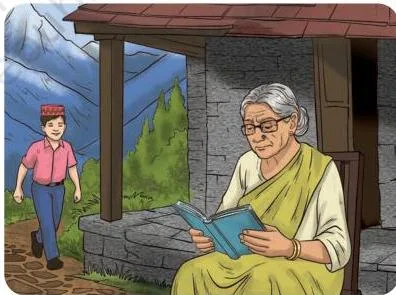
The illustration shows the world the script creates with words. The chapter’s point is that this world needs no sets: the mountain and the spaceship come alive through what the grandmother and grandson say to each other.

Ritu’s interruption is the chapter’s warning about feedback. She objects before hearing the whole draft — the scene uses her to show why Ananya’s rule matters: listen first, give notes at the end.

Meera’s complaint captures the rehearsal-week wall — departments working in isolation, nobody showing up. It is the moment that leads to the teacher’s “right on track” and the storyboard chart.
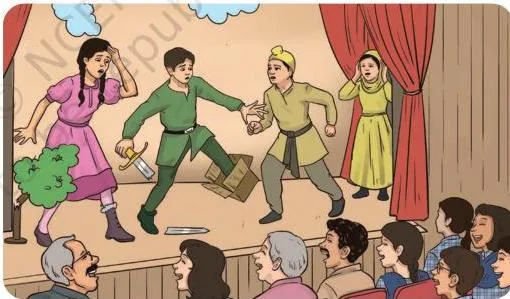
In the run-through feedback, praise does as much teaching as corrections. The puppetry for the little boy’s dream, connected to the folk dance, is called a brilliant idea — a model of how art forms can be integrated.

The curtain-call line closes the script on celebration and reminds readers that one successful performance is a beginning, not an end.
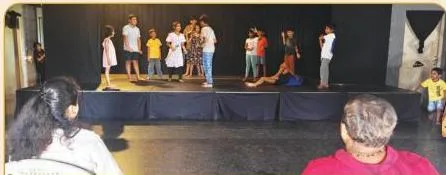
The showtime habit in one line — be alert and use your presence of mind. It is exactly the skill Nandini shows when she picks up Aditya’s line and saves the puppetry cue.
Mistakes the Characters Make, So You Do Not Repeat Them
The script deliberately shows students making mistakes, then shows the fix. Spotting these before your own production is the point.

The figure above is the chapter’s model of feedback done right: Ananya runs out, brings Karan back, and makes the class listen before criticising. The table below turns every mistake in the script into a rule you can check.
| The mistake | The rule the script teaches | How to check yourself |
|---|---|---|
| Everyone wants to act; nobody wants backstage work | Backstage departments are the foundation of a good performance; every student joins at least one team (Scene 1) | Before rehearsals, is every classmate in a team — not only the actors? |
| Interrupting the script reading with objections | Listen to the whole script, make notes, and give feedback at the end; respect each other’s work (Scene 2) | Have you heard the full draft before commenting? |
| Writing scenes that cannot be staged — a spaceship landing | Show impossible action through the characters’ conversation, not through sets (Scene 2) | For every scene, ask: can we show this with what we have? |
| Departments working in isolation | Align everyone with a common storyboard chart, separate spaces and a combined check-in every two days (Scene 3) | Does each team know what the others are making? |
| Slow scene transitions in the run-through | Arrange all props scene-wise before the show (Scene 4) | Are the props for each scene waiting in their own place? |
| Voices not reaching the audience | Use the stage voice — audible to the last row without screaming, while holding emotion (Scene 4) | Can a friend at the back of the hall hear your line? |
| Freezing when something goes wrong | Stay alert, use presence of mind — Nandini takes the missing actor’s line and the show continues (Scene 5) | Do you know who covers whom if a line or cue fails? |
The Chapter’s Activities: Thought Splash, Quiz Time and Circle Time
After the script, the book sets you several tasks. Knowing what each expects keeps homework and classwork from being a surprise.
- Thought Splash (Activity 3.1): write down your immediate thoughts after reading the play — reactions, questions, even doodles — then share and discuss them with the class.
- The scene-by-scene analysis table: for each scene, the chapter lists steps for preparation and lessons learnt; you discuss each scene and add your own points.
- Quiz Time (Activity 3.2): observe the script’s writing style — the non-dialogue lines, how to tell them from dialogue, and how the intended emotion is signalled. It ends by inviting you to write a play of your own.
- Circle Time: list your individual strengths and weaknesses and the class’s, then plan how to work on the weaknesses and use the strengths — as a team.
- Documentation: the chapter stresses recording the process with photos, videos and regular diary entries.

The activity pages invite you to treat the five scenes as a study object — read them once for the story, then again to spot each element of theatre-making.

The note to the teacher explains why: writing your own script makes you apply what you learnt in Grades 6 and 7, so the chapter’s script stays an example rather than a ready-made answer. The teacher’s role, the chapter adds, is to stay supportive and let the students decide and solve problems themselves.
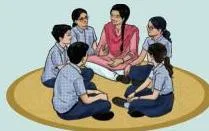
Circle Time ends where teamwork begins — the class turns its individual weaknesses into a shared plan.
How This Chapter Is Assessed: The Competency Grid
The closing grid tells you what the book expects you to be able to do by the end. It is participation-based, with a Teacher column and a Self column for each outcome.
- C-1.1: expresses personal and everyday life experiences confidently through various drama activities.
- C-3.1: demonstrates care and basic stage etiquette, and makes informed choices while using materials, tools and techniques of drama.
- C-4.1: demonstrates familiarity with various local and regional forms of theatre.
| Competency | Learning outcome checked | Where the chapter shows it |
|---|---|---|
| C-1.1 | Brings relevant experiences into the story and script | Scene 1 — students suggest stories from their own regions |
| C-1.1 | Relates to others’ experiences and stories to build a script | Scene 2 — class feedback shapes Karan’s draft |
| C-3.1 | Respects others’ work and helps when required | Scenes 2 and 5 — the feedback rule and the backstage cover |
| C-3.1 | Works with whatever is available and reduces wastage | The opening — resources are not a necessity |
| C-4.1 | Connects art forms — dance, puppetry, music — at relevant points | Scene 1 — blending folk music, dance and puppetry |
| Overall participation in class | The grid’s final row, marked by teacher and self | The full grid at the chapter’s end |
This is an Arts textbook, so the assessment is participation-based through teacher and self grids. Also keep in mind: textbook contents and the examinable syllabus are not always identical — check the current official syllabus.
Theatre-Making in One Page: A Night-Before Recap
Revise the whole chapter in a few minutes — one action and one lesson per scene, then the motto.
| Scene | The one action | The one lesson |
|---|---|---|
| Brainstorming | Choose a story with a beginning, middle and end and a real conflict; put every student in a team | Respect all ideas; backstage work is the foundation |
| Work Begins | Finish the script by the deadline; rehearse only after it is ready | Listen fully before giving feedback |
| Rehearsals and Preparation | Align teams with a storyboard chart, separate spaces and check-ins every two days | Stay focused, stay considerate, help others |
| First Run-Through | Do a trial run and take the feedback positively | Reviews and feedback improve the show |
| Showtime | Complete last-minute checks; do the team prayer | Don’t panic — be alert and use presence of mind |
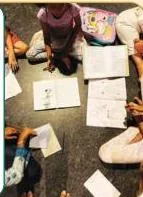
The REMEMBER line of the chapter: everyone has strengths and weaknesses, and a team that stays aware of them through the whole process can enhance the strengths and reduce the weaknesses.
The motto: “The show must go on”
Even if a crown falls off, someone sneezes loudly, or the lights go out, actors do not stop. The audience has given its time — the performer’s job is to smile, improvise and keep the story alive.
The chapter calls this a superpower for real life: when a plan goes wrong, you do not have to freeze, panic or quit. Perseverance and a positive attitude matter more than perfection — because like the show, life goes on.
The chapter proves the motto with a real story from 1995, in a town in the Dharwad district of Karnataka. School students were performing before more than 200 people in an old auditorium with pulley-operated backdrops. The ropes of one backdrop snapped just as the lead actor stood beneath it.
She heard the slip but did not stop her dialogue, trusting the backstage team.
Two crew members ran in and held the heavy backdrop by hand for the remaining hour of the play — their hands bruised and bleeding. The rest of the team took over their other duties, and the show completed without a glitch. With teamwork and determination, the show went on.
Related Resources for From Page to Stage
This listing is maintained for the 2026-27 academic session using the NCERT textbook information available to us. NCERT remains the authority for confirming the latest edition.
This chapter connects to the rest of the Kriti book and to the Class 8 notes on this site.
- Class 8 Arts study material — notes for the Kriti chapters.
- The “Applause and Advice” chapter page — another Kriti chapter on this site.
- All Class 8 subjects — the full class hub.
- The main CBSE notes index — every class and subject covered here.
The chapter’s script doubles as material for the Play Reading exercise in Chapter 1’s page, so the two chapters are best read together.
Sources and Data Verification
This page describes the NCERT Class 8 Arts textbook Kriti (Art Education), Chapter 3, “From Page to Stage”, official edition available as a free PDF on ncert.nic.in. It covers this chapter only — other chapters of Kriti and other subjects have their own pages.
This listing is maintained for the current academic session using the NCERT information available to us. NCERT settles textbooks, editions and PDFs; CBSE settles the curriculum, syllabus and examinations.
| What the chapter holds | Count | Where it is used |
|---|---|---|
| Printed pages | 19 | |
| Figures with NCERT captions | 13 | |
| Tables | 3 | |
| Official NCERT PDF | Download the chapter PDF | the chapter exactly as NCERT publishes it |
Reference: NCERT Class 8 Kriti (Arts) textbook, chapter 3, official edition on ncert.nic.in.
Frequently Asked Questions About From Page to Stage
What are the non-dialogue lines in a play script called?
They are called stage instructions. They communicate the actions and the visual representation of the scenes — what happens on stage and what the audience should see — and in this chapter they are always written in italics within brackets.
Why is “From Page to Stage” written as a play script instead of a lesson?
So theatre-making is shown, not explained. Because the chapter is a script about Grade 8 students staging a play, every dialogue and stage instruction is also a working example of how a script is built. The chapter adds that this script can serve as an example for the Play Reading exercise in Chapter 1.
Why did the teacher say the class was “right on track” when nothing was working?
Because every team hits a wall — it is part of the creative process. The problems showed the class was genuinely creating something. The fix was to step back, breathe, listen to each other, then use a storyboard chart, separate workspaces and combined check-ins.
What does “the show must go on” mean in this chapter?
No matter what goes wrong — a fallen crown, a loud sneeze, a missing actor — the performers smile, improvise and keep the story alive, because the audience has given them their time. The motto teaches resilience and adaptability, and the chapter supports it with a 1995 Dharwad story in which two crew members held a falling backdrop by hand for an hour.
Does putting up this play need expensive sets and costumes?
No. The chapter states plainly that facilities and material resources are not a necessity — theatre can be performed anywhere, with whatever you have. Dedication and enthusiasm matter most, and competency C-3.1 expects students to work with what is available and reduce wastage.
What are the competencies used to assess this chapter?
C-1.1, C-3.1 and C-4.1. C-1.1 covers expressing personal and everyday experiences through drama activities; C-3.1 covers stage etiquette and informed choices with materials, tools and techniques; C-4.1 covers familiarity with local and regional theatre forms. The closing grid lets the teacher and the student each mark these outcomes.
Explore Class 8 Arts Books
Related chapters: