
The official Work with Life Forms Class 9 chapter is the first chapter of the NCERT Kaushal Vikas skill-education book — a 20-page, activity-first chapter on agricultural practices, and the official PDF is right below this paragraph.
This page is for the student who is about to start this unit: it explains what the chapter contains, how each activity works, and what to revise just before you submit your work. Use the download for the official text and this guide for the explanations.
Work with Life Forms Class 9 PDF — Official NCERT Download
You can download the Class 9 Kaushal Vikas Chapter 1 Work with Life Forms PDF from the NCERT online textbooks portal — this is the official chapter file that schools follow, published by NCERT and free to view or download.
The book states on page 3 that Chapter 1 is mandatory — you complete it first, then choose any one vocation from Chapters 2–4 and do that work in a group, with teacher or expert guidance.
What Is Inside Chapter 1
The table on this page lists the chapter’s size — its sections, figures, tables and activities — at a glance. The prose below explains what those contents actually teach.
This is a compulsory foundation chapter for the unit’s seven vocations. It teaches how life forms — plants and animals — give us food and raw materials, and it does that through do-it-yourself activities: measuring rain, testing soil, checking seeds and preparing organic inputs. On page 5 the book lists what you will be able to do after this chapter:
- Understand the importance of agricultural practices
- Understand the agro-climate relationship
- Set up a meteorological observatory
- Test and improve soil quality
- Test and treat seeds
- Identify key processes related to agricultural practices
- Explore vocations related to agricultural practices
- Identify quality criteria related to agricultural practices
What This Chapter Teaches, Section by Section
Use this map to find any topic without reading front to back. The page numbers point to the printed book.
- Importance of work (p. 6): why agriculture is called the mother of all production, and India’s place in world farm output.
- The value chain (p. 7): why the same vegetable costs far more in a supermarket than in a mandi.
- Agro-climatic relationship (pp. 8–9): how IMD weather data guides kharif, rabi and summer planning — including the Ladakh case study.
- DIY meteorological lab (pp. 9–12): build a rain gauge, a dry-wet bulb thermometer and a wind vane, then record data for three months.
- Soil testing and amendment (pp. 13–15): collect samples correctly, run the mason jar texture test and the pH test, then fix the soil.
- Seed selection (pp. 16–17): seed dormancy and the salt-water floating method for healthy seeds.
- Organic fertilisers and pesticides (pp. 17–18): the vermicompost and Daśhaparnī arka caselets.
- Selection of vocation (pp. 18–19): the seven vocational options and the resource-mapping checklist.
- Safe work and self-check (pp. 19–20): five rules for working with plants, and six tasks in Assess your learning.
Key Concepts in Work with Life Forms
The chapter builds its ideas in a deliberate order: understand why the work matters, learn how weather and soil decide what grows, then choose a vocation. Each idea below opens with why it matters, then gives the method the book teaches, with its page.
The value chain: why the same vegetable costs more in a supermarket
Before any activity, the book asks a practical question: why does a price change with the shop? Because each step between farm and shop adds cost, so the produce’s value rises with it. A supermarket vegetable can cost 300–400 per cent more than the same vegetable in a mandi (NCERT, p. 7).
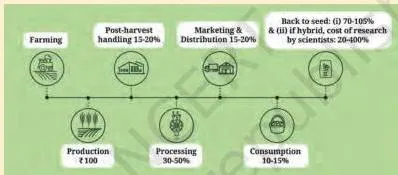
Storage (refrigeration, warehouse rent), processing (grinding wheat or extracting oil), cleaning, pasteurisation, transport and profit all add to the price; hybrid seeds push the initial cost higher too (NCERT, p. 7). The worked example below traces a ₹200 harvest through the chain using the book’s own percentages.
| Stage in the chain | Addition | Value of the harvest |
|---|---|---|
| Harvest produced on the farm | — | ₹200 |
| Post-harvest handling — 15–20 per cent of ₹200 (NCERT, p. 7) | +₹30 to ₹40 | ₹230–₹240 |
| Processing — 30–50 per cent of the ₹30–₹40 just added | +₹9 to ₹20 | ₹239–₹260 |
| Storage, packing, transport and retail | each adds its own share | final retail price well above ₹200 |
That is why the book’s first PORTFOLIO task asks you to trace one product’s price from farmer to shop (p. 7): the farmer’s share is only part of what you finally pay.
The agro-climatic relationship: how weather decides crops
Climate is the first factor the book connects to agriculture because it decides which crops a region can grow — rice in some parts, wheat, cotton or millets in others (NCERT, p. 8).

The India Meteorological Department (IMD) records weather and runs Agrotechnological Advisory Services (AAS). Its forecasts reach farmers through SMS, All India Radio, Doordarshan, community radio, mobile apps, the Kisan Portal and Krishi Vikas Kendras — and IMD data also helps agencies predict livestock disease outbreaks before they spread (NCERT, p. 8).
Kharif, rabi and summer are the three sowing seasons the advisories support. Apps like Bharat-VISTAAR give agro-climatic data, and panchayat-level weather details appear on digital platforms such as GKMS (NCERT, p. 8).
The Ladakh caselet is the book’s proof that weather data is life-saving. Ladakh is a cold desert — most precipitation falls as snow and irrigation depends on glacial meltwater. Farmers can grow only in a short May–September window, and icy winds, sudden frost or unexpected rain can destroy weeks of work within hours.
Livestock — goats, double-humped camels, yaks and horses — suffer too (NCERT, p. 8).
Table 1.1 in the book turns that into a simple logic: heavy rain means floods, little rain means water scarcity, low humidity raises evaporation from leaves, and strong winds damage crops and cause soil erosion (NCERT, p. 9).
The DIY meteorological lab: three instruments you build yourself
The answer to Ladakh’s problem is local weather data — and the book makes you build the instruments. A simple school observatory has three tools (NCERT, p. 9).
- Rain gauge (Figure 1.3, p. 10): measures rainfall in cm or mm. Cut the top third off a transparent bottle and invert it as a funnel, tape a ruler outside, place the setup in an open area at height, then read the water level after rain and compare it with an app.
- Dry-wet bulb thermometer (Figure 1.4, p. 11): measures temperature and humidity. One bulb is wrapped in wet cotton gauze; spinning the bottle evaporates water from it, so the wet bulb reads lower than the dry bulb. A small difference means humid air; a large difference means dry air. A psychrometric chart gives the exact humidity — ask your teacher or an expert.
- Wind vane (Figure 1.5, p. 11): identifies wind direction. A cardboard disc is marked North, East, West and South, and an arrow turns freely on a pin to point where the wind comes from.
Record rainfall, temperature (average and range) and wind direction for three months, then share the record with a farmer or gardener — that is the second PORTFOLIO task (NCERT, p. 12).
Soil health: test first, then amend
You cannot improve soil you have not measured. Soil health has three sides: physical (texture, water holding), chemical (pH, nutrients, organic matter) and biological (microbes) (NCERT, p. 13).

So the mineral part alone — sand, silt and clay — is less than half the soil. Water and air share the pore spaces, which is why texture matters so much.
Collection comes first. Take soil from several spots — for example a sandy area, an organic pit and a water channel — and mix the samples. Avoid shady areas under trees and places where fertilisers are stored, because that soil is not representative.
Remove stones and leaves, dry the sample in sunlight, crush clumps and sieve; then reduce it by quartering — divide into four, discard two opposite quarters, mix the rest and repeat until a small clean sample remains (NCERT, p. 13).
Mason jar test (texture): fill a jar halfway with soil, add water and a little dish soap, shake well, and let it settle for 24–48 hours. Sand settles at the bottom, silt in the middle, clay on top; measure each layer. Clay above 20 per cent means waterlogging and suffocated roots, so add river sand or red-garden soil.
Sand above 80 per cent means the soil barely holds water and plants wilt, so add compost or garden soil (NCERT, p. 14).
pH test: make a paste with distilled water and a little soil, dip a pH strip or metre, and compare with the scale. Most plants prefer pH 6–7. If the pH is below 6 (acidic), add compost, wood ash, lime or dolomite.
If it is above 8.5 (basic), wash the soil with extra water and drain it, add compost, and use gypsum or a sulphur-containing fertiliser (NCERT, p. 15).
Seed quality: dormancy and the floating method
A fertile soil is wasted on a weak seed — the plant will be weak too. That is why the book treats soil and seed as the two quality gates (NCERT, pp. 12, 16).
Seed dormancy is a natural state in which seeds stay alive but do not germinate. It is an adaptation: seeds wait for suitable conditions instead of sprouting into a bad season. Sometimes dormancy is broken deliberately (rice seeds soaked in hot water for a few hours), and sometimes it is induced so seeds do not sprout during storage (NCERT, p. 16).
The floating method uses salt water to separate hollow or damaged seeds from healthy ones. Salt makes the water denser, so lighter, non-germinating seeds float; the salt also cleans microbes off the seed coat. The book’s ratio is (NCERT, p. 17):
- 1 L water + 100 g salt + 250 g wheat seeds
- Wait 3–5 minutes; damaged, infected or hollow seeds float
- Discard the floaters, wash the remaining seeds in fresh water and dry them in shade
Scaling the same recipe to a 5 L bucket is straightforward: 500 g salt and 1.25 kg seeds in 5 L of water, with the same waiting time and the same after-steps. Keep the ratios, not just the volume.
Organic fertilisers and pesticides: the vermicompost caselet
The chapter’s organic inputs come from two school caselets — turning agro waste into fertiliser and local leaves into pesticide. Both reuse what is already around the school (NCERT, p. 17).


Vermicompost: students of Government High School collected 50 kg of agro waste and 50 kg of cow dung, filled them layer by layer in a pit under a green shade-net, introduced worms, kept the pit moist and covered it with a gunny bag. After six days the compost was ready; they sieved it and packed it into 1 kg bags (NCERT, p. 17).

Daśhaparnī arka: an organic pesticide made from ten materials — the leaves of neem, karanj, custard apple, papaya, castor, marigold, lantana, bael, tulsi and hibiscus, plus cow dung and cow urine. Weigh 200 g of leaves, add 220 g cow dung and 500 ml cow urine to a 20 L bucket, add 15 L water, and ferment for 30–40 days.
Spray the ready liquid at 15 mL per 1 L of water (NCERT, pp. 17–18).
Choosing a vocation: seven options and a five-question check
Chapter 1 builds the common concepts; then you choose one vocation to actually do (NCERT, p. 3). The unit’s seven vocations are:
- Rooftop gardening (Chapter 2)
- Precision farming (Chapter 3)
- Mushroom cultivation, aquaponics, pisciculture, backyard poultry and non-timber forest produce (guidelines in Chapter 4)
Before choosing, explore the work around you — what agriculture-related work exists nearby, what inputs it needs and what it produces (NCERT, p. 18). Then run Table 1.2’s five yes/no questions (NCERT, p. 19):
- Can you complete the work in three months?
- Is there adequate space to build the necessary structures?
- Have you identified an expert to help?
- Can you manage the resources needed to complete the work?
- Will you be able to do real, hands-on work?
A “no” anywhere means you should discuss the plan with your teacher before starting — the checklist is there to catch problems early.
Figures in Chapter 1 and What They Show
The diagrams in this book are methods, not decoration — most activities are taught as picture-steps. Here is each figure, where it sits, and the fact to take from it.
The agricultural livelihood ecosystem (p. 3): the opening diagram shows crop cultivation, animal husbandry, forestry, soil science and fisheries as connected work, with a final level linking them to research, training, transport, packing, trading, branding and export-import. Its point: no agricultural work happens in isolation — if demand for a produce falls, transport, equipment-making and experts are affected too (NCERT, p. 3).
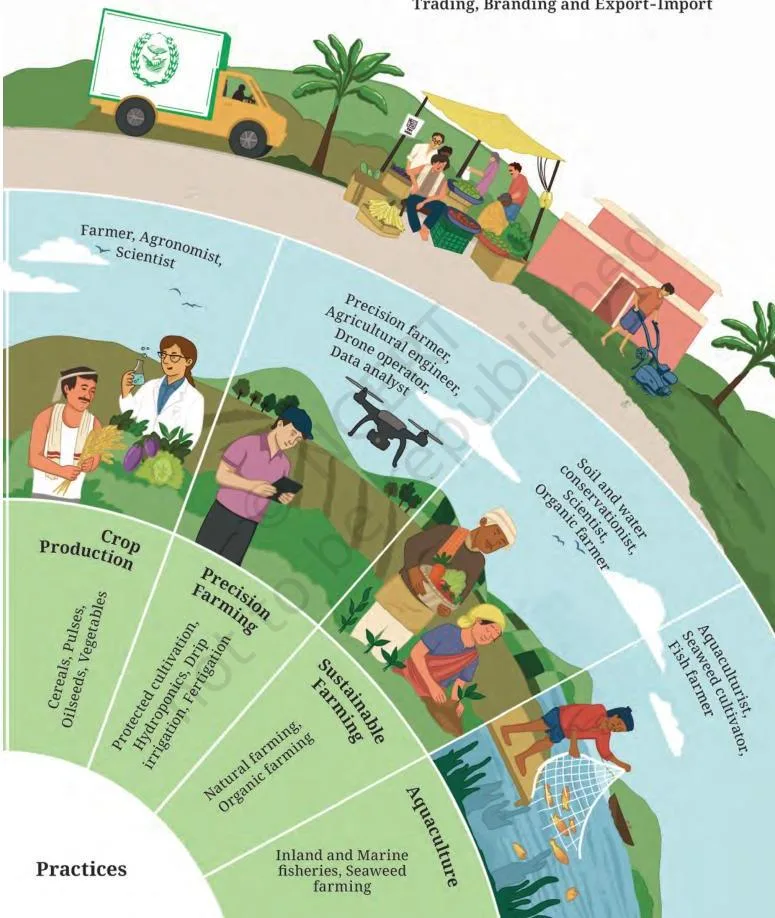
Figure 1.1, the crop calendar (p. 5): a structured schedule of planting, maintenance and harvesting, built on local weather and soil conditions. Farmers, agricultural organisations and researchers create such calendars; the same idea appears in your Grade 9 Social Science textbook.
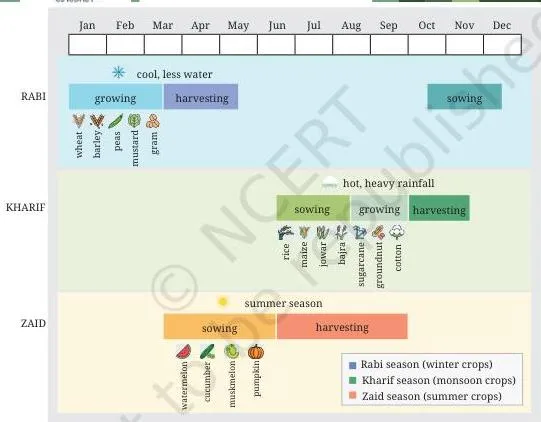
Figure 1.2, the value chain (p. 7): already explained above — the diagram shows the percentage rise in cost as produce moves from farm to consumer.
The IMD and Agrotechnological Advisory Services (p. 8): already explained above with the agro-climatic lesson; the figure shows the agency behind the weather advisories.
Panchayat-level meteorological data on GKMS (p. 8): the figure shows temperature, rainfall, soil moisture and wind direction available on digital platforms. The fact to take: you do not need a big weather station to get useful data — block-level weather reaches farmers on their phones.

Figure 1.3 (rain gauge), Figure 1.4 (dry-wet bulb thermometer) and Figure 1.5 (wind vane) (pp. 10–11): the step-by-step build instructions for the three DIY instruments. The wet bulb reads lower because evaporating water cools it, and a small dry-wet difference means humid air — full methods are in the DIY lab section above.
Figure 1.6 (soil sampling), Figure 1.7 (mason jar test) and Figure 1.8 (pH testing) (pp. 13–15): the sampling routine (zig-zag field, V-shaped hole 15–20 cm deep, quartering), the sand–silt–clay layers, and the pH strip test. Full methods are in the soil section above.
Figure 1.9, the floating method (p. 17): the picture-steps of the salt-water seed test; ratio and steps are in the seed section above.
Figures 1.10 and 1.11, vermicompost and the organic pesticide (p. 18): already explained above with the caselets — the photos show the compost bed and the fermented pesticide bucket in action.
The portfolio figure (p. 12): the record-keeping task — track data from your DIY observatory over three months and share it with a farmer or gardener, then record their feedback.

The vocation figure (p. 18): the image accompanying Section 1.4, where you explore the agricultural work around you and decide which vocation to take up.

Definitions to Know from Chapter 1
Six terms carry the chapter. Check them here without re-reading whole sections.
| Term | Meaning | NCERT page |
|---|---|---|
| Food security | All people, at all times, having reliable access to a sufficient quantity of affordable and healthy food. | p. 1 |
| Livelihood ecosystem | The interconnected network of resources, people, institutions, activities and environmental factors that enables individuals to earn a living while contributing to society and the nation. | p. 3 |
| Value chain | The rise in a product’s cost as it is stored, processed, packed, transported and sold — value is added at every step. | p. 7 |
| Agro-climatic region | A region whose cropping pattern is shaped by its climate — which is why different parts of India grow rice, wheat, cotton or millets. | p. 8 |
| Soil texture | The share of sand (largest particles), silt (medium) and clay (smallest); it decides water holding, nutrient holding and how easily roots grow. | p. 14 |
| Seed dormancy | A natural condition where seeds remain alive but do not germinate until conditions suit them. | p. 16 |
Common Mistakes Students Make in These Activities
These are the errors the book’s instructions are written to prevent. Name each mistake before you make it.
| Mistake | Correct rule | How to check your work |
|---|---|---|
| Collecting soil under trees or near fertiliser storage | That soil is not representative. Avoid shady spots and stored-fertiliser areas; sample several different spots and mix them (NCERT, p. 13). | Your sample was mixed from a sandy area, an organic pit and a water channel. |
| Testing soil that still contains stones and leaves, or skipping the quartering steps | Remove debris, dry in sunlight, crush clumps and sieve; then quarter — discard two opposite quarters and repeat until a small clean sample remains (NCERT, p. 13). | The labelled sample is fine, dry and sieved. |
| Using tap water to make the pH slurry | Tap water contains dissolved minerals that change the reading; the book specifies distilled water (NCERT, p. 15). | Your slurry was made with distilled water only. |
| Reading the wet-bulb difference backwards | A small dry-wet difference means humid air; a large difference means dry air (NCERT, p. 11). | The wet bulb reads equal to or lower than the dry bulb — check the size of the gap. |
| Using the wrong salt proportion in the floating method | Use the book’s ratio: 100 g salt in 1 L water for 250 g seeds (NCERT, p. 17). The salt must raise the water’s density enough to float hollow seeds. | You weighed the salt and seeds and waited 3–5 minutes before reading. |
| Discarding the floaters and sowing the rest without washing | After removing floating seeds, wash the remaining seeds in fresh water and dry them in shade — salt stays on the seed coat (NCERT, p. 17). | The surviving seeds were rinsed and shade-dried, not sown salty. |
| Tasting chemicals or handling glass carelessly during tests | The book’s safety rule: do not taste chemicals; handle glass containers carefully (NCERT, p. 16). | You worked with teacher supervision and used a pH strip, never a taste test. |
How This Chapter Is Assessed
This is a skill-education book, so your work is checked by doing, not by a question paper. Assessment runs through group work, in-chapter checkpoints and a closing task list.
- Group work: the book expects you to do the work in groups, consulting your teacher or an expert at every point (NCERT, p. 3).
- CHECK YOUR UNDERSTANDING boxes: page 9 (what data do farmers in your region use, and why is it useful?) and page 16 (which soil test did you do, what were the results, and what steps did you take to improve the soil?).
- PORTFOLIO tasks: page 7 (trace one product’s price rise from farmer to shop and explain why it increased) and page 12 (three months of weather records shared with a farmer or gardener, with their feedback).
- Assess your learning (p. 20): six closing tasks — two amendments for acidic sandy soil; choosing and justifying two instruments for a lac (Kerria lacca) observatory; reading the ten-year rainfall table; a farm-to-plate value-chain map; a reflection on what you enjoyed or found hard; and examples of applying the learning in real life.
The rainfall task (task 3) is the one with real data, so it deserves a worked answer. Adding the ten annual values — 480, 333, 882, 350, 974, 693, 494, 917, 549 and 596 mm — gives 6,268 mm, so the mean is \[ 6268 \div 10 = 626.8\ \text{mm} \]
The wettest year is 2019 (974 mm) and the driest is 2016 (333 mm), so the range is \[ 974 – 333 = 641\ \text{mm} \]
Now compare that mean and the individual years with each crop’s rainfall requirement:
| Crop | Rainfall needed (mm) | Fit for this region |
|---|---|---|
| Rice | 1500–3000 | No — far above the 626.8 mm mean |
| Jute | 1250–2000 | No — far above the region’s rainfall |
| Wheat | 750–1000 | Risky — only 3 of 10 years reach 750 mm |
| Sugarcane | 750–1500 | Risky — only 3 of 10 years reach 750 mm |
| Pulses | 400–500 | Borderline — only 2015 and 2021 fall in the band |
| Jawar | 500–1000 | Yes — the mean fits the band |
| Groundnut | 500–1250 | Yes — the mean fits the band |
| Soyabean, maize, cotton | 500–1000 | Yes — the mean fits the band |
Six of the ten recorded years fall inside the 500–1000 mm band, so jawar, groundnut, soyabean, maize and cotton are safe in most years. Because the table records annual totals rather than monthly ones, it supports choosing the crops but not the exact sowing month — that is where IMD’s kharif, rabi and summer advisories fill the gap (NCERT, p. 8).
In task 2, the hint is in the case text itself: lac depends on a warm and humid climate, so argue from the instruments that measure temperature and humidity (NCERT, p. 20).
Textbook contents and the examinable syllabus are not always identical — check the current official syllabus for how this skill-education book is assessed in your school.
What to Remember from Chapter 1
A night-before recap, in the chapter’s own order of ideas.
- Agriculture is the mother of all production; in the Economic Survey of India 2026-27 it contributed 16 per cent of India’s GDP and employed 46.1 per cent of the workforce (NCERT, p. 6).
- India leads the world in output of vegetables, fruits, milk, eggs and fish (NCERT, p. 6).
- The value chain raises prices at every step — a supermarket vegetable can cost 300–400 per cent more than the same one in a mandi (NCERT, p. 7).
- IMD advisories help farmers plan kharif, rabi and summer crops and help agencies predict livestock disease outbreaks (NCERT, p. 8).
- Ladakh’s crops grow in a short May–September window; frost, icy winds or sudden rain can destroy them (NCERT, p. 8).
- Your DIY observatory has three instruments: rain gauge, dry-wet bulb thermometer and wind vane (NCERT, pp. 10–11).
- The wet bulb reads lower because evaporation cools it; a small difference means humid air, a large difference means dry air (NCERT, p. 11).
- Mason jar layers: sand at the bottom, silt in the middle, clay on top; clay above 20 per cent waterlogs, sand above 80 per cent wilts (NCERT, p. 14).
- Most plants like pH 6–7; below 6 add compost, wood ash, lime or dolomite; above 8.5 add a soil wash, compost, gypsum or a sulphur fertiliser (NCERT, p. 15).
- Floating method: 1 L water + 100 g salt + 250 g seeds, wait 3–5 minutes, discard floaters, wash in fresh water, dry in shade (NCERT, p. 17).
- Vermicompost from 50 kg agro waste + 50 kg cow dung was ready in six days; Daśhaparnī arka ferments 30–40 days and is sprayed at 15 mL per litre (NCERT, pp. 17–18).
- Five work rules (p. 19): follow tool and material instructions; use weather tools for sowing, harvesting and irrigation decisions; test soil; select healthy seeds; use organic inputs.
Related Chapters and Resources
Chapter 1 is the foundation; the vocations come next. Chapters 2 and 3 detail rooftop gardening and precision farming; Chapter 4 gives guidelines for mushroom cultivation, aquaponics, pisciculture, backyard poultry and non-timber forest produce — you choose any one (NCERT, p. 3).
From here you can go to the Class 9 skill education notes for this unit, the Class 9 notes hub for every subject, or straight to the rooftop gardening notes if that vocation interests you. For the full set of books, start at the CBSE notes home page.
The official chapter file is published on the NCERT online textbooks portal, and the NCERT website settles the edition and PDF of the Kaushal Vikas textbook.
Sources and Data Verification
- All content on this page comes from the NCERT Kaushal Vikas Grade 9 textbook, Chapter 1 “Work with Life Forms”, the official English edition published on ncert.nic.in.
- This page covers that single chapter, not the full Kaushal Vikas curriculum or the larger CBSE skill-education scheme.
- The page is maintained for the current academic session using the NCERT information available to us.
- NCERT settles textbooks, editions and PDFs; CBSE settles curriculum, syllabus and examinations.
| What the chapter holds | Count | Where it is used |
|---|---|---|
| Printed pages | 20 | |
| Sections in the chapter | 9 | |
| Figures with NCERT captions | 14 | |
| Tables | 14 | |
| Worked examples | 2 | solved step by step in our NCERT Solutions |
| Official NCERT PDF | Download the chapter PDF | the chapter exactly as NCERT publishes it |



Reference: NCERT Class 9 Kaushal Vikas textbook, chapter 1, official edition on ncert.nic.in.
Frequently Asked Questions about Work with Life Forms
What is Work with Life Forms in Class 9 Kaushal Vikas?
It is Chapter 1 of the NCERT Class 9 Kaushal Vikas unit on agricultural practices. It teaches working with plants and animals — food production and raw materials — through hands-on activities: the value chain, weather and crops, soil testing, seed selection, organic fertilisers and choosing a vocation.
Is Chapter 1 of this unit compulsory?
Yes. The book states on page 3 that Chapter 1 is mandatory. Chapters 2–4 are the vocational options you choose from after completing it.
How much salt and water do I need for the floating seed test?
For 250 g of wheat seeds, take 1 L of water and 100 g of salt. Wait 3–5 minutes, discard the seeds that float, wash the rest in fresh water and dry them in shade (NCERT, p. 17). For a 5 L bucket, scale up to 500 g of salt and 1.25 kg of seeds.
Why does the wet bulb thermometer read lower than the dry bulb?
Water evaporates from the wet cotton gauze and cools the bulb, so it shows a lower temperature. A small difference between the two readings means the air is humid; a large difference means it is dry (NCERT, p. 11).
What should I add if my soil pH is below 6?
Add compost (organic matter), wood ash, or lime and dolomite. If the pH is above 8.5, wash the soil with extra water and drain it, add compost, and use gypsum or a sulphur-containing fertiliser (NCERT, p. 15).
What are the seven vocations in this unit?
Rooftop gardening (Chapter 2), precision farming (Chapter 3), and mushroom cultivation, aquaponics, pisciculture, backyard poultry and non-timber forest produce (Chapter 4). You choose any one (NCERT, p. 3).
Explore Class 9 Skill Education Books
- Next: Rooftop Gardening
Related chapters:
- Precision Farming
- Additional Vocations
- Work with Machines and Materials