
Work in human services Class 9 is covered in Chapter 9 of the NCERT Kaushal Vikas (Skill Education) textbook. The printed chapter runs from page 145 to page 162, and the official NCERT chapter PDF is right below. Every page number and figure caption on this page follows that same printed edition.
Download the Work in Human Services Class 9 PDF
Open the official NCERT Class 9 Kaushal Vikas Chapter 9 Work in Human Services PDF to read the chapter exactly as printed — the page references and figure captions on this page follow that same NCERT edition.
Chapter 9 at a glance
The table below lists what the chapter file contains — its sections, figures, worked examples, tasks and tables — so you can see at a glance how the chapter is put together.
What Chapter 9 covers, section by section
This is a practical, people-facing chapter. It teaches through concepts, stories and tasks rather than numerical exercises, so every box in the book is part of the content, not decoration.
Chapter 9 is the mandatory foundation of the Personal and Lifestyle Services unit (NCERT, p. 145). Chapters 10 and 11 apply its concepts and processes to healthcare and tourism, while Chapter 12 adds hospitality, event management, data-based services, interior design and public information services.
You can choose work from these vocations or pick another kind of human-services work. Either way, consult your teacher and work in a group — service means working with others, for others (NCERT, p. 145).
| Section | What it does | Printed page |
|---|---|---|
| 9.1 Introduction | Defines informal, voluntary and professional service; links service to sevā and sahabhāgitā | 146 |
| Value chain | Shows how value is added at each step of a service | 147 |
| 9.2 Developing service orientation | Builds the four qualities of service orientation | 148 |
| 9.3 Creating service environments | Covers physical environment, social environment and safety | 154 |
| 9.4 Consent | Explains the consent form as an agreement with the user | 157 |
| 9.5 Service quality criteria | Introduces input, process and output quality checks | 158 |
| 9.6 Selection of vocation | Guides choosing a vocation and mapping resources | 159 |
| 9.7 While delivering human services | Lists the practical rules that close a service properly | 160 |
| 9.8 Assess your learning | Reflection, planning and voluntary-service tasks | 161 |
Watch for the boxes: TASK boxes ask you to observe or plan something; PORTFOLIO boxes ask for evidence you can keep; CASELET boxes are stories of real service to analyse. A Think and Discuss box follows the health-camp caselet, and a Technology and AI box on page 159 shows how digital tools and AI chat assistants can support service delivery.
Attempt all of them — the chapter’s assessment draws on what these boxes produce.
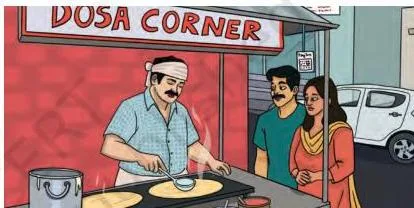
Figure 9.1 opens the chapter with two familiar scenes: a parent cooking for a child and a food-cart vendor serving passers-by. Both provide nourishment; one is personal, the other is a livelihood. That contrast is what makes work a human service — deeply personal and oriented to the well-being of both self and others (NCERT, p. 145).

Key concepts in Work in Human Services
Everything in this chapter hangs on a small set of ideas. Once you can explain these concepts in your own words, the caselets and tasks become scenes you can read quickly.
What counts as human services
Services given at home or in the community are informal; services organised so large numbers benefit are voluntary or professional. The book stresses one point: “professional” refers only to how the work is organised, not to its worth. Dignity — the inherent respect every person deserves — belongs to every worker whatever their job title (NCERT, p. 146).
All three forms share the same core value: respecting and fulfilling the needs of others. In India this connects to the ethos of sevā (selfless service) and sahabhāgitā (working together) (NCERT, p. 146).
The scale is large — the service sector contributed nearly 55 per cent of Gross Value Added and gave work to about 30 per cent of the workforce, per the Economic Survey of India 2026-27 (NCERT, p. 146).
| Type of service | How it is organised | Examples from the chapter |
|---|---|---|
| Informal | Everyday help in the home or community | A student helping an elderly person cross a road; a guard guiding parents at a school gate |
| Voluntary | Organised so large numbers of people benefit | Volunteers serving at a temple; a voluntary group cleaning an area |
| Professional | Offered by trained people who combine skill and commitment | Doctor, teacher, waiter, tourist guide, nurse, driver, counsellor, clerk, technician |
Empathy, compassion and sevā
Empathy is the ability to identify another person’s needs by putting yourself in their shoes. Compassion goes further: caring for others plus a commitment to actually fulfil their needs. Together they mean treating everyone with respect and sensitivity while keeping their dignity intact (NCERT, p. 145).
This core value is rooted in the Indian ethos of sevā — it connects identifying a need with fulfilling it in a dignified way. The chapter therefore calls this work central to human well-being and social progress, existing to improve the quality of life for individuals and communities (NCERT, p. 145).
Service orientation and its four qualities
Service orientation is a way of thinking: valuing people’s needs, acting with care and finding satisfaction in serving. The chapter’s example is the salesperson who listens patiently, explains where things are kept and never shows irritation — you feel at ease and return to the shop (NCERT, p. 148).
Everyone is both a giver and a receiver of service. Just as we expect good service when we receive it, we must offer thoughtful service when it is our turn (NCERT, p. 148). The orientation has four qualities, and most of the chapter’s tasks test one of them:
| Quality | What it means | Chapter’s example |
|---|---|---|
| User at the centre | Ask who you serve and what they really need before starting | Flood-relief camp with separate tables for grocery, clothing, bedding and toys; portable toilets; first-aid centre (p. 148–149) |
| Fair and ethical decisions | Follow agreed processes; protect dignity and privacy; consider everyone’s needs; keep confidentiality | Queues and tokens; seats earmarked for the elderly; the closed clinic door; the photographer who needs permission (p. 150) |
| Contribution to society | Every act of service, big or small, improves the community | Professionals who kept services running through the COVID-19 pandemic (p. 151–152) |
| Organisation and teamwork | Plan, assign responsibility and follow standard processes so the chain of service never breaks | Waiter communicating with the kitchen; nurses handing over patient needs at shift change (p. 152) |
One caselet pushes the fair-decisions quality further. Anita has migrated from another state and cannot read the PHC signs; her grandfather has waited 30 minutes while the queue grows.
The nurse’s dilemma is whether helping Anita skip the queue is fair — the chapter’s answer is to set up processes that handle special circumstances in advance, so fairness and trust hold for everyone (NCERT, p. 151).
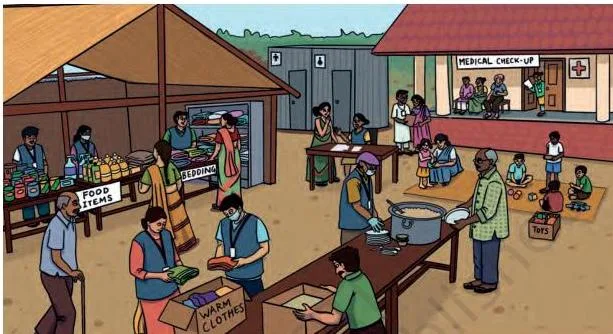
Figure 9.3 is the chapter’s model of a user-centred service. The camp is housed in a school with limited toilets, so portable toilets were organised; because people may be hurt or fall ill from exposure, a first-aid centre was set up.
Tables are placed so people can move easily between grocery, clothing, bedding and toys. The book then asks you to think of a better arrangement, and of how to treat distressed displaced people with the utmost respect and sensitivity (NCERT, p. 148–149).

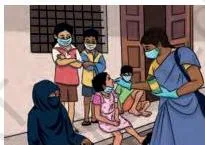
Figure 9.4 makes contribution to society concrete. Doctors, nurses and hospital staff worked day and night; sanitation workers kept streets and hospitals clean; grocery owners, delivery staff and drivers ensured food and medicines reached homes. When schools and offices closed, these services continued online — proof that service is the backbone of every community in ordinary times and emergencies (NCERT, p. 151–152).
The value chain
A service becomes better when each step is planned with care — a smile, a polite gesture, hygienic surroundings, beautiful spaces. Value does not come only from doing the work: it comes from elements added at each step, such as the people involved, the effort taken, the environment and the clarity offered to users (NCERT, p. 147).

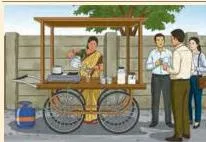
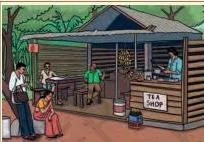
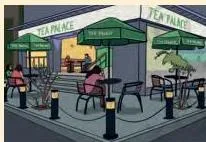
Figure 9.2 shows the value chain in action: a roadside stall serving tea with hospitality, hygiene and quality grows into a shop with seating and readymade snacks, then a café with décor and a variety of teas, then a restaurant in beautiful natural surroundings. Each step adds value — not from the tea itself, but from what surrounds it (NCERT, p. 147).
A TASK then asks you to pick a service you have experienced, find how its value increases in different scenarios, and list the sources of information you used (NCERT, p. 148).
Service environments: physical, social and safety
The service environment has two parts — physical and social — with safety running through both. The chapter’s rule: a good environment is not only about what people see but about how smoothly things work (NCERT, p. 155).
- Physical environment (p. 154–155): clean, well-organised and safe; well-ventilated with no bad odour; basic amenities such as clean bathrooms, a water dispenser and a first-aid kit.
- Social environment (p. 154): created by interaction and by the provider’s attitude, attire and communication. The neat dental clinic with a cold receptionist loses the patient — people do not return even when the dentist’s work is good.
- Safety — the Three Cs (p. 155): cleanliness, care and caution. Safety builds trust: users must be confident they will be heard, respected and kept confidential. Everyone should know what to do, when to do it, how to avoid delay, and the second plan of action if someone falls sick or the work stops.
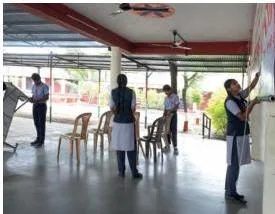
Figure 9.7 shows the physical side — a school event space being arranged so it is clean, organised and ready. The arrangement is part of the service itself, not a backdrop to it (NCERT, p. 155).

Consent
A consent form is an agreement between the service provider and the person being helped. It states exactly what service the person will receive and what is expected in return, and it acknowledges the user’s right to decide about their comfort and safety. This builds a safe, trusting relationship (NCERT, p. 157).
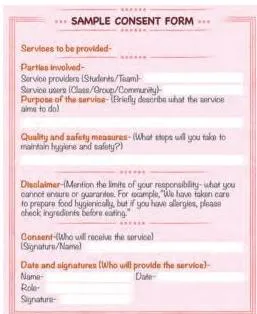
Figure 9.10 is the chapter’s sample consent form. Read it as the agreement the definition describes: the service is named, the user’s permission is recorded, and what each side expects is made clear. The rules around it are simple — ask permission before you start, and keep any personal information you learn private afterwards (NCERT, p. 157).

Service quality criteria
Quality is judged at three stages of any service — input (before), process (during) and output (after). Table 9.1 in the book lists the focus areas and quality parameters for each stage (NCERT, p. 158).
| Stage | When | Quality parameters (summarised) |
|---|---|---|
| Input | Before the service starts | User needs are known; the space is clean and hygienic; tools and materials are procured; a task checklist is prepared; consent has been received |
| Process | During the service | Work flows without jams; interaction is timely and respectful; rules and protocols are followed; practices are safe and hygienic, including cyber safety; staff listen and solve problems; user data stays confidential |
| Output | After the service | The place is cleaned and waste is disposed of safely; users are asked about satisfaction and comfort; the feedback is turned into improvement |
Choosing a vocation
Section 9.6 turns the chapter towards your own work. First, observe a human service near you and describe its inputs, key processes and outcomes. Then test whether you can do it in school by answering four questions — Can you complete the work in the time allocated? Do you have adequate space? Have you identified an expert to help?
Can you manage the resources needed? (NCERT, p. 159–160).
How to read the figures in this chapter
The figures here are mini case studies, not decoration. Read each one like a scene, then answer the question the book attaches to it.
Figure 9.5: the inter-school sports event (p. 153)
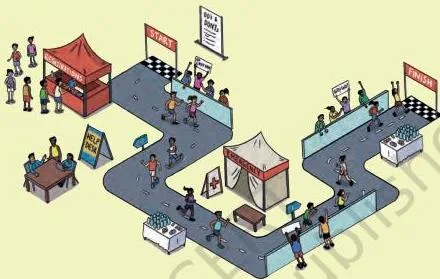
Figure 9.5 shows an annual inter-school sports event with participation from 35 schools. Notice what the organisers did: separate areas were allocated for different activities, and water and refreshments were provided at different points. These choices — planning zones, arranging supplies where they are needed, keeping comfort and safety in mind — are the elements that ensure smooth implementation despite the crowd (NCERT, p. 153).

Figure 9.6: the volunteer at the health camp (p. 153–154)
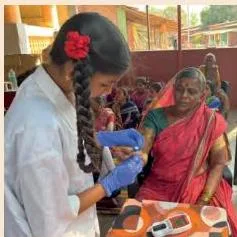
Read Figure 9.6 with the caselet that surrounds it. The camp worked while registration flowed: volunteers greeted visitors, checked the list, helped fill forms, issued tokens and guided people to the correct desk.

Then three breakdowns happened — the registration desk ran out of forms, the microphone for calling tokens failed, and the waiting area became crowded because visitors moved chairs (NCERT, p. 153–154).
The team fixed all three on the spot with extra forms, floor pathway markings, voice announcements and open windows, restoring visitor satisfaction. Now translate the scene into the quality vocabulary: the input broke down during the process, and quick fixes restored the output (NCERT, p. 154).
The Think and Discuss box asks which aspects of service the caselet shows and what you would change next time. Good answers name planning, teamwork and quick problem-solving (NCERT, p. 154).
Figure 9.8: the grocer’s shop in two situations (p. 155)
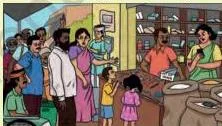
The task attached to Figure 9.8 asks three questions about the same grocer’s shop shown in two situations (NCERT, p. 155):
- Three steps in the left picture that help the service move smoothly: a clear entry; sections with labels so shoppers find things without asking; an organised counter with an orderly queue. Any three such features count — the point is that order guides the user.
- Three missing steps in the right picture that cause delay or confusion: no labels, so people wander; a cluttered counter where staff search for things; crowding with no queue order, so nothing is fair or fast.
- The one change you would make, and why: restore queue or token order at the counter, because the chapter’s rule says users must be served as per their turn — one change attacks both the delay and the confusion at once (NCERT, p. 150, 155).
These are model answers, not the only possible ones — the chapter wants your observation and your reasoning. Any good answer uses the same logic: the environment either moves a service forward or stalls it (NCERT, p. 155).
Key terms used in this chapter
The chapter uses a small vocabulary. The table below is for a quick check the night before an assessment, with each term defined in original words beside the printed page where the book explains it.
| Term | Meaning in this chapter | Page |
|---|---|---|
| sevā | Selfless service — the Indian ethos the chapter places at the centre of human services | 145 |
| sahabhāgitā | Working together, the companion value to sevā | 146 |
| empathy | Identifying another person’s needs by putting yourself in their situation | 145 |
| compassion | Caring for others with a commitment to fulfil their needs | 145 |
| dignity | Inherent respect and honour every person deserves, regardless of job title | 146 |
| informal service | Services provided every day in the home or community | 146 |
| voluntary service | Service organised so large numbers of people can benefit | 146 |
| professional service | Service offered by trained people who combine skill and commitment — a term about how work is organised, not its worth | 146 |
| service orientation | Valuing people’s needs, acting with care and finding satisfaction in serving | 148 |
| value chain | The value added at each step of a service by people, effort, environment and clarity | 147 |
| chain of service | Work in which one person’s output directly affects the next person’s work | 152 |
| service environment | The physical and social surroundings of a service, including safety | 154 |
| physical environment | The clean, well-organised, safe space with basic amenities | 154–155 |
| social environment | Created by interaction, attitude, attire and communication | 154 |
| Three Cs | Cleanliness, care and caution — the safety rule of a service space | 155 |
| consent | An agreement between provider and user about the service to be given | 157 |
| confidentiality | Keeping user data private and never sharing it without permission and explanation | 150 |
| protocols | Fixed rules and processes that keep a service fair and consistent | 150 |
| input | The resources and preparation required before the service starts | 158 |
| process | How people, processes and time are managed while the service runs | 158 |
| output | Reflection, feedback and clearing the workplace after the service | 158 |
| vocation | The kind of work you choose to take up | 159 |
| Gross Value Added | The measure of a sector’s contribution to the economy — the service sector contributed nearly 55 per cent | 146 |
Mistakes students make in this chapter
The chapter names most of these traps through its own examples. Each pair below — the wrong idea and the book’s correction — comes from a specific printed page.
| Mistake | Correct rule | How to check your answer |
|---|---|---|
| “Professional work is more dignified than informal work.” | “Professional” describes only how the work is organised; every person’s work is equally worthy of respect because it fulfils a human need (p. 146). | Ask whether the informal worker’s service also fulfils a need — the chapter says all forms share the same core value. |
| Confusing empathy with being polite. | Empathy is identifying the other person’s actual need by standing in their situation; compassion is the commitment to fulfil that need (p. 145). | Ask: do I know what this person truly needs, or only how I sound to them? |
| Beginning a service without consent, or sharing user data freely. | Ask permission before starting and keep personal information private; a photographer and a surveyor must both protect data (p. 150, 157). | Would the user be comfortable if their details reached someone unauthorised? |
| Making the space beautiful but the interaction cold. | The social environment — attitude, attire, communication — decides whether users return. A neat clinic with a rude receptionist loses patients (p. 154). | Would you return to a tidy clinic where you were spoken to coldly? |
| Ignoring how layout guides the user. | The environment either moves a service forward or stalls it; the grocer’s shop figure shows both at once (p. 155). | Could a first-time visitor find things and finish quickly in this layout? |
| Treating the service as finished when the visible work ends. | A service is not finished until waste is managed and the place is left cleaner; feedback and review close the loop (p. 160). | Is the space cleaner than I found it, and have I asked how it could go better next time? |

Figure 9.9 shows the positive model — the Swachh Bharat Swachh Vidyalaya clean-up run by Grade 9 students. The caselet behind it shows the whole service cycle: teams planned roles a week ahead, delivered the clean-up, then washed tools and handed filled bins to sanitation workers.
Afterwards the group met to review what worked and what to improve. That sequence — plan, deliver, clean up, review — is the chapter’s definition of a complete service (NCERT, p. 156–157).
Using this chapter for assessment and portfolio work
Section 9.8 assesses action and reflection, not definitions. Its tasks include reflecting on which actions in the chapter showed service orientation, comparing two service spaces and how environment changes behaviour, identifying school safety measures, and planning a cloth donation drive (NCERT, p. 161).
It also asks you to respond to guests who demand to be served first, collect and use feedback after an event, participate in a voluntary service and report it, and apply the learnings in real life (NCERT, p. 161).
Four pieces of work are explicitly marked for your portfolio:
- The neighbourhood service observation record — observe any one service you pass regularly (ration shop, anganwadi, milk booth, bus stop, handpump, local grocer, panchayat help point) and record five observations about it (p. 149).
- A prepared consent form (p. 157).
- Your chosen vocation, with the reason for choosing it (p. 160).
- The report of the voluntary activity you participate in, such as a Pulse Polio drive, a community event or a Swachhta Abhiyan (p. 161).
Worked example: plan a cloth donation drive
The book’s own planning question at the end of section 9.8 asks you to organise a drive with 4 volunteers, 60 donors and 2 hours. Here is a new version with different numbers — 6 volunteers, 80 donors and 3 hours in a school hall — planned with Table 9.1’s input, process and output criteria (NCERT, p. 158, 161).
- Input (before): identify the need and the receiving group; book the hall; announce the date, time and what to donate; arrange three stations — collection, sorting, packaging; procure tags, bags and a recording sheet; prepare a task checklist; get consent from donors if names and contact details are recorded; brief all six volunteers on their roles.
- Process (during): run a one-way flow — donor enters, drops clothes at collection, moves past sorting and packaging, exits; place one volunteer at the door and queue, two at collection, two at sorting, one at packaging; issue tokens or keep a queue so donors are served by turn; keep walkways clear of bags; record category counts as the drive proceeds.
- Output (after): count, tag and bundle the sorted clothes by category; clean the hall and dispose of packaging waste safely; thank donors and volunteers; collect quick feedback on whether the flow was clear and how long people waited; hold a short review of what to improve next time.
The seven delivery points of section 9.7
Section 9.7 condenses the whole chapter into seven practical rules. Keep them as your baseline for any service activity (NCERT, p. 160):
- Make the service environment clean, hygienic, welcoming and attractive before you begin.
- Let the other person finish speaking; listen carefully so the service actually addresses their need; watch your attire and demeanour.
- Follow a set schedule and fixed protocols so the service is fair and nobody waits needlessly.
- Ask permission before you start, and keep any personal information you learn private.
- Plan in advance and allocate responsibility among groups.
- Manage waste — a service is not finished until the place is left cleaner than you found it.
- Ask yourself and others, “How can I do this better next time?” and use feedback to close service gaps.
One note on exams: textbook contents and the examinable syllabus are not always identical. Check the current official CBSE skill-education syllabus for what this chapter contributes in your session.
Chapter 9 revision summary
The chapter has no printed summary block, so this revision summary is built from its own emphasised lists, compressed into original words.
- The four qualities of service orientation (p. 148): user at the centre; fair and ethical decisions; contribution to society; organisation and teamwork.
- The two environments (p. 154–155): physical — clean, organised, ventilated, with amenities; social — attitude, attire and communication that make people want to return.
- Safety — the Three Cs (p. 155): cleanliness, care and caution; every user must be heard, respected and kept confidential.
- The three quality stages (p. 158): input — needs known, space clean, materials ready, consent taken; process — smooth, fair, safe, confidential; output — clean-up, feedback, improvement.
- One line to close: the book frames service as sevā that improves the quality of life for individuals and communities (p. 145) — and Chapter 9 is the mandatory foundation before the healthcare and tourism chapters apply it.
Related chapters and resources
Chapter 9 is the foundation of the Personal and Lifestyle Services unit. Use these links to move around the book and the site:
- Class 9 skill education hub — all chapters of the Kaushal Vikas book.
- The previous chapter in this book — the additional vocations chapter that leads into human services.
- The next chapter in this book (healthcare) — applies Chapter 9’s concepts to healthcare work.
- Class 9 notes hub and the main notes index for study material across subjects.
For the official source, the NCERT Class 9 Kaushal Vikas Chapter 9 PDF is the exact file this page describes, and the NCERT website is the authority for textbook editions and downloads.
| What the chapter holds | Count | Where it is used |
|---|---|---|
| Printed pages | 22 | |
| Sections in the chapter | 10 | |
| Figures with NCERT captions | 25 | |
| Tables | 4 | |
| Worked examples | 3 | solved step by step in our NCERT Solutions |
| Official NCERT PDF | Download the chapter PDF | the chapter exactly as NCERT publishes it |



Reference: NCERT Class 9 Kaushal Vikas textbook, chapter 9, official edition on ncert.nic.in.
Sources and data verification
- This page describes the NCERT Kaushal Vikas — Skill Education, Class 9 textbook, Chapter 9, “Work in Human Services”, printed pages 145–162.
- It covers this chapter only — not other skill-education books, other classes, or the optional vocational chapters’ details.
- It is maintained for the current session using the NCERT information available to us; page numbers and figure captions follow the NCERT edition linked above.
- NCERT settles textbook editions and PDFs; CBSE settles the curriculum, syllabus and examinations.
Frequently asked questions
Why is Chapter 9 of the Kaushal Vikas book compulsory for Class 9?
Chapter 9 introduces the concepts and processes common to all human-services work, so the book marks it as mandatory. Chapters 10 and 11 then apply those concepts to healthcare and tourism, and Chapter 12 adds guidelines for further vocations (NCERT, p. 145).
What is the difference between empathy and compassion in this chapter?
Empathy is identifying another person’s needs by putting yourself in their shoes. Compassion adds caring and a commitment to fulfil those needs. Empathy without compassion notices the need but does not act on it; the chapter says a service worker needs both (NCERT, p. 145).
What are the three Cs of a safe service space?
Cleanliness, care and caution. Safety here means building trust — users must be confident their needs will be handled, they will be heard and respected, and their information kept confidential (NCERT, p. 155).
How do I make a consent form for a Class 9 service activity?
Base yours on the sample in the chapter: state the service being provided, what is expected of the user in return, and record the user’s permission. Then follow the two rules around it — ask permission before you start and keep personal information private afterwards (NCERT, p. 157).
What are the four qualities of service orientation?
Keeping the person receiving the service at the centre; fair and ethical decision-making; contribution to society; and organisation and teamwork (NCERT, p. 148). Most of the chapter’s tasks test one of these four.
What kind of assessment does this chapter use?
Action-based and reflective assessment. Section 9.8 asks you to reflect on actions that showed service orientation, plan a service event such as a cloth donation drive, design and judge service spaces, and participate in and report a voluntary activity such as a vaccination drive or a Swachhta Abhiyan (NCERT, p. 161).
Explore Class 9 Skill Education Books
- Previous: Additional Vocations
- Next: Healthcare
Related chapters:
- Work with Life Forms
- Rooftop Gardening
- Precision Farming