
Looking for the healthcare Class 9 chapter PDF? This page has it: NCERT Kaushal Vikas (Skill Education) Grade 9, Chapter 10 “Healthcare” — a practical, project-style chapter of about 22 printed pages. The official NCERT PDF is right here, and below it you’ll find a guided walkthrough of every section, figure and task in the chapter.
Download the NCERT Class 9 Kaushal Vikas Healthcare chapter PDF
Open the official NCERT Class 9 Kaushal Vikas Healthcare chapter PDF from ncert.nic.in — this is the English edition of Kaushal Vikas Grade 9, Chapter 10 “Healthcare”, printed as pages 163–184 of the book. Save a copy for offline study; every page reference on this page follows that same official edition.
Chapter 10 at a glance
The table below is counted from the NCERT edition itself: how many sections, figures, worked examples and tasks the chapter holds.
What the count cannot show is the chapter’s character. Healthcare is practical, not theoretical: the book teaches through DID YOU KNOW boxes, caselets about students of Government High School, Portfolio prompts and Tasks, and it closes with “Assess your learning” questions instead of a numbered exercise block.
What this chapter covers: planning and running a community health service
This chapter takes you through organising a real healthcare service — in the running example, a school health camp — from the first idea to the final clean-up. The spine is the book’s “In this chapter, you will” list (NCERT, p. 163):
- Identify the healthcare service to be provided.
- Prepare to provide it — plan, materials, tools, budget, consent.
- Create a service environment, physical and social.
- Prepare a consent form.
- Apply safety and hygiene requirements.
- Promote the service.
- Provide the service.
- Collect feedback.
The book teaches this cycle through repeating devices: DID YOU KNOW boxes, CASELET boxes that follow the Government High School students as they set up a health camp, PORTFOLIO tasks you keep as evidence, TASK prompts, and SAFETY notes.
The eleven numbered sections — 10.1 Introduction, 10.2 scoping and process chart, 10.3 site visit, 10.4 materials, 10.5 tools, 10.6 Bill of Materials, 10.7 consent, 10.8 skill builders (vital signs, home remedies, occupational hazards, emergency response), 10.9 providing the service, 10.10 while delivering, 10.11 assess your learning — move you from planning to delivery to reflection.
Key concepts: what the chapter teaches
This section explains the ideas the chapter builds, in the order the book teaches them, with the NCERT page for each so you can read along. One rule runs through everything: your job is support, awareness and assistance — never diagnosis, treatment or medicines (NCERT, pp. 165, 169).
The people and the system: health, community workers and digital care
Health is the foundation of daily life. The chapter insists it is not hospital care alone: it is shaped every day by clean surroundings, safe water, nutritious food, physical activity, mental well-being, timely care and support from people around us (NCERT, p. 164).
Who delivers community care in India? The book names two frontline roles (NCERT, p. 164):
- ANMs (Auxiliary Nurse Midwives) — trained professionals who focus on maternal health, child health and immunisation.
- ASHA workers (Accredited Social Health Activist) — women from the village itself who spread awareness on nutrition, hygiene and family planning, give basic first aid, and escort patients to hospital. They were recognised as “Corona Warriors” during COVID-19.
India’s preventive-care tradition is old: the Charaka-Saṃhitā, compiled between 100 BCE and 200 CE, already described healthy living, disease prevention, diet and the balance of mind and body (NCERT, p. 164).
Technology now adds digital healthcare: telemedicine, AI-based diagnostics, health data, wearable monitors, digital records and health apps (NCERT, p. 165).
Planning the service: scoping, process chart and site visit
Before any material is bought, the chapter makes you plan with three tools, in order.
Scoping work (NCERT, p. 165) settles four decisions: what service to provide (an awareness camp, hygiene drive, nutrition material or first-aid awareness); what resources and expert support exist; whether the community actually needs it; and where it will be held — checking safety, cleanliness, space and ease of setting up.
Process chart (NCERT, p. 166): a table listing every task with its estimated date and the responsible person or group. The caselet chart (Table 10.1) runs from identifying experts and learning instruments to waste disposal and feedback collection.
Site visit (NCERT, pp. 167–168): with your teacher, visit a place where healthcare is provided and talk to a practitioner — doctor, nurse, ASHA/ANM, pharmacist or lab technician. Note the observation pointers: tools and materials, key processes, safety protocols, records, quality criteria and technology use (Table 10.2).
Materials, tools, cost and consent
This is the practical preparation block. Four parts.
Materials (NCERT, p. 168): PPE — gloves and masks, a new pair for each person, disposed of in a covered biomedical waste bin; separate labelled waste bins; measuring tape and weighing scale; and clean yoga mats on a flat surface.
Tools (NCERT, p. 169): thermometer, pulse oximeter or smartwatch, stopwatch, blood pressure monitor (sphygmomanometer) and glucometer. Each has a safety note: sanitise the tip, dry the finger, dry hands, never overinflate the cuff; the glucometer is for observation only.
Bill of Materials (NCERT, p. 170): a cost estimate made in advance so only what is necessary gets bought. It is material cost plus labour cost, where
\[ \text{Labour cost} = \text{time in hours} \times \text{hourly estimate} \times \text{number of people} \]
Worked example with original numbers: suppose your team runs a one-day health awareness desk at school. Materials — 30 pairs of gloves at ₹5 = ₹150, one sanitiser bottle = ₹150, 40 masks at ₹4 = ₹160, posters and stationery = ₹250 — come to ₹710.
Labour — poster making \(3 \times 40 \times 3 = 360\), registration \(2 \times 40 \times 2 = 160\), set-up and conduct \(2 \times 40 \times 4 = 320\), cleaning \(1 \times 40 \times 2 = 80\) — comes to ₹920. Grand total: ₹710 + ₹920 = ₹1,630. The book’s own caselet camp, with borrowed instruments, came to about ₹2,250 (NCERT, p. 170).
Consent (NCERT, p. 171): a consent form is not a legal document but a trust-building record. Five elements make it work:
- It is a record of understanding, not a legal document — its job is to prevent confusion.
- It shares the healthcare services to be provided — the visitor knows what to expect.
- It shares safety expectations — both sides know the ground rules.
- It clarifies that this is not a substitute for medical treatment — nobody mistakes the camp for a clinic.
- It takes consent for health data and photographs — privacy is protected in advance.
Health knowledge: vital signs, home remedies and occupational hazards
The supervision rule comes first: every instrument task happens under adult supervision; students never diagnose or interpret results, only practise safe measurement and recording; any abnormal reading means calling a teacher or practitioner immediately (NCERT, p. 173).
Vital signs (NCERT, p. 172) are body signals that show how well the body is functioning: temperature, blood pressure, oxygen saturation and blood sugar, plus height, weight and BMI from Physical Education. Table 10.7 gives the normal boundaries:
| Instrument | What it measures | Normal value | When it needs an adult |
|---|---|---|---|
| Thermometer | Body temperature | \(97\text{–}99^\circ\text{F}\) (average \(98.6^\circ\text{F}\)) | Above \(99^\circ\text{F}\) = fever; above \(103^\circ\text{F}\) = medical emergency |
| Blood pressure monitor (sphygmomanometer) | Force blood uses to move through arteries | \(\lt 120/80\ \text{mmHg}\) | Above \(140/90\ \text{mmHg}\) requires medical attention |
| Pulse oximeter | \(\text{SpO}_2\) — oxygen saturation in the blood | \(98\text{–}100\%\) | Below \(94\%\) needs urgent attention |
| Glucometer (demonstration only) | Blood sugar level | Fasting \(70\text{–}100\ \text{mg/dL}\); after a meal below \(140\ \text{mg/dL}\) | Fasting above \(125\ \text{mg/dL}\) or random above \(200\ \text{mg/dL}\) needs medical attention |
Home remedies (NCERT, pp. 173–174): turmeric milk, Tulasi-ginger tea and aloe vera gel are made from natural or household ingredients for minor, everyday complaints. The guardrails are hard: they are not medical treatments, they are prepared under adult guidance, and at the camp you only demonstrate and explain — you must not give remedies to visitors.
Occupational hazards (NCERT, pp. 174–176) are health risks from long hours, repeated movements, heat, noise, pollution or poor posture. A computer user gets eye and neck strain, a driver back pain, a cook heat and smoke, a factory worker noise and heat. Table 10.9 pairs each occupation with its risk and its preventive action:
| Occupation group | Common health risk | Preventive action (Tables 10.9–10.10) |
|---|---|---|
| Computer work (IT, designers) | Eye strain, dry eyes, neck pain | 20-20-20 rule: look 20 m away from the screen for 20 seconds after every 20 minutes; blink; screen at correct height; neck stretches |
| Sitting long (drivers, desk jobs) | Back pain, stiffness | Straight-back posture, lumbar support, standing breaks, back stretches |
| Heavy lifting (farmers, technicians) | Muscle or joint injuries | Lift with knees bent, avoid twisting, proper grip, ask for help |
| Polluted areas (chefs, traffic police, sanitation) | Breathing problems, skin irritation | Cloth masks, hydration, deep breathing, breaks |
| Noisy environment (factory, traffic) | Hearing strain | Ear protection such as earplugs |
| Heat (factory, food processing) | Dehydration, heat stress | Water or electrolytes, rest in shade, light clothing |
The general toolkit (Table 10.10) adds posture correction — straight back, feet flat, screen at eye level, rolled towel or lumbar roll — plus 2–3 minute stretching exercises and breathing routines: deep breathing, diaphragmatic breathing and Anuloma-Viloma.
First response and promoting the service
Basic emergency response (NCERT, pp. 176–177): from Grade 7 you already know cleaning small wounds, cooling burns and preparing ORS. These are only the first response. Always call an adult first; never give medicines or home remedies; never attempt CPR — only trained adults do that.
The chapter also asks you to explore two health-related apps (NCERT, p. 177). The examples it names: e-Sanjeevani (free online doctor consultation), CoWIN/ABHA (vaccination details and digital health ID), FIT India (fitness and activity tracking), mYoga (guided yoga), step-counter apps (daily steps) and MANODARPAN (mental well-being of students, teachers and families).
Promoting the service (NCERT, pp. 177–178) means five channels: posters with date, time, place and services; announcements in assemblies; community walks; notices at schools, anganwadis, community centres and shops; and school notice boards or social media with permission.
Delivering, cleaning up and reflecting
Event checklist (NCERT, p. 179): finalise the processes and assign responsibilities. The caselet checklist tracks stalls, tables, chairs, displays, dustbins, thermometer, weighing scale, BP monitor, oximeter, first aid kit, gloves, tissues and sanitiser, each marked available or yet to arrange.
Service environment (NCERT, pp. 180–181): lay out the physical space so crowding does not happen — entrance, signboards, stalls, smooth exit — and build a positive social environment with a helping, respectful manner at every desk.
Feedback, cleanup and reflection (NCERT, p. 182): collect feedback by short form or a few verbal questions, recording only general comments with no names or personal details. Then wipe tables, pack reusable items into a labelled storage box, and dispose of dry, wet and sanitary waste in separate colour-coordinated bins, wearing gloves.
Finish with a group reflection on what was planned versus what actually happened.
Section 10.10 (NCERT, p. 183) lists six rules for the day itself: tools only as taught and for awareness; safe, hygienic handling; consent, privacy and respectful communication; explain procedures and share results without causing fear; emphasise healthy habits; and clean up per protocol.
Reading the figures: what the diagrams teach
These are the figures in your own book; each one carries a lesson worth reading. The chapter’s real-world goal appears right at the start.
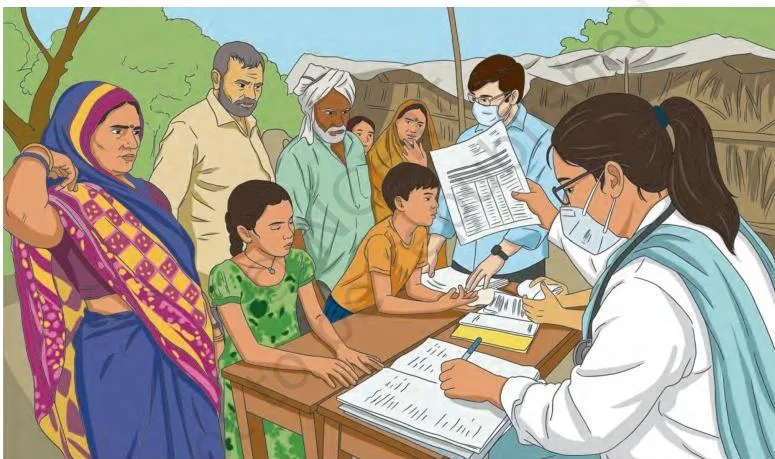
Figure 10.1 (NCERT, p. 163) shows the whole point of the chapter: a camp where all eligible people are vaccinated, general health parameters are checked (including malnourishment and eye health), and awareness of preventive care spreads through the community. Everything you plan — scope, materials, consent, promotion — serves this picture.
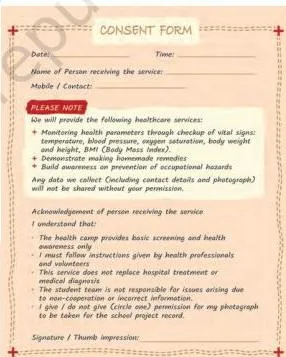
Figure 10.2 (NCERT, p. 171) is the consent form the Government High School students used; visitors filled and signed it during registration. It protects both sides — the team knows what it may do, and the visitor knows exactly what is being offered, and what is not.
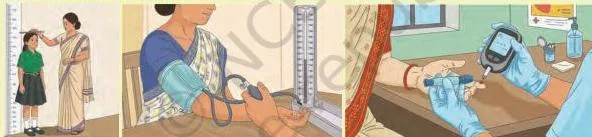
Figure 10.3 (NCERT, p. 172) shows the vital-sign tasks in action. The caption pairs with Table 10.7: you practise measuring on peers under adult supervision and record what you find — you do not decide what the reading means.

Figure 10.4 (NCERT, p. 174) makes the home-remedy point visually: the ingredients are ordinary household items, not medicines. That is exactly why the chapter allows demonstrating them — and forbids giving them out.
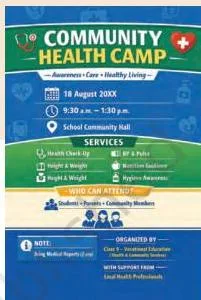
Figure 10.5 (NCERT, p. 178) is the poster the students made to promote their camp. Use it as a model: date, time, place and services offered, clear enough for a passer-by to understand in seconds.
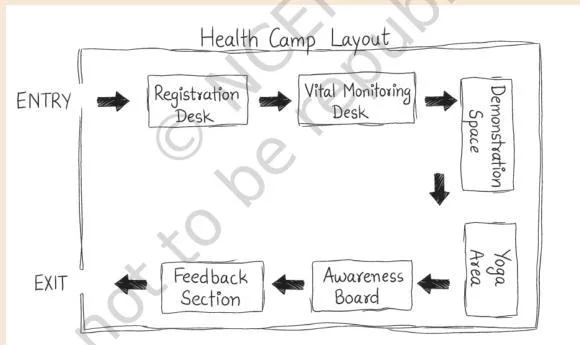
Figure 10.7 (NCERT, p. 180) is the camp layout. Read it as a flow: entrance → signboards → stalls → smooth exit. The design question behind it is always the same — where could crowding happen, and how does the layout stop it?
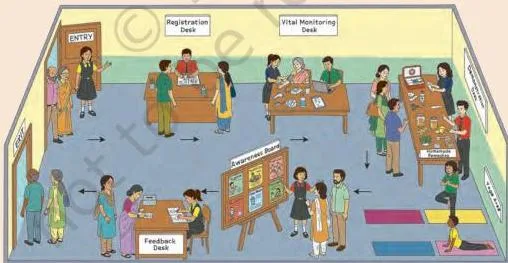
Figure 10.8 (NCERT, p. 181) shows the camp running. The lesson is the social environment: a helping, respectful service orientation at every desk, with safety protocols followed while the team works.
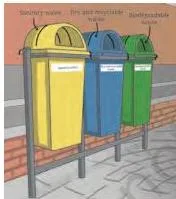
Figure 10.9 (NCERT, p. 182) is the cleanup rule in one image: dry, wet and sanitary waste each go into their own colour-coordinated bin. Wear gloves while handling waste and wash hands thoroughly afterwards.
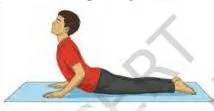
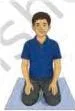
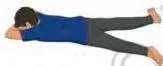
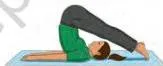
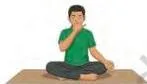
NCERT page 176 carries small illustrations of the five yogāsanas and the Anuloma-Viloma routine. Match each pose to its benefit:
| Yogāsana | Benefit (NCERT, p. 176) |
|---|---|
| Tāḍāsana | Improves posture |
| Bhujaṅgāsana | Reduces back stiffness |
| Vajrāsana | Aids digestion after meals |
| Makarāsana | Relaxes body and mind |
| Halāsana | Improves flexibility |
| Anuloma-Viloma | Alternate-nostril breathing routine |
Practise these under adult supervision and share them with camp participants so they can avoid harm from excessive work strain (NCERT, p. 176).
Key terms explained in plain words
These are the terms the chapter keeps using, defined the way the book means them.
| Term | Plain definition | NCERT page |
|---|---|---|
| Healthcare | Everyday preventive and curative practices that bring health services close to where people live | 164 |
| Health camp | A community event to vaccinate, check general health parameters and spread preventive-care awareness | 163 |
| Process chart | A table listing tasks, estimated dates and responsible people for smooth delivery | 166 |
| Bill of Materials (BoM) | A cost estimate of materials plus labour, made before buying anything | 170 |
| Consent form | A simple record of the service offered, safety expectations, and approval for health data and photographs | 171 |
| Vital signs | Body signals such as temperature, pulse, blood pressure and oxygen saturation that show how well the body is functioning | 172 |
| Home remedies | Simple preparations from natural or household ingredients for minor complaints, not a substitute for a doctor | 173 |
| Occupational hazards | Health risks from long hours, repeated movements, heat, noise, pollution or poor posture at work | 174 |
Mistakes students make in this chapter
This chapter’s traps are not about memorising facts wrong — they are about forgetting that a student’s role has firm limits. The book’s own safety notes and the rushed-camp scenario in the closing questions name them directly.
| Mistake | Correct rule | How to check your answer |
|---|---|---|
| Treating the health camp like a clinic — offering diagnoses or treatment | The service is support, awareness and assistance only; tools are never for diagnosing or giving medical advice (NCERT, pp. 165, 169) | Re-read your scoping decision: does it say “camp” or “clinic”? |
| Handing home remedies to visitors instead of demonstrating | Only demonstrate and explain; remedies are not medical treatments (NCERT, p. 174) | Ask: did any visitor receive a remedy from our hands? |
| Interpreting instrument readings for visitors | Practise safe measurement and recording only; any abnormal reading means calling a teacher or practitioner (NCERT, p. 173) | Did any student give a “diagnosis” to a visitor? |
| Attempting advanced first aid like CPR | Only trained adults perform these; first aid is only the first response and an adult must be called first (NCERT, p. 177) | Before any emergency action, was an adult called? |
| Collecting data or photographs without consent | The consent form must cover health data and photos; feedback forms carry no names (NCERT, pp. 171, 182) | Did every visitor sign consent before measurement? |
| Rushing visitors and skipping safety | The closing scenario (NCERT, p. 183) shows the result: confused visitors and negative feedback; keep respectful communication and safety rules even under pressure | Check the camp against the six “while delivering” rules on page 183 |
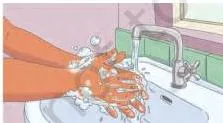
The Safety box on page 169 is the chapter’s bottom line: hand hygiene with soap or 70% alcohol sanitiser, clean masks and tidy surfaces, tools used only as taught, and waste disposed of in separate labelled bins.
How this chapter checks your learning
This chapter does not test you with a conventional question bank; it checks whether you can plan, run and review a real health service. The closing “Assess your learning” prompts (NCERT, pp. 183–184) ask you to:
- compare two community healthcare needs and prioritise one for a school-based service, with reasons;
- create a safety checklist for the service you provided;
- explain the essential elements of service orientation and environment in healthcare, with examples;
- argue why the patient or visitor must stay at the centre of healthcare services, with one example;
- analyse the rushed-camp scenario — what went wrong, how to improve behaviour and communication, which safety practices were missed, and how to make visitors feel welcomed;
- respond fairly and ethically when an elderly person and a pregnant woman arrive late while others wait;
- reflect on which tasks you enjoyed most and least, and how you would apply the learnings in real life.
Textbook contents and the examinable syllabus are not always identical — check the current official CBSE Skill Education syllabus for what is assessable this session before you plan your revision.
Portfolio and Task prompts: turning the chapter into your project
The Portfolio and Task prompts are not optional extras — they are how this chapter is meant to be learned. Work through them in the book’s own order and you will have a complete project file:
- Community survey on healthcare needs; decide one service (p. 166)
- Process chart — tasks, dates, responsibilities (p. 166)
- Site visit notes using the observation pointers (p. 168)
- Materials and tools list with safety notes (pp. 168–169)
- Bill of Materials — material cost plus labour cost (p. 170)
- Consent form covering the four required points (pp. 171–172)
- Occupational-hazards survey, then posture and yoga practice (pp. 174–176)
- Emergency-response and health-app tasks (pp. 176–177)
- Promotional material such as a poster (p. 178)
- Event checklist with availability status (p. 179)
- Layout sketch that prevents crowding (pp. 180–181)
- Feedback form, cleanup with separate waste bins, group reflection (p. 182)
Practical tip: keep every deliverable in one project file. The book’s own flow from survey to reflection is the learning evidence.
Key takeaways from the Healthcare Class 9 chapter
These are drawn from the book’s own “In this chapter, you will” outcomes (NCERT, p. 163) and its repeated safety rules. If you remember nothing else, remember these:
- Healthcare is an everyday, community-level matter, not only hospital care (NCERT, p. 164).
- A school health service runs a full cycle — scope, plan, prepare, consent, promote, deliver, clean up, reflect (NCERT, p. 163).
- Every instrument is used only under adult supervision and only for measurement and recording, never interpretation (NCERT, p. 173).
- The student’s role is support, awareness and assistance — no diagnosis, no medicines, no giving out remedies, no CPR (NCERT, pp. 165, 174, 177).
- Safety is non-negotiable: hand hygiene, clean tools, separate labelled waste bins, gloves during cleanup (NCERT, pp. 169, 182).
- Respectful, unhurried communication is part of the service, and feedback without names drives improvement (NCERT, pp. 182–183).
The “while delivering the service” checklist on page 183 is the chapter’s own code of conduct — use it on the day of your camp.
Related chapters and resources
This listing is maintained for the 2026-27 academic session using the NCERT textbook information available to us. NCERT remains the authority for confirming the latest edition.
Chapter 10 builds directly on the previous chapter, where consent forms, the physical service environment and feedback were first introduced (NCERT, pp. 171, 180). To study the rest of the book, open the Class 9 Kaushal Vikas book page or the wider Class 9 hub; the preceding chapter is Chapter 9.
For quick revision, see the Class 9 Skill Education notes, the Class 9 notes hub and the full notes index. Notes for the book’s other chapters include work in human services and tourism.
| What the chapter holds | Count | Where it is used |
|---|---|---|
| Printed pages | 22 | |
| Sections in the chapter | 23 | |
| Figures with NCERT captions | 27 | |
| Tables | 14 | |
| Worked examples | 7 | solved step by step in our NCERT Solutions |
| Official NCERT PDF | Download the chapter PDF | the chapter exactly as NCERT publishes it |




Reference: NCERT Class 9 Kaushal Vikas textbook, chapter 10, official edition on ncert.nic.in.
Sources and data verification
- This page describes the NCERT Class 9 Kaushal Vikas (Skill Education) textbook, Chapter 10 “Healthcare”, pages 163–184 of the official English edition.
- The figures, tables, caselets and page references named here are taken from that NCERT textbook edition.
- This listing is maintained for the current session using the NCERT information available to us. NCERT settles textbooks, editions and official PDFs; CBSE settles the curriculum, syllabus and examinations.
- This page does not describe other textbooks or other editions, and it makes no claim about the examinable weight of any section — the examinable scope is set by the current CBSE Skill Education syllabus.
Frequently asked questions
What is the Class 9 Kaushal Vikas Healthcare chapter about?
It is a practical chapter about planning and running a community healthcare service, usually a school health camp. You work through the whole service cycle — scoping, process chart, site visit, materials, budget, consent, vital signs, home remedies, occupational hazards, emergency response, promotion, delivery, cleanup and reflection (NCERT, p. 163).
Can students give medicines or home remedies at a school health camp?
No. Students provide support, awareness and assistance only — they must not give medicines or suggest treatments (NCERT, p. 165). Home remedies may be demonstrated and explained, but never given to visitors (NCERT, p. 174).
What are the normal vital sign values a Class 9 student should learn?
Body temperature \(97\text{–}99^\circ\text{F}\) (above \(103^\circ\text{F}\) is a medical emergency); blood pressure below \(120/80\ \text{mmHg}\) (above \(140/90\) needs attention); oxygen saturation \(98\text{–}100\%\) (below \(94\%\) is urgent); fasting blood sugar \(70\text{–}100\ \text{mg/dL}\) (NCERT, p. 172).
What is a Bill of Materials and how is labour cost calculated?
A Bill of Materials (BoM) is a cost estimate of materials plus labour, made before buying anything so you avoid waste (NCERT, p. 170). Labour cost is \(\text{hours} \times \text{hourly estimate} \times \text{number of people}\). The book’s caselet camp came to a total of about ₹2,250.
Which tasks in this chapter require adult supervision?
All of them. Instruments are used under adult supervision, and a teacher, nurse or health practitioner must be present during all demonstrations and visitor interactions (NCERT, pp. 169, 173). Students practise measurement and recording only — they never interpret results.
Where is the official NCERT Class 9 Kaushal Vikas PDF available?
On ncert.nic.in, the official NCERT website — that is the authoritative source for the Class 9 Kaushal Vikas textbook. Use the download block at the top of this page to open the chapter file directly.
Explore Class 9 Skill Education Books
- Previous: Work in Human Services
- Next: Tourism
Related chapters:
- Work with Life Forms
- Rooftop Gardening
- Precision Farming