
Need the rooftop gardening class 9 chapter PDF? This page is for Chapter 2, Rooftop Gardening, of the NCERT Kaushal Vikas Class 9 (Skill Education) textbook. The chapter runs 18 printed pages — book pages 21 to 38 — and the official PDF is right below.
Download the rooftop gardening class 9 chapter PDF
This is the complete chapter file — 18 pages of the official NCERT textbook, including the layout tables, the pest identification chart and the packaging guide.
Download the NCERT rooftop gardening class 9 chapter PDF from the official NCERT portal and save it, print it, or read it on your phone while you work on your garden.
Chapter 2 at a glance: sections, figures and questions
The table below lists what Chapter 2 holds — its sections, captioned figures, tables, worked examples and in-text questions — so you know the size and shape of the file before you open it.
What the Rooftop Gardening Class 9 chapter covers
Rooftop gardening means growing plants on the roof of a house, school or building — vegetables, fruits, herbs and flowers in pots, grow bags or specially-prepared beds (NCERT, p. 21). The chapter’s promise: even one square metre of rooftop can yield about 10 kg of vegetables in a year (NCERT, p. 22).
The garden does more than feed you. It cools the building, reduces air pollution, and creates a habitat for animals (NCERT, p. 21). Figure 2.1 shows the finished product the chapter is building towards.
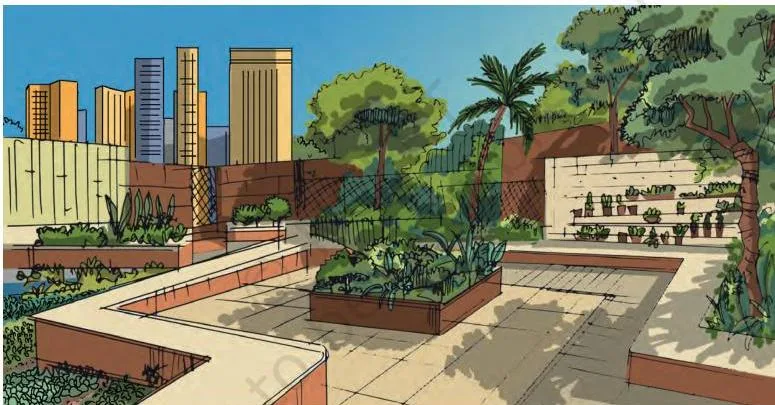
Notice the three things the chapter treats as non-negotiable: strong shade trees, heavy containers sitting at the roof edge, and open paths that keep every pot reachable for watering and maintenance.
The chapter then walks the whole project in order. The sequence is:
- scoping work and the process chart (p. 22–23)
- site visit to a working rooftop garden (p. 23–24)
- layout design using six factors (p. 24–25)
- structural safety check and waterproofing (p. 26)
- selecting materials and tools (p. 27–28)
- Bill of Materials (p. 28–29)
- potting mixture, pH adjustment and sowing (p. 29–30)
- seed germination test (p. 31)
- irrigation by water holding capacity (p. 32)
- protection from pests and weeds (p. 33–34)
- harvesting and storage (p. 35–36)
- packaging and transport (p. 37)
Each step depends on the one before it: you cannot choose plants — the chapter’s first task — before you decide what the garden is for. That is why the book starts with scoping work, not with pots.
Portfolio, caselet and site-visit work in the chapter
This is a do-it chapter, not a read-it chapter. The book embeds its own checkpoints, and each one produces something you can put in your portfolio:
- Portfolio entry: which plants you will grow and why (p. 23)
- Process chart: tasks with dates and responsibility, using the Table 2.1 template (p. 23)
- Site visit: observe a working rooftop garden using the Table 2.2 guidelines (p. 23–24)
- Layout sketch: draw and label your garden layout, giving reasons for each pot’s position (p. 25)
- Bill of Materials: list items, quantities and estimated costs before buying anything (p. 28–29)
- pH record: note your potting mix results and amendments in the Table 2.6 template (p. 30)
- Storage observation: watch how long produce stays fresh under different storage conditions (p. 36)
These are the chapter’s own checkpoints, not extra homework. If you complete all seven, you have done the practical work of the chapter.
Key concepts: planning, growing and protecting the rooftop garden
Everything on the roof — where pots go, how much the roof can hold, what fills the pots and how much water the plants need — is decided by the six sub-topics below. They are the difference between a garden that thrives and a roof that leaks.
The six layout factors: space, sunlight, weight, water, shade, wind
Before a single pot is placed, the chapter makes you answer six questions about the roof (NCERT, p. 24–25):
| Factor | What the chapter demands |
|---|---|
| Space | Leave enough room between pots for watering and general maintenance. |
| Sunlight | At least 5–6 hours of direct sunlight daily. Sun-lovers (tomato, cucurbits) go in open areas; herbs and leafy greens tolerate partial shade. |
| Weight | Heavy containers go close to roof edges or above the beams, where the roof supports more load. |
| Water | Pots sit on trays, tiles or stands so excess water is collected and the roof surface is protected from seepage. |
| Shade | Shade nets, bamboo screens or vertical trellises balance light for plants that cannot take strong direct sun. |
| Wind | Record wind direction for about a week — using the meteorological observatory from Chapter 1 — before finalising the layout. |
Figure 2.2 is the visual key to the whole weight question. A roof is not uniformly strong: the beams underneath carry the load, so a pot is safer when it sits over a beam (NCERT, p. 25).

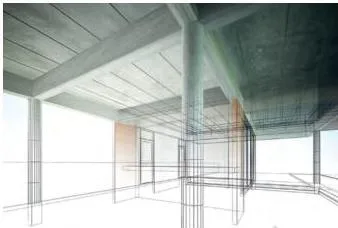
The chapter also suggests a CAD (Computer Aided Design) tool for the layout and a Lux Meter mobile app to check sunlight intensity on different parts of the roof (NCERT, p. 25).
The roof-load check, with a worked example
This is the safety gate of the chapter. The safe load per square metre comes from the building contractor or an engineer — never from guesswork (NCERT, p. 26). The Go-Green team in the book’s caselet did exactly this before touching a single pot.
Worked example: checking a 6 m² roof section
Step 1: Get the safe load from the contractor.
Here, the contractor states the roof can carry 120 kg per square metre.
Step 2: Find the area of the planned garden: 3 m × 2 m = 6 m².
\[ \text{Permissible load} = 120 \times 6 = 720\ \text{kg} \]
Step 3: Estimate what the garden will actually weigh — about 50 pots, potting mix, plants and stored water add up to roughly 500 kg.
\[ 500\ \text{kg} \lt 720\ \text{kg} \]
Final answer: 500 kg stays inside the 720 kg limit, so the section is safe. If the estimate had exceeded the limit, the number of pots or the weight of the potting mix would have to shrink.
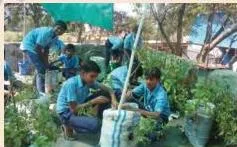
Two protective steps follow the load check: the roof is waterproofed with a tarpaulin liner, and bamboo supports hold climbing plants (NCERT, p. 26). Figure 2.5 shows the Go-Green team putting the plan into practice.
Materials affect weight too. Grow bags are flexible and easy to move; terracotta pots let air and moisture pass; plastic pots are light. Cement pots are limited because they are heavy and retain heat (NCERT, p. 27).
The 1:1:1 potting mixture and the pH test
Why bother mixing a potting mixture at all? Because ordinary garden soil is too dense and heavy for pots. When watered, soil particles pack tightly, block air from the roots, drain poorly and can waterlog and rot the roots (NCERT, p. 30).
The chapter’s fix is a 1:1:1 proportion: cocopeat (or vermiculite or perlite) + compost (or vermicompost) + soil (NCERT, p. 29). The mix stays loose and airy — roots get oxygen and excess water drains out.
Figure 2.6 shows why this matters for the roof too:

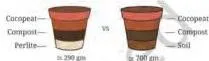
A cocopeat + compost + perlite mix weighs about 290 g per 1-litre pot. Replace the perlite with soil and the same pot weighs about 700 g — almost two and a half times heavier (NCERT, p. 30). Cutting soil from the mix is one of the easiest ways to cut the load on the roof.
pH comes next, using the process from Chapter 1. The target for the potting mix is 6.5 to 7.0 (NCERT, p. 30).
If the mix tests below 6.0, add garden lime (calcium carbonate); if it tests above 8.5, add sulphur or organic manure. Add about one tablespoon, test again, and repeat until the pH lands in range.
Seed germination: testing seeds before you sow
Seed packets print a germination rate, but the actual rate varies with sowing conditions like soil moisture and temperature (NCERT, p. 31). The chapter’s test checks the quality of your batch before it all goes into the pots:
- Count the seeds and estimate how many you need for your pots.
- Plant them in a seedling tray, pot or container.
- Water regularly.
- After 2–3 weeks, count how many germinated.
- Calculate the germination percentage and compare it with the packet’s claim.
- Transplant the seedlings carefully, and protect young seedlings from strong wind with small covers or nets, or by placing pots against a wall (p. 31).
The chapter adds a seed-saving note: hybrid seeds give higher yield but are costly and usable only once, while saving local seeds supports seed security and biodiversity (NCERT, p. 31).
Water: the water holding capacity formula, with a worked example
In soil-based farming, roots grow deep to find water and excess water percolates harmlessly away. Pots give roots neither advantage, so watering has to be precise: too little causes water stress (demand for water exceeds supply), too much suffocates the roots (NCERT, p. 32).
The chapter’s tool is the water holding capacity (WHC) of the potting mixture — the maximum amount of water the mix can hold (NCERT, p. 32).
\[ \text{WHC} = \frac{\text{wet weight} – \text{dry weight}}{\text{dry weight}} \times 100 \]
Worked example: WHC of a potting mix and the water it holds
- Step 1: Note the dry weight of the mix — here, 250 g.
- Step 2: Saturate it with water, let the excess drain for 10–15 minutes, then weigh again — 300 g.
\[ \text{WHC} = \frac{300 – 250}{250} \times 100 = 20\% \]
Step 3: Scale up.
A garden using 350 kg of this mix can hold about 70 litres at saturation.
\[ 350\ \text{kg} \times 20\% = 70\ \text{L} \]
Final answer: The mix holds about 70 litres at saturation — but that is the maximum for plant growth, not a daily watering dose (NCERT, p. 32).
The figure below ties the WHC measurement to the chapter’s scaling rule: once you know the WHC of your mix, you can estimate the approximate water requirement of the whole garden (NCERT, p. 32–33).

Pests and weeds: the integrated protection approach
Pests and diseases cannot be eliminated — they are part of our ecology — but their damage can be limited (NCERT, p. 33). The chapter’s integrated disease and pest management approach works in three lanes:
- Physical: remove diseased leaves and insect larvae by hand.
- Chemical: spray organic pesticides.
- Biological: rear beneficial insects that prey on the pests (p. 33).
Observe each plant for spots, bites or discolouration, identify the pest — with a mobile app or expert help — then use the chapter’s remedy table (NCERT, p. 33):
| Symptom you see | Pest | Crops commonly hit | Remedy |
|---|---|---|---|
| Chewed leaf | Caterpillar | Cabbage, cauliflower, broccoli, tomato, brinjal, chilli | Neem spray and turmeric to repel |
| Discoloured leaves | Spider mites | Rose, hibiscus, beans, brinjal, cucumber, watermelon, indoor plants | Spray with water to dislodge the pests |
| Deformed leaves | Aphids | Mustard, cabbage, cauliflower, tomato, brinjal, chilli, rose, hibiscus, marigold | Neem spray, chilli-garlic spray, manual removal at an early stage |
| Large holes and shiny trails | Slug / snail | Cabbage, lettuce, spinach, seedlings of all vegetables | Manual removal and salt lines |
| Wilted and chewed leaves | Chafers (beetles) | Rose, hibiscus, jasmine, potato, groundnut, maize, sugarcane | Dig out larvae, neem spray, hand-pick beetles |
| Black mould and weak sticky leaves | Whitefly | Tomato, brinjal, chilli, cotton, okra, cucumber, hibiscus | Neem spray and soap-water spray |
Weeds are simply unwanted plants in your garden (NCERT, p. 34). Farmers fight them physically, with mulching, or with chemical weedicides. The chapter’s mulching options appear in Figure 2.9: plastic sheets (a) or organic material like bark, straw, wood chips and shredded leaves (b).
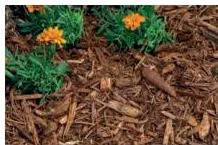
Manual weeding is a five-step routine (NCERT, p. 34):
- Identify the weeds growing near the main plant.
- Loosen the soil around each weed gently with your fingers so the roots come out easily.
- Hold the weed firmly at its base, near the soil surface.
- Pull slowly and steadily so the complete root comes out.
- Level the soil around the main plant afterwards.
Harvest, storage and packaging rules
The chapter gives four harvest rules (NCERT, p. 35):
- Handle gently — every fruit, leaf or flower is valuable in a small rooftop garden.
- Harvest early morning or late evening — at midday, plants lose more water and turn limp.
- Use scissors or pruning shears — pulling by hand damages the plant.
- Watch maturity indicators — spinach when tender, tomatoes when red, coriander before flowering.
Storage keeps produce usable. Wash vegetables and herbs, dry them, and use baskets or perforated containers that let air circulate. Leafy greens stay fresh in a cool, moist place or wrapped in damp cloth; tomatoes stay at room temperature until fully ripe (NCERT, p. 36). The chapter’s time-from-sowing table covers the common crops:
| Crop | Harvest time (days from sowing) | Storage method |
|---|---|---|
| Lettuce | 45–55 | In a plastic bag in the refrigerator for up to 1 week |
| Spinach | 30–60 | Wash, dry thoroughly, store in an airtight container in the refrigerator |
| Radish | 25–45 | Remove the leaves and refrigerate |
| Okra (bhindi) | 45–55 | Store in a container and refrigerate |
| Capsicum | 60–80 | Refrigerate for 1–2 weeks |
| Basil, mint, coriander | 25–30 | Stems in a jar of water, or loosely wrapped in a damp paper towel |
| Tomato | 55–70 | Keep at room temperature |
| Brinjal | 60–70 | Store in a cool place |
Figure 2.11 shows the harvest in action — the gentle, timely picking the chapter asks for.

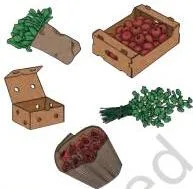
Packaging keeps produce fresh longer, and the rules differ by crop (NCERT, p. 37):
- Leafy greens (spinach, coriander, mint): wrap in a clean damp cloth or newspaper, refrigerate soon.
- Fruits (tomatoes, chillies): ventilated corrugated boxes or baskets — never tight plastic bags. Many fruits emit ethylene gas, which speeds ripening; the holes let the gas escape, so the fruit lasts longer.
- Herbs: tie small bunches with jute string or paper bands and label them.
- Flowers: baskets lined with damp cloth or corrugated sheets.
Figures in the chapter, read closely
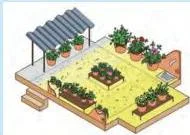
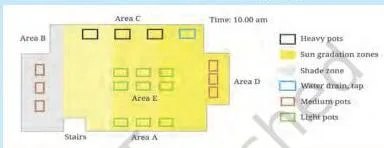
Figures 2.3 and 2.4 are the two layout plans the chapter’s Check Your Understanding questions are built on, so they come with the answers here (NCERT, p. 26).
The four Check Your Understanding questions, answered
Question 1: Why do you think some pots are placed in area B?
Answer: Area B is most likely a part of the roof that gets partial shade rather than full sun. The chapter says areas with partial shade can be used for herbs and leafy vegetables, while sun-loving plants like tomatoes and cucurbits need open areas (NCERT, p. 24).

So the pots in area B are probably shade-tolerant greens and herbs — in most regions, leafy greens like spinach, coriander and mint.
Question 2: Can the pots in area C be placed in area E? Why or why not?
Answer: Only if area E provides the same growing conditions. Two layout factors decide it: sunlight and wind. If area E gets fewer than 5–6 hours of direct sunlight, sun-loving plants placed there will grow weakly; if it is more wind-exposed, plants may be damaged or pots thrown off-balance (NCERT, p. 24–25).
Check watering access as well. The honest answer: moving the pots works only when light, wind and access all match.
Question 3: If the number of plants is increased, which area should be expanded first and why?
Answer: Expand the area with the best sunlight and the easiest water access. Sunlight is the chapter’s fixed condition — at least 5–6 hours of direct sun daily (NCERT, p. 24) — and water must drain into trays without seeping into the roof. Starting with the area that already satisfies both gives new plants the best chance.
Question 4: Does the layout have enough space? Can you imagine any other layout?
Answer: The chapter’s test is simple: adequate space must be left between pots for watering and general maintenance (NCERT, p. 24). If the gaps are too narrow to water, reach and move around comfortably, the layout is crowded.
One alternative arrangement: place heavy pots along the beams and roof edges where the roof carries more load, group shade-loving leafy greens under a single screen, and keep sun-loving plants in the open, sunniest part.
The figures above each carry a piece of the procedure. This table shows where each one was explained:
| Figure | What it shows | Explained in |
|---|---|---|
| Figure 2.1 | A finished rooftop garden | What the chapter covers |
| Figure 2.2 | Beams and roof load | The six layout factors |
| Figure 2.5 | The Go-Green team setting up | The roof-load check |
| Figure 2.6 | Potting mix weight comparison | The 1:1:1 potting mixture |
| WHC figure | Estimating the garden’s water requirement | Water: WHC formula |
| Figure 2.9 | Plastic and organic mulching | Pests and weeds |
| Figure 2.11 | Harvesting vegetables | Harvest, storage, packaging |
| Figure 2.12 | Types of packaging | Harvest, storage, packaging |
Key terms, defined the way the chapter uses them
Quick glossary — one-line definitions in the chapter’s own sense of each term, with a link to the section that explains it.
| Term | Meaning in this chapter | See |
|---|---|---|
| Rooftop gardening | Growing plants on the roof of a house, school or building, in pots, grow bags or prepared beds | What the chapter covers |
| Process chart | A list of all tasks with estimated dates of completion and responsibility | Portfolio and caselet work |
| Site visit | Visiting an existing rooftop garden — at a residence, office, hospital, hotel or institute — to learn from practitioners | Portfolio and caselet work |
| Parapet wall | The low wall along the roof edge; it must be strong for safety | The roof-load check |
| Bill of Materials (BoM) | A table of items, quantities and estimated costs that estimates costs in advance, avoids wastage and organises the work | Portfolio and caselet work |
| Potting mixture | An airy mix of cocopeat/vermiculite/perlite, compost/vermicompost and soil in 1:1:1 proportion | The 1:1:1 mixture |
| Water holding capacity (WHC) | The maximum amount of water the potting mixture can hold | Water: WHC formula |
| Water stress | The condition when demand for water exceeds the available supply | Water: WHC formula |
| Germination rate | The percentage of seeds that germinate; printed on packets but varies with field conditions | Testing seeds |
| Integrated disease and pest management | Combining physical, chemical and biological methods to limit pest damage | Pests and weeds |
| Weeds | Unwanted plants in your garden | Pests and weeds |
| Mulching | Covering the soil with plastic sheets or organic material (bark, straw, wood chips, shredded leaves) to suppress weeds | Pests and weeds |
| Grow bag | A flexible container for growing plants; light and easy to move | The roof-load check |
| Ethylene gas | A gas many fruits emit that speeds ripening; ventilation lets it escape so fruit lasts longer | Packaging rules |
Where rooftop gardens go wrong: mistakes and fixes
Each of these failures comes from the chapter’s own assessment questions — the book expects students to hit them, and to be able to fix them (NCERT, p. 38).
| Mistake | Correct rule | How to check your answer |
|---|---|---|
| Waterlogged pots with blocked drainage holes — tomato plants turn yellow despite regular watering | Keep drainage holes clear; stand pots on trays, tiles or stands so excess water collects and drains | Water a pot and watch: water should run out of the bottom into the tray, not pool in the soil (assess Q3, p. 38; p. 32) |
| Filling pots with garden soil alone — heavy, airless, waterlogged; roots rot | Use the 1:1:1 potting mixture: cocopeat/vermiculite/perlite, compost/vermicompost and soil | Lift the pot: a 1-litre pot of the right mix weighs about 290 g; with soil it weighs about 700 g (assess Q2, p. 38; p. 30) |
| Reading the WHC result as a daily watering dose | WHC is the maximum the mix can hold at saturation, not a daily schedule | Check the mix’s actual moisture before watering; use the calculated figure only as the upper limit (p. 32) |
| Harvesting at midday — produce turns limp | Harvest early morning or late evening, when plants have not lost water to the heat | Pick at a cool hour and the leaves stay turgid; mid-day picking wilts within minutes (p. 35) |
| Packing leafy greens in plastic and fruit in sealed bags | Leafy greens go in a damp cloth or newspaper; fruit goes in ventilated boxes because of ethylene gas and trapped moisture | Compare after two days: spinach in damp cloth stays fresh, spinach in plastic wilts (assess Q4, p. 38; p. 37) |
| Placing heavy pots anywhere on the roof | Heavy containers go near roof edges or over the beams, with weight distributed evenly | Locate the beams first; heavy pots sit over them, never in the middle of an unsupported span (p. 24, p. 26) |
How the chapter assesses your learning
This is a skill textbook, so the chapter does not end with marks-based questions — it ends with tasks you perform and justify (NCERT, p. 38). What it actually demands:
- Compare containers: one advantage and one disadvantage each for grow bags and clay pots, then recommend one and justify it (Q1).
- Explain why a soil + compost + cocopeat mix produced healthier, lighter plants than soil alone (Q2).
- Diagnose waterlogged pots and suggest two preventive measures (Q3).
- Interpret a packaging experiment — damp cloth vs plastic bags for spinach — and state the lesson for packaging (Q4).
- Choose plants for 15 donated pots from spinach, tomato and marigold seeds, justifying by agro-climatic fit, usefulness, life cycle and water need (Q5).
- Suggest two recycled containers and explain how recycling helps the environment (Q6).
- Reflect: which task you enjoyed most and least, what went well, what you would change (Q7).
- Give examples of applying the learning in a real-life situation (Q8).
Two calculation-style skills run through the chapter and you should be able to repeat both: the WHC formula — \( \text{WHC} = \frac{\text{wet} – \text{dry}}{\text{dry}} \times 100 \) — and the roof-load check, \( \text{permissible load} = \text{safe load per square metre} \times \text{area} \). Both appear as worked examples above.
One honest caveat: textbook contents and the examinable syllabus are not always identical — check the current official syllabus for what is assessable this session.
Rooftop garden, start to finish: a quick recap
The chapter’s final checklist (NCERT, p. 37) restates the whole project in the order the work is actually done:
- Decide the scope of the work and make the process chart (p. 22–23).
- Visit a working rooftop garden and record your observations (p. 23–24).
- Design the layout using the six factors — space, sunlight, weight, water, shade, wind (p. 24–25).
- Confirm structural safety with the contractor or engineer and waterproof the roof (p. 26).
- Select materials and tools, then prepare the Bill of Materials (p. 27–29).
- Prepare a light potting mixture, test and adjust pH, and test seed germination (p. 29–31).
- Irrigate according to the water holding capacity and monitor pests and weeds (p. 32–34).
- Harvest at the right time, with gentle handling (p. 35).
- Store, package and transport the produce (p. 36–37).
Work through the list once and you have completed the chapter’s entire practical arc.
Related resources and where this chapter fits
This listing is maintained for the 2026-27 academic session using the NCERT textbook information available to us. NCERT remains the authority for confirming the latest edition.
Chapter 1 of this same book supplies three tools this chapter reuses: the agro-climatic relationship for choosing plants (p. 22), the pH-testing process (p. 30) and the meteorological observatory used to record wind direction for the layout (p. 25). If you skipped it, go back before you start your garden.
- Chapter 1: Work with Life Forms notes — the agro-climatic, pH and wind tools this chapter builds on.
- NCERT Kaushal Vikas Class 9 skill education notes — the full set of chapters from this book.
- Class 9 notes hub — all Class 9 subjects in one place.
- Precision farming notes — another Kaushal Vikas chapter page for Class 9.
The official edition of the book is published on the NCERT portal, linked in the download section above. The figures, page references and page numbers on this page describe that official edition.
Sources and data verification
- The figures and page references on this page describe the NCERT Kaushal Vikas Class 9 (Skill Education) textbook, Chapter 2, Rooftop Gardening, book pages 21–38, official edition published on ncert.nic.in.
- This page covers that single chapter only — it does not cover other chapters of Kaushal Vikas or other skill education subjects.
- This listing is maintained for the current academic session using NCERT’s published book.
- NCERT settles textbook editions and official PDFs; CBSE settles curriculum, syllabus and examinations.
- Textbook contents and the examinable syllabus are not always identical — check the current official syllabus before relying on any chapter for assessment.
Rooftop gardening questions students ask
What is the right potting mixture ratio for a rooftop garden?
Mix cocopeat/vermiculite/perlite with compost/vermicompost and soil in 1:1:1 proportion, then adjust pH to 6.5–7.0 (NCERT, p. 29–30).
How do you calculate the water holding capacity of a potting mix?
Use \( \text{WHC} = \frac{\text{wet weight} – \text{dry weight}}{\text{dry weight}} \times 100 \). For example, dry weight 250 g and wet weight 300 g gives \( \frac{300-250}{250} \times 100 = 20\% \) (NCERT, p. 32).
Why do plants in rooftop pots turn yellow even when watered regularly?
Usually because the pots are waterlogged — blocked drainage holes trap water and suffocate the roots. Clear the holes and keep the pots on trays that collect excess water (assess Q3, p. 38; p. 32).
Which crops grow fastest in a rooftop garden?
Radish (25–45 days), basil/mint/coriander (25–30 days) and spinach (30–60 days) lead the chapter’s harvest-time table (Table 2.8, NCERT, p. 36).
Should harvested vegetables be packed in plastic bags?
Not as a rule. Leafy greens stay fresh wrapped in a damp cloth or newspaper, and fruits like tomatoes and chillies must not go in tight plastic bags — trapped moisture and the ethylene gas the fruit emits cause rotting (NCERT, p. 37). Use ventilated corrugated boxes for fruit.
How do you know whether a rooftop can safely hold a garden?
Get the safe load per square metre from the building’s contractor or engineer, multiply it by the garden area, and keep your estimated weight — pots, mix, plants and water — below that figure (NCERT, p. 26).
| What the chapter holds | Count | Where it is used |
|---|---|---|
| Printed pages | 18 | |
| Sections in the chapter | 17 | |
| Figures with NCERT captions | 20 | |
| Tables | 12 | |
| Worked examples | 2 | solved step by step in our NCERT Solutions |
| In-text questions | 4 | |
| Official NCERT PDF | Download the chapter PDF | the chapter exactly as NCERT publishes it |




Reference: NCERT Class 9 Kaushal Vikas textbook, chapter 2, official edition on ncert.nic.in.
Explore Class 9 Skill Education Books
- Previous: Work with Life Forms
- Next: Precision Farming
Related chapters:
- Additional Vocations
- Work with Machines and Materials
- Construction