
This page gives you the official NCERT Theatre Class 9 chapter PDF — Chapter 2 of the NCERT Class 9 Arts textbook Madhurima (English edition) — and explains what the chapter actually contains. The chapter’s main body is titled “The Stage Is Yours”; it is a hands-on unit that takes a student team from naming itself to staging a short theatre production.
The official file is right below.
Download the official NCERT Theatre Class 9 chapter PDF (Madhurima, Chapter 2) — this takes you to NCERT’s e-textbooks portal, where the full Madhurima book is published chapter by chapter.
Chapter at a Glance
The table below shows how much the chapter holds — sections, figures, activities and tables — counted directly from the book. Below the table is the chapter’s map: what the file does in what order.
[PLACEHOLDER_COUNTS_TABLE] The chapter opens with a Sanskrit verse from Mālavikāgnimitram (Act 1, verse 4), then moves through a Note to the Teacher, a theatre-journal section, and the main body “The Stage Is Yours” — which revisits basics with Vidūṣhaka, has you form a team, find a story, explore puppetry and mime, and complete a six-step production project.
It closes with performance-based exercises and a final “Window” image for a reasoned response.
What This Chapter Covers
This is a doing-chapter: a workshop that moves a team from naming itself to staging a short production. Here is the flow inside the file.
- Opening verse: the verse from Mālavikāgnimitram frames nātya (drama) as a visual offering to the gods that entertains people of different tastes.
- Note to the Teacher: sets the spirit — theatre has no single right answer, needs no expensive infrastructure, and every child brings a different strength.
- A Journal of My Theatre Journey: builds the habit of reflecting on every rehearsal and performance, with a sample journal entry and a list of dos and don’ts.
- “The Stage Is Yours”: revises four basics with Vidūṣhaka — body language, expression and voice, improvisation, and story building.
- Form Your Theatre Team: make teams of six to eight members, name the team, and design a logo.
- Finding Your Story: pushes purpose before story — “who are you telling it to?” — then treats genre and forms of theatre.
- Puppetry and mime: each gets its own subsection with a recall reference to earlier Kriti chapters.
- The six-step project: runs from choosing a social theme to a staged performance.
- Exercises: close the chapter with themes, activities, and image-based questions.
The hands-on tasks you will actually perform in the chapter are: make a small puppet from recycled materials and perform a two-minute show (Activity 2.2), play the “Mime a Team Goal” guessing game, name your team and design its logo, and put together the final team production.
Key Concepts: What the Chapter Wants You to Understand
The chapter treats theatre as a collaborative craft built from a few basic skills. Everything in it — journal, team, story, project — feeds one team production.
Theatre is collaborative
The book opens its main body with the line “As a theatre artist you can be —” and then shows the range of jobs a production needs. As Fig. 2.1 puts it, these are the different roles in theatre: acting, writing, designing, directing, and backstage work all come together in one production.
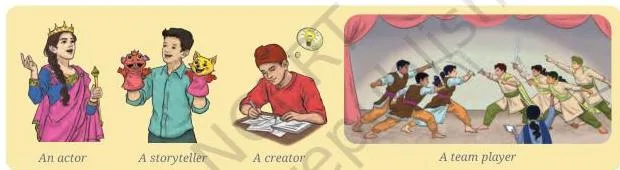
The chapter’s point is practical: because theatre is collaborative, every role matters — not every student needs to shine as an actor.
The four basics, revisited with Vidūṣhaka
Vidūṣhaka is the clever, witty companion from classical Indian theatre who adds laughter and insight. He returns here to recall the four skills you explored in earlier grades:
- Body language — how you stand, move and gesture tells the audience who you are even before you speak;
- Expression and voice — tone, volume and facial expressions carry emotion and intent;
- Improvisation — thinking and reimagining on the spot, staying in character when theatre surprises you;
- Story building — every scene, even a small one, needs a beginning, middle and end.
The navarasa: the nine emotions
You met the navarasa in earlier grades and studied the Nātyashāstra in Chapter 1 (Introduction to the History of Arts). The nine emotions are listed in the book; the plain one-word glosses below are added to help you recognise each one:
| Rasa (emotion) | Plain meaning |
|---|---|
| śrīṅgāra | love, attraction |
| vīra | heroic valour |
| karuṇa | compassion, sorrow |
| raudra | anger, fury |
| bhayānaka | fear, terror |
| bībhatsa | disgust, aversion |
| hāsya | humour, laughter |
| adbhuta | wonder, amazement |
| śānta | peace, calm |
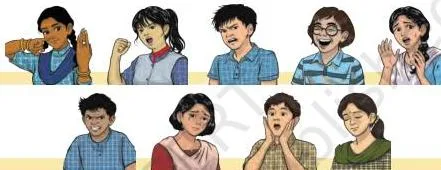
The final exercise of the chapter asks you to name all nine and perform each one with an action or a short line of speech — so the table above is directly examinable through performance.
Theatre with a purpose, genre and form
The chapter’s central anecdote: a group of students argues about what play to do — comedy from the Purāṇas? suspense and mystery? — until their teacher asks, “Before you decide the story… tell me — who are you telling it to?” Purpose comes before story.
The book then introduces genre — categories based on forms and styles, such as tragedy, comedy, fantasy and musical theatre — and notes that genres can be mixed: imagine a comic tragedy or a mythical mystery. Finally it points to India’s many regional theatre traditions, with puppetry and mime as the two detailed examples.
The Six-Step Theatre Project
This project turns a real social concern into a staged story, and every team in the class does it. Here are the six steps with the chapter’s details.
- Step 1: Define your focus. Each team picks one social theme. The book’s examples: what role do festivals play in building community bonds, and what makes young people feel hopeful today. Choose something relevant to you and the people around you.
- Step 2: Framing questions. Prepare a set of questions — some open-ended, some close-ended (see the comparison table below).
- Step 3: Meet people and gather information. Three methods are given: questionnaires and surveys (for perspectives from a larger group), interviews (conversations that allow emotional depth), and observation (watching behaviour in markets, schools, workplaces). Note down what people say, plus character sketches — age-group, profession, manner of speaking, gestures and expressions — in your theatre journal.
- Step 4: Turning information into stories. Gather as a group and ask: what emotions and themes emerged? What surprised you? How can this information help you write a story on the topic?
- Step 5: Building the story. Choose three key moments, create a situation for each, and use improvisation to develop characters and script. Then settle the genre or form, the props, costumes, make-up, and backstage responsibilities.
- Step 6: Theatre team production. With the story’s characters and a basic script ready, rehearse and perform the story on stage.
Open-ended vs close-ended questions (Step 2)
Asking the right question is the key skill of Step 2. How you frame a question depends on the tool you use and the person answering. The chapter’s own comparison:
| Question type | What it does | Example from the chapter |
|---|---|---|
| Open-ended | Lets people speak freely in their own words; encourages storytelling, memories, opinions, and experiences that may not show on the surface. | “Can you share a situation where you felt misunderstood?” |
| Close-ended | Offers limited, fixed options such as Yes/No or multiple choices; gives clear, measurable information that can be counted and compared. | “Does your community celebrate festivals that include theatre or folk performances? Yes/No.” |
Using both types together gives a holistic picture — that is why the chapter asks each team to frame two questions of each kind.
The chapter closes this project with a discussion circle: what is the biggest obstacle in forming a theatre team, how did your role contribute to the team’s work, and which theatre practitioners perform in your region?
Figure Walkthrough: Reading the Chapter’s Illustrations
Every numbered figure in the chapter is a teaching tool. Here is what each one shows and how to use it.
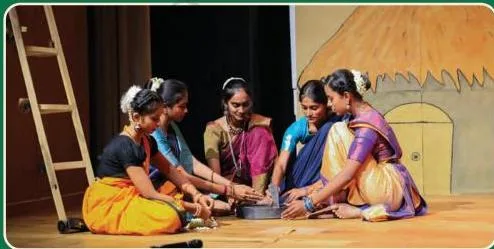
The first image sits beside the chapter’s epigraph from Mālavikāgnimitram. Its idea — that nātya is a single form of entertainment that caters to diverse tastes — is the chapter’s reason for welcoming every kind of contribution.

Use this poster to answer the question every student asks first: “I can’t act — what do I do?” The chapter’s answer is that a production also needs writers, designers, directors and organisers.

This image marks the start of the team activity. The book adds a note to the teacher: teams should be inclusive, and sizes can be adjusted to the classroom.

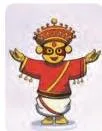
Before designing your own logo, the chapter tells you to examine existing ones — the NCERT logo here, or your school’s. Ask what you notice and what the elements represent; then sketch, keep the design simple and easy to replicate, and choose colours that carry your team’s ideas.
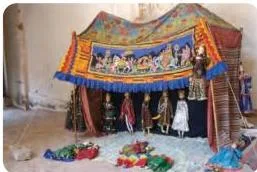
Puppetry is the chapter’s first detailed theatre form. It reminds us that storytelling can live in objects — a handkerchief becomes a bird, a stick becomes a king. India’s traditions include string puppetry, shadow puppetry, stick/rod puppetry and glove puppetry. This figure connects directly to Activity 2.2: make a small puppet from recycled materials and perform a two-minute show with it.
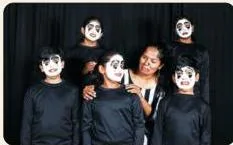
Mime is the second form: stories told without words, speech or dialogue, only through body movements, gestures and expressions. The “Mime a Team Goal” activity after this figure asks you to perform an action representing your team’s goal while your friends guess it.

The final figure anchors the closing exercise. Four options are offered — openness, new perspectives and curiosity; isolation and restriction; discipline and strict boundaries; confusion and unpredictability — and you must say which qualities you associate with the image and why. There is no single key; the task is to give a reasoned personal reading.
Definitions: Theatre Terms in Plain Words
This chapter uses a handful of craft terms, and each does a specific job in the activities.
| Term | Plain meaning |
|---|---|
| Theatre | A collaborative art in which acting, writing, design, direction and backstage roles together bring a story to an audience. |
| Nātya | The Sanskrit word for drama used in the opening verse — described there as a visual offering, pleasant to the eye, that entertains people of different tastes. |
| Navarasa | The nine emotions of Indian performance, drawn from the Nātyashāstra tradition. |
| Genre | The category of a play based on its form and style — tragedy, comedy, fantasy and musical theatre are named in the chapter. |
| Puppetry | Telling stories through objects. India’s traditions include string, shadow, stick/rod and glove puppetry. |
| Mime | A silent form in which stories are told only through body movements, gestures and expressions. |
| Open-ended question | A question that lets a person answer freely in their own words, inviting stories and memories. |
| Close-ended question | A question with fixed options such as Yes/No or multiple choices, giving countable data. |
| Theatre journal | Your personal record of what you did, learned and struggled with in each rehearsal and performance. |
| Character sketch | Notes on how a person speaks and moves — age-group, profession, gestures — used to build a role. |
| Backstage responsibilities | The non-acting jobs — props, costumes, sets — that hold a production together. |
Common Mistakes Students Make in This Chapter
The chapter itself tells you where its work usually goes wrong. These are the traps to avoid.
| Mistake | Correct rule | How to check your work |
|---|---|---|
| Hunting for the single “right” way to perform a scene. | There is rarely one right way; experiment, interpret and find your own response. | Ask: can I defend my interpretation, not just repeat one? |
| Treating the journal as homework and writing what the teacher wants to hear. | Journal dos: write honestly, regularly, reflect deeply, respect privacy. Don’ts: no generic lines like “it was nice”, no copying others, don’t skip difficult experiences. | Does the entry name a real struggle and what it taught you? |
| Choosing a story before knowing the audience. | Purpose comes first — ask “who are you telling it to?” before “what story?”. | Can you name the audience and what you want them to feel? |
| Asking only close-ended questions in field research. | Open-ended and close-ended questions together give a holistic picture. | Do your questions include at least two of each type? |
| Assuming theatre needs equipment and a stage. | An empty classroom, a corridor or a playground is enough; imagination transforms the space. | Can your scene work in a cleared classroom right now? |
How This Chapter Is Assessed
This chapter is assessed by doing, not by writing out definitions.
The book’s own table, “Learning Outcomes That Can Be Assessed” for Chapter 2, lists four outcomes: discuss the ideas and processes that interest you in dramatic arts; explore the potential of theatre for a social purpose; demonstrate empathy and sensitivity in interacting with people; and interact with peers, teachers, family members and community artists to learn the scope of theatre.
The closing exercises demand the same practical skills:
- Two themes — hard work leads to success, and being kind and helpful to those in trouble is always appreciated — each with three activities: show the theme through body language; speak five lines with proper voice and expression; write a short story with a beginning, middle and end.
- Prepare a questionnaire for a theatre workshop you plan to conduct in your locality.
- Name the nine rasas and perform each with an action or a suitable line of speech.
- Give reasoned qualities for the Window image (Fig. 2.7).
One honest note: textbook contents and the examinable syllabus are not always identical — check the current official CBSE syllabus for how this chapter counts in your assessment.
Recap: The Theatre Chapter in Ten Lines
The chapter has no printed summary of its own, so this recap is built from the chapter’s content. For the night before your assessment:
- The opening verse treats drama as a visual offering that pleases people of different tastes.
- Theatre is a collaborative process, not a solo art — every role matters.
- The four basics are body language, expression and voice, improvisation, and story building.
- The nine rasas — śrīṅgāra, vīra, karuṇa, raudra, bhayānaka, bībhatsa, hāsya, adbhuta, śānta — are the emotional palette of Indian performance.
- A team needs a name and a logo that communicate its identity at a glance.
- Purpose comes before story — ask who you are telling it to.
- Genre (tragedy, comedy, fantasy, musical) can be mixed.
- Puppetry and mime are distinct forms: objects versus silent body.
- The six-step project moves from social theme to staged production through field research.
- The theatre journal makes every rehearsal a lesson.
Related Resources
This listing is maintained for the 2026-27 academic session using the NCERT textbook information available to us. NCERT remains the authority for confirming the latest edition.
- NCERT Class 9 Arts (Madhurima) notes — the hub for this book.
- Chapter 1: Introduction to the History of Arts — the companion chapter this one refers back to for the Nātyashāstra.
- Chapter 3: Symbols and Metaphors on Stage — the next chapter in the book’s learning-outcomes table.
- Class 9 study hub — all Class 9 subjects and chapters.
- All CBSE notes — study resources across classes.
| What the chapter holds | Count | Where it is used |
|---|---|---|
| Printed pages | 12 | |
| Figures with NCERT captions | 10 | |
| Tables | 3 | |
| Activities | 4 | |
| Official NCERT PDF | Download the chapter PDF | the chapter exactly as NCERT publishes it |
Reference: NCERT Class 9 Arts (Madhurima) textbook, chapter 2 (“Theatre”), official edition on ncert.nic.in.
Sources and Data Verification
- The PDF and figures described here come from the NCERT Class 9 Arts textbook Madhurima (English edition), Chapter 2, “Theatre”.
- This page covers only that NCERT book, not other arts titles, and not the full CBSE subject scheme.
- The listing is maintained for the current academic session using the NCERT information available to us.
- NCERT settles textbooks, editions and official PDFs; CBSE settles curriculum, syllabus and examinations.
Frequently Asked Questions
What are the nine rasas in the Theatre chapter?
The nine rasas are śrīṅgāra (love), vīra (valour), karuṇa (compassion), raudra (anger), bhayānaka (fear), bībhatsa (disgust), hāsya (humour), adbhuta (wonder) and śānta (peace). The chapter lists them under “Let us recall” and the final exercise asks you to name and perform each one.
What is the difference between open-ended and close-ended questions in Step 2 of the project?
Open-ended questions let people speak freely in their own words and invite stories and memories — for example, “Can you share a situation where you felt misunderstood?” Close-ended questions offer fixed options such as Yes/No and give countable data — for example, “Does your community celebrate festivals that include theatre or folk performances?
Yes/No.” The chapter says using both gives a holistic picture.
How is puppetry different from mime in this chapter?
Puppetry tells stories through objects — India’s traditions include string, shadow, stick/rod and glove puppetry — while mime tells stories without words, only through body movements, gestures and expressions. Puppetry hands the story to a puppet; mime keeps it in the performer’s body.
How should I answer the exercise with the Window image (Fig. 2.7)?
The exercise offers four sets of qualities — openness/new perspectives, isolation/restriction, discipline/boundaries, and confusion/unpredictability — and asks which you associate with the image and why. The chapter gives no fixed answer; a full response states your choice and supports it with what you see in the image.
Do I need a stage or special equipment for the Theatre chapter?
No. The Note to the Teacher says theatre does not require expensive infrastructure — an empty classroom, a corridor or a playground is enough. A cleared space can become a forest, a courtroom or a battlefield through imagination.
Which Kriti chapters should I revise for puppetry and mime?
The chapter’s “Let us recall” notes point you to Chapter 19 of the Grade 6 Kriti textbook for puppetry, Chapter 2 of the Grade 7 Kriti textbook for mime, and Chapter 2 of the Grade 8 Kriti textbook for scripts, dramatic structures and genres.
Explore Class 9 Arts Books
- Previous: History of Arts
- Next: Symbols and Metaphors on Stage
Related chapters:
- Creativity in Light and Sound
- From Vision to Performance: Direction and Acting
- The Science of Music