
This page is the home of NCERT Class 9 arts Chapter 11, Dance as Visual Storytelling, from the Madhurima textbook (English edition). If you need the official 11 dance as visual storytelling class 9 PDF, it is right below — the chapter runs six printed pages, beginning at page 153.
Keep scrolling for a plain-language walkthrough: the three abhinayas, every dance form the chapter names, what its photographs show, and what the closing exercises ask.
Download the NCERT Class 9 Madhurima Chapter 11 PDF
The official chapter file is published by NCERT on its textbooks portal, and it is the same current edition your school follows. Open the Class 9 Dance as Visual Storytelling Chapter 11 PDF (NCERT Madhurima) at ncert.nic.in to view or save the six-page chapter; the same portal also holds the full Madhurima book if you need the complete textbook.
11 Dance as Visual Storytelling Class 9: chapter at a glance
The table below lists what is inside this chapter — printed pages, sections, photographs, activities and closing questions — so you know what the PDF holds before you open it.
| What the chapter holds | Details | NCERT pages |
|---|---|---|
| Printed pages | 6 | Begins at p. 153 |
| Sections | Opening idea, three abhinayas, three activities, contemplation, identification exercise, final exercises | 153 onward |
| Captioned photographs | 9, from Fig 11.1 to Fig 11.8 (Fig 11.5 appears twice) | 154–157 |
| Classroom activities | 3, one for each abhinaya | 155–157 |
| Closing exercise questions | Q1–Q5, each testing a different part of the chapter | 159 |
How Chapter 11 is organised
The chapter moves from one big idea — dance as visual poetry — through the three abhinayas, each with its own hands-on activity, and closes with an identification exercise and five questions. Use this map to follow it through the book.
| Stop of the chapter | What happens | NCERT pages |
|---|---|---|
| Opening: dṛishya-kāvya | Dance is introduced as visual poetry; Kālidāsa’s Abhijñāna-Śhākuntalam and Shakespeare’s Romeo and Juliet are the two examples; Kathak and Kathakali photographs begin the chapter | 153–154 |
| Āṅgika Abhinaya | The body as the tool of expression; the movement vocabulary; Activity 11.1 ‘Strike a sculpturesque pose’ with the Dancing Śhiva of Badami | 154–155 |
| Vāchika Abhinaya | Voice, words and song as expression; Activity 11.2 ‘Experience dance through sound, song, and silence’ | 155–156 |
| It’s time to contemplate! | Discussion prompts comparing the three vāchika experiences, plus a note to the teacher on running the activity in groups | 156 |
| Āhārya Abhinaya | Costume, make-up and props; the Lezim and chikkā examples; costume as a way to identify a dance | 156–157 |
| Spot the āhārya and identify the dance | Activity 11.3: eight photographs (Figs 11.9–11.16) with blank captions; the names are given on p. 157 | 157–158 |
| EXERCISES | Five questions testing the three abhinayas, ending with an opinion question on costume and movement | 159 |
The three abhinayas: the backbone of Chapter 11
Abhinaya is how a dancer transmits emotion and intent to the audience. This chapter explores three of the four abhinayas introduced in the previous chapter, and each uses a different channel: the body, the voice, or the dancer’s appearance.
Why dance is called visual poetry
The chapter opens by calling Indian dance dṛishya-kāvya, or visual poetry — a performance that communicates meaning through movement, gesture and facial expression (p. 153).
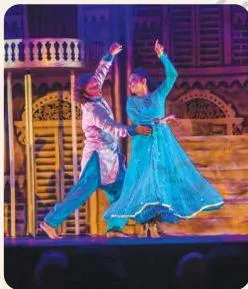
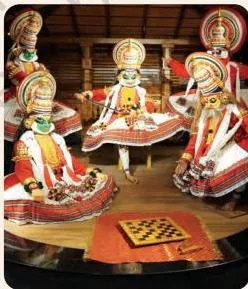
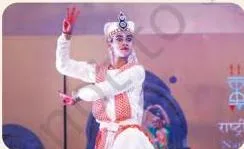
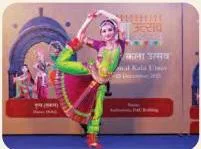
The range of stories is wide: classical literature such as Kālidāsa’s Abhijñāna-Śhākuntalam, modern retellings like Shakespeare’s Romeo and Juliet, the rhythm of the seasons and the journey from sowing to harvest, and scenes from everyday life. Fig 11.1 and Fig 11.2, printed together on p. 154, show this visual poetry in two very different dance styles.
Āṅgika Abhinaya: the body as the storyteller
Āṅgika abhinaya is using the body as the tool of communication and articulation in dance. Every dance form has its own movement vocabulary, and the chapter names the stylised movements you can recall from previous grades: sthāna, chārī, gati, utplavana, bhramarī and hastas — hand gestures (p. 154).
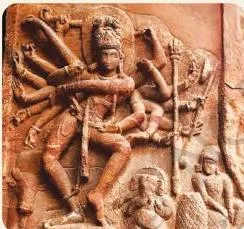
The activity ‘Strike a sculpturesque pose’ starts from the sixth-century CE Dancing Śhiva of Badami, carved with 18 hands. Permutations and combinations of these hands can lead to 81 different dance poses (p. 155).
You identify a few poses with hand gestures, try them out yourself, then add a movement, walk, jump, spin or a combination to make your own sequence communicating the dance of Śhiva.
Vāchika Abhinaya: sound, song and silence
Vāchika abhinaya uses verbal elements — speech, poetry, lyrics, narration and dialogue — and it even includes the recitation of rhythmic syllables (p. 155). These aural elements create the soundscape that shapes a dance’s movement vocabulary. Through vāchika the dancer communicates the essence of the story or shares the energy of the performance.
Activity 11.2, ‘Experience dance through sound, song, and silence’, has three parts (p. 156): dance with instrumental music — using claps or rhythmic syllables such as dhā tā kā dhin — dance with lyrical music, and dance to your own singing.
The contemplation prompts ask you to compare instrumental and lyrical dancing, to notice whether you felt you were communicating, and to compare singing while dancing with dancing without singing.
Āhārya Abhinaya: costume, make-up and props
Āhārya abhinaya is expression through visual elements — costume, make-up and props — that convey visual narratives, cultural context and mood (p. 156).
Its sharpest point: a dance form can often be identified simply by its costume, because costume reflects the region’s textile and jewellery traditions. Props support rhythm too. The Lezim, with its metal cymbals, gives aural accompaniment to the Lezim dance of Maharashtra, and the chikkā, a wooden clapper used in Bhangra from Punjab, adds both visual and rhythmic complexity (p. 157).
In harvest dances, movements imitate farming activities and representative props may be used.
All the dance forms in the chapter, with their states
Before the list of forms, here is the same material compressed: a comparison table, a memory hook, and the one-to-one match between activities and abhinayas.
| Abhinaya | What it uses | What it communicates | Chapter example | NCERT page |
|---|---|---|---|---|
| Āṅgika | Body: sthāna, chārī, gati, utplavana, bhramarī, hastas | Stories carried by posture and gesture | Poses of the Dancing Śhiva, Figs 11.3–11.5 | 154–155 |
| Vāchika | Speech, poetry, lyrics, narration, dialogue, rhythmic syllables | The story’s essence and the performance’s energy | Kuchipudi (Fig 11.6); Bauls of West Bengal (Fig 11.7) | 155–156 |
| Āhārya | Costume, make-up, props | Visual narratives, cultural context, mood | Students in costumes, Fig 11.8 | 156–157 |
Fix the three abhinayas in this order — Body, Voice, Attire. Body movement is āṅgika, anything the mouth produces is vāchika, and everything the dancer wears or carries is āhārya. When a question asks ‘which abhinaya?’, ask which part of the dancer is doing the work.
- Activity 11.1 ‘Strike a sculpturesque pose’ — āṅgika: the body becomes the sculpture (p. 155).
- Activity 11.2 ‘Experience dance through sound, song, and silence’ — vāchika: instrumental music, lyrics and your own voice (p. 156).
- Activity 11.3 ‘Spot the āhārya and identify the dance’ — āhārya: identify the form from costume, make-up and accessories (p. 157).
The chapter names sixteen regional dance forms, mostly in Activity 11.2 and the identification exercise. The table pairs each form with its state, using the book’s spellings.
| Set | Dance form | State |
|---|---|---|
| Instrumental (Activity 11.2) | Tārpā | Maharashtra |
| Instrumental (Activity 11.2) | Dimsā | Andhra Pradesh |
| Instrumental (Activity 11.2) | Kaikottikali | Kerala |
| Instrumental (Activity 11.2) | Rāut Nāchā | Chhattisgarh |
| Lyrical (Activity 11.2) | Bihu | Assam |
| Lyrical (Activity 11.2) | Ghoomar | Rajasthan |
| Lyrical (Activity 11.2) | Dhamāl | Haryana |
| Lyrical (Activity 11.2) | Rāuf | Kashmir |
| Identification (Activity 11.3) | Lāvaṇī | Maharashtra |
| Identification (Activity 11.3) | Cheraw | Mizoram |
| Identification (Activity 11.3) | Kullu Nāṭī | Himachal Pradesh |
| Identification (Activity 11.3) | Baigā | Madhya Pradesh |
| Identification (Activity 11.3) | Pūjā Kunitā | Karnataka |
| Identification (Activity 11.3) | Siddi Dhamāl | Gujarat |
| Identification (Activity 11.3) | Bastar | Chhattisgarh |
| Identification (Activity 11.3) | Phāg | Haryana |
What the chapter’s photographs show
Nine captioned photographs carry the chapter’s argument. Read them as evidence: each one demonstrates a point made in the text above.
Two classical stories, two styles: Figs 11.1 and 11.2
Fig 11.1 shows Romeo and Juliet danced in Kathak; Fig 11.2 shows the Dyūta-krīḍā, the dice-game scene, from the Mahābhārata in Kathakali. Together they prove the opening idea — any story can be told in any dance vocabulary.
The Kathakali photograph already hints at āhārya, because the form’s elaborate costume and make-up are part of how it tells the story (p. 154).
The Dancing Shiva of Badami and its 18 hands: Figs 11.3–11.5
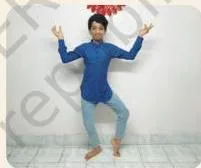
Fig 11.3 is the sixth-century CE sculpture the activity builds on: the Dancing Śhiva of Badami, Karnataka, whose 18 hands give 81 dance poses (p. 155). Figs 11.4 and 11.5 show students trying it — striking a pose, then depicting the dance of Śhiva in movement. The sequence runs sculpture, dancer, you.
Voice and song in dance: Figs 11.6 and 11.7
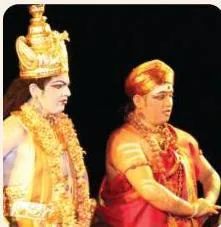
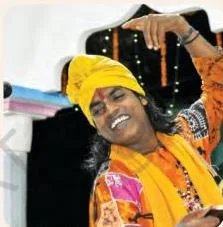
Fig 11.6 shows vāchika abhinaya in Kuchipudi, where the dancer’s voice and song are part of the performance. Fig 11.7 shows the Bauls of West Bengal, who sing, narrate and dance with Bhakti songs (p. 156). Both photographs make the same point: the voice is a dance instrument.
Costume identifies the dance: Fig 11.8
Fig 11.8 shows students performing in different costumes, illustrating the āhārya claim that a dance form can often be identified simply by its costume (p. 157). Costume carries the region’s textile and jewellery traditions, so the look of the dancer is part of the story.
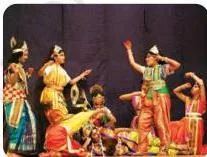
The caption-blank exercise: identifying dances from costume, make-up and accessories
The third activity prints eight photographs, Figs 11.9 to 11.16, with their captions left blank for you to fill in. The task is to name each dance form from costume, make-up and accessories alone. The eight names are printed on p. 157 in no particular order, so treat this as a self-check list, not an answer key:
| Dance form | State |
|---|---|
| Lāvaṇī | Maharashtra |
| Cheraw | Mizoram |
| Kullu Nāṭī | Himachal Pradesh |
| Baigā | Madhya Pradesh |
| Pūjā Kunitā | Karnataka |
| Siddi Dhamāl | Gujarat |
| Bastar | Chhattisgarh |
| Phāg | Haryana |
Dance terms used in Chapter 11, explained
These are the terms the chapter uses, with the page where each appears. If a word stops you while reading, find it here and keep going.
| Term | Plain meaning | NCERT page |
|---|---|---|
| dṛishya-kāvya | Visual poetry — dance that tells stories through movement, gesture and facial expression | 153 |
| Dyūta-krīḍā | The dice-game scene from the Mahābhārata, shown here in Kathakali | 154 |
| abhinaya | The integrated means by which a dancer transmits emotion and intent; four types were introduced in the previous chapter and three are explored here | 154 |
| āṅgika | Abhinaya through the body as a tool of communication | 154 |
| sthāna, chārī, gati, utplavana, bhramarī, hastas | Stylised movements listed in the āṅgika section; hastas are hand gestures | 154 |
| vāchika | Abhinaya through verbal elements: speech, poetry, lyrics, narration, dialogue and rhythmic syllables | 155 |
| dhā tā kā dhin | Example rhythmic syllables a dancer recites while moving | 156 |
| āhārya | Abhinaya through visual elements: costume, make-up and props | 156 |
| Lezim | A prop with metal cymbals that gives aural accompaniment to the Lezim dance of Maharashtra | 157 |
| chikkā | A wooden clapper used in Bhangra from Punjab; adds visual and rhythmic complexity | 157 |
Mistakes students make with abhinaya (and the corrections)
Most errors in this chapter are mix-ups between the three abhinayas, and between the folk dances and their states. The table names each mistake before you make it.
| Mistake | Correct rule | How to check your answer |
|---|---|---|
| Assigning costume to āṅgika or song to āhārya | Body movement is āṅgika, voice and words are vāchika, costume-make-up-props are āhārya | Ask: which part of the dancer is doing the work — body, voice or appearance? |
| Thinking vāchika means only spoken words | Vāchika also covers poetry, lyrics, narration, dialogue and rhythmic syllables — and silence, since the activity is called ‘sound, song, and silence’ (p. 156) | If the element produces sound or carries words, it belongs to vāchika |
| Mixing up the states of the folk dances | Use the state table in the abhinaya section above | Quiz yourself: Dhamāl is Haryana, not Punjab; Rāut Nāchā is Chhattisgarh, not Rajasthan |
One reassurance about the caption-blank activity: it is not guesswork. The eight dance forms are printed on p. 157, and the real task is reading costume, make-up and accessories in the eight photographs.
How the chapter’s exercises test you
The chapter ends with five questions, and each tests a different piece of the chapter. Use this map to know what to prepare for each.
| Question | What it asks | Section it tests | What to prepare |
|---|---|---|---|
| Q1 | Choose any two of (i) chārī/gati, (ii) utplavana and bhramarī, (iii) hastas, and describe and show them in your āṅgika | Āṅgika Abhinaya (pp. 154–155) | The movement vocabulary list, plus a short demonstrated sequence |
| Q2 | Which vāchika elements you explored, and how each helped you communicate your idea and thoughts | Vāchika Abhinaya (pp. 155–156) | The vāchika elements — speech, poetry, lyrics, narration, dialogue, rhythmic syllables — and your Activity 11.2 experience |
| Q3 | Three Indian dance forms where dancers sing and dance simultaneously, with their states | Vāchika Abhinaya (pp. 155–156) | The chapter shows Kuchipudi and the Bauls of West Bengal; add a third form you have learnt in class |
| Q4 | The āhārya elements in two dance forms you have learnt, connected to Visual Arts | Āhārya Abhinaya (pp. 156–157) | Costume, make-up and props of two forms, and one Visual Arts connection |
| Q5 | A reasoned opinion: does appropriate costume enhance the movement (āṅgika) of a dance form? | Āhārya and Āṅgika together (pp. 154–157) | A clear opinion with a concrete example from the chapter |
A complete answer names the abhinaya it is using and points to the element it demonstrates — a body movement for Q1, a voice element for Q2, a costume or prop for Q4 — and for Q5 it states an opinion and defends it with an example.
Textbook contents and the examinable syllabus are not always identical, so check the current official syllabus before planning revision.
Chapter 11 in brief
The whole chapter, compressed to its essential chain, with page references so you can check each link:
- p. 153 — Indian dance is dṛishya-kāvya, visual poetry: movement, gesture and facial expression tell the story.
- pp. 153–154 — The range of stories: Kālidāsa, Shakespeare, the seasons, everyday life; Kathak and Kathakali both dance them.
- p. 154 — Abhinaya transmits emotion and intent; this chapter explores āṅgika, vāchika and āhārya.
- pp. 154–155 — Āṅgika: the body’s movement vocabulary — sthāna, chārī, gati, utplavana, bhramarī, hastas; the Badami Śhiva’s 18 hands give 81 poses.
- pp. 155–156 — Vāchika: speech, poetry, lyrics, narration, dialogue and rhythmic syllables; sound, song and silence.
- pp. 156–157 — Āhārya: costume, make-up and props; costume alone identifies a form; Lezim and chikkā as rhythmic props.
- pp. 157–158 — Activity 11.3: identify eight dances from costume, make-up and accessories.
- p. 159 — Five exercises test each abhinaya and the links between them.
The chapter’s closing idea is its opening one, made precise: the integrated use of abhinayas is what allows a dancer’s emotion and intent to reach the audience.
Related chapters and resources
This listing is maintained for the 2026-27 academic session using the NCERT textbook information available to us. NCERT remains the authority for confirming the latest edition.
This chapter builds directly on the abhinaya concepts from the previous chapter, and it leads into the next arts chapter in the same book. The links below get you to both.
- Class 9 Madhurima (Arts) book page — every chapter of the arts textbook together.
- Class 9 hub — the starting point for all Class 9 NCERT books on this site.
- Class 9 Arts revision notes — chapter-wise notes for Madhurima.
- Class 9 dance notes — the abhinaya chapter and this one together.
- Next chapter: Cultural Connections through Dance — where the journey continues.
- CBSE notes home — all subjects and classes.
The official NCERT textbooks portal at ncert.nic.in holds every edition of Madhurima, and the CBSE website at cbse.gov.in publishes the current Class 9 syllabus and examination scheme.
| What the chapter holds | Count | Where it is used |
|---|---|---|
| Printed pages | 6 | |
| Figures with NCERT captions | 9 | |
| Activities | 3 | |
| Official NCERT PDF | Download the chapter PDF | the chapter exactly as NCERT publishes it |
Reference: NCERT Class 9 Madhurima textbook, chapter 11, official edition on ncert.nic.in.
Sources and data verification
The page numbers and figures in this listing describe the NCERT Class 9 Madhurima (Arts) textbook, English edition, Chapter 11, ‘Dance as Visual Storytelling’.
This page covers that one book. Other Class 9 NCERT textbooks — mathematics, science, social science and languages — are listed on their own pages, and this listing is maintained for the current NCERT edition.
NCERT settles textbooks, editions and official PDFs. CBSE settles the curriculum, syllabus and examinations, and textbook contents and the examinable syllabus are not always identical — check the official CBSE syllabus for what is examinable this session.
Frequently asked questions
What is the difference between āṅgika, vāchika and āhārya abhinaya?
The three abhinayas use different channels of expression. Āṅgika is the body — posture, movement and gesture (p. 154); vāchika is the voice — speech, poetry, lyrics, narration, dialogue and rhythmic syllables (p. 155); āhārya is the appearance — costume, make-up and props (p. 156). A quick check: which part of the dancer is doing the work — body, voice or look?
The integrated use of all of them lets emotion and intent reach the audience (p. 154).
Which folk dance in Chapter 11 belongs to which state?
The chapter names sixteen forms. In the instrumental set: Tārpā (Maharashtra), Dimsā (Andhra Pradesh), Kaikottikali (Kerala) and Rāut Nāchā (Chhattisgarh). In the lyrical set: Bihu (Assam), Ghoomar (Rajasthan), Dhamāl (Haryana) and Rāuf (Kashmir).
The identification exercise adds Lāvaṇī (Maharashtra), Cheraw (Mizoram), Kullu Nāṭī (Himachal Pradesh), Baigā (Madhya Pradesh), Pūjā Kunitā (Karnataka), Siddi Dhamāl (Gujarat), Bastar (Chhattisgarh) and Phāg (Haryana) (pp. 156–157).
What does dṛishya-kāvya mean in this chapter?
Dṛishya-kāvya means visual poetry — the chapter’s opening description of Indian dance as storytelling through movement, gesture and facial expression (p. 153). Just as a poem carries meaning through words, dance carries it through the visible body. The chapter gives examples from Kālidāsa’s Abhijñāna-Śhākuntalam to Shakespeare’s Romeo and Juliet.
How many dance poses does the Dancing Shiva of Badami show?
The sixth-century CE Dancing Śhiva of Badami is carved with 18 hands, and the permutations and combinations of these hands can lead to 81 different dance poses (p. 155). That is the chapter’s number — it comes from the possible combinations of the 18 hands, not from counting each arm in the stone.
The activity asks you to identify a few poses with hand gestures and try them yourself.
Which dance forms in Chapter 11 use singing as part of the performance?
Two are shown directly: Kuchipudi, where the dancer performs vāchika abhinaya with song (Fig 11.6, p. 156), and the Bauls of West Bengal, who sing, narrate and dance with Bhakti songs (Fig 11.7, p. 156). Exercise Q3 asks you to name three such forms, so you would add one more from what you have learnt in class.
What is abhinaya, and why do dancers need it?
Abhinaya is how a dancer transmits emotion and intent to the audience (p. 154). The chapter explores three types — āṅgika (body), vāchika (voice) and āhārya (costume, make-up, props) — and dance works because all of them act together. Without abhinaya, movement would be decoration; with it, the story reaches the audience.
Explore Class 9 Arts Books
- Previous: Dance
- Next: Cultural Connections Through Dance
Related chapters:
- History of Arts
- Theatre
- Symbols and Metaphors on Stage