This page presents the NCERT Class 9 Madhurima Chapter 15, Mediums and Techniques in Visual Art — a 15-page chapter running from page 193 to page 207 of the textbook. The official PDF for 15 Mediums and Techniques in Visual Art Class 9 is right below.
Beneath the download is a readable walkthrough of what the chapter teaches: the meaning of a medium, six art-material families, care and storage rules, two Indian sculptural crafts, the Chitra-sūtra colour system, and both perspective techniques, each tied to its NCERT page.
Download 15 Mediums and Techniques in Visual Art Class 9 PDF
Download the 15 Mediums and Techniques in Visual Art Class 9 PDF from the official NCERT textbook portal to read and print the chapter exactly as published, including every figure caption, activity and exercise on pages 193–207.
Chapter 15 at a Glance
The table below summarises how much of Chapter 15 is sections, figures, activities and exercises, taken directly from the NCERT edition of Madhurima. Use it to see the chapter’s shape quickly, then jump into the sections below for what each part teaches.
This is a practical, activity-driven chapter. Most of its teaching happens in studio tasks and open-ended questions rather than long passages of text, so the table is a map of things to do as much as a list of things to read.
What This Chapter Covers: From Cave Painting to Digital Art
This section maps the chapter’s path so you know where each idea sits before you read. The chapter opens with a thesis: the choice of materials, tools and techniques has shaped every artist’s expression throughout history (NCERT, p. 193).

The opening image states the chapter’s central claim in a single line. The proof follows: many artworks have survived changing weather, climate and other external threats, and the fact that we can still see art made thousands of years ago shows that artists had deep knowledge and advanced techniques with materials (NCERT, p. 193).
The range the chapter asks you to imagine runs from prehistoric cave paintings made with earth pigments to today’s digital drawing devices. Its “Let us recall” note adds a concrete anchor: some pottery and metal casting techniques practised today are more than 5,000 years old (NCERT, p. 193).
From this opening, the chapter moves through five blocks: talking about mediums, care and responsible storage, the sculptural crafts of India, colour theory, and perspective techniques, ending with the exercises on pages 206–207.
Key Concepts: The Medium and What It Includes
This section defines the chapter’s central term — medium — and shows what it looks like in real studios. A medium means the materials, tools and processes used in making visual artwork (NCERT, p. 193). That single definition covers everything from a pencil to a potter’s kiln.
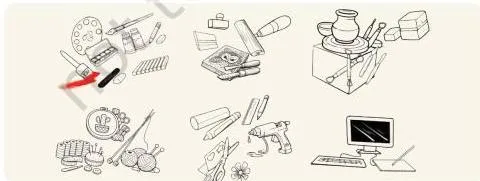
Figure 15.1 shows the range one word covers: drawing and painting, printmaking, sculpture, textile crafts, paper crafts, and digital art. Use the caption as a classification key — whenever you meet a new material, ask which of the six families it belongs to.
The chapter then follows a conversation between students to make the definition concrete (NCERT, pp. 194–196). The points that come out of it are worth remembering:
- Charcoal is soft and smudges easily, which is why it suits sketching.
- Pencils come in grades like 2B, 4B, 6B and 8B with soft leads.
- Clay must be fired at a very high temperature, so it needs experience.
- Other beginner-friendly mediums include wood, jute fibres and wire sculptures.
- Oil paint uses turpentine as a thinner, though some students find it irritating.
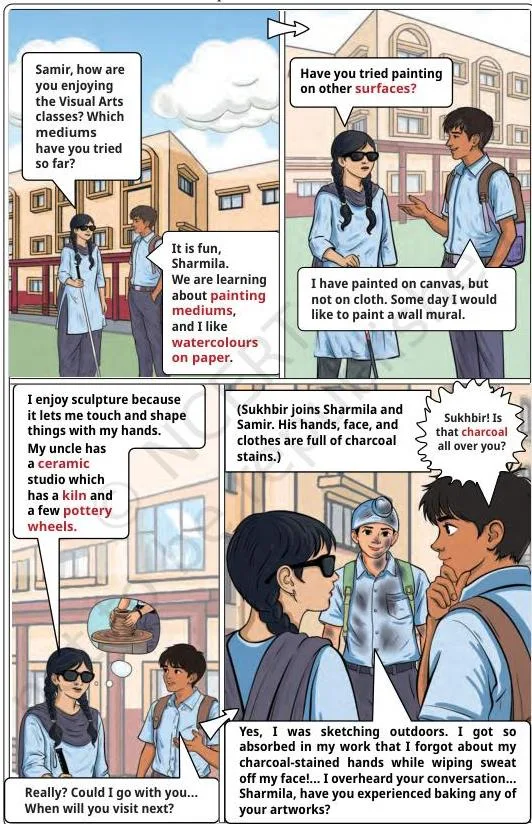
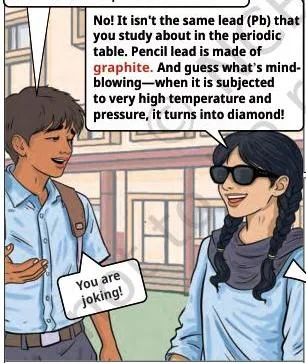
One exchange in this conversation settles a common fear: pencil “lead” is graphite, not the element lead (Pb). Under very high temperature and pressure, graphite can even turn into diamond (NCERT, p. 195). Activity 15.1 then turns the whole discussion into practice — list the mediums you are interested in, find the ones easily available, and use them in your artwork (NCERT, p. 197).
Definitions: Art Terms Used in This Chapter
This quick-reference table collects the art terms the chapter expects you to use, with the NCERT page where each is explained. Keep it beside you while you read.
| Term | NCERT page | Plain meaning |
|---|---|---|
| Medium | p. 193 | The materials, tools and processes used to make visual artwork |
| Linear perspective | p. 203 | Drawing lines that are parallel in reality so they converge at a vanishing point on the horizon |
| Vanishing point | p. 203 | The point on the horizon where parallel lines appear to meet |
| Aerial (atmospheric) perspective | p. 204 | Showing distance and depth with colour tonalities instead of lines |
| Complementary colours | p. 202 | Colours directly opposite each other on the colour wheel |
| Analogous colours | p. 202 | Colours lying next to each other on the colour wheel |
| Tint | p. 202 | A colour variation made by adding white |
| Shade | p. 202 | A colour variation made by adding black |
Care, Maintenance, and Responsible Storage of Materials
This section teaches the chapter’s practical rules for keeping materials alive. The chapter gives the reason plainly: being organised and careful ensures materials can be shared with others and preserves the vibrancy and longevity of artworks (NCERT, p. 198).
Source consciously
- Choose non-toxic and sustainable materials as much as possible.
- Reuse paper and experiment with recyclable materials.
Handle and maintain with care
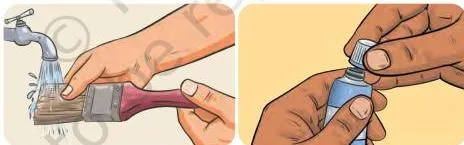
- Clean brushes immediately after use — wash with soap, rinse thoroughly, shape the bristles, and dry them horizontally or upright with bristles facing up.
- Close paint tubes tightly and replace the caps of markers and ink bottles to stop them drying out.
- Do not touch artworks with dirty or oily hands.
- Dispose of inks, acrylics and chemical waste such as turpentine responsibly.
Responsible storage
- Store paper, canvas and drawings in dry, flat spaces.
- Keep sharp objects — cutters, scissors, needles and sculpting tools — safely in a box, away from young children, animals and vulnerable others.
- Keep food and water away from artwork; they attract fungi and other organisms that destroy it (NCERT, p. 198–199).
Figure 15.2 shows the care routines in action, and Figure 15.3 shows the organised-storage ideal the chapter recommends.
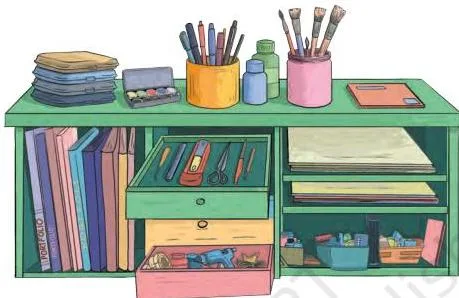
The chapter also suggests visiting a stationery or art supplies store to see how paper, books and stationery are stored carefully in limited space (NCERT, p. 198). That observation is the model for your own storage at home.
Indian Sculptural Crafts: Sumok Thyāktuk and Śholāpith
This section introduces the chapter’s two detailed case studies of material knowledge. The chapter frames them inside the wider wealth of Indian craft: every region has traditions that add colours and textures to our cultural fabric (NCERT, p. 199).
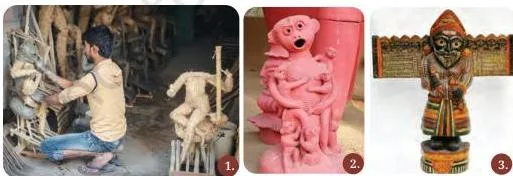
The craft gallery in Figure 15.4 showcases handcrafted objects made of stone, metal, terracotta, wood, grass, palm, beads and fabrics (NCERT, p. 199). The chapter’s table of materials adds craft names to those materials: basketry, brass work, wood crafts, marble inlay, bidriware, jewellery, sikki grass crafts, terracotta crafts, wooden chessboard pieces, and embroidery and textile crafts (NCERT, p. 200).
Sumok Thyāktuk: the bamboo hats of Sikkim
Sumok Thyāktuk are traditional bamboo hats made by the Lepchas of Sikkim, worn during festivals, rituals and special occasions. The hats are made from cane and bamboo, and each one takes about a month to weave (NCERT, p. 200).
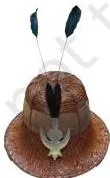
The technique begins with making fine threads of cane and bamboo, after which the hat is woven in four layers, each with its own pattern and symbolic meanings (NCERT, p. 200). That layering is the craft’s signature — every layer is both structure and meaning.
Śholāpith: the spongy-core craft of West Bengal and Odisha
Śholāpith is practised in West Bengal and Odisha; a similar tradition in Tamil Nadu is called Neṭṭī. Artists extract the milky-white spongy core (pith) of the śholā plant (Aeschynomene aspera) to make intricately carved decorative objects (NCERT, p. 201).
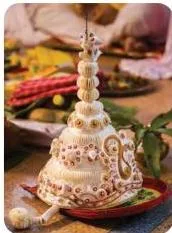
Traditionally, śholāpith was used for garlands, headgear for brides and grooms, idols of deities, and festival decorations. The craft is practised by artisans called malakars (garland-makers), though they now craft much more than garlands (NCERT, p. 201).
| Feature | Sumok Thyāktuk | Śholāpith |
|---|---|---|
| Region | Sikkim | West Bengal and Odisha (Neṭṭī in Tamil Nadu) |
| Material | Cane and bamboo | Milky-white spongy core of the śholā plant (Aeschynomene aspera) |
| What is made | Bamboo hats worn at festivals and rituals | Garlands, bridal headgear, idols of deities, festival decorations |
| Key craft fact | Four woven layers, each with its own pattern and symbolic meaning; one month per hat | Made by malakars (garland-makers), who now craft much more than garlands |
Two studio tasks complete this part of the chapter (NCERT, p. 201). The “Find out” activity asks for a one-page report on any two Indian sculptural crafts with drawings or photos — name the tradition and region, an artist if known, the materials, the technique, and your source of information.
The “Handcraft a three-dimensional object” activity asks you to make something functional from easily available materials — clay, fabric, natural fibres or soft wood — while exploring traditional processes, planning your work, and then displaying and discussing it.
Colour Theory: The Chitra-sūtra, Colour Wheels, and Colour Pairs
This section explains where the chapter’s colour rules come from and how to use them on a colour wheel. Colour mixing is the one technique every medium shares, so the theory applies whether you work in paint, crayon or collage.
The chapter’s source is ancient: the Chitra-sūtra of the Viṣṇu-dharmottara Purāṇa lists the basic colours as white, yellow, red, blue and black, and says that mixing them produces innumerable colours. It also says secondary colours yield many variations of tints and shades by adding varying amounts of white and black respectively (NCERT, p. 202).
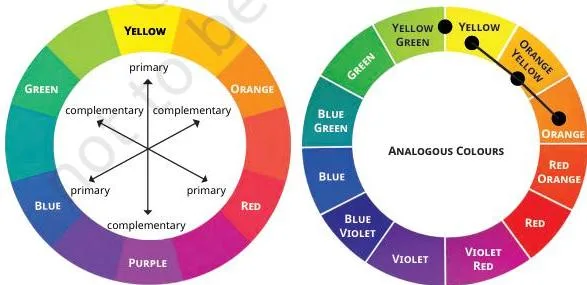
Figure 15.7 is a working tool, not decoration. Complementary colours are directly opposite each other on the wheel; analogous colours lie next to each other (NCERT, p. 202). The chapter asks you to list complementary pairs and to group analogous colours in threes, then say which combination you like and why.
The mixed-media colour wheel activity puts the theory into your hands (NCERT, p. 202): build a wheel with primary, secondary and tertiary colours using many mediums — pencils, crayons, pens, markers, collage with printed matter, and fabric scraps — then map the warm and cool colours and practise making tints, shades and tones.
Keep the chapter’s “Let us recall” note in mind: knowing how to make colour tints, tones and shades is exactly what you need for atmospheric perspective (NCERT, p. 204). Colour theory and perspective are connected, not separate topics.
Perspective Techniques: Linear and Aerial Perspective
This section gives you the chapter’s two ways to show depth on a flat surface. Perspective is a drawing technique used to show three-dimensionality or spatial depth on a two-dimensional surface (NCERT, p. 203).
Linear perspective
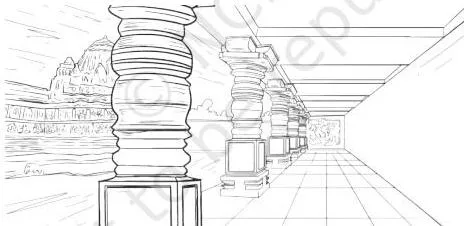
In linear perspective, lines that are parallel in reality are drawn to converge towards a vanishing point on the horizon. The chapter’s example is a corridor: its parallel lines are drawn to converge in the distance, which creates the illusion of spatial depth (NCERT, p. 203).
Seeing it in a masterpiece: School of Athens
In Raphael’s fresco, the architectural lines converge at the centre of the painting, where Aristotle and Plato are surrounded by a gathering of philosophers, scientists and mathematicians — including Socrates, Pythagoras, Archimedes and Heraclitus (NCERT, pp. 203–204).
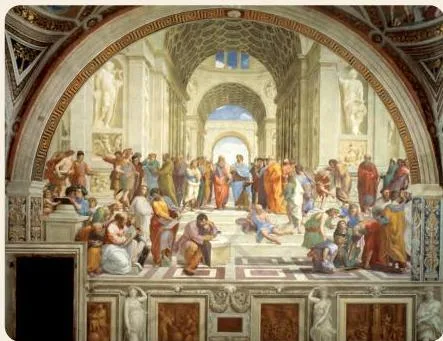
The chapter’s activity for this painting is direct: use a pencil to mark the vanishing point, then draw lines below eye level and above eye level that converge at that point (NCERT, p. 203).
Aerial (atmospheric) perspective
Aerial perspective, also called atmospheric perspective, uses colour tonalities to depict distance and depth. No lines are involved — the depth comes from colour itself (NCERT, p. 204).
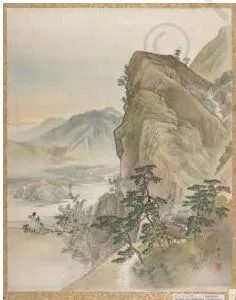
In this landscape, the mountain on the right is painted with richer colours than the mountains in the distance, which appear hazy behind a layer of mist. The plants and trees closer to the viewer carry more detail than those far away (NCERT, p. 204).
Those three signs — richer colour, sharper detail, and haze — are the ones to look for in any painting.
| Feature | Linear perspective | Aerial (atmospheric) perspective |
|---|---|---|
| What creates depth | Lines drawn to converge | Colour tonalities |
| Key element | Vanishing point on the horizon | Hazy, softer colour in the distance |
| Detail rule | Lines below and above eye level converge at the vanishing point | Near objects have richer colour and more detail; distant objects lose both |
| Chapter example | Corridor (Fig 15.8); School of Athens (Fig 15.9) | Landscape by Kawabata Gyokusho (Fig 15.10) |
Figure Walkthrough: Reading the Chapter’s Key Images
This short section trains you to read the chapter’s figures as evidence rather than decoration. Three figures repay the closest attention.
- Figure 15.1 (shown above) — its caption organises mediums into six families. Use the caption as a classification key for every material you meet.
- Figure 15.7 (shown above) — the colour wheel is a tool. The colour opposite any chosen colour is complementary; the neighbours are analogous.
- Figure 15.8 (shown above) — the converging lines are what create the illusion of depth. Trace the corridor’s edges backwards to the vanishing point and you will see how the trick works.
Once you can read these three, the paintings in the exercises — School of Athens, the Deccan miniature, the Mewar miniature and Emperor’s March to Kashmir — become evidence you can analyse instead of pictures you can only admire.
Worked Example: Analysing the Deccan Miniature
The chapter’s main analysis task is the four-question exercise on Figure 15.11, and it prints no model answer. This section shows the method that produces one from evidence alone.
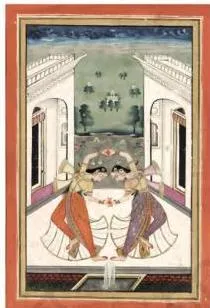
Work in three passes. First, look for linear perspective: examine the built elements — floors, arches, walls — and ask whether any lines converge toward a common point on the horizon. If they do, that is linear perspective (NCERT, p. 203).
Second, look for aerial perspective: check the distance for colour changes, haze and softening, while nearer areas such as the two dancers hold richer colour and sharper detail (NCERT, p. 204). Third, decide whether both systems act together.
Question 1 asks what kind of perspective you see — linear, aerial, both, or none. Say “both” only if you actually found both signs; the chapter’s point is that a painting can be a confluence of different perspectives. Questions 2 and 3 ask where each sign appears, so point to the exact parts of the painting.
Question 4 asks you to explain your judgement — that is where you show your reasoning, not just your answer.
The “Do you know?” box closes the loop: the word perspective also refers to a person’s opinions and attitudes, which are based on their experiences (NCERT, p. 205).
The chapter’s main studio task, “Create an artwork using perspective techniques” (NCERT, p. 205), follows a clear sequence:
- Visualise: recall dance forms you have seen and imagine two or more dancers — their postures, actions, expressions, costumes and jewellery.
- Set: choose an indoor or outdoor setting with architectural elements, such as a school building, wedding venue, street or monument.
- Plan: sketch the scene in your journal, decide where linear and aerial perspective will act, and share the sketch for feedback.
- Finish: draw with linear perspective in mind, colour with aerial perspective in mind, then complete, display, and review the artworks of others (NCERT, p. 205).
Common Mistakes in This Chapter
This section names the misunderstandings the chapter itself anticipates, so you can avoid them before they cost you time in the art room.
| Mistake | Correct rule | How to check your answer |
|---|---|---|
| Assuming pencil “lead” is the toxic element lead | Pencil lead is graphite, not lead (Pb); extreme heat and pressure can turn graphite into diamond (NCERT, p. 195) | Recall the periodic table: lead is Pb; graphite is a form of carbon |
| Starting clay work without knowing it must be fired | Clay is fired at a very high temperature, so the material demands experience (NCERT, p. 194) | Before investing in a clay piece, ask whether you can reach the required firing temperature |
| Confusing complementary with analogous colours | Complementary colours sit opposite each other; analogous colours lie next to each other (NCERT, p. 202) | Pick one colour on the wheel: its opposite is complementary, its neighbours are analogous |
| Treating aerial perspective as a line technique | Aerial perspective works through colour tonalities — tints, tones and shades (NCERT, p. 204) | Look for haze and softer colour in the distance, not converging lines |
| Damaging brushes by leaving them unwashed or caps off | Clean brushes immediately and dry bristles up; close tubes and cap markers (NCERT, p. 198) | After every session, check that brushes are washed, caps are replaced and paper is dry and flat |
The Exercises: What You Are Asked to Make and Analyse
This section shows what the four end-of-chapter exercises demand and what a strong answer needs. They are practical and open-ended — only the colour-pair question has a definite shape, and even that depends on what you actually see in the painting.
Q1 — Natural sources of colour
List five or six natural sources for obtaining colours from vegetables, food and nature. The book’s own example is traditional: soot from oil lamps, used by artists to make a black pigment (NCERT, p. 206). Look around you — leaves, roots, spices, berries and tea all give colour — and record what each source produces.
Q2 — Colour pairs in the Mewar miniature
This question names Figure 15.12 and asks for two complementary and two analogous pairs visible in the painting.
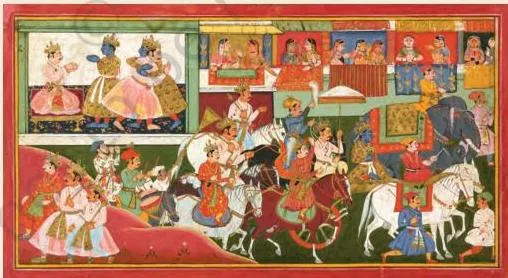
Work from the colour wheel, not from memory. Hold your wheel against the painting, find the colours that are actually present, and pair opposites for complementary colours and neighbours for analogous colours (NCERT, p. 206). Name the pairs precisely.
Q3 — Paragraph on Emperor’s March to Kashmir
This question names Figure 15.13 and asks for a paragraph covering three points: the scene, the use of perspective, and the medium you would use to blend colours.
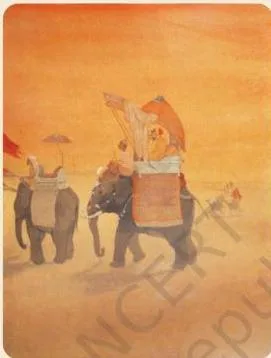
The caption gives you the material facts: wash and tempera on paper, by Abanindranath Tagore, 1920 (NCERT, p. 207). Describe the scene from the title and what you see, analyse the perspective with the signs from Figure 15.8 and Figure 15.10, and justify your medium choice — a wash-based medium blends colours through exactly the soft transitions that aerial perspective needs.
Q4 — Reflect on your own mediums
Write a paragraph on the visual-arts mediums you have used. There is no wrong answer here; the chapter is checking that you can name the materials and processes from your own studio experience, and say something specific about each one.
Using This Chapter in Class and in Your Art Journal
This section tells you honestly how the chapter is used in classwork. It is a practical, process-based chapter — the activities are its real assessment, and the exercises are open-ended enough that a thoughtful, specific answer always beats a generic one.
- Keep a dated journal entry for Activity 15.1 — the list of mediums you want to try and the ones you actually used (NCERT, p. 197).
- Write the one-page “Find out” report on two Indian sculptural crafts, with drawings or photos (NCERT, p. 201).
- Build the mixed-media colour wheel and record the complementary and analogous pairs you found (NCERT, p. 202).
- Complete and display the perspective artwork, then review classmates’ work and note your observations (NCERT, p. 205).
A paragraph with specific observations — named colours, named crafts, concrete signs of perspective — is far stronger than a general one. One caution applies to every textbook chapter: textbook contents and the examinable syllabus are not always identical, so check the current official syllabus for what is assessed this session.
Chapter 15 Recap: What to Remember
This recap compresses the chapter into the points worth remembering the night before class. There is no printed summary in the chapter, so this list is built from its own emphases.
- A medium is materials + tools + processes (NCERT, p. 193).
- Art survives because artists mastered their materials; some pottery and metal casting techniques are over 5,000 years old (NCERT, p. 193).
- Source consciously, handle with care, store responsibly (NCERT, p. 198).
- Sumok Thyāktuk — cane-and-bamboo hats of the Lepchas of Sikkim, woven in four symbolic layers (NCERT, p. 200); Śholāpith — śholā-plant core craft of West Bengal and Odisha, Neṭṭī in Tamil Nadu, made by malakars (NCERT, p. 201).
- Chitra-sūtra basics: white, yellow, red, blue and black; tints come from adding white, shades from adding black (NCERT, p. 202).
- Complementary colours are opposite on the wheel; analogous colours sit next to each other (NCERT, p. 202).
- Linear perspective uses converging lines and a vanishing point (NCERT, p. 203); aerial perspective uses colour tonalities (NCERT, p. 204).
Related Chapters and Resources
This listing is maintained for the 2026-27 academic session using the NCERT textbook information available to us. NCERT remains the authority for confirming the latest edition.
Use these pages to move between the NCERT book and the notes on this site:
- Madhurima Class 9 Arts book — the full textbook page with every Madhurima chapter listed.
- NCERT Class 9 books — all Class 9 subjects in one place.
- Class 9 arts study notes — chapter-level notes for Madhurima.
- CBSE notes for Class 9 — the class-level notes hub.
- CBSE notes index — every subject and class covered on this site.
- Exploring the fundamentals of visual arts — the earlier Madhurima chapter that sets up this one.
- Visual Composition — the chapter that follows Mediums and Techniques in this book.
For the official editions, visit the NCERT textbook portal, the official source of every NCERT textbook PDF, including Madhurima.
Sources and Data Verification
Four short points about the data behind this page:
- The figures and page numbers on this page describe the NCERT Madhurima Class 9 textbook, Chapter 15, “Mediums and Techniques in Visual Art”, in its current NCERT edition.
- This page covers the NCERT textbook chapter; it is not the CBSE curriculum. Textbook contents and the examinable syllabus are not always identical — check the current official syllabus.
- This listing is maintained for the current academic session using the NCERT information available to this site.
- NCERT settles textbook editions and PDFs; CBSE settles the curriculum, syllabus and examinations. This site does not claim a subject-expert review process beyond what is stated here.
| What the chapter holds | Count | Where it is used |
|---|---|---|
| Printed pages | 15 | |
| Figures with NCERT captions | 16 | |
| Tables | 1 | |
| Activities | 7 | |
| Official NCERT PDF | Download the chapter PDF | the chapter exactly as NCERT publishes it |
Reference: NCERT Class 9 Madhurima textbook, chapter 15, official edition on ncert.nic.in.
Frequently Asked Questions
What is a medium in visual art?
A medium is the materials, tools and processes used in making visual artwork (NCERT, p. 193). Figure 15.1 groups these into six families: drawing and painting, printmaking, sculpture, textile crafts, paper crafts, and digital art.
What is the difference between linear perspective and aerial perspective?
Linear perspective draws parallel lines so they converge at a vanishing point on the horizon; aerial (atmospheric) perspective uses colour tonalities — richer colour and detail nearby, hazier colour far away (NCERT, pp. 203–204).
Is pencil lead actually lead, and is it toxic?
No. Pencil “lead” is graphite, not the element lead (Pb); under extreme heat and pressure graphite can turn into diamond (NCERT, p. 195).
What are complementary and analogous colours on the colour wheel?
Complementary colours sit directly opposite each other on the wheel; analogous colours lie next to each other (NCERT, p. 202).
Which Indian sculptural crafts are described in this chapter?
Two in detail: Sumok Thyāktuk, the cane-and-bamboo hats woven by the Lepchas of Sikkim, and Śholāpith, the West Bengal and Odisha craft using the śholā plant’s spongy core, known as Neṭṭī in Tamil Nadu (NCERT, pp. 200–201).
How should art materials be stored after use?
Clean brushes immediately and dry them bristles-up, close paint tubes and marker caps, store paper flat and dry, keep sharp tools in a safe box, and keep food and water away from artwork (NCERT, p. 198).
Explore Class 9 Arts Books
- Previous: Exploring the Fundamentals of Visual Arts
- Next: Visual Composition
Related chapters:
- History of Arts
- Theatre
- Symbols and Metaphors on Stage