
The 8 Rāga and Tāla Class 9 chapter of the NCERT Madhurima (Arts) textbook is the book’s melody-and-rhythm chapter, running across sixteen printed pages. It moves from the seven svaras to the tāla cycles that organise them, and the official chapter PDF from NCERT is right here below.
This page then gives you a tour of the chapter’s main sections with their printed page numbers, so you can find any idea quickly — whether you are reading the chapter for the first time or coming back to it before an exam.
Download the 8 Rāga and Tāla Class 9 NCERT Chapter PDF
The official 8 Rāga and Tāla Class 9 NCERT chapter PDF is published on the NCERT website, which hosts the full Madhurima textbook and its chapter files — open it there to read the chapter exactly as printed, with every figure, table, activity and exercise in place.
This is Chapter 8 of Madhurima, the NCERT Class 9 Arts textbook in its official English edition. All page numbers on this page follow the printed book.
Chapter 8 at a Glance: What the Rāga and Tāla Chapter Holds
The table below lists how much the chapter holds — its sections, figures, activities, tables and exercise set — so you can see the chapter’s size before you open it. Inside the file you will find:
- A recall opener (p. 111) that re-establishes nāda, śhruti, svara and the saptak.
- Svara and svara-sthāna material, including the twelve positions with both Hindustani and Carnatic names (p. 112).
- Rāga-jāti classification with worked note scales as examples (pp. 113–114).
- A legend and a discussion circle that put the theory in a human setting (pp. 114–115).
- Two rāga-family systems, Carnatic and Hindustani (pp. 115–116).
- Carnatic and Hindustani compositions with full profiles of one rāga from each tradition (pp. 116–121).
- Tāla definitions, four tālas with counting tables, and activities (pp. 122–125).
- A closing exercise set and a Notes page (pp. 125–126).
What This Chapter Covers, Section by Section
This tour follows the book’s own order, so you can jump straight to the page you need.
- Let us recall (p. 111) — one-line definitions of nāda (musical sound), śhruti (a clearly heard, distinguishable sound), svara (a note; the seven are S R G M P D N) and saptak/sthāyī (an octave or register).
- Svara (p. 112) — the seven notes, the achala/chala split, and Table 8.1 listing all twelve svara-sthānas with their Hindustani and Carnatic names; Fig. 8.1 shows the same positions on a keyboard.
- Rāga (p. 113) — the definition of a rāga as a melodic framework and the start of rāga-jāti classification by number of notes, with Table 8.2 of examples and Fig. 8.2.
- Rāga-jātis and Activity 8.1 (p. 114) — the combined jātis with the ascent named first, and a writing exercise on auḍava, śhāḍava and auḍava-śhāḍava scales.
- Tānsen and the rāga of fire (pp. 114–115) — the legend of Rāga Dipaka and Rāga Megha with the Tānsen portrait (Fig. 8.3), then a discussion circle in which you name and describe a rāga of your own.
- Carnatic 72 meḷakartā system (p. 115) — meḷakartā scales that use all seven svaras in ascent and descent, Venkatamakhi’s treatise, and janaka-janya derivation (Śhaṅkarābharaṇam to Haṁsadhvani).
- Hindustani thāṭ system (p. 116) — Bhatkhande’s ten thāṭs, the Kalyāṇ thāṭ example, and two rāgas of that family.
- Carnatic compositions (pp. 116–118) — the Śhaṅkarābharaṇam profile, then Jatisvaram (pure notes) and Svarajati (notes with lyrics), each with its rāga, tāla and section structure.
- Hindustani compositions (pp. 119–121) — the Alhaiyā Bilāval profile, a Teen Tāla bandiṣh with its Sthāyī and Antarā, and the Lakṣhaṇa-Gīta.
- Tāla (p. 122) — the six rhythm terms, then Teen Tāla and Jhaptāla with their mātrā, vibhāg, tālī and khālī tables.
- Applying tāla (pp. 123–124) — identifying bols, finding sam, and counting Ādi Tāla and Rūpaka Tāla with finger actions.
- Tāla activities (pp. 124–125) — listening for a tāla cycle, writing a lyric to Teen Tāla or Rūpaka Tāla, and fitting your own song to a steady beat.
- Exercises and Notes (pp. 125–126) — a closing exercise set that runs from one-line definitions to Teen Tāla’s notation, then a Notes page. Short “Do you know?” asides are placed at pp. 113, 115 and 116 along the way.
Key Concepts: Svaras, Rāga Families and Tāla Cycles
Everything in this chapter rests on a small set of ideas: seven notes, the rāgas built from them, and the tālas that time them.
Chapter 7, The Science of Music, set up the sound basics — nāda, śhruti and svara — that this chapter’s recall opener revisits (notes for that chapter); this one arranges those sounds into melody and rhythm.
Seven Svaras, Twelve Positions
A svara is a note, and Indian music uses seven: S, R, G, M, P, D, N. The book calls S (śhāḍja) and P (pañchama) achala-svaras, also called prakṛiti-svaras — they are fixed and have no variants.
The other five, R, G, M, D and N, are chala-svaras (vikṛiti-svaras); each has a lower and a higher form (NCERT, p. 112).
That is the arithmetic behind “7 notes, 12 positions”: \(2 + (5 \times 2) = 12\) svara-sthānas in every octave (p. 112).
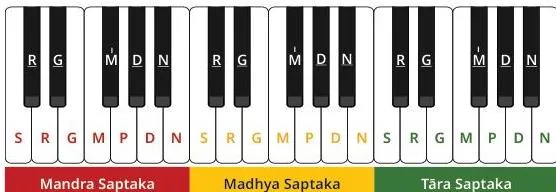
Look at the keys in Fig. 8.1: the white and black keys together make twelve positions, and the pattern repeats in every octave of the instrument. The seven names S R G M P D N stay the same — what changes is which position you press for R, G, M, D and N.
The same position often carries different names in the two traditions, and Table 8.1 (p. 112) prints both columns side by side. The table below shows the pairs students mix up most:
| Note position | Hindustani variant | Carnatic variant |
|---|---|---|
| Lower R | Komala | Śhuddha |
| Higher R | Śhuddha | Chatuḥśhruti |
| Lower M | Śhuddha | Śhuddha |
| Higher M | Tivra | Prati |
| Lower D | Komala | Śhuddha |
| Higher N | Śhuddha | Kākalī |
Note the interesting rows: lower M is called śhuddha in both traditions, while lower R is komala in Hindustani but śhuddha in Carnatic — the same key, two names. Read the correct column for the tradition you are working in.
Rāga and the Three Jātis
A rāga is a melodic framework: a set of notes with its own identity. The chapter classifies rāgas in two ways; the first counts notes. The ārohaṇa is a rāga’s ascending scale and the avarohaṇa its descending scale (p. 113).
Counting the notes in ascent and descent gives the rāga-jāti. The three basic jātis, from Table 8.2 (p. 113):
| Jāti | Svaras | Hindustani example | Carnatic example |
|---|---|---|---|
| Saṃpūrṇa | 7 | Alhaiyā Bilāval, Yaman | Śhaṅkarābharaṇam |
| Śhāḍava | 6 | Gurjarī Todī | Śhrīrañjanī |
| Auḍava | 5 | Bhūpālī | Haṁsadhvani |
Ascent and descent need not match. Combine the three jātis and you get nine mixed forms, with the ascent named first: auḍava-śhāḍava means 5 notes in the ārohaṇa and 6 in the avarohaṇa, while śhāḍava-auḍava means the reverse (p. 114).
Worked example. Take a rāga with ārohaṇa S R G M P Ś and avarohaṇa Ś N P M G R S. The ascent uses five distinct svaras (S R G M P — the final Ś is the tonic repeated an octave higher) and the descent uses six (S N P M G R).
Its jāti is therefore auḍava-śhāḍava, always named with the ascent count first.
Activity 8.1 (p. 114) turns this directly into practice: write any auḍava scale, any śhāḍava scale, and any auḍava-śhāḍava scale of your own.
Two Rāga-Family Systems: Meḷakartā and Thāṭ
The second classification groups rāgas into families by their note positions — and here the two traditions split. Carnatic music uses the meḷakartā system; Hindustani music uses the thāṭ system. The differences that matter for the exercises:
| Feature | Meḷakartā system | Thāṭ system |
|---|---|---|
| Music tradition | Carnatic | Hindustani |
| Number of scales | 72 | 10 |
| Scale contents | All seven svaras in both ārohaṇa and avarohaṇa | Seven svaras (S R G M P D N) arranged in order |
| Variant notes | R, G, M, D, N, each with lower and higher forms | R, G, M, D, N, each with two variants |
| Established by | Venkatamakhi, in the treatise Chaturdaṇḍi-Prakāśhikā (published in the 18th century) | Pandit Vishnu Narayan Bhatkhande, in the early 20th century |
| Role | Basic scale system of Carnatic music; each meḷakartā is a janaka (parent) rāga | Groups all Hindustani rāgas into ten scale families |
The 72 meḷakartās are also called janaka (parent) rāgas, because many janya (derived) rāgas come from each one — made by removing notes or changing their order (p. 115).
Worked example. Śhaṅkarābharaṇam is the seven-note scale S R G M P D N Ś. Remove M and D, and what remains is S R G P N Ś — Rāga Haṁsadhvani, an auḍava (5-note) janya of Śhaṅkarābharaṇam (p. 115).
The same parent can yield other scales: remove G and N instead, and you get S R M P D, another five-note scale.
For the Hindustani side, the book gives the Kalyāṇ thāṭ as an example: S R G M’ P D N Ś, where M’ is the higher (tivra) M. Two rāgas of this thāṭ are Yaman and Śhuddha Kalyāṇ (p. 116).
Composition Forms in Both Traditions
With the theory in place, the chapter studies one representative rāga from each tradition and the compositions written in them. The two profiles side by side:
| Feature | Śhaṅkarābharaṇam (Carnatic, p. 116) | Alhaiyā Bilāval (Hindustani, p. 119) |
|---|---|---|
| Family | Meḷakartā 29 | Bilāval thāṭ |
| Jāti | Saṃpūrṇa | Saṃpūrṇa |
| Notes | All seven svaras, near the Western major scale | All svaras śhuddha; āroha S G R G P D N Ś |
| Distinctive markers | ‘Enduku Peddala’ by Tyāgarāja; one of the first rāgas students learn because its scale is simple | Vādi D, saṃvādi G; sung in the first prahāra of the night; pakaḍ G R G P D N Ś; Bilāval and Alhaiyā Bilāval are separate rāgas |
The Carnatic compositions both sit in janya rāgas of Śhaṅkarābharaṇam. A Jatisvaram is built from svaras and optional rhythmic syllables, with no lyrics; the book’s example is in Rāga Kaṇṇaḍā, Ādi tāla, composed by Veena Padmanābhayya, and its parts are the Pallavi and the Chitte-svara (p. 117).
A Svarajati does the same but adds simple lyrics or sāhitya; the book’s example is in Rāga Haṁsadhvani, Ādi tāla, with Pallavi, Anupallavi and Charana (p. 118). The difference in one line: Jatisvaram has no words; Svarajati does.
The Hindustani equivalents centre on the Bandiṣh, a composed piece with fixed text and melody. The book’s example is set to Teen Tāla and divides into a Sthāyī (first section) and an Antarā (second section) (p. 120).
A Lakṣhaṇa-Gīta is a composition whose own text carries the rāga’s identifying facts; the book’s example names Dhaivata as the vādi and Gāndhāra as the saṃvādi and states the singing time, so you learn the rāga’s theory while singing it (p. 121).
Tāla: The Rhythmic Cycle
If rāga is the melody’s framework, tāla is the rhythm’s: a rhythmic cycle that organises beats into a repeating pattern (p. 122). Six terms do most of the work:
- Ṭhekā — the basic pattern of tabla strokes or rhythmic syllables that defines a tāla.
- Mātrā — a single beat within the tāla.
- Vibhāg — a division or group of beats.
- Tālī — a stressed beat, usually marked by a hand clap.
- Khālī — an unstressed or “empty” beat, usually marked by a wave of the hand.
- Sam — the first and most important beat of the cycle.
All six are defined on p. 122. The chapter’s four tālas come in two pairs, one per tradition.
| Tāla | Mātrās | Vibhāgs | Tālī (clap) | Khālī (wave) | Bol pattern across the vibhāgs |
|---|---|---|---|---|---|
| Teen Tāla | 16 | 4 (4+4+4+4) | 1, 5, 13 | 9 | dha dhin dhin dha | dha dhin dhin dha | dha tin tin ta | ta dhin dhin dha |
| Jhaptāla | 10 | 4 (2+3+2+3) | 1, 3, 8 | 6 | dhee Naa | dhee dhee naa | tee naa | dhee dhee naa |
In the book’s grid, the tālī row is marked X at mātrā 1 (the sam), then 2 at mātrā 5 and 3 at mātrā 13, with the khālī sign 0 at mātrā 9 (p. 122).
Carnatic music counts its tālas aloud on the fingers. The two popular ones the chapter revises (pp. 123–124):
| Tāla | Beats | Syllables | Finger actions |
|---|---|---|---|
| Ādi Tāla | 8 | Ta Ka Dhi Mi Tha Ka Ta Ta | Beat, little finger, ring finger, middle finger, beat, turn, beat, turn |
| Rūpaka Tāla | 6 | Ta Ka Ta Ka Dhi Mi | Beat, turn, beat, little finger, ring finger, middle finger |
Figure Walkthrough: The Diagrams of Rāga and Tāla
The chapter’s illustrations do two jobs: some show where notes physically sit, and the rest place the music in a live performance setting. Here is what each image shows and what to look for in it.

The first image (p. 111) explains the word “saptak” visually: an octave is a register, and musicians perform in three of them — mandra (lower), madhya (middle) and tāra (higher). The same seven svaras appear in each register at a different pitch, and the same note positions repeat across octaves: the names do not change, only the pitch level.
Fig. 8.1, the keyboard (p. 112), is rendered and taught above in Key Concepts. It is the chapter’s core diagram: twelve positions per octave, repeating across the keyboard, with S and P as the fixed anchors.
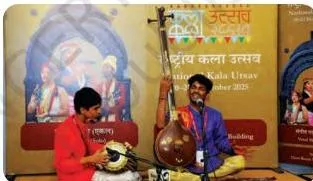
The photo on p. 113 is placed exactly where the chapter begins classifying rāgas, and it shows why: the students are performing Carnatic classical music at Kala Utsav 2025. The rāgas and tālas in the tables around it are what such performances are built from.
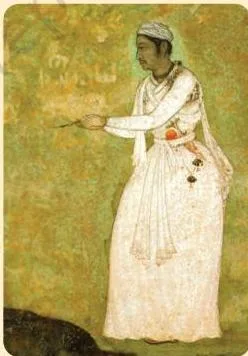
The portrait (p. 114) anchors the chapter’s legend. Tānsen, Akbar’s favourite singer, was tricked by jealous courtiers into singing Rāga Dipaka, believed to create deadly heat.
Only Rāga Megha could save him, so he trained his daughter Sarasvatī and her friend Rūpavatī; as the heat rose during his performance, the girls sang Rāga Megha and brought rain.
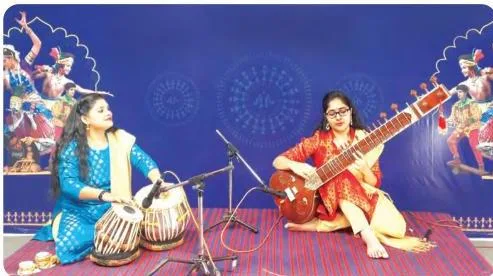
The photograph on p. 119 sits at the head of the Hindustani compositions section, and it pairs the chapter’s two subjects: the sitar carries the melodic line (rāga) while the tabla spells out the rhythm (tāla). The two instruments together show the rāga–tāla partnership the whole chapter is about.

This photo accompanies the listening activity (p. 124): first you react to the beat naturally — tapping your feet or clapping — and then you count how many beats the tāla cycle has. Counting the cycle is what lets you name a tāla: 16 beats suggests Teen Tāla, 10 suggests Jhaptāla, 8 the Ādi Tāla.

The final photo (p. 125) belongs to the song-fitting activity. The chapter asks you to sing or recite your own song while keeping a steady beat, and to notice how the feel of the song changes — that is tāla providing structure and definition to music.
Definitions: From Nāda to Sam
Use this glossary to check a word without rereading the chapter. Meanings are in this page’s words; the NCERT page number shows where the term appears. Terms marked † are used in the book without a formal definition, so the meaning given is a plain-language clarification.
| Term | Meaning | NCERT page |
|---|---|---|
| nāda | Musical sound | 111 |
| śhruti | A sound that is heard clearly and recognised as distinct from another | 111 |
| svara | A note; the seven notes of Indian music are S R G M P D N | 111 |
| saptak / sthāyī | An octave or register; musicians perform in the mandra (lower), madhya (middle) and tāra (higher) octaves | 111 |
| achala-svara / prakṛiti-svara | An invariant note; S and P, which have no variants | 112 |
| chala-svara / vikṛiti-svara | A note with higher and lower variants; R, G, M, D and N | 112 |
| svara-sthāna | A note position; 2 fixed + 2 variants each for R G M D N = 12 in an octave | 112 |
| rāga | A melodic framework comprising a set of notes | 113 |
| ārohaṇa | The ascending scale of a rāga | 113 |
| avarohaṇa | The descending scale of a rāga | 113 |
| rāga-jāti | Classification of rāgas by the number of notes in the scale (Hindustani) | 113 |
| saṃpūrṇa | A jāti using 7 notes | 113 |
| śhāḍava | A jāti using 6 notes | 113 |
| auḍava | A jāti using 5 notes | 113 |
| meḷakartā | One of the 72 basic scales of Carnatic music, each using all seven svaras in ascent and descent | 115 |
| janaka | A parent rāga; the 72 meḷakartās | 115 |
| janya | A derived rāga, made from a janaka by removing notes or changing their order | 115 |
| thāṭ | A Hindustani scale of seven svaras arranged in order; the 10 thāṭs group all rāgas | 116 |
| jatisvaram | A Carnatic composition of svaras and optional rhythmic syllables, generally without lyrics | 117 |
| pallavi † | The opening section of a Carnatic composition | 117 |
| chitte-svara † | A passage of written-out svaras within a Carnatic composition | 117 |
| svarajati | A Carnatic composition that combines simple lyrics with svaras and optional rhythmic patterns | 118 |
| anupallavi † | The second section, following the pallavi | 118 |
| charana † | The closing section of a svarajati | 118 |
| vādi † | The most emphasised note of a rāga | 119 |
| saṃvādi † | The note next in importance to the vādi | 119 |
| pakaḍ † | The characteristic or identifying phrase of a rāga | 119 |
| prahāra | One-eighth of a day; each prahāra lasts three hours | 119 |
| uttarāṅga pradhāna † | A rāga whose melodic weight sits in the upper half of the octave | 119 |
| bandiṣh † | A composed piece in Hindustani music with fixed text and melody | 120 |
| sthāyī † | The first section of a bandiṣh | 120 |
| antarā † | The second section of a bandiṣh | 120 |
| lakṣhaṇa-gīta † | A composition whose text carries the rāga’s characteristics | 121 |
| tāla | The rhythmic cycle that organises beats into a repeating pattern | 122 |
| ṭhekā | The basic pattern of tabla strokes or rhythmic syllables that defines a tāla | 122 |
| mātrā | A single beat within a tāla | 122 |
| vibhāg | A division or group of beats within a tāla | 122 |
| tālī | A stressed beat, usually marked by a hand clap | 122 |
| khālī | An unstressed or “empty” beat, usually marked by a wave of the hand | 122 |
| sam | The first and most important beat of a tāla cycle | 122 |
Note on sthāyī: the word appears twice in this chapter with two meanings — as a name for an octave or register (p. 111), and as the first section of a bandiṣh (p. 120).
Common Mistakes Students Make in Rāga and Tāla
This chapter compares two traditions and counts notes, and both activities invite specific errors. The table names each mistake before you make it, with the correction and a way to check your answer.
| Mistake | Correct rule | How to check your answer |
|---|---|---|
| Treating S and P as variable notes | S (śhāḍja) and P (pañchama) are achala/prakṛiti svaras — fixed, with no higher or lower variant (p. 112) | Table 8.1 shows “No variant” against both S and P |
| Computing 7 × 2 = 14 note positions | Only R, G, M, D and N vary, so positions = 2 + (5 × 2) = 12 (p. 112) | Count Table 8.1: two fixed svaras and ten variant positions |
| Using Hindustani variant names in Carnatic contexts | Names differ: lower R is komala (Hindustani) but śhuddha (Carnatic); higher M is tivra but prati; higher N is śhuddha but kākalī (Table 8.1, p. 112) | Read the correct column of the table for the tradition you are working in |
| Reading jāti names backwards | auḍava-śhāḍava means 5 svaras in the ārohaṇa and 6 in the avarohaṇa — the ascent is named first (p. 114) | Exercise Q10 asks exactly this; say the ascent count before the descent count |
| Mixing the two rāga-family systems | Meḷakartā: Carnatic, 72 scales, Venkatamakhi; thāṭ: Hindustani, 10 scales, Bhatkhande (pp. 115–116) | Attach the scholar to the system: Venkatamakhi ↔ meḷakartā, Bhatkhande ↔ thāṭ |
| Placing Teen Tāla’s khālī on the wrong beat | Khālī is on mātrā 9; tālī is on mātrās 1, 5 and 13 (p. 122) | Redraw the grid and mark X at 1, 2 at 5, 0 at 9, 3 at 13 |
| Treating Bilāval and Alhaiyā Bilāval as one rāga | The book explicitly flags them as two separate rāgas; Alhaiyā Bilāval belongs to the Bilāval thāṭ (p. 119) | Check the “Distinction” row of the Alhaiyā Bilāval profile |
Exam Notes: What the Chapter’s Exercises Test
Textbook contents and the examinable syllabus are not always identical — check the current official CBSE syllabus (cbse.gov.in) before deciding what to revise hardest. The mapping below connects each exercise in the chapter (pp. 125–126) to the skill it tests; it is a map of the chapter, not a promise about any exam paper.
| Exercise | Skill it tests |
|---|---|
| Q1 — explain in one line | Precise definitions: śhāḍava-saṃpūrṇa (6-note ascent, 7-note descent), vibhāg (a division of beats), jāti (classification by number of notes) |
| Q2 — 6 svaras in ārohaṇa and 6 in avarohaṇa | Jāti from note counts; the answer is śhāḍava-śhāḍava, and a learned example such as Gurjarī Todī or Śhrīrañjanī is expected |
| Q3 — achala and chala svaras | Knowing that S and P are fixed while R G M D N have two variants each, with examples from Table 8.1 |
| Q4 — two rāgas derived from Śhaṅkarābharaṇam | Janaka-janya recall: Haṁsadhvani (remove M and D) and Kaṇṇaḍā, the two janya rāgas named in the compositions section |
| Q5 — fill in the blanks | Factual recall: auḍava (5-note rāga), Venkatamakhi (meḷakartā), thāṭ (Bhatkhande’s system), and completing a svara series by extending the given note pattern |
| Q6 — Jatisvaram vs Svarajati | The comparison in one line: Jatisvaram has no lyrics; Svarajati combines svaras with lyrics and optional rhythmic patterns |
| Q7 — introduce Rāga Haṁsadhvani | A short profile: auḍava janya of Śhaṅkarābharaṇam, scale S R G P N Ś |
| Q8 — one classification system with examples | Explaining either rāga-jāti, meḷakartā or thāṭ with two examples from the chapter’s tables |
| Q9 — contributions of four stalwarts | Independent research: Tānsen, Kumar Gandharva, Mīrābāī, MS Subbulakshmi |
| Q10 — identify the jāti | Reverse identification, ascent first: 5/6 → auḍava-śhāḍava; 6/5 → śhāḍava-auḍava; 5/5 → auḍava-auḍava; 7/7 → saṃpūrṇa-saṃpūrṇa |
| Q11 — complete the table | Reproducing the svara-sthāna variant names for S, higher R, lower M, higher N and P from Table 8.1 |
| Q12 — write Teen Tāla’s tāla lipi | The full grid: 16 mātrās, the bol row, and tālī marks X at 1, 2 at 5, 0 at 9, 3 at 13 |
Three revision moves cover almost everything the exercises ask:
- Memorise the twelve-position svara-sthāna grid (Table 8.1) — Q11 asks you to reproduce parts of it, and every jāti question needs you to think in positions, not just names.
- Practise jāti identification in both directions, and always name the ascent first — Q2 and Q10 test exactly this counting, in both orders.
- Be able to redraw Teen Tāla’s full grid from memory: 16 mātrās, the bol row, and tālī marks X at 1, 2 at 5, 0 at 9, 3 at 13 — that is precisely Q12’s tāla lipi.
Activities in the Chapter: Learning Rāga and Tāla by Doing
The activities turn the chapter’s definitions into ear training and writing practice, and each one feeds a skill the exercises check.
- Activity 8.1 — write the scales (p. 114). Write any auḍava scale, any śhāḍava scale and any auḍava-śhāḍava (5-up, 6-down) scale. This is direct practice for the jāti questions Q2 and Q10.
- Discussion circle — name a rāga (p. 115). Give your rāga a name and describe the feeling it should create. The exercise forces you to use the chapter’s descriptive vocabulary.
- Activity 8.2 — identify the bols (p. 123). Listen to a ṭhekā played on the tabla and pick out its bols, the rhythmic syllables that the tāla tables print.
- Activity 8.3 — find the sam (p. 123). Follow the tabla ṭhekā of a bandiṣh and locate the sam, noticing how the artist arrives at it from different directions.
- Activity 8.4 — count a tāla cycle (p. 124). Tap or clap along with a song, then count how many beats its tāla cycle has. Naming a tāla is largely recognising its length.
- Activity 8.5 — write a lyric to tāla (p. 124). Fill in lyrics with one syllable per mātrā, for Teen Tāla (16 mātrās) and Rūpaka Tāla (6 mātrās).
- Activity 8.6 — fit your song to tāla (p. 125). Take the song you created in Chapter 6, Activity 6.7, and fit it to a steady beat — by speeding it up or slowing it down, elongating or compressing a syllable, or adding or removing a word.
Fastest way to learn a tāla cycle: use the lyric activity. The book’s Teen Tāla example fits one syllable to each mātrā — “Once-upon-a / Time-there-lived-a / Little-girl-who / Liked-to-sing-songs” — four syllables per vibhāg, sixteen per cycle.
Write your own sixteen-syllable line, clap on mātrās 1, 5 and 13, wave on 9, and recite it: you will feel the cycle’s length and stress points before you memorise a single bol.
The chapter closes the activity set with its conclusion, in the book’s own words: tāla gives a song structure and definition, and that is one of the factors that separates prose from song lyrics (p. 125).
Key Takeaways: Rāga and Tāla in One Read
The chapter ends with exercises rather than a summary, so this recap is built from its content. Revise from these lines if you have one read left:
- Seven svaras (S R G M P D N) occupy twelve svara-sthānas because S and P are fixed while R G M D N each have two variants (p. 112).
- A rāga is a melodic framework; its jāti is set by the number of notes in the ārohaṇa and avarohaṇa — saṃpūrṇa (7), śhāḍava (6), auḍava (5) — and mixed jātis name the ascent first (pp. 113–114).
- Two family systems group rāgas: 72 meḷakartās in Carnatic music (Venkatamakhi) and 10 thāṭs in Hindustani music (Bhatkhande) (pp. 115–116).
- Janaka (parent) rāgas yield janya rāgas when notes are removed or reordered — Śhaṅkarābharaṇam loses M and D to become Haṁsadhvani (p. 115).
- Carnatic composition forms: Jatisvaram (notes, no lyrics) vs Svarajati (notes plus lyrics); the Hindustani bandiṣh has a Sthāyī then an Antarā; the Lakṣhaṇa-Gīta encodes a rāga’s traits in its own text (pp. 117–121).
- Four tālas: Teen Tāla (16 mātrās), Jhaptāla (10), Ādi Tāla (8), Rūpaka Tāla (6); every tāla has a sam, tālī and khālī structure (pp. 122–124).
Two mnemonics fix the chapter’s most-tested facts: “S and P stand fixed; R G M D N have two homes each.” And for Teen Tāla: “Clap at 1, 5, 13; wave at 9.”
Related Resources for Class 9 NCERT Arts
This listing is maintained for the 2026-27 academic session using the NCERT textbook information available to us. NCERT remains the authority for confirming the latest edition.
Start from the NCERT Class 9 Madhurima (Arts) book page to open other chapters of this textbook, or the Class 9 NCERT books hub for every subject.
For revision-focused versions of individual chapters, the Class 9 Arts revision notes hub collects them chapter by chapter — The Science of Music (Chapter 7) covers the sound foundations this chapter builds on, and Music Travels Around the World (Chapter 9) carries the same ideas into other musical cultures. The notes home and the Class 9 notes section organise everything by subject.
Official sources: the NCERT website (ncert.nic.in) hosts the Madhurima textbook and its chapter PDFs, and the CBSE website (cbse.gov.in) carries the current Class 9 curriculum and syllabus.
Sources and Data Verification
- The figures and page references on this page describe Chapter 8, “Rāga and Tāla”, of the NCERT Class 9 Madhurima (Arts) textbook, official edition on ncert.nic.in; page numbers follow the printed book.
- This page covers Chapter 8 only — not the other chapters of Madhurima, and not other Class 9 arts textbooks.
- The listing is maintained for the current NCERT edition of the book.
- NCERT settles textbook editions, contents and PDFs; CBSE settles curriculum, syllabus and examinations. A chapter appearing in the textbook does not by itself prove what is examinable — check the current official syllabus.
| What the chapter holds | Count | Where it is used |
|---|---|---|
| Printed pages | 16 | |
| Figures with NCERT captions | 7 | |
| Tables | 25 | |
| Activities | 6 | |
| Official NCERT PDF | Download the chapter PDF | the chapter exactly as NCERT publishes it |
Reference: NCERT Class 9 Madhurima (Arts) textbook, chapter 8, official edition on ncert.nic.in.
FAQs: Rāga and Tāla Questions Students Ask
Why does the chapter say there are 7 notes but 12 note positions?
Because only five of the seven notes have variants. S (śhāḍja) and P (pañchama) are achala — they never change. R, G, M, D and N each have a lower and a higher form, so the positions are \(2 + (5 \times 2) = 12\), not \(7 \times 2 = 14\) (NCERT, p. 112).
The seven names S R G M P D N stay seven; the twelve are the actual keys on a keyboard, which is what Fig. 8.1 shows repeating across octaves.
What is the difference between the meḷakartā and thāṭ systems?
They are the two systems that organise rāgas into families. The Carnatic meḷakartā system has 72 scales, each using all seven svaras in both ascent and descent, and was established by Venkatamakhi in the treatise Chaturdaṇḍi-Prakāśhikā (published in the 18th century).
The Hindustani thāṭ system has 10 scales of seven svaras arranged in order and was developed by Pandit Vishnu Narayan Bhatkhande in the early 20th century (pp. 115–116). The rāga itself, not the system, is what a performance uses — the systems exist for classification.
Which svaras are achala and which are chala?
S and P are achala (also called prakṛiti) — fixed. R, G, M, D and N are chala (vikṛiti) — each moves between a lower and a higher position (p. 112).
Examples from Table 8.1: the lower R is komala in Hindustani but śhuddha in Carnatic; the higher M is tivra in Hindustani but prati in Carnatic; S and P have “no variant” in both traditions.
What is the difference between Jatisvaram and Svarajati?
Lyrics. A Jatisvaram is a Carnatic composition built from svaras and optional rhythmic syllables, with no lyrics or sāhitya; the book’s example is in Rāga Kaṇṇaḍā, Ādi tāla, composed by Veena Padmanābhayya (p. 117).
A Svarajati combines simple lyrics with the svaras and optional rhythmic patterns; the book’s example is in Rāga Haṁsadhvani, Ādi tāla (p. 118). Both are janya rāgas of Śhaṅkarābharaṇam.
How do you count Teen Tāla and where are the tālī and khālī?
Teen Tāla has 16 mātrās divided into four vibhāgs of four. Tālī (clap) falls on mātrās 1, 5 and 13; khālī (wave) falls on mātrā 9; sam is mātrā 1 (p. 122).
The bols run dha dhin dhin dha | dha dhin dhin dha | dha tin tin ta | ta dhin dhin dha. Count aloud “1 2 3 4 / 5 6 7 8 / 9 10 11 12 / 13 14 15 16” and you have marked every vibhāg.
What is tāla lipi and how do you write Teen Tāla’s notation?
Tāla lipi is the written notation of a tāla — a grid that lines up each mātrā with its bol and marks the tālī and khālī beats.
Writing Teen Tāla’s tāla lipi (exercise Q12) means drawing 16 columns with the bols dha dhin dhin dha… and marking tālī X on mātrā 1, 2 on 5, khālī 0 on 9, and 3 on 13, exactly as the chapter’s grid does on p. 122.
Explore Class 9 Arts Books
- Previous: The Science of Music
- Next: Music Travels Around the World
Related chapters:
- History of Arts
- Theatre
- Symbols and Metaphors on Stage