
This is the 7 The Science of Music Class 9 chapter of the NCERT Arts book Madhurima — 8 printed pages (NCERT pp. 103–110) that treat music as physics, biology and mathematics.
The official chapter PDF is published on the NCERT portal, linked right below, and this guide maps every section, activity, figure and exercise so you can use the chapter with the book open or revise without it.
Download the NCERT Class 9 Madhurima Chapter 7 PDF
Open the NCERT Class 9 Madhurima Chapter 7 The Science of Music PDF on the official NCERT portal whenever you want the printed text in front of you — its figures, activities and exercises included.
7 The Science of Music Class 9: what is inside Chapter 7
The chapter builds in a fixed order: The Science of Sound, Connecting to musical instruments, The concepts of sound in India, Biology of the Human Voice, How to care for our voices, Vocal warm-ups, Making patterns in rhythm, and a closing EXERCISES set.
It is activity-led: most pages send you to do something — stretch a rubber band, tap your belly, clap in two groups — and the text then explains what you just heard. The chapter’s examples ride on its opening photographs, the sitar and vocal-system diagrams, and a ‘Do you know?’ box on C.V. Raman.
| What the chapter holds | Count |
|---|---|
| Printed pages | 8 (NCERT pp. 103–110) |
| Reading length | about 2,200 words |
| Activities | 6 (Activity 7.1–Activity 7.6) |
| Captioned figures | 8 (Fig. 7.1–Fig. 7.8) |
| Tables | 1 (the three vocal subsystems) |
| Exercise questions | 10 (Q1–Q10) |
The page numbers follow the printed book, so a citation like ‘(NCERT, p. 106)’ points to the same page in the PDF and in your copy.
How Chapter 7 connects music to physics, biology and maths
The chapter opens by stating its plan: music is both an art and a science (NCERT, p. 103). You can enjoy it for the emotions it raises — and you can equally study it in depth.
It then follows three subject threads:
- Physics — vibration, and how a performer controls pitch, loudness and quality, first on a rubber band, then on real instruments.
- Biology — the three subsystems of the human vocal system and how to care for them.
- Maths — counted syllables (akṣharas) build rhythm, and tāla cycles come together at the lowest common multiple.
The closing exercises test exactly these three connections: Q5 is the maths, Q8 asks for the physics link in 50 words, and Q10 asks you to place the human voice in an instrument family.
Pitch, loudness and quality: what the rubber band experiment shows
Sound starts as vibration, and the chapter’s first activity, Activity 7.1, builds a one-string model to hear that vibration (NCERT, p. 104). The activity gives you three separate controls, and each one controls a different property of sound.
| What you change on the model | Property of sound | What you hear |
|---|---|---|
| Tighten or loosen the string | Pitch | The note goes higher or lower |
| Stretch the string over the hollow box | Loudness | The sound gets louder |
| Use a different thickness or material | Quality | The tone changes character |
Why do these three controls work? A tighter string vibrates faster, so its note is higher in pitch. A hollow body shakes with the string and moves more air, so the sound is louder. A thicker string, or one of different material, vibrates in its own pattern — that is why the quality of its tone feels different.
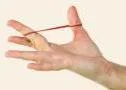
The photograph above shows the finished model: a rubber band stretched across the open face of a small box (Fig. 7.6). Pluck the band and it vibrates; the box turns that small vibration into a noticeably louder sound (NCERT, p. 104).
The same three knobs reappear on real instruments in the next part of the chapter, so hold on to the table above.
The instruments in the chapter and what they demonstrate
Before any theory, the chapter trains your ear. The teacher plays a recording of an instrument from one of four families — string (tata-vādya), wind (suṣhira-vādya), percussion (avanaddha-vādya) and solid (ghana-vādya) — and the class names the family it belongs to (NCERT, p. 103).
The four photographs below are the sorting exercise in picture form — Fig. 7.1 a Chintā, Fig. 7.2 a flute, Fig. 7.3 a santoor, Fig. 7.4 a mridangam.
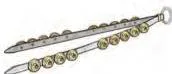
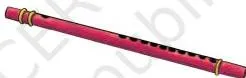
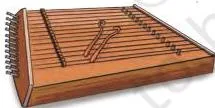
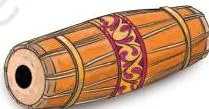
Notice how different the four shapes are: a small hand-held piece, a long tube with holes, a wide box strung with many wires, a two-sided drum. The point of the exercise is that the ear does the sorting — the look alone is not trusted.
The chapter then connects the science of sound to a real instrument. The photograph below shows a sitar (Fig. 7.7), and the observations requested are the rubber band’s three controls in professional form (NCERT, p. 105).
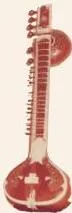
The sitar’s body is hollow, so it makes the sound louder. Its tuning pegs tighten or loosen the strings, so they raise or lower the pitch. Its strings come in different thicknesses, which changes the quality. The chapter’s discussion prompt adds one more skill: describe a played note in words — short or sustained, high or low.
Between the activities the book inserts a ‘Do you know?’ note on C.V. Raman (1888–1970). Raman studied the sounds of the mridangam and the tabla and found them sustained, rich and tunable to a higher or lower pitch (NCERT, p. 104).
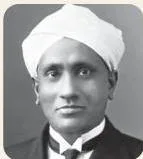
Raman traced that richness to the preparation of the drum membranes. The karaṇai or syāhī, a black patch at the centre made of iron or manganese powder, starch and water, makes the membrane vibrate in complex patterns instead of a single simple motion.
The human vocal system: three subsystems that make your voice
From external instruments the chapter turns inward: the human voice is a musical instrument built into your body (NCERT, p. 106). The chapter’s trick is to make you feel each part working before naming it.
Try the row’s activity, then read the subsystem it reveals:
| Activity you do | Subsystem | Body parts involved |
|---|---|---|
| Hand on belly; breathe in big and let the belly expand, then exhale and feel it move in | Air pressure system | Diaphragm, lungs and surrounding muscles |
| Same breath, but on the exhale make a soft mmmm sound | Vibratory system | Voice box (larynx) and vocal folds (vocal cords) |
| Same again, start at mmmmm then shape the mouth to aaaa, oooo, eeee, uuuuu | Resonating system | Throat, mouth and nasal cavities |
Notice the order. The air pressure system supplies the breath, the vibratory system turns that breath into sound at the vocal folds, and the resonating system shapes the sound into vowels in the throat, mouth and nose. That is the whole chain of the voice.
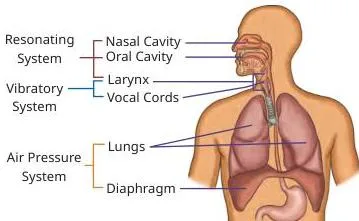
The diagram above (Fig. 7.8) shows the same chain as one picture: the route runs from the lungs and diaphragm up through the larynx to the mouth and nasal cavities.
The book points you to Chapter 10 of the Grade 9 Science textbook for a labelled illustration of the vocal cords. It also quotes Saint Thyagaraja’s kriti, Shobhillu Saptasvara, which describes the seven notes glowing in the abdomen, heart, neck, tongue and nose (NCERT, p. 106).
How to protect your voice: the chapter’s care routine
You have probably felt your voice go tired, or even ‘lost’ it, after hours of speaking or singing. The chapter answers that problem with three care rules (NCERT, p. 107):
- Drink sufficient water — water keeps the vocal cords hydrated and lets them vibrate efficiently.
- Eat a healthy diet — oily or very acidic food can irritate the vocal cords, while fruits and vegetables boost immunity and keep colds and coughs from affecting voice quality.
- Speak at a moderate volume — shouting and raised voices strain the voice, so keep the volume moderate even when you are excited.
Four vocal warm-ups and what each one trains
Warm-ups prepare the three vocal subsystems before real singing, the way stretching prepares muscles before exercise. The chapter gives four (NCERT, p. 108):
| Warm-up | What you do | What it trains |
|---|---|---|
| 1. Breathing and diaphragm exercise | Inhale deeply through the nose, hold for 2–3 seconds, exhale slowly through the mouth | Activates the lungs and diaphragm; breath control that supports long phrases |
| 2. Humming (Bhrāmarī prāṇāyāma) | Hum a comfortable note, feel the vibration in the lips, nose and chest, then slide up and down in pitch | Gently warms the vocal cords; improves resonance |
| 3. Lip trills / bubbles | Blow air through closed lips making a ‘brrr’ sound; glide up and down in pitch | Relaxes the facial muscles, reduces tension, improves airflow |
| 4. Sargam exercises | Sing alankāra patterns at varying speeds; complete the patterns SGR, RMG, GPM and SRGM, RGMP, GMPD | Voice flexibility and breath control |
The sargam patterns are printed incomplete on purpose — completing them is the task, and counting how many phrases you can sing in one breath is the progress measure.
Rhythm is mathematics: akṣharas, tālas and the lowest common multiple
Rhythm, the chapter says, is built using patterns just like numbers. Its language uses spoken syllables as counting words: 1 akṣhara is ta, 2 is taka, 3 is ta kita, and 4 is tha ka di mi (NCERT, p. 109).
Combine the blocks to build longer phrases. A 5-beat phrase is 2 + 3, spoken taka takita; a 6-beat phrase can be 3 + 3 (takita takita) or 2 + 2 + 2 (taka taka taka).
Activity 7.5 asks you to build your own phrases for 7, 8 and 9 akṣharas — for 7 you could use 3 + 4, giving ta kita tha ka di mi.
Then Activity 7.6 makes the arithmetic visible. One group claps the 3-beat phrase ta kita, the other the 4-beat phrase tha ka di mi, starting together. Both groups clap together again after 12 beats: the first has done 4 cycles of 3 and the second 3 cycles of 4 (NCERT, p. 109).
The chapter names the tool behind that alignment: the lowest common multiple, or LCM — the smallest number that is a multiple of two or more numbers. Twelve is the LCM of 3 and 4, which is why the cycles realign at beat 12 and not anywhere earlier.
The same thinking extends to tālas you learned in Grade 7: Teen Tāla has 16 beats and Ektāla has 12, and the LCM of 12 and 16 is 48, so the two cycles complete together after 48 beats (NCERT, p. 109).
Worked example with new numbers — a 5-akṣhara phrase and a 7-akṣhara phrase start together:
- Step 1: List the multiples of the 5-beat cycle: \(5, 10, 15, 20, 25, 30, 35\).
- Step 2: List the multiples of the 7-beat cycle: \(7, 14, 21, 28, 35\).
- Step 3: Find the smallest number that appears in both lists.
\[ \text{LCM}(5, 7) = 35 \]
Final answer: both phrases complete full cycles together after 35 beats.
Why is the LCM the product this time? Five and seven share no common factor, so their LCM is simply \(5 \times 7 = 35\). When cycle lengths share factors — like 12 and 16, which share 4 — the LCM is smaller than the product: 48 rather than 192.
Key terms in this chapter, explained
This chapter mixes physics, biology and Indian musical terms, and each has a precise meaning. The quick glossary below covers the Indian and technical terms the chapter introduces.
| Term | Meaning | Where it appears |
|---|---|---|
| dhvani | sound | ‘The concepts of sound in India’ (p. 105) |
| nāda | musical sound | same |
| śhruti | discernible intervals of sound | same |
| svaras | notes | same; Thyagaraja’s seven svaras |
| Nāṭyaśhāstra, Saṅgita-ratnākara | the ancient Indian texts that explain dhvani, nāda, śhruti and svaras | p. 105 |
| karaṇai / syāhī | the black patch at the centre of a mridangam membrane — iron/manganese powder, starch and water | C.V. Raman note (p. 104) |
| akṣhara | the count unit of rhythm | rhythm section (p. 109) |
| mātra | beat | Exercise Q5 (p. 110) |
| āvartana | cycle | Exercise Q5 (p. 110) |
| tāla | rhythmic cycle | Teen Tāla, Ektāla (p. 109) |
| tata-vādya, suṣhira-vādya, avanaddha-vādya, ghana-vādya | string, wind, percussion and solid instrument families | opening note (p. 103) |
| ta, taka, ta kita, tha ka di mi | spoken counts for 1, 2, 3 and 4 akṣharas | rhythm building blocks (p. 109) |
Mistakes students make in this chapter
Most slips in this chapter come from mixing up two similar ideas. The exercises are built on exactly those mix-ups, so fixing these five clears most of the exercise set (NCERT, pp. 104–110).
| Mistake | Correct rule | How to check your answer |
|---|---|---|
| ‘Tightening a string makes the sound louder.’ | Tightening raises the pitch; the hollow box is what increases loudness. | Activity 7.1 steps 2–3: pluck over the box, then tighten — two separate changes (p. 104). |
| ‘The diaphragm is the vibratory subsystem.’ | The diaphragm and lungs form the air pressure system; the vocal folds in the larynx do the vibrating. | The activity table assigns organs to subsystems (p. 106). |
| ‘C.V. Raman experimented on the veena.’ | He studied the mridangam and the tabla. | Exercise Q2(iii) is false (p. 110). |
| ‘Drinking water is bad for the voice.’ | Water hydrates the vocal cords so they vibrate efficiently. | Exercise Q2(ii) is false (p. 107). |
| ‘When two tāla cycles start together, add the beats to find when they realign.’ | Take the LCM, not the sum. | The 3-beat and 4-beat groups realign at 12, not 7 (Activity 7.6, p. 109). |
How to prepare from the chapter’s exercises
The exercise list at the end of the chapter is the book’s own statement of what you should be able to do after it (NCERT, p. 110). Revise by skill rather than reading linearly.
| Exercise | Skill tested | What a complete answer includes |
|---|---|---|
| Q1 (fill in the blanks) | Direct recall of three key facts | Pitch rises on tightening; diaphragm and lungs = air pressure subsystem; the hollow body increases loudness (pp. 104–106). |
| Q2 (true/false) | Spotting the common mistakes | Thickness affects quality — true; water is good, not bad — false; Raman worked on mridangam and tabla, not veena — false. |
| Q3 (three subsystems) | The full vocal system | Name all three subsystems and the organs of each (p. 106). |
| Q4 (voice condition) | The care rules | Hydration, healthy diet, moderate volume (p. 107). |
| Q5 (Jhaptāla 10 beats, Kehervā 8 beats) | Numerical — applying the LCM | \(\text{LCM}(10, 8) = 40\) beats; show the multiples or the factor method. |
| Q6 (warm-up routine) | The warm-up set | A sensible daily sequence using the four warm-ups (p. 108). |
| Q7 (phrases for 5 and 6) | Building rhythm phrases | 5 = taka takita; 6 = takita takita or taka taka taka (p. 109). |
| Q8 (50-word connection) | Explaining, not listing | Link vibration to pitch, loudness and quality, with an instrument example. |
| Q9 (design a string instrument) | Applying the three controls | A labelled sketch that shows how pitch, loudness and quality are controlled. |
| Q10 (voice’s instrument family) | Reasoning from evidence | No printed answer — argue from the three subsystems and justify the family you choose. |
Two notes. Q10 has no single printed answer; the chapter expects an argument built from the air pressure, vibratory and resonating subsystems. And textbook contents and the examinable syllabus are not always identical — check the current official syllabus to confirm what is examined from this chapter.
How to revise Chapter 7 in one read
The chapter moves in a straight line — sound, the Indian tradition of sound, the voice, and rhythm. Revise it in that order:
- Sound is vibration, and a performer controls three properties: pitch (tightness of the string), loudness (hollow body) and quality (thickness or material).
- Indian texts (Nāṭyaśhāstra, Saṅgita-ratnākara) already named dhvani, nāda, śhruti and svaras (p. 105).
- The voice is three subsystems: air pressure (diaphragm, lungs), vibratory (larynx, vocal folds), resonating (throat, mouth, nose).
- The voice stays healthy with water, a good diet and moderate volume.
- Four warm-ups prepare the voice: breathing, humming, lip trills, sargam.
- Rhythm is count, so tāla cycles align at the lowest common multiple — 3 and 4 at 12, 12 and 16 at 48, 10 and 8 at 40.
One-line takeaway: an instrument, including the human voice, is a controlled vibrating system, and rhythm is arithmetic you can hear.
Where this chapter sits in the Class 9 Madhurima book
Chapter 7 sits inside the NCERT Class 9 Arts book Madhurima, between two chapters that share its hands-on style. The previous chapter, From Vision to Performance: Direction and Acting, leads into it, and the next chapter, Chapter 8 Rāga and Tāla, continues the study of rhythm.
For the rest of the book, browse the Class 9 Arts notes for Madhurima, step up to the Class 9 notes hub, or start from the main CBSE notes index.
| What the chapter holds | Count | Where it is used |
|---|---|---|
| Printed pages | 8 | |
| Figures with NCERT captions | 10 | |
| Tables | 1 | |
| Activities | 6 | |
| Official NCERT PDF | Download the chapter PDF | the chapter exactly as NCERT publishes it |

Reference: NCERT Class 9 Arts (Madhurima) textbook, chapter 7, official edition on ncert.nic.in.
Sources and data verification
This listing is maintained for the 2026-27 academic session using the NCERT textbook information available to us. NCERT remains the authority for confirming the latest edition.
- The figures, page numbers and chapter details on this page describe the NCERT Class 9 Arts textbook Madhurima, Chapter 7, ‘The Science of Music’, in the official edition published on ncert.nic.in.
- This page covers that one chapter only; the previous and next chapters of Madhurima have their own pages.
- The listing is maintained for the current session using the NCERT information available to us.
- NCERT settles textbooks, editions and PDFs; CBSE settles the curriculum, syllabus and examinations.
Frequently asked questions about Chapter 7
Which NCERT book contains Chapter 7 The Science of Music for Class 9?
Chapter 7, ‘The Science of Music’, is in the NCERT Class 9 Arts book Madhurima. It runs from pages 103 to 110 in the official edition.
What are the three subsystems of the human vocal system in this chapter?
They are the air pressure system (diaphragm, lungs and surrounding muscles), the vibratory system (voice box or larynx with the vocal folds) and the resonating system (throat, mouth and nasal cavities).
Does tightening a string make the sound louder or higher in pitch?
Tightening a string raises the pitch — the note gets higher. Loudness comes from a different control: the hollow box or body that vibrates with the string.
How is the lowest common multiple used in the rhythm section of Chapter 7?
The LCM tells you when two rhythmic cycles starting together come back into alignment. In the chapter’s activity, the 3-beat and 4-beat groups clap together again after 12 beats, the LCM of 3 and 4. For Teen Tāla (16 beats) and Ektāla (12 beats), the alignment falls at 48 beats.
What did C.V. Raman discover about the mridangam and the tabla?
Raman found that the mridangam and tabla produce a sustained, rich sound that can be tuned higher or lower. He showed that the karaṇai or syāhī — the black patch of iron/manganese powder, starch and water — makes the membrane vibrate in complex patterns.
After how many beats do Jhaptāla and Kehervā complete full cycles together?
Jhaptāla has 10 beats and Kehervā has 8; their lowest common multiple is 40, so both complete full cycles together after 40 beats.
Explore Class 9 Arts Books
- Previous: From Vision to Performance: Direction and Acting
- Next: Rāga and Tāla
Related chapters:
- History of Arts
- Theatre
- Symbols and Metaphors on Stage