
From Vision to Performance: Direction and Acting is Chapter 5 of the NCERT Madhurima textbook for Class 9 Arts, spanning printed pages 71 to 85. It explains what a theatre director actually does, how actors are trained in Indian and global traditions, and why a play falls apart without direction.
The official From Vision to Performance: Direction and Acting Class 9 PDF is offered on this page, straight from the NCERT portal.
The fastest way to understand this chapter is to do what it asks — it teaches through activities, rehearsals and a final workshop project, not just reading. Use the download link below to get the official file, then jump to any idea from the table of contents.
Download From Vision to Performance: Direction and Acting Class 9 PDF
Get the official From Vision to Performance: Direction and Acting Class 9 PDF from the NCERT portal at ncert.nic.in, so the file you read is the current official edition of the Madhurima book — the one that matches the printed pages and page numbers used across this page.
| What the chapter holds | Count | Where it is used |
|---|---|---|
| Printed pages | 15 | |
| Figures with NCERT captions | 19 | |
| Activities | 3 | |
| Official NCERT PDF | Download the chapter PDF | the chapter exactly as NCERT publishes it |

Reference: NCERT Class 9 Madhurima textbook, chapter 5, official edition on ncert.nic.in.
Chapter 5 at a Glance: Sections, Figures and Activities
The chapter is 15 printed pages, from page 71 to page 85. The table below shows what is inside the file.
| What the chapter holds | Count |
|---|---|
| Printed pages | 15 (pp. 71–85) |
| Sections | 38 |
| Figures | 19 |
| In-class activities | 3 |
The chapter is practice-heavy: it teaches through two class activities, one ensemble activity and a final workshop project rather than through solved examples.
What This Chapter Covers: From the Director’s Chair to the Actor’s Craft
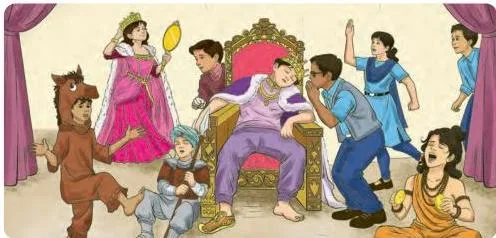
This chapter teaches theatre as a planned craft, not spontaneous play. It opens with a rehearsal of the school play The King Who Lost His Shoes going hilariously wrong — every actor doing something on their own — until the director walks in and fixes posture, movement and voice.
That scene is the book’s definition by example of what direction is (NCERT, p. 71).
Once you know what a director is, the chapter builds the craft in order:
- The director’s role: a director is like a painter arranging colours or a cook balancing ingredients (p. 71).
- The process from micro to macro: script work, visualisation, blocking, balance, movement, then run-throughs and stage rehearsals (pp. 72–75).
- The five styles of direction, from realistic to collaborative (pp. 75–76).
- Acting: the Nāṭyaśhāstra’s four abhinayas, four Indian folk traditions, and four global schools of acting (pp. 77–80).
- Solo and ensemble acting — when to lead and when to blend (pp. 80–82).
- Exercises and a workshop project that turn the reader into the director (pp. 83–85).
The Director’s Process: From Script Work to the Big Picture
The director begins work weeks before rehearsals start and finishes long after the show ends. The primary requirement is reading the script in minute detail while holding the “big picture” — the larger vision of the whole play and the impact it will have on the audience (NCERT, p. 72).
Script work is almost like detective work (pp. 72–73). The director:
- goes through the script more than once to pin down its main themes, emotions and message;
- notes each scene — the place, the characters present, how relationships change, the mood of the moment;
- pictures the play’s visual world: how space, light, sound, costumes and overall tone will feel;
- keeps the freedom to edit or rewrite parts of the script.
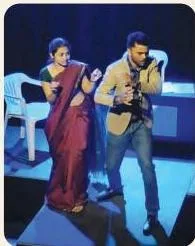
Visualisation and scene building turn those notes into pictures (p. 73). Simple sketches of stage layouts record where the characters are, how and why they move, what props are used and why, and which emotions fill the space through music, light and sound. Earlier, Fig 5.2 asks “Is this similar to what you visualised?”
— a quick test of whether you pictured the opening rehearsal before the chapter started teaching. The chapter also shows a sample scene-building sketch (Fig 5.4) as an example of such visual notes (NCERT, p. 74).
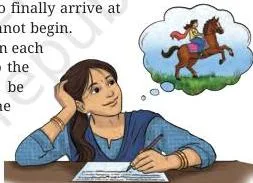
Fig 5.3, captioned “Visualisation and imagination”, is the book’s image for this phase — the scene as it first takes shape inside the director’s head, before the actors arrive.
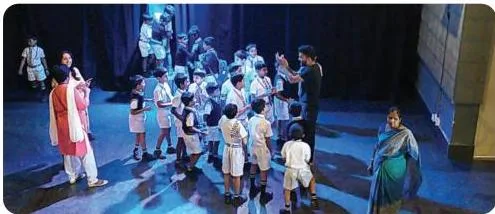
The process then moves through blocking, balance and movement (the next sections), consolidates the departments of music, sound, costumes and lighting, and finishes with polishing, run-throughs and stage rehearsals; Fig 5.7, “Rehearsals and feedback”, shows that final phase (NCERT, p. 76).
Blocking and the Nine Stage Divisions
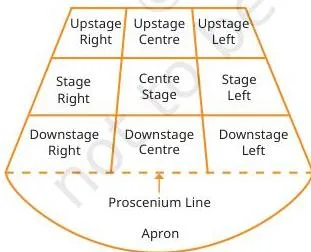
Blocking is the process of deciding the positions of sets, props and actors, and their entries and exits. The universal terminology for naming parts of the stage is called stage division, and it is used across the world (NCERT, p. 73).
Stage division matters in four ways (p. 74):
- Communication — one unambiguous vocabulary for the director, cast and crew avoids miscommunication.
- Blocking of movement — a step toward the audience, downstage, reads as “stronger” and grabs more attention than a move upstage.
- Focus and emphasis — centre and downstage centre are the most prominent areas, often used for major speeches or solos; upstage left suits a discreet entrance.
- Technical crews — lighting designers, sound engineers and set crews use the divisions to place equipment and set pieces.
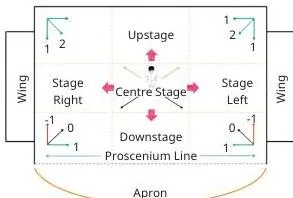
The diagram below, Fig 5.5, splits the performance space into the named zones of the nine-stage division. Read it as a map: every spot on stage has a name, so a director can say “enter upstage left” and everyone knows the identical place.
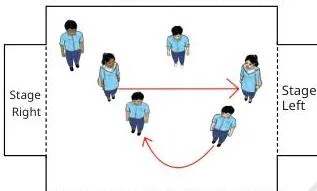
Fig 5.6, “Planning movement on stage”, shows blocking in practice — movement plotted on the stage map so entries, exits and crosses are decided in advance (NCERT, p. 75). Movement that looks random is never random; it has been planned.
Keep this vocabulary ready: the exercises ask you to place characters using the nine divisions (p. 83).
Stage Balance, Composition and Movement
Once the blocking is set, the director checks how the stage looks. Balance Visual Weight means arranging actors, props and actions so the stage does not look empty on one side or crowded on the other, and gives the best visual impact (NCERT, p. 74).
Three composition rules (p. 74):
- Clear focus — direct the audience towards where to look first; highlight the place or person where the action is.
- Strong diagonals — diagonal lines from upstage-left to downstage-right add depth and interest.
- Levels and grouping — different heights and group shapes such as triangles and circles create attractive stage pictures.
Movement on stage is never random — it expresses purpose, emotion and story (pp. 74–75):
- Motivated movement — walk only if the character has a reason; every move connects to dialogue or emotion.
- Avoid upstaging — never block another actor from the audience’s view.
- Use the whole stage — upstage, downstage, left or right, each part should feel alive.
Styles of Direction: Five Ways to Stage a Play
The same script can be directed in very different ways, and this chapter names five styles (NCERT, pp. 75–76). The table below compares them.
| Style | What the audience sees | The director’s main job |
|---|---|---|
| Realistic | Everyday life on stage: characters talk naturally, the set passes for a real place, emotions ring true | Make everything believable — “I’ve seen someone like that!” |
| Abstract or symbolic | The story told through ideas, images and emotions — a cloth may be a mountain, a light colour may show anger or love | Encourage the audience to think and imagine |
| Devised theatre | A performance created together by the group during rehearsals, with no fixed script | Act as guide or facilitator — help actors improvise and explore |
| Script-based | A written text staged faithfully; blocking, movement and tone serve the story | Study the script and respect the playwright’s intention |
| Collaborative | Creative inputs combined — two directors, or a director working with a choreographer or musician | Blend expert inputs into one common concept |
One note holds all five together: the director is “the captain of the ship” — the person who takes decisions for the team, is responsible for the team, and is answerable to the audience (NCERT, p. 76).
Fig 5.8, captioned simply “Direction”, sits at the end of the styles list — the chapter’s single image for the idea that all five styles share one job: someone steering the play from vision to stage (NCERT, p. 77).
Indian Roots: Chaturvidha Abhinaya and Four Folk Traditions
Long before modern acting schools, the Nāṭyaśhāstra (around fifth century BCE) defined the four pillars of performance — chaturvidha abhinaya. The four aspects cover everything a performer uses (NCERT, p. 78):
| Aspect | Element it uses | Example in the chapter |
|---|---|---|
| Āṅgika | Body | Bhedas of head and eyes (śhiro, dṛiṣṭi), hastas — gestures and postures |
| Vāchika | Voice | Voice modulations for different character styles (vṛttis) |
| Āhārya | Accessories | Hand props, jewellery |
| Sāttvika | Inner experience | The rasānubhava — the unique experience of each actor and audience |
Memory aid: remember the four in order as A-V-A-S (Āṅgika, Vāchika, Āhārya, Sāttvika) — body, voice, accessories, inner experience.
Beside this classical framework, the chapter presents four living folk traditions (pp. 78–79):
- Gaura-lilā and Gūsta-lilā (Manipur) — blend music, dance, acting and rituals; the audience joins through chants and responses.
- Bhūta-kola (Karnataka) — a divine folk tradition where local deities and ancestors are worshipped through dance, rituals and Chende drums; it is central to the community’s collective memory and justice system.
- Rammān (Uttarakhand) — on UNESCO’s Intangible Cultural Heritage list; historical stories told through gestures, music and masks, with roles traditionally passed down within groups such as carpenters and drummers.
- Teyyam (Kerala) — an ancient divine tradition with more than 400 variants; its most striking feature is the performer’s transformation into a divine state.
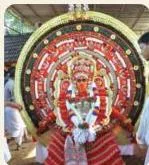
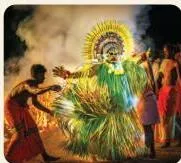
Fig 5.11 shows Bhūta-kola and Fig 5.12 shows Teyyam. Glance at both while you read the list above, because the matching exercise at the end of the chapter expects you to connect each form to its region and description (NCERT, p. 79).
Global Schools of Acting: Four Twentieth-Century Approaches
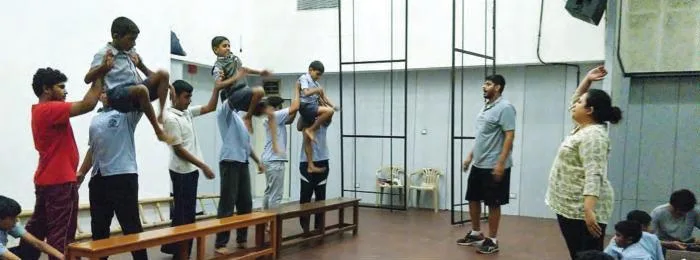
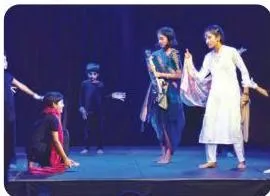
Acting is what fills the director’s structure with life; Fig 5.10, “Children bringing characters to life on stage”, shows how that looks (NCERT, p. 78). In the twentieth century, master teachers then built competing answers to one question: what makes acting truthful? The chapter presents four schools (pp. 78–79):
| School | Founder(s) | Core idea |
|---|---|---|
| The System and Method Acting | Konstantin Stanislavsky, Lee Strasberg | Emotional truth drawn from the actor’s own experiences; the magic “if”; inner monologue; commitment even off stage |
| Epic Theatre — Alienation Theory | Bertolt Brecht | Keep distance between actor and character; avoid emotional involvement so the audience thinks |
| Poor Theatre | Jerzy Grotowsky | Remove elaborate sets, props and costumes; the actor’s body is the most important medium |
| Stella Adler’s Technique | Stella Adler | Build the character through imagination first, then train to that character |
Do not blur Brecht with method acting — the chapter sets them as opposites. Method acting asks the actor to live the emotion; Brecht asks the actor to hold emotion at a distance so the audience thinks rather than being carried away (pp. 78–79).
Fig 5.13, “Method acting”, shows a performer deep inside a character — the emotional commitment that Stanislavsky and Strasberg demanded (NCERT, p. 79).
Solo Acting and Ensemble Acting: Two Ways of Holding the Stage
Actors must know when to lead and when to blend. Theatre is both a personal craft and a shared experience (NCERT, p. 81).
Solo acting is individual presence on stage — monologues, soliloquies, narrations, or a character isolated even while others are present. The actor must hold the audience using only voice, body language, emotional truth and imagination. The chapter’s example: a character delivering a soliloquy about a secret fear keeps the audience engaged with personal energy and expression alone (p. 81).
Group acting is ensemble dynamics — each actor supports the scene rather than trying to stand out. It demands listening, timing, awareness of space and truthful response to others. The chapter’s example: in a market scene one actor speaks while everyone else contributes through movement, reactions and coordinated actions (pp. 81–82).
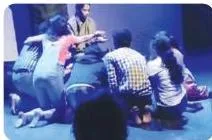
A strong actor knows when to lead and when to blend — individual effort and teamwork are equally important (p. 81). This balance is exactly what Activity 5.3 below exercises.
Learning by Doing: The Chapter’s Activities and Final Workshop
This chapter expects you to learn direction and acting by performing, not just by reading. Three activities build the skills in steps, and the final project asks you to teach them to younger students.
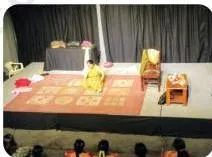
Fig 5.9, a chair used as a symbol of theatre for directors, sits beside the first activity as a reminder that direction begins as an idea before actors arrive (NCERT, p. 77).
Activity 5.1 — The director in you (NCERT, p. 77). In groups of 5–10, re-design a scene you have already performed. Choose one of four techniques:
- emphasise movement — āṅgika;
- focus on voice — vāchika;
- re-work positions and movements using the nine parts of the stage;
- enact the scene without any emotions.
Then perform the redesigned scene and discuss how different the impact was. There is no end to the variations you can try.
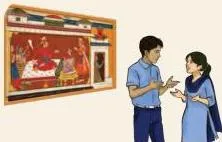
Activity 5.2 — The living painting (NCERT, p. 80). Each group chooses a famous painting, sculpture or traditional artwork and turns it into a one-minute performance. First imagine the situation: what happened before, what happened after; build a small story around the artwork. Then direct: plan each character’s position by importance and by stage divisions, and plan entries and exits.
Then act: turn the still image into a living moment with expression, movement and short lines — try a pure-āṅgika version, then a pure-vāchika version, and add music, rhythm or dance.
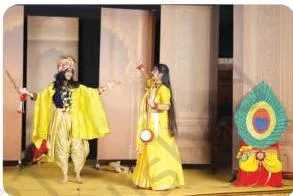
Fig 5.14, “The living painting”, is the chapter’s image of the moment a frozen composition becomes a staged one — the actors’ positions still echo the artwork, but expression and movement make it breathe.
Activity 5.3 — Solo to ensemble (NCERT, p. 82). Step 1: one student performs a simple silent action — waiting for a bus, tying a shoelace, searching for something lost — while the class reads the posture, energy and clarity. Step 2: five or six students perform the same situation together, with no main character; everyone listens with eyes and bodies, adjusting spacing, rhythm and reactions.
Step 3: one actor deliberately changes the tempo or emotion, and the group must adjust organically without speaking. The discussion circle compares the āṅgika and vāchika versions and how solo felt different from group.
The final workshop project (NCERT, pp. 83–85). Working in pairs, plan and run a three-hour theatre workshop for Grades 3–5 students. The brief has three parts:
- Eight possible themes — storytelling through body and voice; emotions and expressions on stage; animals, nature and movement; creating characters from everyday life; the magic of imagination; folk stories and simple drama; rhythm, sound and movement games; teamwork and trust games.
- Three-hour shape — Hour 1: warm-up and comfort (name games, body and voice warm-ups, mirroring games); Hour 2: core theatre activities (theme activities, small group improvisations, story or scene creation); Hour 3: creation and sharing (prepare a short performance, informal sharing, an appreciation circle).
- Six planning steps — divide roles (Partner A leads activities, Partner B manages energy and safety); know your audience (attention span, clear instructions, demonstrations, repetition); design 6–8 short activities of 10–20 minutes; prepare materials (music, simple props, a time-slotted plan); rehearse as facilitators and keep backup activities ready; reflect after the workshop with the children and with each other.
Key Figures in This Chapter and How to Read Them
The figures in this chapter are not decoration — each one carries an idea the text assumes you have already seen. Four repay the closest reading.
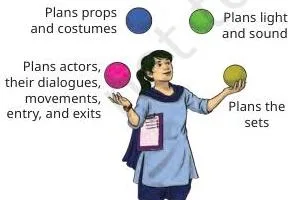
Fig 5.1, “Multiple roles of the director” (NCERT, p. 72), is a map of the chapter’s job description. Read it as everything a director is at once: the guiding vision that shapes how the story looks and feels, the arranger of people, props, costumes, light and sound, and the decision-maker who is answerable to the audience.
If the rest of the chapter is details, this figure is the job advertisement.
Fig 5.5, “Stage divisions” (NCERT, p. 74), the diagram you met in the blocking section, is best read zone by zone:
- Downstage is closest to the audience — a move into it is “stronger”, so it carries dramatic weight.
- Centre and downstage centre are the most prominent zones, reserved for major speeches or solos.
- Upstage left is the quiet corner — good for a discreet entrance.
Fig 5.6, “Planning movement on stage” (NCERT, p. 75), shows arrows plotted on the stage map. Read it as proof that movement is designed, not random: every entry, exit and cross is a decision the director records.
Fig 5.14, “The living painting” (NCERT, p. 80), turns a still image into a staged moment. Read it with Activity 5.2: the actors’ positions still compose like the painting, but expression and movement have brought it to life.
Key Terms and Definitions in This Chapter
The chapter introduces a working vocabulary of theatre, and most of it is examined as vocabulary. Each term below is defined with the printed page where it appears.
| Term | Definition |
|---|---|
| Director (p. 71) | The person who plans how the story looks and feels, guides the actors, and takes the final decisions. |
| Blocking (p. 73) | Deciding the positions of sets, props and actors, and their entries and exits. |
| Stage division (pp. 73–74) | The universal terminology for naming parts of the stage. |
| Downstage / upstage (p. 74) | Downstage is closer to the audience and is a “stronger” area; upstage is farther away. |
| Balance Visual Weight (p. 74) | Arranging actors, props and actions for the best visual impact and an even stage picture. |
| Motivated movement (p. 74) | Moving on stage only when the character has a reason connected to dialogue or emotion. |
| Upstaging (pp. 74–75) | Standing in a way that hides another actor from the audience — to be avoided. |
| Chaturvidha abhinaya (p. 78) | The four pillars of performance from the Nāṭyaśhāstra: āṅgika, vāchika, āhārya, sāttvika. |
| Magic “if” (pp. 78–79) | The actor asks “what if?” and lives the character’s situation as though it were their own. |
| Inner monologue (p. 79) | Keeping the character’s thought process running even when not speaking. |
| Alienation theory (p. 79) | Brecht’s principle of keeping actor–character distance so the audience thinks. |
| Poor theatre (p. 79) | Grotowsky’s stripped-down theatre where the actor’s body is the essential medium. |
| Solo acting / ensemble acting (p. 81) | Holding the stage alone versus supporting a scene as part of a group. |
Common Mistakes Students Make in Direction and Acting
This chapter keeps warning you about the same handful of errors. Here they are before you make them.
| The mistake | The correct rule | How to check yourself |
|---|---|---|
| Blocking a fellow actor from the audience — upstaging (pp. 74–75) | Never hide another actor; the audience must always see everyone important. | Watch the scene from the audience’s side — can you see every face? |
| Moving without a reason (p. 74) | Movement is never random; every move connects to dialogue or emotion. | For each cross, ask: why does this character move now? |
| Forgetting that downstage is stronger (p. 74) | A move toward the audience carries more power than an upstage move. | Save downstage moves for the dramatic moments. |
| Calling abstract direction “wrong” (p. 76) | Abstract or symbolic direction is a deliberate style that makes the audience think and imagine. | Judge it by whether the idea came through, not by realism. |
| Mixing up the four abhinayas (p. 78) | Āṅgika = body; vāchika = voice; āhārya = accessories; sāttvika = inner experience. | Run the A-V-A-S order before you answer. |
| Confusing method acting with Brecht (pp. 78–79) | Method acting builds emotional truth and involvement; Brecht keeps deliberate distance so the audience thinks. | Ask: is the actor drawn in, or standing apart? |
| Treating solo and ensemble as opposites (p. 81) | A strong actor knows when to lead and when to blend — both are part of the craft. | Practise both: a monologue and a group scene. |
Using This Chapter for Practice and Assessment
The exercises at the end of the chapter test application, not memory — you are asked to stage, improvise and explain choices (NCERT, p. 83). The tasks move across the whole chapter:
- a question on the styles of direction — you name them, choose your own style and defend the choice;
- a staging task: place Chhatrapati Śivājī Mahārāja, a visiting poet, the in-house poets and the royal guards on the nine stage divisions, and draw the positions;
- a question on the global schools of acting — which one appeals to you and why;
- an improvisation: the notebook-shop scene, performed with two people and then with five or six, comparing the difference as actor and as audience;
- a question on which theatre departments come together, and the order in which you, as director, would work with them starting from the script;
- a matching exercise linking Āṅgika, Bhūta-kola, Gaura-līlā and Āhārya to their descriptions.
Textbook contents and the examinable syllabus are not always identical — check the current official CBSE syllabus to see how this chapter is assessed. And because the three activities and the workshop are designed into the chapter as learning, attempting them is the intended preparation.
The Chapter in One Read: From the Rehearsal Chaos to the Living Painting
If this chapter had a single line on each page, it would read like this:
- A play without a director is noise and confusion; with guidance it becomes theatre (p. 71).
- A director sees the minute detail and the big picture at once (pp. 71–72).
- The process runs script work, visualisation, blocking, balance, movement, consolidating departments, then run-throughs and stage rehearsals (pp. 72–75).
- Five styles of direction exist, from realistic to collaborative — and the director is the captain of the ship (p. 76).
- Actors fill the director’s structure with life (p. 78).
- India’s four abhinayas and four folk traditions stand beside twentieth-century global schools, from Stanislavsky to Stella Adler (pp. 78–80).
- Solo presence and ensemble harmony are both part of the craft (p. 81).
- The chapter closes by making you direct, act, and run a workshop for younger students (pp. 83–85).
Related Chapters and Resources
This listing is maintained for the 2026-27 academic session using the NCERT textbook information available to us. NCERT remains the authority for confirming the latest edition.
This is chapter 5 of the NCERT Madhurima textbook for Class 9 Arts. Open the Madhurima book page to browse its chapters, or start from the Class 9 hub to see which Class 9 NCERT textbooks this site covers. Sibling chapters in the same book include Creativity in Light and Sound (chapter 4) and The Science of Music (chapter 7).
For revision-oriented notes on the arts chapters, see the Class 9 arts notes, the Class 9 notes hub or the main notes directory.
The official NCERT portal (ncert.nic.in) is the authoritative source for the Madhurima textbook and its chapter PDFs.
Sources and Data Verification
- The figures on this page describe the NCERT Madhurima Class 9 Arts textbook, chapter 5, “From Vision to Performance: Direction and Acting”, printed pages 71–85, official edition.
- This page covers that single NCERT chapter; it does not cover other Class 9 textbooks or other chapters of Madhurima.
- The listing is maintained using the NCERT information available to us for the current academic session.
- Authority: NCERT settles textbooks, editions and official PDFs; CBSE settles the curriculum, syllabus and examinations. The official chapter PDF is hosted on ncert.nic.in, and the page numbers cited here match the printed textbook edition.
Frequently Asked Questions
What is blocking in theatre and how do stage divisions help?
Blocking is deciding the positions of sets, props and actors, and their entries and exits (NCERT, p. 73). Stage divisions give every part of the stage a name, so a director can say “enter upstage left” and the whole cast and crew understand the same spot. The shared vocabulary avoids miscommunication across acting, lighting, sound and set teams.
What are the nine stage divisions of a performance space?
The stage is divided into nine named zones — three depths (upstage, centre, downstage) across three lanes (left, centre, right) — so every position has one clear name (NCERT, p. 74). The chapter says that centre and downstage centre are the most prominent areas for major speeches, and upstage left suits a discreet entrance.
A move into downstage is “stronger” than a move upstage.
What is chaturvidha abhinaya in the Nāṭyaśhāstra?
Chaturvidha abhinaya is the four-pillar framework of performance from the Nāṭyaśhāstra (around fifth century BCE): āṅgika (body), vāchika (voice), āhārya (accessories) and sāttvika (inner experience) (NCERT, p. 78). Together they cover everything a performer uses on stage. Remember the order as A-V-A-S.
What is the difference between Stanislavsky’s method acting and Brecht’s epic theatre?
Method acting builds emotional truth — the actor draws on personal experience, uses the magic “if” and stays committed to the character even off stage (NCERT, pp. 78–79). Brecht’s epic theatre is the deliberate opposite: the actor keeps distance from the character and avoids emotional involvement, because the goal is for the audience to think instead of being swept away (NCERT, p. 79).
What is the difference between realistic and abstract direction?
Realistic direction makes the stage look and feel like real life — natural speech, believable sets and genuine emotions (NCERT, p. 76). Abstract or symbolic direction tells the story through ideas and images, such as a cloth as a mountain or a light colour as anger. Neither is a mistake — they are two deliberate styles with different jobs.
Is the chapter on direction and acting part of the examinable Class 9 Arts syllabus?
The chapter is part of the NCERT Madhurima textbook, but textbook contents and the examinable syllabus are not always identical. Check the current official CBSE syllabus for Class 9 Arts to see how this chapter is assessed — and treat the activities and workshop as the intended way to learn the skills it teaches.
Reference: NCERT Class 9 Madhurima textbook, chapter 5, official edition on ncert.nic.in.
Explore Class 9 Arts Books
- Previous: Creativity in Light and Sound
- Next: The Science of Music
Related chapters:
- History of Arts
- Theatre
- Symbols and Metaphors on Stage