
The 9 Music Travels Around the World Class 9 chapter of the NCERT Madhurima Arts book runs eight printed pages, from book page 126 to page 133, and the official NCERT PDF is right below.
The chapter follows music as it moves with people — from Chutney music in the Caribbean to UK Bhangra — then groups the world’s instruments into families and ends with the making of the veena. Download the free official PDF below, or read the explanations here with your book open.
Download the 9 Music Travels Around the World Class 9 PDF
The official 9 Music Travels Around the World Class 9 PDF is NCERT’s own file for Chapter 9 of the Madhurima book — the complete eight-page chapter, pages 126 to 133, exactly as printed, free to read or save. This is the same file NCERT publishes on its official site, so what you download is the official edition, not a copy made by anyone else.
Chapter at a Glance: What Is Inside
The table on this page lists what the chapter holds — its sections, figures, activities and questions — so you can see the size of the file before you open it. This chapter is 8 printed pages, NCERT book pages 126 to 133.
What This Chapter Covers, From Migration to the Veena
This is a short Arts chapter about how music travels with people and how instruments are grouped into families. The flow runs in one straight line from people to genres to instruments.
- Music and migration — what a diaspora is and what migrant music does (p. 126)
- Chutney music — the Caribbean genre born from Bihar and Uttar Pradesh migration (p. 126)
- UK Bhangra — how Punjabi migrants reworked Bhangra in British cities (p. 127)
- Siddi Dhamal and flamenco — music that entered India, and Indian music that reached Spain (pp. 127–128)
- The Nātyāśāstra four-family classification — tata, sushira, avanaddha and ghana (p. 128)
- The lute family and the flute family — instruments from five countries (pp. 128–131)
- The making of the veena — from a single block of wood to the finished instrument (pp. 131–133)
- Exercises on page 133
Key Concepts: Diaspora, Hybrid Genres and Instrument Families
The ideas the exercises on page 133 test are few and short. Read them as a set — the chapter builds from migration to instruments in a straight line.
Migration and diaspora
Migration is the movement of people from one place to another to settle in a new location. When a group with a shared origin settles in a new country, it forms what the chapter calls a diaspora (p. 126).
Over thousands of years, people moved in and out of the Indian subcontinent, carrying their music with them. That music linked them to home, helped them bond with fellow migrants, preserved cultural practices, and expressed feelings and hardships (p. 126).
When migrant music met local sounds, it blended into new, hybrid genres and enriched the cultural landscape. This one idea explains everything else in the chapter (p. 126).
Chutney music
Chutney is the chapter’s first example of a hybrid genre — music born when two places meet inside one community. It emerged from the migration of Indians from Bihar and Uttar Pradesh to the Caribbean islands in the nineteenth and early twentieth centuries (p. 126).
Three things define it (p. 126):
- Blend — Bhojpuri folk songs, bhajans and the dholak joined Caribbean styles soca and calypso, creating a lively fusion.
- Lyrics — mixed in Bhojpuri, Hindi, English and Creole, reflecting everyday life and cultural identity.
- Sound — the dholak, tassa, dhantal and keyboards give Chutney its energetic, dance-driven beat.
UK Bhangra
UK Bhangra is the second hybrid genre, and it shows the same process happening in Britain. Bhangra itself is a vibrant folk music-and-dance tradition from Punjab, rooted in energetic dhol rhythms and celebration (p. 127).
Punjabi migrants who settled in the UK between the 1950s and 1980s brought it with them to preserve their identity and community. Young musicians growing up between Punjabi homes and British cities blended Bhangra with reggae, hip-hop, pop and electronic sounds (p. 127).
The result, UK Bhangra, combines fast beats, heavy bass, Punjabi lyrics and modern instruments (p. 127).
Listening guide: the chapter’s named tracks
The chapter names four tracks to listen to. Each one lets you hear the genre description above in action:
- Phulowrie Bina Chutney Kaise Bani, by Sundar Popo (p. 126) — listen for the dholak and tassa percussion, and the Bhojpuri-Hindi-English-Creole lyric mix.
- Cham Cham Baje, by Drupatee Ramgoonai (p. 126) — listen for the dance-driven beat built from the Chutney instruments, dholak, tassa, dhantal and keyboards.
- Tutak Tutak Tootiya, by Malkit Singh (p. 127) — listen for the energetic dhol rhythm that carries the Bhangra tradition.
- Dowain Jaaniya, by the Heera group (p. 127) — listen for Punjabi vocals over fast beats and heavy bass, the UK Bhangra blend.
You do not need to name every instrument you hear — just notice which tradition each sound belongs to. That is exactly the skill the closing listening question tests.
Music moving both ways
Migration is not one-directional. The chapter makes this point twice (pp. 127–128):
- The Siddi community’s Siddi Dhamal music-dance combines African traditions with Gujarati folk traditions — music that came into India (p. 127).
- Flamenco, the tradition of song, dance and guitar music from southern Spain, traces its roots to Roma migrations from Rajasthan to Spain between the ninth and fourteenth centuries, where the music blended with Jewish and Moorish cultures (p. 128).
The Nātyāśāstra classification
Before comparing instruments across countries, the chapter anchors you in an Indian system. The Nātyāśāstra classifies all instruments into four families (p. 128):
- Tata — string instruments
- Sushira — wind instruments
- Avanaddha — percussion instruments
- Ghana — solid instruments
What is remarkable is that this classification applies to instruments found anywhere in the world. Instruments can also be classified by musical genre, by country or region, or by shared characteristics (p. 128) — which is exactly what the lute and flute families do.
The lute family
The lute family is a cross-cultural family of plucked string instruments. All members share one basic design — a wide resonating body and a narrow neck — but differ in materials and construction (pp. 128–129).
- Oud (West Asia) — belly of wood
- Banjo — belly of skin
- Shamisen (Japan) — traditionally cat skin
- Cuatro (Puerto Rico) — seasoned jagrumo wood
- Sarod (India) — stretched goatskin top
Recent times have also brought synthetic materials (p. 129). A bowed instrument like the violin is not a lute, because the lute family means plucked strings on a resonating body with a neck.
The flute family
The flute is among the most ancient types of musical instruments — archaeologists have uncovered flutes dating back tens of thousands of years. At its most basic, a flute is a hollow tube that produces sound when the player blows air into it or across a hole on its surface (pp. 129–130).
Found in nearly every culture, flutes show how different societies shaped one basic idea into astonishing variety. The chapter compares four of them — the ocarina, recorder, bansuri and shakuhachi — in the table below (pp. 130–131).
| Instrument | Region of origin | Type of flute | Material | Sound and key features |
|---|---|---|---|---|
| Ocarina | Central America; modern form in Italy | Vessel flute | Clay or ceramic | Warm, pure tone; compact shape |
| Recorder | Europe | Duct flute | Wood or plastic | Clear, bright tone; easy to learn |
| Bansuri | India | Transverse flute | Bamboo | Smooth, airy sound; expressive slides (meend) |
| Shakuhachi | Japan | End-blown flute | Bamboo | Breath-rich, meditative tone; flexible pitch bending |
All four work on the same hollow-tube principle, yet each culture shaped it differently — the material, the way air is blown, and the playing technique change the sound completely.
The veena
The veena is one of the oldest string instruments of India and the chapter’s closing subject. It is traditionally crafted from a single block of wood, most commonly jackwood (pp. 131–132).
The instrument has two principal parts: a resonator called the kuḍam and a long hollow neck called the daṇḍi. At the end of the daṇḍi is a decorative carving of the yazhi, a mythical creature (p. 133).
The veena is central to Carnatic Music and is most commonly played in southern India (p. 133). The photos on pages 132–133 take you through its making step by step.
Figures in This Chapter, Explained
The photographs in this chapter carry its evidence — they show the dances, performers and instruments the text describes. Work through them in order with the book open.
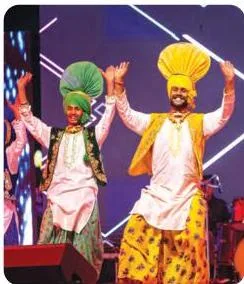
Fig. 9.1 shows Bhangra, the Punjabi folk music-and-dance tradition rooted in energetic dhol rhythms and celebration (NCERT, p. 128). This is the tradition that Punjabi migrants took to the UK, where young musicians blended it with reggae, hip-hop, pop and electronic sounds to create UK Bhangra (p. 127).
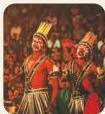
Fig. 9.2 shows Siddi Dhamal, the music-dance form the chapter offers as proof that music also moved into India. It combines African traditions with Gujarati folk traditions (NCERT, p. 128) — the reverse direction from Chutney and UK Bhangra.

This familiar icon is your hook into the chapter’s second migration story. The flamenco tradition it represents traces its roots to Roma migrations from Rajasthan to Spain between the ninth and fourteenth centuries, where the music blended with Jewish and Moorish cultures (NCERT, p. 129).
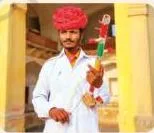
The rāvaṇa-hatthā is an ancient bowed string instrument that, according to folklore, was invented by Rāvaṇa in Lanka. It continues to be used as a folk instrument in Rajasthan (NCERT, p. 129). The chapter uses it to open a question: can you find other instruments that belong to the family of bowed string instruments?
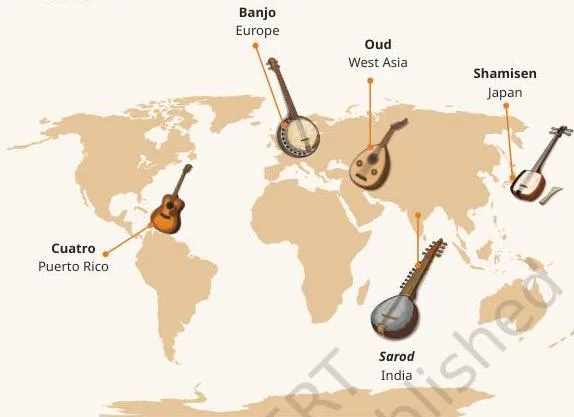
Fig. 9.4 gathers several flutes in one plate so you can see the family at a glance. They all work on the same idea — a hollow tube played by blowing — yet each culture shaped that idea differently (NCERT, p. 130). The four individual photos that follow are the chapter’s close look at this variety.

Fig. 9.5 is the ocarina, a vessel flute from Central America, with its modern form in Italy, made of clay or ceramic. The chapter highlights its warm, pure tone and compact shape (NCERT, p. 130).
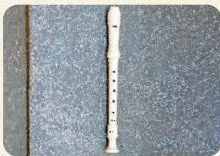
Fig. 9.6 is the recorder, a duct flute from Europe made of wood or plastic. The chapter notes its clear, bright tone and says it is easy to learn (NCERT, p. 131).

Fig. 9.7 is the bansuri, India’s transverse flute made of bamboo. Its key feature is a smooth, airy sound capable of expressive slides called meend (NCERT, p. 131).
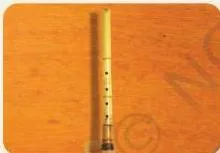
Fig. 9.8 is the shakuhachi, an end-blown bamboo flute from Japan. The chapter describes its tone as breath-rich and meditative, with flexible pitch bending (NCERT, p. 131) — a different character from the recorder’s bright clarity.
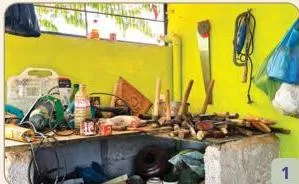
The veena-making plates on p. 132 record the instrument being built, stage by stage. The sequence matters because it answers the chapter’s question — how does a single block of wood become a playable instrument (NCERT, p. 132)?
Read the photos in this order: the craftsperson works a single block of wood — most commonly jackwood — into the two principal parts, the resonator called the kuḍam and the long hollow neck called the daṇḍi.
The final images show the finished veena with its decorative carving of the yazhi, a mythical creature, at the end of the daṇḍi (NCERT, p. 133).
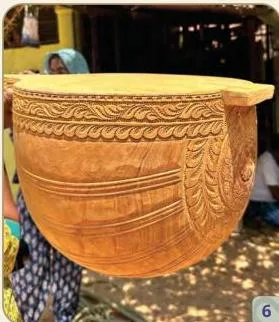
The finished veena on p. 133 lets you see the argument of the whole chapter in one instrument. The wide body is the resonator, the kuḍam; the long hollow neck is the daṇḍi; the carving at its end is the yazhi (NCERT, p. 133).
Terms and Definitions to Remember
These are the terms the exercises on page 133 expect you to use correctly. Each definition gives the chapter’s own sense of the word, in fewer words.
| Term | Definition | Page |
|---|---|---|
| Migration | The movement of people from one place to another to settle in a new location. | p. 126 |
| Diaspora | A population of people with a shared origin that settles in a new country. | p. 126 |
| Hybrid genre | A new style created when migrant music blends with local sounds. | p. 126 |
| Chutney music | Caribbean genre from Bhojpuri folk songs, bhajans and the dholak blended with soca and calypso; lyrics mix Bhojpuri, Hindi, English and Creole. | p. 126 |
| UK Bhangra | Punjabi Bhangra blended with reggae, hip-hop, pop and electronic sounds by Punjabi migrants in Britain; fast beats, heavy bass, Punjabi lyrics, modern instruments. | p. 127 |
| Tata | String instruments — the first of the four Nātyāśāstra classes. | p. 128 |
| Sushira | Wind instruments — the second of the four Nātyāśāstra classes. | p. 128 |
| Avanaddha | Percussion instruments — the third of the four Nātyāśāstra classes. | p. 128 |
| Ghana | Solid instruments — the fourth of the four Nātyāśāstra classes. | p. 128 |
| Lute family | Plucked string instruments across Asia and Europe sharing a wide resonating body and narrow neck (oud, banjo, shamisen, cuatro, sarod). | pp. 128–129 |
| Flute family | Wind instruments made as hollow tubes that sound when the player blows air into or across a hole (ocarina, recorder, bansuri, shakuhachi). | pp. 129–131 |
| Ocarina | Vessel flute from Central America, modern form in Italy; clay or ceramic; warm, pure tone. | p. 130 |
| Recorder | Duct flute from Europe; wood or plastic; clear, bright tone; easy to learn. | p. 131 |
| Bansuri | Transverse flute from India; bamboo; smooth, airy sound with expressive slides (meend). | p. 131 |
| Shakuhachi | End-blown flute from Japan; bamboo; breath-rich, meditative tone. | p. 131 |
| Kuḍam | The resonator of the veena. | p. 133 |
| Daṇḍi | The long hollow neck of the veena. | p. 133 |
| Yazhi | The decorative carving of a mythical creature at the end of the veena’s daṇḍi. | p. 133 |
Two Activities in This Chapter (and Why They Matter)
The chapter plants two activities inside the text, and both feed directly into the final questions on page 133. Doing them first makes the exercises much easier.
Activity 1: Migration in your family (p. 127)
Speak to a person who has migrated and ask them to share a song that reminds them of their home. Then write a few lines of a song about your own home and family in your journal — this feeds straight into Q9, where you imagine migrating to another state and write song lines describing your emotions.
Activity 2: Discovering families (p. 130)
Zithers are a family of stringed instruments. Find four or five zither-family instruments from around the world, listen to their sound, and table the differences in sound, material and playing technique.
Then listen to two different stringed instruments and note their similarities and differences — this is the preparation for Q10, where the chapter asks you to compare the bowed violin and the plucked guitar.
Common Mistakes in This Chapter (and How to Fix Them)
These are the errors students make with this chapter’s exercises — usually from rushing the matching question or classifying by material instead of by how sound is produced.
| Mistake | Correct rule | How to check your answer |
|---|---|---|
| Matching Sarod to West Asia because it looks like an oud | Sarod is Indian with a goatskin top; Oud is West Asian with a wooden belly; Shamisen is Japanese; Cuatro is Puerto Rican (p. 129) | For Q4, say the country and one material detail for each instrument before you match, then check your pairings against the lute family list on pp. 128–129 |
| Calling every string instrument a lute | The lute family means plucked strings with a wide resonating body and a narrow neck (pp. 128–129) | Ask: is it plucked, and does it have a body plus neck? A bowed violin fails both tests |
| Treating bansuri as not a wind instrument because it is made of bamboo | The flute family is a wind family — bamboo is only the material; bansuri is a transverse flute blown across a hole (p. 131) | Classify by how sound is produced (blowing into or across the tube), never by material alone |
| Answering the Chutney question without the blend | Chutney is Bhojpuri folk songs, bhajans and the dholak blended with Caribbean soca and calypso; lyrics mix four languages; instruments include dholak, tassa, dhantal and keyboards (p. 126) | A full 50-word answer names both blended sides, the instruments, and the language mix |
| Thinking migration only moved music out of India | Music moved both ways — Siddi Dhamal brought African traditions into Gujarat, and Roma migration from Rajasthan to Spain helped shape flamenco (pp. 127–128) | For Q8, give one example of music entering India and one leaving it |
How the Exercises Use This Chapter
The questions on page 133 test the chapter in the order it teaches. Use this map to revise by working the questions yourself.
| Question | What it asks | Where the answer lives |
|---|---|---|
| Q1 | Name two instruments of the flute family and where they are from | Ocarina, recorder, bansuri or shakuhachi — comparison table, pp. 130–131 |
| Q2 | Describe features of Chutney music (50 words) | Chutney section, p. 126 |
| Q3 | Give two musical instruments and the materials used to make them | Lute and flute families — e.g. bansuri (bamboo), oud (wood), sarod (goatskin), pp. 128–131 |
| Q4 | Match Cuatro, Sarod, Shamisen and Oud to their countries | Lute family list, pp. 128–129 |
| Q5 | Other ways to classify instruments besides tata, sushira, avanaddha and ghana | Families of Musical Instruments, p. 128 |
| Q6 | Describe characteristic features of the lute family with examples | Lute family, pp. 128–129 |
| Q7 | What purpose does music serve when people migrate? | Music and Migration, p. 126 |
| Q8 | Is the mixing of musical genres from migration beneficial? Justify | Chutney, UK Bhangra, Siddi Dhamal and flamenco, pp. 126–128 |
| Q9 | Write a few lines of a song about migrating within India and leaving family behind | Activity “Migration in your family”, p. 127 |
| Q10 | Listen to the violin (bowed) and guitar (plucked) and explain the difference in sound | Activity “Discovering families”, p. 130 |
How to structure the 50-word Chutney answer (Q2): use four points — origin (migration from Bihar and Uttar Pradesh to the Caribbean), the blended styles (Bhojpuri folk songs and bhajans with soca and calypso), the instruments (dholak, tassa, dhantal, keyboards), and the language mix (Bhojpuri, Hindi, English, Creole). Four sentences, one per point, stays safely inside fifty words (p. 126).
The Chapter in Brief
Music travels with people, and where it lands it blends. Migrants used music to stay linked to home, bond with fellow migrants and express hardship, and the blend of home and local sounds created hybrid genres — Chutney music in the Caribbean and UK Bhangra in Britain.
Music also moved into India, through communities like the Siddi, and Indian-rooted traditions travelled out, as with the Roma migration behind flamenco. Instruments can be classified by the Nātyāśāstra’s four families — tata, sushira, avanaddha and ghana — or by shared characteristics such as the lute family and the flute family across cultures.
The chapter closes with the veena, one of India’s oldest string instruments, made from a single block of jackwood with its kuḍam, daṇḍi and yazhi, and the exercises on page 133 test all of the above.
Related NCERT Pages
If this chapter connected with you, the next places to go are the other pages of the same book and the Class 9 hub.
- Class 9 Madhurima Arts book page — the full list of chapters in this reader
- Class 9 hub — the NCERT subject pages for Class 9
- The previous chapter, Rāga and Tāla — the companion chapter of this book on Indian classical music
- Dance pages for Class 9 — for the dance side of the performing arts
Sources and data verification
This listing is maintained for the 2026-27 academic session using the NCERT textbook information available to us. NCERT remains the authority for confirming the latest edition.
- This page describes NCERT Class 9 Madhurima (English), Chapter 9, “Music Travels Around the World”, pages 126–133. The official PDF is on ncert.nic.in.
- It covers the Madhurima book only — not the other Class 9 Arts readers or the wider CBSE scheme.
- It is maintained for the current academic session using the NCERT information available to us.
- NCERT settles textbooks, editions and PDFs; CBSE settles curriculum, syllabus and examinations. Textbook contents and the examinable syllabus are not always identical — check the current official syllabus.
| What the chapter holds | Count | Where it is used |
|---|---|---|
| Printed pages | 8 | |
| Figures with NCERT captions | 11 | |
| Tables | 1 | |
| Activities | 2 | |
| Official NCERT PDF | Download the chapter PDF | the chapter exactly as NCERT publishes it |
Reference: NCERT Class 9 Arts textbook, chapter 9, official edition on ncert.nic.in.
Frequently Asked Questions
What is Chutney music and which instruments are used in it?
Chutney music emerged from the migration of Indians from Bihar and Uttar Pradesh to the Caribbean islands in the nineteenth and early twentieth centuries. It blends Bhojpuri folk songs and bhajans with Caribbean styles soca and calypso, and its lyrics mix Bhojpuri, Hindi, English and Creole. The dholak, tassa, dhantal and keyboards give it its energetic, dance-driven sound (p. 126).
What is UK Bhangra and how did it start?
Bhangra is a vibrant folk music-and-dance tradition from Punjab rooted in energetic dhol rhythms. When Punjabi migrants settled in the UK between the 1950s and 1980s, young musicians blended it with reggae, hip-hop, pop and electronic sounds. The result, UK Bhangra, combines fast beats, heavy bass, Punjabi lyrics and modern instruments (p. 127).
Which instruments belong to the lute family?
The lute family is made of plucked string instruments from across Asia and Europe that share a wide resonating body and a narrow neck. The chapter’s examples are the oud (West Asia), the banjo, the shamisen (Japan), the cuatro (Puerto Rico) and the sarod (India). They differ mainly in materials — wood, skin, or more recent synthetic materials (pp. 128–129).
What are the four flutes compared in the chapter and how do they differ?
The chapter compares the ocarina (Central America, with its modern form in Italy), the recorder (Europe), the bansuri (India) and the shakuhachi (Japan). They differ in type — vessel, duct, transverse and end-blown — and in material, with the two bamboo flutes sounding entirely different from the clay ocarina and the wooden recorder (pp. 130–131).
What do tata, sushira, avanaddha and ghana mean?
These are the four classes of instruments in the Nātyāśāstra: tata means string instruments, sushira wind instruments, avanaddha percussion instruments and ghana solid instruments. The chapter stresses that this classification applies to musical instruments found anywhere in the world (p. 128).
How is the veena made and what are its parts?
The veena is traditionally crafted from a single block of wood, most commonly jackwood. Its two principal parts are the resonator, called the kuḍam, and the long hollow neck, called the daṇḍi.
At the end of the daṇḍi is a decorative carving of the yazhi, a mythical creature; the instrument is central to Carnatic Music and most commonly played in southern India (pp. 132–133).
Explore Class 9 Arts Books
- Previous: Rāga and Tāla
- Next: Dance
Related chapters:
- History of Arts
- Theatre
- Symbols and Metaphors on Stage