This page carries Chapter 3, Symbols and Metaphors on Stage, from the NCERT Class 9 Arts textbook Madhurima — 11 printed pages, NCERT page 51 to 61. The official 3 Symbols and Metaphors on Stage Class 9 chapter PDF is right below, followed by an explanation of what the chapter teaches, how its figures work, and what the exercises expect from you.
Download 3 Symbols and Metaphors on Stage Class 9 PDF
This is the official NCERT textbook file for the chapter — the same Madhurima PDF used in class, with every figure, the Scene work tables and the end-of-chapter exercises at full size.
Download 3 Symbols and Metaphors on Stage Class 9 chapter PDF and keep it open while you work through this page — the figures and the exercise questions at page 61 refer back to the printed chapter.
Chapter at a glance
The table below shows what is inside the chapter file — sections, figures, activities and questions — so you can size up the work before you read.
| What the chapter file holds | Count |
|---|---|
| Printed pages | 11 |
| Section headings | 26 |
| Figures | 13 |
| Tables | 3 |
| Activities | 3 |
| In-text questions | 2 |
The chapter is one continuous design project. Scene 1 — two kings about to sign a peace treaty — and Scene 2 — a hospital waiting room — are introduced at page 54, and every Scene work block builds the same two scenes, element by element, as you learn each new tool.
What this chapter covers, in the order it teaches
This chapter is not reading-heavy prose. It is built from observation tasks and design work, and each section ends by asking you to apply an idea to the two scenes. The chapter’s opening image makes the first point visually: the moment a stage is dressed, it is already speaking.

In the book’s order, the blocks are:
- The opening claim, under the label Śhṛṅgāra Rasa: everything on stage — lights, props, set designs, even a red scarf — communicates (p. 51).
- Beyond words: observe Fig 3.1 and answer the open questions — what the two levels imply, what the first object you notice could represent, and what other forms of communication exist and why they are necessary (p. 51).
- Symbolism and Metaphors in Theatre: the two definitions and the five reasons they are necessary (p. 52–53).
- Symbolism Using Colour: why colour leads the eye, and the Nātyashāstra rasa colours (p. 53–54).
- Scene work: the two recurring scenes are introduced (p. 54).
- Symbolism Using Music: the swara–rasa table and its caveat (p. 55).
- Symbolism Using Costumes: fabric, style and transformation, with the weather example (p. 56).
- Symbolism Using Make-up: age, cultural marks and abstract make-up, with the ageing example (p. 57).
- Symbolism in Sets and Props: scale, levels and symbolic objects (p. 58).
- Symbolism Using Light: intensity, direction and shadows (p. 59).
- What do you think it means?: the dance/combat scene under low light with a spotlighted ancestral photo (p. 60).
- Designing abstract concepts: an environment-minded AI robot and a talking book (p. 60).
- Discussion circle and the EXERCISES section (p. 61).
When you finish, you should be able to name the six stage elements — colour, music, costume, make-up, sets and props, and light — and apply each one to a scene of your own.
How the six stage elements carry meaning
A stage picture is built from six elements, and each one can say something the dialogue does not. The chapter teaches them one by one; each block below matches a section of the book.
Symbolism and metaphor: the two ideas
Symbolism grounds the whole chapter. A symbol is an object, action, colour, sound or movement that stands for something deeper than its literal meaning (NCERT, p. 52). The book’s examples: a single lamp for hope, a closed door for fear or opportunity, a red light for passion or energy.
A metaphor is different: it draws a comparison between two seemingly dissimilar things. Walking in circles can be a metaphor for confusion or being trapped; a torn costume can be a metaphor for a broken identity. A symbol stands for something; a metaphor says one thing is like another. That is the difference to keep.
Why bother? The book gives five reasons (p. 52–53):
- Deeper meaning: the audience discovers the idea itself, which makes the experience richer.
- Emotional connection: symbols express what words cannot — fear, love, loss.
- Creativity on stage: a single object represents many ideas when sets or props are limited.
- Cultural expression: traditions like Kathakali and Yakshagāna use symbolic gestures, colours and costumes.
- Visual impact: a striking image — a candle blowing out, a flower handed over — stays with the viewer.
So symbolism and metaphors turn theatre into what the chapter calls a language of images, feelings and ideas.
Colour and the rasas
Colour is the first thing the human eye notices, and the chapter says it has the maximum impact on the mind — so every colour choice in lights, costume, set or make-up is a meaning choice (p. 53). But the meanings are not fixed: they shift with geographical location, time period, local culture and traditions, and the situation or context.
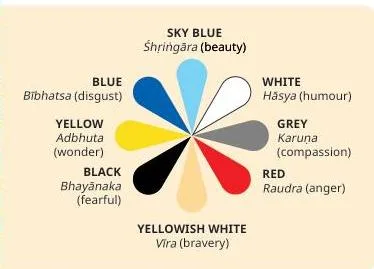
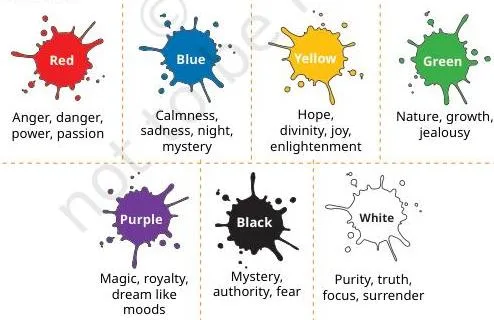
The chart above shows the classical pairing: the Nātyashāstra attaches a colour to each rasa, meant to evoke that specific emotion (p. 53–54). Use it as a starting point, then argue every colour from your own scene’s context — the book is explicit that interpretation varies.
Music and the swaras
Music changes how a scene is read. The book’s comparison: if a snake’s hiss plays when a character enters, the audience reads them as dangerous; a soothing flute makes the same entrance read as calm and endearing (p. 55). The instruments used in the theme music set the mood of the whole play.
The Nātyashāstra suggests which swaras evoke which rasas (Ch. 17, Kāvyamālā edition). The seven notes are ṣhaḍja (S), riṣhabha (R), gāndhāra (G), madhyama (M), pañchama (P), dhaivata (D) and niṣhāda (N).
| Musical notes (Svara) | Rasa evoked | Meaning |
|---|---|---|
| M, P | Hāsya, Śhṛṅgāra | Comic; love |
| S, R | Vīra, Raudra, Bhayānaka, Adbhuta | Heroic; furious; terrible; marvellous |
| G, N | Karuṇa | Pathetic (sorrow) |
| D | Bibhatsa | Odious (revulsion) |
The book adds its own caveat: this use of swaras may not be exactly the same today, in how music is composed or how a scene is perceived, and it invites you to create your own way of evoking the required rasa (p. 55).
Costume and make-up
Costume tells the audience about the world of the story — time period, country, social setting — before a line is spoken (p. 56). Style and texture carry meaning:
- Heavy, rich fabrics suggest royalty.
- Simple cotton suggests humility or innocence.
- Flowing costumes suggest softness or dream-like qualities.
- Sharp, structured lines suggest rigidity.
- A costume change, or even an added layer, symbolises a character’s internal change or a shift in the story.
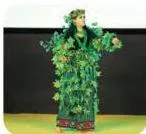
The figure above shows costume standing in for the natural world. The book’s own example: a character goes in and out of his house — first in loose cotton clothes, then in a raincoat, then in woollen clothes with gloves. The layers symbolise a change in weather and the passage of time (p. 56).
Make-up works the same way on the face (p. 57). Wrinkles or grey shading can show wisdom or burden; smooth, bright make-up can show youth or innocence. Cultural markings or motifs represent identity, heritage or spiritual qualities. Abstract make-up can express themes like chaos, harmony or duality — for instance, half the face painted differently.
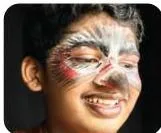
The ageing example, which the figure illustrates: a character narrating her life enters and exits again and again; every time she re-enters, her hair is whiter and the ageing lines are deeper. Hair and lines become symbols of the passage of time (p. 57).
The book adds a safety note for teachers: make-up sessions should use skin-safe, non-allergenic products, with care near the eyes (p. 57).
Sets, props and space
The space itself speaks. A huge empty stage can symbolise loneliness or powerlessness; a cluttered set can show confusion, chaos or mental overwhelm (p. 58).
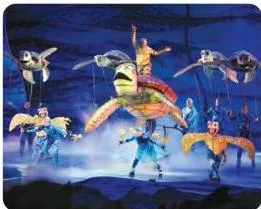
Levels are the chapter’s first observation task. Higher platforms symbolise authority, aspiration or dominance; lower levels show vulnerability or submission — which is exactly what Fig 3.1 asks you to notice (p. 58).
Props add detail to characters directly:
- A broken mirror may symbolise inner conflict.
- A key may represent freedom, secrets or opportunity.
- A repeated prop becomes a motif carrying deeper meaning.
- Props can stand in for emotions — an empty chair for loss, a rope for connection or constraint.
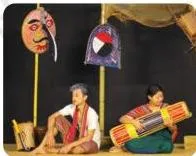
The figure makes the point that objects can carry a scene. The book’s example: a character walks barehanded into a store and comes out wearing a luxurious watch — the watch becomes a symbol of power and status. A broom, a basket, a spear or the colour of a costume can symbolise a situation or mood the same way (p. 58).
Light: intensity, direction and shadows
Lights do more than provide visibility — they tell the audience what to see, where to see it, and what it means (p. 59). Three factors carry symbolism:
Intensity (brightness):
- Bright light: clarity, revelation, happiness.
- Dim light: fear, secrecy, confusion, suspense.
- Sudden blackouts: shock, transitions, dramatic endings.
Direction and angles:
- Footlight: fear, supernatural effects.
- Backlight: mystery, silhouette, inner struggle.
- Front light: honesty, clear emotions, openness.
Shadows are one of the strongest symbols in theatre:
- Long shadows: fear, loneliness, internal conflict.
- Soft shadows: memory, nostalgia.
- No shadows: honesty, clarity, safety.
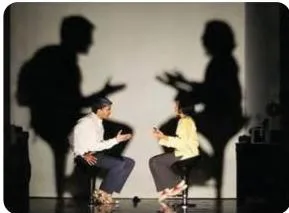
Read the figure above the way the chapter teaches. The actors’ long shadows stretch across the stage floor — that shape signals fear, loneliness or internal conflict. If the same scene used soft shadows, it would read as memory or nostalgia; with no shadows at all, it would read as honesty, clarity or safety. The shadow is the symbol (p. 59).
The book’s scene-work example shows the tool in action: the powerful emperor could have a bigger shadow thrown behind him to represent his unspoken supremacy over the regional ruler (p. 60).
Worked example: a third scene built from the six elements
Here is a scene the book does not include, designed with all six elements. Scene 3: a village athlete, after losing a final race, returns alone to the empty training ground at dusk.
- Colour: washed-out blues and greys for the set and the fallen athlete’s shirt — the loss; one warm orange ribbon lying on the bench — the hope that remains. The meaning comes from this context, not from a fixed colour chart.
- Music: a slow, gentle flute — the book’s own example of calm — fading to near-silence, with a distant crowd cheer fading in and out like a memory.
- Costume: the crumpled cotton jersey (humility) with a new, neatly folded jersey waiting on the bench — the change to come.
- Make-up: dull shading under the eyes and grey-dusted hair at the temples — burden and fatigue, the same visual language as the book’s ageing example.
- Sets and props: one empty bench on a huge empty stage — loneliness; the fallen ribbon as the repeated prop, a motif that returns each time hope appears.
- Light: dim light with long shadows at the start (internal conflict), a soft shadow when the memory plays (nostalgia), and a bright front light in the final moment when the athlete picks up the ribbon — honesty, clarity, a decision.
Every choice above is one of the chapter’s six elements carrying meaning. That is the skill the whole chapter trains.
Applying the six elements to the chapter’s two scenes
The Scene work blocks ask you to design Scene 1 (the peace treaty) and Scene 2 (the hospital waiting room) element by element (p. 54, 56–59). One possible starting map:
| Element | Scene 1: two kings signing a peace treaty | Scene 2: hospital waiting room |
|---|---|---|
| Colour | Deep reds and golds for the emperor’s side — the book links red to passion and energy; muted earth tones for the unhappy regional ruler. | Pale, cold tones for the anxiety of waiting; one warm colour spot near the mother and child for care and hope. |
| Music | Low drums on the S and R notes — the heroic group — while the emperor speaks, softening to gentle M–P notes as the treaty is signed. | Soft instruments on G and N — the Karuṇa group for sorrow and empathy — in a slow, gentle rhythm. |
| Costume | Rich brocade, jewels and crown for the emperor; dignified but simple cotton for the regional ruler; flowing fabrics for the queen and daughter. | Crumpled office cotton for the injured sales employee; plain cotton and a shawl for the old woman; simple, comfortable clothes for the mother and child. |
| Make-up | Smooth, bright make-up for the young daughter; grey shading and deeper lines for the weary regional ruler. | Grey shading and deeper lines for the old woman — age as wisdom and burden; smooth, bright make-up for the 3-year-old — youth and innocence. |
| Sets and props | A high platform for the emperor, a lower level for the ruler — authority against vulnerability; the treaty document and the emperor’s sword as props. | Five chairs placed close but separate — five backstories, each person alone; an empty chair near the doctor’s door for the unknown. |
| Light | Bright front light over the treaty table — honesty and openness; a bigger shadow behind the emperor — the book’s own example of unspoken supremacy. | Dim light with soft shadows — fear, secrecy and memory; a sharp beam of front light when the doctor’s door opens — clarity. |
Reading the chapter’s figures
The first pages of the chapter are observation exercises: the book shows a stage picture and asks what it means before teaching the vocabulary of symbols (p. 51). Work through each figure the same way — notice, ask what it could represent, justify your reading.
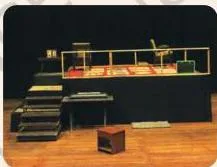
This is the chapter’s first question. The two levels are the clue the book wants you to read: higher platforms symbolise authority, aspiration or dominance, and lower levels show vulnerability or submission — the principle stated later at page 58. A character on the upper level reads as powerful; one on the lower level reads as exposed.
The second question — the first object that caught your attention — has no single right answer; whatever you noticed is your symbol. The chapter also asks what other forms of communication exist and why they are necessary; the answer is the chapter itself — light, music, costume, make-up, sets and props.
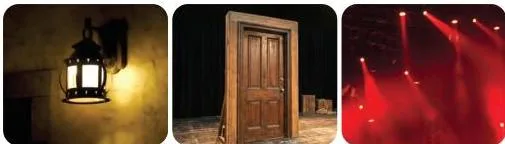
This figure sits beside the definitions. Model your observation on the book’s examples: a single lamp can symbolise hope, a closed door fear or opportunity, a red light passion or energy (p. 52). Describe what catches your eye first, then say what it could represent and why.
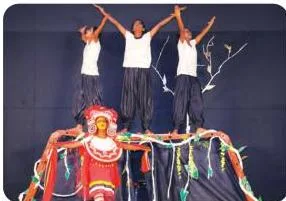
This is symbolism in practice. The figure supports the five reasons symbolism is necessary — especially creativity on stage and cultural expression. Notice how much the children’s performance says without words (p. 53).
Colour is the most prominent thing the human eye notices and has the maximum impact on the mind (p. 53). This figure makes that point before the rasa colours are introduced in Fig 3.5.
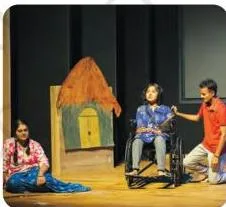
This figure sits beside the Scene work block where the two recurring scenes are introduced (p. 54). It is an example of what a designed scene looks like once meaning has been layered in — the target of every Scene work task.
Quick reference: terms and symbolic meanings, with page numbers
This table collects the chapter’s vocabulary — the terms it defines and the meanings it assigns — so you can check any of them against the book in seconds.
| Term | What it means on stage | NCERT page |
|---|---|---|
| Symbolism | An object, action, colour, sound or movement standing for something deeper — a single lamp for hope, a closed door for fear or opportunity, a red light for passion or energy | p. 52 |
| Metaphor | A comparison between two seemingly dissimilar things — walking in circles for confusion or being trapped, a torn costume for a broken identity | p. 52 |
| Motif | A repeated prop that gains deeper meaning each time it appears | p. 58 |
| Levels | Higher platforms for authority, aspiration or dominance; lower levels for vulnerability or submission | p. 58 |
| Footlight | Fear, supernatural effects | p. 59 |
| Backlight | Mystery, silhouette, inner struggle | p. 59 |
| Front light | Honesty, clear emotions, openness | p. 59 |
| Long shadows | Fear, loneliness, internal conflict | p. 59 |
| Soft shadows | Memory, nostalgia | p. 59 |
| No shadows | Honesty, clarity, safety | p. 59 |
| The eight rasas | Hāsya (comic), Śhṛṅgāra (love), Vīra (heroic), Raudra (furious), Bhayānaka (terrible), Adbhuta (marvellous), Karuṇa (pathetic, sorrow), Bibhatsa (odious) | p. 55 |
Common mistakes in this chapter
This chapter looks like a set of meaning charts, but the book itself warns that the charts are not fixed rules. The biggest mistakes come from treating them as one.
| Mistake | Correct rule | How to check your answer |
|---|---|---|
| Treating the colour meanings as universal | Interpretations vary with geographical location, time period, local culture and traditions, and situation or context (p. 53). | Can you justify every colour from the scene’s own context — time, place, culture? |
| Treating the swara–rasa table as a law | The Nātyashāstra mapping may not hold exactly today, in how music is composed or how a scene is perceived (p. 55). | Use the table as a starting point, then test your own composition against the mood you want. |
| Hunting for one correct answer | The book repeats that its questions have no single right answer (p. 51, 60), and the discussion circle asks whether a symbol is obvious to everyone (p. 61). | Ask instead: can I defend this interpretation clearly? |
| Confusing symbol with metaphor | A symbol stands for something deeper — a lamp for hope; a metaphor compares two unlike things — walking in circles for being trapped. Both are defined at p. 52. | Say the relation aloud: “X stands for Y” (symbol) or “X is like Y” (metaphor). |
| Ignoring that everything on stage communicates | The chapter opens with this claim — lights, props, the set, even a red scarf speak to the audience (p. 51). | For every design choice, ask what it says to the audience. |
The end-of-chapter exercises and how to approach them
The chapter ends with an EXERCISES section at page 61, and all of it tests one ability: to assign meaning to a stage element and justify it. There is no formula to apply — only the chapter’s six elements and your reasoning.
Q1: read the scene and list what each thing represents
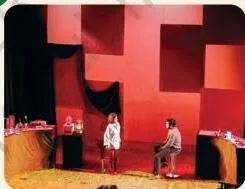
Q1 asks you to look at this picture and list what each thing represents, then write the overall meaning of the scene (p. 61). The figure is the same type as Fig 3.1 — a dressed stage where objects have been placed for a reason.
A full answer names the object, assigns a meaning, justifies it from the scene’s context, then combines the separate meanings into one overall reading — the scene’s single dominant idea. That structure works for any stage picture.
Q2: show ten years of growing wisdom without a word
Q2 asks for a design, not an essay: how would you show a person growing in wisdom and intelligence over 10 years using costumes, lights, props and music, with no speech or dialogue? Work in the chapter’s own planning order: fix the mood first, then colour and music, then costume and props.
The book’s two ready-made models are the costume change (cotton, then raincoat, then woollen with gloves) and the ageing make-up (whiter hair, deeper lines) — reuse them as your visual vocabulary (p. 56–57).
Q3: assign a friend to each colour
Q3 is personal: fill the table with one friend per colour and explain why (p. 61). There is no wrong answer; the explanation is the point. Use the chapter’s caution — colour meanings vary with context — to argue your choice.
Q4: why use symbolism and metaphors on stage?
Q4 asks for the reasons. Answer from the five at pages 52–53: deeper meaning, emotional connection, creativity when sets are limited, cultural expression, and visual impact.
The same open style runs through the chapter’s in-text activities: Beyond words (observe Fig 3.1, p. 51); What do you think it means? — the dance/combat scene under low light with a spotlighted ancestral photo (p. 60); and Designing abstract concepts — an environment-minded AI robot and a talking book (p. 60).
All three carry the same instruction: there is no right or wrong answer, only a justified interpretation. Use that freedom to make bold choices, but be ready to explain each one.
Textbook contents and the examinable syllabus are not always identical — check the current official syllabus.
Chapter recap
This chapter has no printed summary of its own, so here is the load-bearing core in a quick scan:
- Everything on stage communicates — lights, props, the set, even a red scarf — not just the actors (p. 51).
- Symbolism and metaphor turn theatre into a language of images (p. 52).
- Six elements carry meaning: colour, music, costume, make-up, sets and props, and light (p. 53–59).
- The Nātyashāstra links swaras and colours to rasas, but context decides meaning today (p. 53–55).
- The activities have no single correct answer — a justified interpretation is what counts (p. 51, 60–61).
Related resources
This listing is maintained for the 2026-27 academic session using the NCERT textbook information available to us. NCERT remains the authority for confirming the latest edition.
Continue with the NCERT Class 9 Arts textbook pages for the other Madhurima chapters, or browse the Class 9 study hub. The next chapter, Creativity in Light and Sound, continues the same ideas about stagecraft speaking to the audience, and the Class 9 theatre notes keep the performance-related material together.
| What the chapter holds | Count | Where it is used |
|---|---|---|
| Printed pages | 11 | |
| Figures with NCERT captions | 13 | |
| Tables | 3 | |
| In-text questions | 2 | |
| Activities | 3 | |
| Official NCERT PDF | Download the chapter PDF | the chapter exactly as NCERT publishes it |
Reference: NCERT Class 9 Arts textbook (Madhurima), chapter 3, official edition on ncert.nic.in.
Sources and data verification
Page numbers and content in this article describe the NCERT Class 9 Arts textbook Madhurima, Chapter 3, Symbols and Metaphors on Stage, in the current NCERT edition.
This page covers that single chapter — not the rest of the arts curriculum.
The listing is maintained for the current academic session using the NCERT edition available to us.
NCERT settles textbooks, editions and PDFs; CBSE settles the curriculum, syllabus and examinations.
Frequently asked questions
What is the difference between a symbol and a metaphor on stage?
A symbol is an object, action, colour, sound or movement that stands for something deeper than its literal meaning — a single lamp for hope, a closed door for fear or opportunity (p. 52). A metaphor compares two seemingly dissimilar things — walking in circles for confusion or being trapped, a torn costume for a broken identity.
Remember: a symbol stands for something; a metaphor says one thing is like another.
Which swaras evoke which rasas, according to the Nātyashāstra?
M and P evoke Hāsya (comic) and Śhṛṅgāra (love); S and R evoke Vīra (heroic), Raudra (furious), Bhayānaka (terrible) and Adbhuta (marvellous); G and N evoke Karuṇa (pathetic, sorrow); D evokes Bibhatsa (odious, revulsion). The book adds that this mapping may vary today, in composition and perception (p. 55).
How can costume and make-up show the passage of time in a play?
Change the layers. A character entering first in loose cotton, then in a raincoat, then in woollen clothes with gloves signals changing weather and passing time (p. 56). In make-up, a character who re-enters with whiter hair and deeper ageing lines each time makes hair and lines symbols of time passing (p. 57).
How does light change the meaning of a scene?
Through intensity, direction and shadows. Bright light means clarity or happiness; dim light means fear or secrecy; footlights suggest fear or the supernatural; backlight suggests mystery or inner struggle; front light suggests honesty; long shadows suggest fear or loneliness; soft shadows suggest memory; no shadows suggest clarity and safety (p. 59).
The book’s example: giving the emperor a bigger shadow shows his unspoken supremacy (p. 60).
Do the activities in this chapter have right or wrong answers?
No. The book repeats that its questions have no one correct answer (p. 51) and that the activities are based entirely on creative interpretation (p. 60). The discussion circle even asks whether a symbol is obvious to everyone (p. 61). What matters is a justified interpretation you can defend.
What are the exercises at the end of Chapter 3 of Madhurima?
Four tasks at page 61: Q1 — look at Fig 3.12 and list what each thing represents, then state the overall meaning; Q2 — design, without dialogue, how to show a person growing in wisdom over 10 years using costumes, lights, props and music; Q3 — assign a friend to each colour and explain why; Q4 — explain why symbolism and metaphors are used on stage.
All four test the same skill: assigning meaning to a stage element and justifying it.
Explore Class 9 Arts Books
- Previous: Theatre
- Next: Creativity in Light and Sound
Related chapters:
- History of Arts
- From Vision to Performance: Direction and Acting
- The Science of Music