
Nature’s Palette Class 7 is the sixteenth chapter of NCERT’s Kriti art textbook. It teaches how artists control colour — why a bright red tomato looks dull in dim light, how to build a colour wheel from red, blue and yellow, and how miniature painters got colours from natural pigments.
The official NCERT Class 7 Kriti Nature’s Palette chapter PDF is linked right below, with a plain-language guide to every activity underneath it.
Download the NCERT Class 7 Kriti Nature’s Palette Chapter PDF
This chapter sits inside Kriti, the visual arts textbook NCERT publishes for Class 7. It runs to 10 pages in the official PDF.
Open the NCERT Class 7 Kriti Nature’s Palette chapter PDF whenever you need the full text, the activity instructions or the colour plates exactly as NCERT printed them for the current Kriti edition. The file lives on NCERT’s own textbook server, so it is always the current version.
Keep your downloaded copy handy — you will return to the colour wheel figure again and again while working through the activities.
Chapter 16 at a Glance
The table below lists the sections, figures and tables inside Chapter 16 of Kriti.
| What the chapter holds | Count |
|---|---|
| Sections | 17 |
| Figures | 8 |
| Tables | 2 |
What Nature’s Palette Covers in Kriti
The chapter opens with a simple observation: colours are visible because of light, and when light changes, the same colour looks different. A bright red tomato may turn dull and dark in a dim room, too much light makes everything look white, and no light makes everything black.
Because of this, artists do not just copy colours — they show how light affects them. That is the idea behind the chapter’s flow:
- Activity 16.1 — extend the colour wheel: build every colour from three primaries.
- Activity 16.2 — make colour tones: create tints, shades and tones of a colour.
- Activity 16.3 — plant study in colour: observe, draw and colour a real plant.
- Colours in miniature paintings: where natural pigments came from.
- Care for art materials and tools: keeping colours usable.
- Activity 16.4 — decode the palette of a miniature: read moods and seasons in a painting.
- Assessment: recognise moods, emotions and seasons expressed through colours.
Three “Do You Know” boxes give the chapter its wider context: one on colour vision impairment, one on Hortus Malabaricus, a 17th-century record of the medicinal plants of the Malabar coast, and one on the word “miniature” — which comes from minium, a red pigment.
A Guided Look at the Figures in Nature’s Palette
Each figure below is worth reading, not just glancing at. Here is what each one shows and where it appears in the chapter.
The colour wheel is the chapter’s central tool. The three primary colours — yellow, red and blue — sit at the centre of the wheel, and the colours made from them spread outward. This is the figure Activity 16.1 asks you to extend.
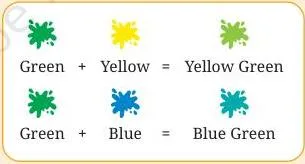
The same page shows how a secondary colour grows into tertiary colours. Since green is made from yellow and blue, mixing green with yellow and green with blue gives the two new colours shown here.
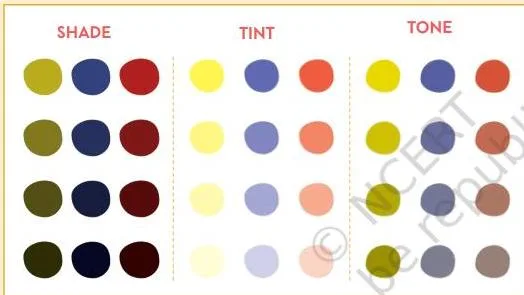
Earlier in Kriti you practised light and shade with cross-hatching and stippling. This figure recalls that skill before Activity 16.2 asks you to create the same effect with colour instead of lines.
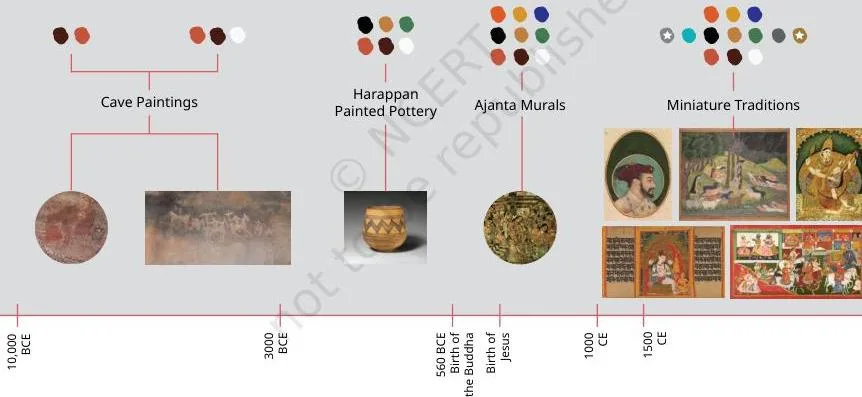
The miniature section opens with this timeline of Indian painting. It shows the important phases in Indian painting and how the colours artists used evolved over time — which is why natural pigments matter in the story.
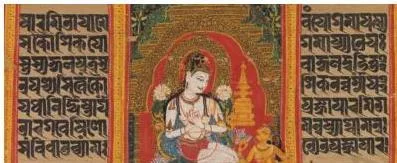
Three miniatures sit together here: a palm leaf manuscript, a Mughal miniature and a Kishangarh miniature. They make the chapter’s point that miniature paintings are of many styles and are generally small — and that in India they began on palm leaves before paper came into use from the 12th century CE.
Beyond mineral and plant colours, miniatures also used metals. Gold and silver were hammered into very thin sheets — gold leaf and silver leaf — and pressed into the painting to make details shine.
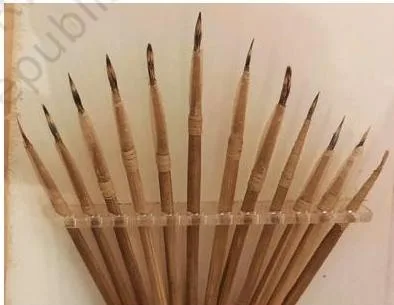
The fine lines in miniatures needed fine brushes. Painters used brushes made of soft hair from the fur or hair of camels, goats and cows, and hair from the tails of rats, squirrels and mongoose.
The chapter’s care section ends with storage. Materials kept in an organised way can be found and used by anyone in the class — and colours stay safe from the light, moisture and living organisms that fade them.
The Colour Wheel: Primary, Secondary and Tertiary Colours
Before you start Activity 16.1, you need the order in which colours are made. The wheel puts that order where you can see it.
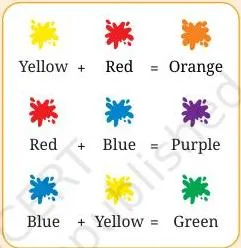
The three primary colours — yellow, red and blue — cannot be made by mixing any other colours. Mixing each pair of primaries gives a secondary colour; the chapter’s example is green, made from yellow and blue.
| Kind of colour | How it is made | Example from the chapter |
|---|---|---|
| Primary | Cannot be made by mixing | Yellow, red and blue |
| Secondary | Mix a pair of primary colours | Green = yellow + blue |
| Tertiary | Mix a secondary colour with one of its primaries | Green + yellow, and green + blue |
The most important rule in the activity is also the simplest: mix every colour using only red, blue and yellow. If you reach for a ready-made green or orange, you skip the practice the exercise exists for.
Activity 16.1 leaves the other tertiary colours blank. Using your wheel, write down which two colours mix into each one, and paint or paste swatches in the boxes. Display your finished wheel — the chapter reuses it in the plant study.
Tints, Shades and Tones: How Light Changes a Colour
The tomato example explains why this matters. A bright red tomato looks dull in a dimly lit room, so painters cannot just copy a colour — they show its tint, shade or tone instead.
| Term | Recipe | What it does | Example with blue |
|---|---|---|---|
| Tint | Colour + white | Lightens the colour | Blue + white = pale sky tint |
| Shade | Colour + black | Darkens the colour | Blue + black = deep navy shade |
| Tone | Colour + grey | Softens the colour | Blue + grey = dusty blue-grey tone |
| Grey | Black + white | The base for every tone | — |
Activity 16.2 asks for at least four gradations of tints and shades, and four tonal gradations. Begin by mixing small quantities of black or white, then increase the amount gradually for each gradation — a big blob at once jumps the step.
Here is the chapter’s Technical Tip: change the water in your bowl and rinse the brush well after mixing each colour. Skip this and the gradations turn muddy, because leftover colour bleeds into the next mix.
Plant Study in Colour: What Activity 16.3 Asks You to Do
This activity moves from the wheel to the world. Plants change form and colour as they grow through the seasons, so a plant is perfect practice for matching colours to real life.
- Select a stem with a few leaves, or a single flower at any stage of its life.
- Place it in front of you and do not disturb its position.
- Sit at least two feet away and observe its shapes and the empty space around it.
- Using light lines, make two quick drawings from two different angles.
- Choose one of those angles and start a new drawing.
- Cover the maximum space on your paper and draw slowly to capture the details.
- Complete the drawing before you begin colouring.
For colour, choose any medium — crayons, colour pencils, pastels, watercolour or poster colour. Observe the tints, shades and tones on the plant, find them on your colour wheel, mix the required colours, and show light, shade and shadows in the artwork.
The activity ends with three self-assessment questions: how many sketches you made, what you were able to do well, and the challenges you faced or improvements you would like.
The “Do You Know” box here shows a botanical illustration from Hortus Malabaricus — “Garden of Malabar” — a book that recorded thousands of medicinal plants found on the Malabar coast of India during the 17th century.
Colours in Miniature Paintings: Natural Pigments and Their Sources
This listing is maintained for the 2026-27 academic session using the NCERT textbook information available to us. NCERT remains the authority for confirming the latest edition.
Miniature paintings take the colour story into history. The pigments painters used came from the soil, minerals and plants around them, and the chapter traces where each colour came from.
Miniatures are small paintings in many styles. In India they were first done on palm leaves; from the 12th century CE, artists began to use paper. Their themes included religious texts, mythology, nature, portraiture and court life.
The word “miniature” originates from minium, a red-coloured pigment used to draw outlines and write text in medieval manuscripts.
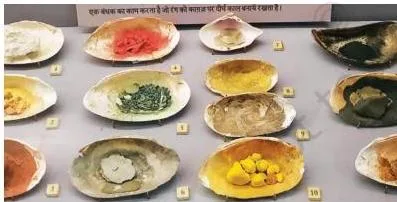
| Colour | Source |
|---|---|
| Bright red | Sindhoor or vermillion |
| Earthy red | Geru or red clay |
| Yellow | Yellow stone or cow urine |
| Green | Malachite (copper carbonate) |
| Blue | Lapis lazuli or indigo |
| Black | Carbon |
| White | Khariya or white clay |
These colours were processed and mixed with gum extracted from the Babul tree, which acts as a binder. Gold and silver were hammered into thin sheets — gold leaf and silver leaf — and added for shine. Fine brushes made of soft animal hair did the delicate painting.
Caring for Art Materials and Tools
Colours are fragile. The chapter warns that colours fade and disappear over time when exposed to excessive light, moisture and the touch of living organisms — so tools and materials need care.
- Clean your brushes, palettes and other tools thoroughly with soap after every use.
- Close paint tubes, bottles, sketch pens and markers with their caps, so the colour does not dry.
- Store all materials in an organised way so they can be easily found and used by others too.
These three habits keep your colours usable and your workspace ready. The storage figure in the walkthrough above shows the organised arrangement the chapter has in mind.
Decoding a Miniature: How Activity 16.4 Works
Activity 16.4 asks you to read a painting the way you now read a colour wheel. The painting is Swami Haridasa with Tansen and Akbar at Vrindavana, 1700–1760 CE, a Rajasthani miniature.
The chapter tells you who is in the lush green landscape: the musician Tansen, his guru Swami Haridasa and the Mughal emperor Akbar. Then it poses six discussion points.
- What is happening — start from what you know: a guru, a musician and an emperor meeting in a garden.
- Guess the time and season — let the greens and the quality of light guide your guess.
- What moods or feelings you experience — name the feeling honestly, then point to the colour or detail that creates it.
- Analyse the shades of green using the colour wheel — every green is a secondary colour (yellow + blue); lighter greens lean toward tints or green mixed with yellow, deeper greens toward shades or green mixed with blue, the two tertiary colours from green.
- Where the biggest tree is placed — find it first, then suggest why the artist put it there: to balance the figures, frame the scene, or draw your eye toward them.
- Patterns on the leaves and fine lines of the clouds — list the other small details you notice.
The activity ends with a writing task: a short paragraph on all you have learnt about miniatures.
A clean structure is — name the painting and who is in it; give your guess for season and mood; analyse the greens with the wheel; say where the biggest tree sits and why; close with one small detail such as the leaf patterns or cloud lines.
Colour Terms You Need to Know from This Chapter
These are the terms the chapter uses all the way through. Learn them once and every activity becomes clearer.
| Term | What it means |
|---|---|
| Primary colours | Yellow, red and blue — cannot be made by mixing |
| Secondary colour | Made by mixing two primary colours (green = yellow + blue) |
| Tertiary colour | Made by mixing a secondary colour with one of its primaries |
| Tint | A colour mixed with white |
| Shade | A colour mixed with black |
| Tone | A colour mixed with grey |
| Grey | Made by mixing black and white |
| Pigment | Colouring material sourced from soil, minerals and plants |
| Binder | Gum (such as Babul gum) that holds pigment together |
| Miniature | A small painting; in India, first on palm leaves, then on paper |
| Minium | The red pigment whose name gave us the word “miniature” |
Common Mistakes in Colour Mixing (and How to Avoid Them)
These are the errors the chapter’s activities usually invite. Name them before you start, and your colour wheel and gradations will come out clean.
| Mistake | Correct rule | How to check your work |
|---|---|---|
| Keeping the same water and skipping the rinse between colours | Change the water and rinse the brush well after each colour (the chapter’s Technical Tip) | Each gradation stays clean; nothing looks muddy by accident |
| Adding a big blob of black or white at once | Begin with small quantities and increase gradually for each gradation | You can count four even gradations going light to dark |
| Using ready-made secondary or tertiary colours in the wheel activity | Mix every colour from only red, blue and yellow | On your wheel, every colour can be traced back to a pair of primaries |
| Calling every dark version a “shade” and forgetting tones | Tone uses grey (black + white); shade uses black alone | A tone looks softened, not just darkened |
The chapter opens with one more awareness point: not everyone sees colour the same way. People with colour vision impairment, commonly called colour blindness, may see red as brown or find it difficult to tell blue from green.
So do not assume a classmate’s colour wheel looks identical to yours, and the chapter notes that many visual artists and designers with such impairments have excelled by finding creative solutions.
How This Chapter Is Assessed in Class 7
The chapter’s assessment line asks you to “observe the details and recognise moods, emotions and seasons expressed through colours in any given artwork.” The closing table of learning outcomes shows what each activity trains you to do.
| Chapter activity | What it practises | Learning outcome it feeds |
|---|---|---|
| Activity 16.1 — extend the colour wheel | Making secondary and tertiary colours from primaries | Practises colour exercises to create the colour wheel |
| Activity 16.2 — make colour tones | Four gradations each of tints, shades and tones | Practises colour exercises for colour tints, shades and tones |
| Activity 16.3 — plant study in colour | Observing, drawing and colouring a plant part | Observes, draws and colours any chosen part of a plant in detail |
| Activity 16.4 — decode a miniature | Reading moods, emotions and seasons in colours | Recognises moods, emotions and seasons expressed through colours |
School evaluation will likely look at your completed activities and your self-assessment answers, but exact weightage is set by your school and the board — not by this page. Textbook contents and the examinable syllabus are not always identical, so check the current official syllabus.
What to Remember from Nature’s Palette
Here is the whole chapter in seven lines, useful the night before a test.
- Colours are visible because of light; when light changes, colours appear to change.
- The colour wheel maps the three primary colours to the secondary and tertiary colours made from them.
- Tint = colour + white; shade = colour + black; tone = colour + grey, and grey comes from mixing black and white.
- Mix every colour from only red, blue and yellow — ready-made colours defeat the practice.
- Miniature painters used natural pigments from soil, minerals and plants, bound with Babul-tree gum.
- Colours fade with excessive light, moisture and living organisms, so clean and store your tools.
- Regular practice builds both skills: making colours and reading moods, emotions and seasons in any artwork.
Related Resources for Class 7 Kriti
Kriti is one part of your Class 7 arts work. Keep practising with the Class 7 Arts notes hub, go deeper into the visual arts section, or see how colour carries emotion on the how you feel page. The Class 7 hub lists every subject at this level, and the CBSE notes home holds the full set.
Sources and Data Verification
This page describes NCERT Class 7 Kriti, Chapter 16, Nature’s Palette, as published in the current Kriti textbook on the official NCERT portal, ncert.nic.in.
NCERT settles textbook editions and PDFs; CBSE settles curriculum, syllabus and examinations. Textbook contents and the examinable syllabus are not always identical — check the current official syllabus.
The listing is maintained for the current academic session using the NCERT edition of Kriti published on ncert.nic.in.
| What the chapter holds | Count | Where it is used |
|---|---|---|
| Printed pages | 10 | |
| Figures with NCERT captions | 8 | |
| Tables | 2 | |
| Official NCERT PDF | Download the chapter PDF | the chapter exactly as NCERT publishes it |
Reference: NCERT Class 7 Kriti textbook, chapter 16, official edition on ncert.nic.in.
Frequently Asked Questions About Nature’s Palette Class 7
What are primary, secondary and tertiary colours in Nature’s Palette Class 7?
Primary colours are yellow, red and blue, and they cannot be made by mixing any other colours. Secondary colours come from mixing pairs of primaries — the chapter’s example is green from yellow and blue. Tertiary colours come from mixing a secondary colour with one of its primaries, such as green mixed with yellow and green mixed with blue.
How do you make tints, shades and tones in this chapter?
Add white for a tint, black for a shade, and grey for a tone. Grey itself is made by mixing black and white. Start with small quantities and increase gradually to get at least four gradations, and change the water and rinse the brush after every colour so the gradations stay clean.
Why does the colour wheel activity say to mix everything from red, blue and yellow?
Because the exercise is about learning how colours are made, not about having ready-made colours. If you start with a ready-made green, you never learn that green comes from yellow and blue. Mixing every colour from the three primaries builds the skill the colour wheel exists to teach.
What is a miniature painting and where does the word miniature come from?
A miniature is a small painting. In India, miniatures were first done on palm leaves, and from the 12th century CE artists used paper. The word “miniature” originates from minium, a red pigment used to draw outlines and write text in medieval manuscripts.
Which natural materials were used as colours in Indian miniature paintings?
Bright red came from sindhoor or vermillion, earthy red from geru or red clay, yellow from yellow stone or cow urine, green from malachite, blue from lapis lazuli or indigo, black from carbon, and white from khariya or white clay. These pigments were bound with gum from the Babul tree, and gold and silver leaf were added for shine.
What is the chapter’s advice for caring for brushes and paints?
Clean brushes, palettes and other tools thoroughly with soap after every use; close the caps on paint tubes, bottles, sketch pens and markers so the colour does not dry; and store all materials in an organised way so others can find them. This matters because colours fade when exposed to excessive light, moisture and living organisms.
Explore Class 7 Arts Books
Related chapters: