
Here is the official NCERT Class 7 Arts textbook Kriti, Chapter 6, “Music, Emotions” — in full, “Music, Emotions and Creativity”. The music, emotions class 7 chapter PDF is right below, straight from NCERT.
Below: what the chapter contains, what each activity asks of you, and what the closing learning outcomes table expects of a Class 7 student.
Download the official Music, Emotions Class 7 chapter PDF
The official file is hosted by NCERT: NCERT Class 7 Kriti Chapter 6 Music, Emotions PDF opens the chapter exactly as published — the songs, the activities and the closing learning outcomes table included.
Chapter 6 at a glance
The table below lists how much the chapter holds — sections, figures, activities and exercise questions — so you can see the size of the PDF before you open it.
This is an activity-led chapter, not a question-led one. It teaches through things you do. The chapter moves from a devotional song to a patriotic Urdu song, then through activities that build vocabulary, painting-reading, storytelling, listening and acting.
What this chapter covers: from rasa to acting out emotions
This section walks the chapter in the order it appears in the book, so you know what is coming before you turn a page. Every heading below matches a section or activity the book names.
The chapter opens with one big idea: music expresses emotions. In the Indian performing arts those emotions are called rasas, felt by the artist and the audience together. The book says this shared emotion is what connects the two — so sing with passion and expression.
It then quotes the Abhinaya Darpana by Nandikeshvara: sabha kalpataru bhaati — the audience is like a tree that fulfils your inner wishes. Though the saying was written for dance, the book adds that it applies to all art forms.
Devotional Music and the Shabad
People pray in very different ways, and devotional music exists to express that feeling of devotion. Groups often sing together, and the chapter’s point is that they can do so with different words, tunes and rhythms.
The first song is the Shabad — musical prayers in the Sikh religion, sung in the Gurudwara. Its opening lines gather several names for God, and its meaning is unpacked in Key concepts below.
The Urdu song: ‘Lab Pe Aati Hai Dua’
The second song, ‘Lab Pe Aati Hai Dua Ban Ke Tamanna Meri’, is a devotional and patriotic song in Urdu. Its meaning is a wish: that life shine for everyone like a guiding light, that work uplift the less fortunate as flowers beautify a garden, and that life be marked by care and compassion.
Activity 6.1: think about the song you learnt
For whichever devotional song you learnt, ask what emotion it carries and what language it is in. Then note its important words and understand their meanings — the book calls this a great way to increase your vocabulary.
The note to the teacher says you may learn one or both songs, or choose devotional songs from your own culture or faith.
Activity 6.2: Understanding a Painting Through Music
You are shown a Phad painting by Prakash Joshi and asked to observe it carefully. From its style you try to identify the state or region it comes from. Then you write two rhythmic, singable lines describing what the plates show — in your native language if you like.
The book’s example line is ‘Dekho dekho sakhi dwar pe suj sanwar kay kaun khada’.
Groups sing the lines plate by plate, building one composition, and record the whole process. The point is to see how words and music work together to evoke emotions. The note to the teacher says any painting can be substituted, and suggests seeing ragamala paintings exhibited in museums.
Activity 6.3: Musical Narrative
This activity links music with history. Choose a topic from the history section of your Social Science textbook — the chapter names Chandragupta Maurya and Kautilya, Prabhavati Gupta, Chandragupta II Vikramaditya and his nine jewels, and Prithviraj Chauhan.
For your topic you write a short story, draw a picture, describe the scene in a few sentences, then sing the lines in a tune of your choice. That is how musicals and musical storytelling are created, the book says.
The activity also names Indian forms of musical storytelling to research — Powada, Kaavad Katha and Alha-Udal — and asks you to connect it with the other art forms you are learning. The note to the teacher prints the NEP 2020 passage on art-integrated education and asks that this session be planned with the History lesson.
Activity 6.4: Active Listening
Active listening means listening to something carefully and trying to understand it. The more music you listen to, the more you notice styles, structures, genres, rhythms and even nuances in production.
Here you actively listen to a folk, tribal, modern or contemporary song and explore how its lyrics and tune tell a story. Then you do the same with a piece of instrumental music and compare the moods and emotions of the two.
Activity 6.5: Act It Out
The last activity turns listening into performance. You listen to an instrumental piece or background music from a film, take turns analysing what emotions you can recognise, and enact those expressions. The book invites you to use whatever you have learned in Theatre and Dance to communicate the emotion and story of the music.
The chapter ends with a learning outcomes table rather than a set of questions. Five outcomes, each with a code and Teacher and Self columns for recording progress, are explained below.
Key concepts: the ideas behind the songs
The activities are not random tasks. Each one rests on an idea from Indian music and performing arts, and once you see the idea, the activity makes sense.
Rasa: the emotion in the music
Rasa is the chapter’s word for the emotions in Indian performing arts. The artist and the audience experience the same rasa at the same time, and that shared emotion is the connection between them. It is the reason the book tells you to sing with passion and expression.
The Abhinaya Darpana saying
The Abhinaya Darpana gives the chapter its framing line: sabha kalpataru bhaati, the audience is a tree that fulfils your inner wishes. The book notes the line was written for dance, then says it applies to all art forms.
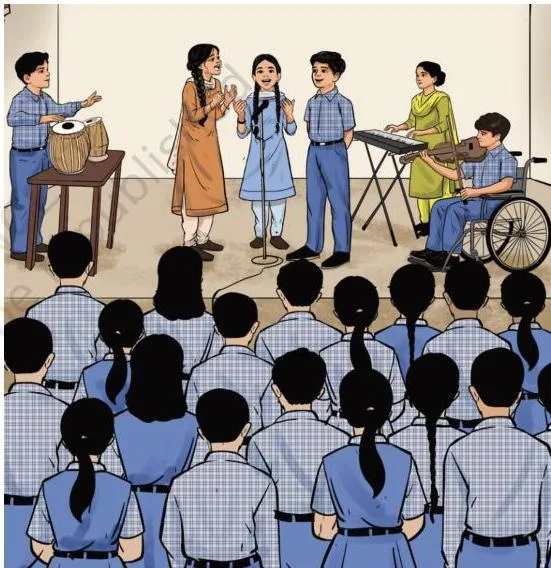
Devotional music and the Shabad’s names
Devotional music is the chapter’s first example of words, tune and rhythm coming together. The Shabad’s opening lines call on the same almighty by different names: koi boley raam raam — one says Raam; koi khudaye — another says Khudaye; koi sevai gosayya — one serves Gosaiyya; koi alaahey — another calls Alaahey.
The meaning the book prints draws the conclusion: we pray with different names — Rama, Guru, Allah and others — to thank the one almighty for the beautiful world.
Two songs, two moods
‘Lab Pe Aati Hai Dua’ is the chapter’s second song — devotional and patriotic, in Urdu. The table below puts the two songs side by side.
| Point of comparison | The Shabad | ‘Lab Pe Aati Hai Dua’ |
|---|---|---|
| The book’s label | Musical prayers in the Sikh religion, sung in the Gurudwara | A devotional and patriotic song in Urdu |
| Language and names | Its lines carry names from several traditions — Raam, Khudaye, Gosaiyya, Alaahey — and the meaning glosses them as Rama, Guru, Allah and others | In Urdu |
| Mood | Thanks for the beautiful world the almighty gave | A wish: life like a guiding light, work that uplifts the less fortunate, compassion |
| Setting | Sung as kirtan in the Gurudwara | The chapter gives no setting; the song is learnt for its words and meaning |
Musical storytelling
Activity 6.3 names three Indian forms of musical storytelling — Powada, Kaavad Katha and Alha-Udal. You are not expected to know them yet; the activity asks you to research them.
Active listening
Active listening is the skill behind Activity 6.4: listening carefully and trying to understand what you hear. The book says the more you listen to a wide range of music, the more you pick up styles, genres, rhythms and nuances you would not notice at first.
The chapter’s figures, explained
The figures in the book are study aids, not decoration. Each belongs to a specific idea or activity — the opening Abhinaya Darpana image above, and the seven below beside the activities they serve.

This image belongs to Activity 6.1. Music chapters rarely ask for vocabulary work, but this one does: learning a song properly means knowing what its words mean, and the book calls it a great way to increase your vocabulary in the song’s language.

This note belongs to the teacher’s note in Activity 6.2. Because the activity reads a painting through music, the note adds that ragamala paintings exhibited in museums are worth seeing.
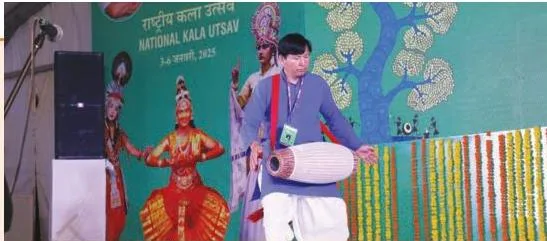
This figure is part of Activity 6.3. It repeats the activity’s closing instruction: connect your musical narrative with the other art forms you have been learning, and share your experience. That same connection returns in Activity 6.5, where Theatre and Dance elements carry the emotion of the music.
This image belongs to the note to the teacher in Activity 6.3. The note prints the NEP 2020 passage on art-integrated education, and the image repeats its directive: plan the session so it collaborates with the History lesson.
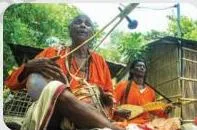
This is the bridge between music and expression. Activity 6.5 lets you act out instrumental music using whatever you have learned in Theatre and Dance — the chapter’s clearest statement that music, theatre and dance carry the same emotions.
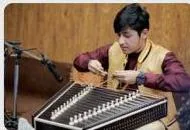

The ektara and the santoor join the veena as the instruments this chapter shows you. Their job is simple: instrumental music carries moods and emotions without words, so these are instruments to listen for when you compare a song with a purely instrumental piece in Activity 6.4.
The book also shows a Shabad kirtan in progress in a Gurudwara beside the devotional section, Sobha Mani playing the Nata Pung beside Activity 6.3, and an artist playing the Veena beside Activity 6.4. The Veena is the one to keep in mind for the vocal-versus-instrumental comparison.
Chapter 6 glossary: the terms you should know
Every term below is defined from what the chapter itself says, so you can learn the chapter’s vocabulary in one look.
| Term | What the chapter says | Why it matters |
|---|---|---|
| rasa | Emotions in the Indian performing arts, experienced by the artist and audience together | The emotion is what connects the singer to the audience — the reason to sing with passion |
| Abhinaya Darpana | The work by Nandikeshvara that the chapter quotes at its opening | Source of the saying sabha kalpataru bhaati |
| sabha kalpataru bhaati | “The audience is like a tree which fulfils your inner wishes” | Written for dance, but the book says it applies to all art forms |
| Devotional music | Music that lets people express the feeling of devotion, often sung in groups | The chapter’s first example of words, tune and rhythm together |
| Shabad | Musical prayers in the Sikh religion, sung in the Gurudwara | The chapter’s first song |
| Gurudwara | The place where the Shabad is sung | Setting of the Shabad kirtan |
| Phad painting | The painting by Prakash Joshi that Activity 6.2 asks you to read | You turn it into rhythmic, singable lines |
| Active listening | Listening carefully and trying to understand, noticing styles, genres, rhythms and nuances | The skill Activity 6.4 builds |
| Powada | A form of musical storytelling in India named in Activity 6.3 | The chapter asks you to research it |
| Kaavad Katha | A form of musical storytelling in India named in Activity 6.3 | The chapter asks you to research it |
| Alha-Udal | A form of musical storytelling in India named in Activity 6.3 | The chapter asks you to research it |
| Nata Pung | The instrument Sobha Mani is shown playing beside Activity 6.3 | An example of an instrument in the chapter |
| Veena | The instrument an artist is shown playing beside Activity 6.4 | Listen for it when comparing a song with instrumental music |
| Ektara | The instrument an artist is shown playing beside Activity 6.5 | Instrumental music carries moods without words |
| Santoor | The instrument an artist is shown playing beside Activity 6.5 | Same idea — mood without lyrics |
Two things the chapter deliberately leaves open. The Phad painting’s region is for you to identify, and the Shabad carries names from several traditions rather than one labelled language.
Mistakes students make in this chapter
This chapter is short, but it fails in predictable ways in class. The table names each mistake before you make it.
| Mistake | Correct approach | How to check |
|---|---|---|
| Singing the Shabad mechanically, without expression | Sing with passion and expression — the emotion is what connects artist and audience, as the chapter’s opening says | Can you name the emotion the song carries? |
| Never learning what the song’s words mean | Activity 6.1 exists exactly for this: note the important words and understand their meanings to build vocabulary | Can you explain each important word in your own words? |
| Calling ‘Lab Pe Aati Hai Dua’ only a patriotic song | The chapter says it is devotional and patriotic, and its meaning reads like a prayer | Can you point to the prayer-like wishes in its meaning? |
| Treating background music as active listening | Active listening is deliberate: listen carefully, try to understand, notice moods, genres and nuances | Next time music plays, can you say what mood and genre you heard? |
The learning outcomes table: what you should be able to do
The chapter closes with its own outcomes table rather than a revision list. Each row carries a competency group (CG), a code (C), the learning outcome, and two columns — Teacher and Self — for recording progress as you finish each task.
| CG | C | Learning outcome |
|---|---|---|
| 1 | 1.2 | Can understand storytelling through lyrics and music |
| 1 | 1.2 | Can creatively act out the emotions expressed in a piece of music |
| 2 | 2.1 | Is eager to learn new songs and new forms of music |
| 2 | 2.2 | Can interpret a painting in words and stories |
| 3 | 3.1 | Understands and can articulate the various roles of music |
Map the activities to the outcomes and the design becomes clear:
- Activity 6.3 (Musical Narrative) builds outcome 1 — understanding storytelling through lyrics and music.
- Activity 6.5 (Act It Out) builds outcome 2 — creatively acting out the emotions in a piece of music.
- Activity 6.2 (Understanding a Painting Through Music) builds outcome 4 — interpreting a painting in words and stories.
- Activities 6.1 and 6.4 feed outcomes 3 and 5 — eagerness to learn new songs and forms of music, and understanding the various roles music plays.
Use the Self column as your own checklist after each activity; the Teacher column is your teacher’s record.
The book places all of this inside NEP 2020’s art-integrated education, described as a cross-curricular approach that uses art and culture as the basis for learning across subjects. That is why Activity 6.3 borrows its topics from the history section of your Social Science textbook.
One caution: textbook contents and the examinable syllabus are not always identical. For an arts subject especially, check the current official syllabus to see how this chapter is assessed.
What to remember from Chapter 6
Eight points, built from what the chapter actually teaches.
- Music communicates emotion. In the Indian performing arts that emotion is rasa, felt by artist and audience together.
- Sing with passion and expression — the shared emotion is what connects you to the audience.
- The Abhinaya Darpana says sabha kalpataru bhaati: the audience is a wish-fulfilling tree. Written for dance, true for every art form.
- Devotional music lets groups express devotion with different words, tunes and rhythms.
- The Shabad is the Sikh musical prayer, sung in the Gurudwara. Its opening lines call the same almighty by different names — Raam, Khudaye, Gosaiyya, Alaahey.
- ‘Lab Pe Aati Hai Dua’ is devotional and patriotic, in Urdu — a wish that life shine like a guiding light and lift up the less fortunate.
- The activities move from understanding a song’s words (6.1) to reading a painting through music (6.2), composing a sung history story (6.3), active listening (6.4), and acting out instrumental music (6.5).
- The closing table is the chapter’s own checklist: five learning outcomes with Teacher and Self columns.
Related resources
This listing is maintained for the 2026-27 academic session using the NCERT textbook information available to us. NCERT remains the authority for confirming the latest edition.
Looking for more? Start with the Class 7 Arts (Kriti) book page for the full book, or the Class 7 hub for every NCERT Class 7 subject listed on this site. The CBSE notes hub holds the revision pages.
Within arts, the music notes and the Ragas and Talas (Taal) notes are the closest neighbours to this chapter. Every official Kriti chapter PDF sits on the NCERT textbooks portal.
| What the chapter holds | Count | Where it is used |
|---|---|---|
| Printed pages | 7 | |
| Figures with NCERT captions | 8 | |
| Tables | 1 | |
| Activities | 1 | |
| Official NCERT PDF | Download the chapter PDF | the chapter exactly as NCERT publishes it |
Reference: NCERT Class 7 Kriti textbook, chapter 6, official edition on ncert.nic.in.
Sources and data verification
- This page describes the NCERT Class 7 Arts textbook Kriti (English medium), Chapter 6, “Music, Emotions”.
- It covers this chapter only; the complete book listing is on the Class 7 Arts page.
- The listing is maintained for the current official NCERT edition of the book.
- NCERT settles textbook content, editions and PDFs; CBSE settles the syllabus and examinations.
Frequently asked questions
What is a rasa in the Kriti Chapter 6 Music, Emotions?
Rasa is the book’s term for the emotions in Indian performing arts. The same emotion is experienced by the artist and the audience at the same time, and the book says this shared emotion is what connects them. It is the reason the chapter tells you to sing with passion and expression.
What is a Shabad and where is it sung?
A Shabad is a musical prayer in the Sikh religion, sung in the Gurudwara. The chapter’s Shabad gathers different names — Raam, Khudaye, Gosaiyya, Alaahey — to thank one almighty for the beautiful world.
Is Lab Pe Aati Hai Dua a patriotic song or a devotional song?
Both. The chapter describes it as a devotional and patriotic song in Urdu, and its meaning reads like a prayer — a wish for life to shine like a guiding light, for work to uplift the less fortunate, and for life to be marked by compassion.
What is active listening in music?
Active listening is listening carefully and trying to understand what you hear. In music it means noticing styles, genres, rhythms and nuances you would otherwise miss. The more you listen, the more you pick up.
What should you be able to do after finishing Class 7 Kriti Chapter 6?
The book’s closing table lists five outcomes: understand storytelling through lyrics and music; creatively act out the emotions in a piece of music; be eager to learn new songs and forms of music; interpret a painting in words and stories; and understand and articulate the various roles of music.
Explore Class 7 Arts Books
Related chapters: