
Looking for Textiles and Traditions Class 7? This is Chapter 18 of NCERT’s Kriti Arts textbook for Class 7 — a practice-based chapter that uses a story and four activities to introduce Indian textile arts. The official chapter PDF is on this page, followed by what the chapter contains and what each activity asks you to do.
The official file is published by NCERT on its textbook portal: Download the NCERT Class 7 Kriti Chapter 18 Textiles and Traditions PDF to read the full chapter with its original illustrations before you try the activities below.
What is inside Chapter 18 of Kriti
This is a hands-on chapter about creating artwork with cloth, thread and needle rather than a chapter of read-and-recall facts. The chapter-at-a-glance table below lists how much the chapter holds — its sections, figures and activities — and by name, the chapter has four parts:
- an opening motif gallery that pairs decorative motifs with their meanings;
- the “Threading Stories” narrative, a story of two quarrelsome characters told by a patchwork curtain;
- Activities 18.1 to 18.4 — a fabric journal, an exploration of embroidery traditions, basic stitches, and making your own textile artwork;
- a closing learning-outcomes table used for teacher and self assessment.
How the chapter is organised: a story, four activities, one outcome table
The chapter is built in a deliberate order: look, listen, collect, learn the traditions, learn the skill, then create. The walk-through below follows that order, and the two sub-sections that follow give the embroidery map and the stitch routine in full.
- Opening motif panel (NCERT, p. 1): Before any activity, the chapter shows motifs such as the peacock and explains that motifs are decorative images that repeat to form patterns and carry symbolic meanings.
- “Threading Stories” (NCERT, p. 2): A curtain made from the pieces of a grandmother’s clothes tells its story while two characters called Dhaaga (thread in Hindi) and Soodi (needle in Telugu) argue over it. The chapter’s point is that fabric records stories, not just colour.
- Activity 18.1: Fabric Journal (NCERT, p. 4): Collect fabric samples from home or a local tailor and note the story of each piece — where you found it, who it belonged to, the fibre, and the patterns you see.
- Activity 18.2: Explore Embroidery Traditions (NCERT, p. 5): Study India’s regional embroidery traditions — the table below maps the nine the chapter lists.
- Invite Local Artists (NCERT, p. 5): A workshop suggestion — bring in local embroiderers to teach basic skills and show the vocational side of textile arts.
- Activity 18.3: Basic Stitches in Embroidery (NCERT, p. 6): Learn a six-step stitch routine, explained below, using simple materials.
- Activity 18.4: Make Your Textile Artwork (NCERT, p. 7): Create your own piece, flat or three-dimensional.
- Closing outcomes table (NCERT, p. 8): Three learning outcomes with Teacher and Self columns tell you how the chapter is assessed.
The nine embroidery traditions and their regions
This is the chapter’s own map of Indian embroidery (NCERT, p. 5). Use it to answer the activity’s question: which tradition have you seen on clothes around you?
| Embroidery tradition | Region |
|---|---|
| Chikankari | Uttar Pradesh |
| Chamba Rumal | Himachal Pradesh |
| Kasuti | Karnataka |
| Toda | Tamil Nadu |
| Ahir | Gujarat |
| Kantha | West Bengal |
| Khneng | Meghalaya |
| Gota | Rajasthan |
| Kashida | Kashmir |
Activity 18.3’s six-step stitch routine
The routine assumes you have never embroidered before, so it works for a first attempt (NCERT, p. 6). Follow the steps in order.
- Take a thread about 50 cm long.
- Thread your needle and keep one of the ends short.
- Make a knot at the end of the longer end.
- Prepare your card sheet or cloth by marking lines and piercing holes with the needle.
- Start stitching and follow the pattern for each stitch.
- At the end of the line, or when the thread is about to finish, make a knot on the reverse side and cut the thread.
Materials for this activity are simple: card paper (discarded invitation cards or a thick drawing sheet of about 20 cm by 15 cm work well), a medium-sized needle, and thread or wool (NCERT, p. 6).
Key concepts: motifs, storytelling cloth, and regional embroidery
Three ideas carry the whole chapter. Once you see them, every activity makes sense.
Motifs and what they mean
A motif is a decorative image that usually repeats and forms patterns; it carries symbolic meaning and varies from region to region (NCERT, p. 1). The chapter opens with examples — the peacock stands for royalty and immortality — and asks you to notice the elements of art in each motif (NCERT, p. 1).
When a motif repeats across a fabric, the pattern becomes the textile’s signature.
Cloth as a record of stories
The patchwork curtain is the chapter’s central image: a piece of knitted sweater, a stained saree portion turned into embroidery, a crochet window, knotted tassels, and loose threads at a tear showing the weave (NCERT, p. 2). Its message is the chapter’s thesis: “Remember, I am not just a curtain, I am a patchwork of stories” (NCERT, p. 2).
Fabric can preserve family memory — that is why the activities ask you to collect samples and record their stories.
Techniques and traditions
Embroidery is the art of different kinds of stitches, patterns and needlework techniques on fabric; some Indian traditions add mirrors, beads and sequins (NCERT, p. 5). Textile art is broader — the chapter names weaving, knitting, crochet, macramé, fabric toys, painting, printing and tie and dye as possibilities for your own artwork (NCERT, p. 7).
Knowing this range is what lets Activity 18.4 end in a piece of your choice.
Reading the chapter’s figures: what the illustrations show
Every illustration in this section is the one printed in your book. Reading each with its caption turns a pretty image into information for the activity that follows it.
The four opening motifs and their meanings
The panel above is where the chapter tells you to look first: explore the motifs and their meanings before the activities (NCERT, p. 1). The peacock motif stands for royalty and immortality, and the panel also carries motifs whose captions read “Wholeness and one’s energy”, “Fertility, life and eternity” and “Truth, knowledge and love”.
Each is an example of a decorative image that repeats into a pattern and carries meaning.
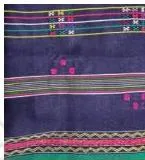
This motif is captioned “Wholeness and one’s energy” — read the drawing as a symbol, not as a picture of an object. In textiles, the same motif would repeat across the fabric to form a pattern (NCERT, p. 1).
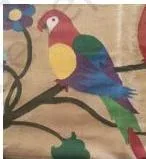
The motif captioned “Fertility, life and eternity” works the same way: its meaning comes from the idea the caption names. Symbolic meanings like this are exactly what the chapter says vary from region to region (NCERT, p. 1).
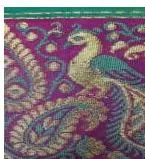
The “Truth, knowledge and love” motif completes the opening set. The chapter’s prompt with these images is to notice the elements of art in each one — shape, line and composition — before you move to the activities (NCERT, p. 1).
The patchwork curtain from Aaji’s clothes
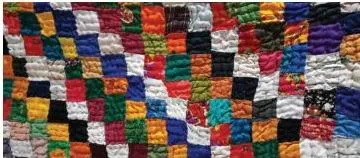
Find the elements the story names: sewn patches of different garments, a square window at the centre made by crochet, tassels along the bottom, and a tear where loose threads show the warp and weft of the weave (NCERT, p. 2).
In the story, each patch is a memory — the knitted sweater, the saree with the tea stain that was covered by embroidery. The image makes visible what the chapter means by patchwork carrying stories.
Fabric samples and embroiderers at work
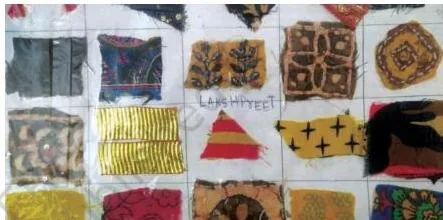
This is the kind of output Activity 18.1 expects: fabric pieces collected by students, laid out so the organisers can compare them. The chapter’s caption offers the ordering rule — organise by material, colour, texture or pattern (NCERT, p. 4). Your journal should do the same: plain fabrics in one group, printed fabrics in another, all cotton together.
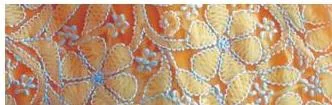
The embroiderers’ image illustrates the invitation at the end of Activity 18.2: find artists who embroider and talk to them about their art (NCERT, p. 5). The chapter also suggests organising a workshop with local artists so the class learns skills directly and sees the vocational possibilities of textile art (NCERT, p. 5).
Student textile artworks, flat and three-dimensional
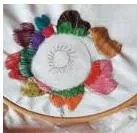
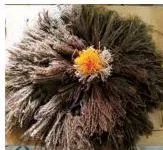
Both figures show artworks made by students in earlier runs of this activity. Their point is the chapter’s key sentence: textile artworks need not be made only on a flat surface — they can be three-dimensional (NCERT, p. 7).
The chapter ties this to a DO YOU KNOW? note: some museums today display textile artworks that can be touched, so visually impaired visitors can experience them (NCERT, p. 7). Which kind — flat, stitched, knitted or a cloth toy — would you attempt for Activity 18.4?
Textile terms used in this chapter, explained
These are the textile terms used in this chapter, in plain words you can scan while working. Each is defined as the chapter uses it.
| Term | What it means in this chapter |
|---|---|
| Motif (p. 1) | A decorative image that usually repeats and forms a pattern; varies by region and carries symbolic meaning. |
| Patchwork (p. 2) | A surface built by stitching together pieces of fabric from different clothes or garments. |
| Knitting (p. 2) | Making fabric by looping yarn with needles — the grandmother knitted her own sweater. |
| Embroidery (p. 5) | Decorative needlework: different kinds of stitches, patterns and needlework techniques on fabric. |
| Crochet (p. 2) | A technique that creates fabric from thread, used for the square window at the curtain’s centre. |
| Tassel (p. 2) | Bunched fine threads arranged together and knotted in patterns, hanging at the edge of a fabric. |
| Knot / knotting (p. 2, 6) | Tying thread to secure it at the start or end of stitching, or as decoration. |
| Weave (p. 2) | The structure of a fabric formed by interlacing threads. |
| Warp and weft (p. 2) | The two sets of threads that make up a weave — visible where the curtain is torn. |
| Textile artwork (p. 7) | Artwork made with cloth, thread, yarn or fibre, flat or three-dimensional. |
| Fabric journal (p. 4) | A collection of fabric samples with notes and stories, organised by material, colour, texture or pattern. |
Mistakes students make with these activities (and the fix)
These slips happen because the activities read like craft projects, and craft projects feel like “do what looks nice”. The corrections below come straight from the chapter’s instructions.
| Mistake | Correct rule | How to check your answer |
|---|---|---|
| Assuming textile art must be flat | Textile artworks need not be made only on a flat surface; they can be three-dimensional, like cloth toys (NCERT, p. 7). | Re-read the chapter’s line about three-dimensional pieces — does your Activity 18.4 plan have to stay flat? |
| Threading the needle with both ends equal | Thread the needle and keep one end short, then knot the longer end (NCERT, p. 6). | Before knotting, check that one thread end is clearly shorter than the other. |
| Ending a line of stitching without a knot | At the end of the line, make a knot on the reverse side and cut the thread (NCERT, p. 6). | Turn your work over — is there a knot holding the last stitch? |
| Collecting fabric samples without their stories | The Fabric Journal asks for where you found it, who it belonged to, what fibre it is and notes on the pattern (NCERT, p. 4). | Pick up any sample — can you answer all four questions about it? |
| Confusing a motif with the weave | A motif is a decorative image that repeats to form a pattern and carries meaning (NCERT, p. 1); warp and weft are the structure of the weave itself (NCERT, p. 2). | Would the fabric still hold together if the motif were removed? The weave would; the motif is decoration on top of it. |
Learning outcomes: what this chapter asks you to be able to do
The chapter closes with a table of learning outcomes used for teacher and self assessment (NCERT, p. 8). It tells you honestly what “finished” means here — and this is activity skill, not a written paper.
- Gathers fabric samples from their surroundings and writes about them — the Fabric Journal, completed with your own notes.
- Identifies and draws common textile motifs seen in their culture and surroundings.
- Creates a textile artwork using simple stitches or any other technique.
The table gives each outcome a code (1.1, 2.2, 3.2) and a column for Teacher and Self, so progress is checked in class and by the student, not by an external exam (NCERT, p. 8). Textbook contents and the examinable syllabus are not always identical — check the current official syllabus.
What to remember from Textiles and Traditions
Everything below is in the chapter above — keep it as your one-screen recap of what the activities test.
- A motif is a decorative image that repeats into patterns and carries symbolic meaning; the peacock means royalty and immortality, and the other opening motifs stand for wholeness and one’s energy, fertility-life-eternity, and truth-knowledge-love (NCERT, p. 1).
- The story’s job is to show that fabric carries stories — Dhaaga is thread in Hindi, Soodi is needle in Telugu, and the patchwork curtain is made from a grandmother’s clothes (NCERT, p. 2).
- Nine embroidery traditions are mapped to regions, from Chikankari in Uttar Pradesh to Kashida in Kashmir (NCERT, p. 5).
- The basic stitch routine starts with a 50 cm thread, keeps one end short, knots the longer end, prepares the card with marked lines and pierced holes, and ends with a knot on the reverse side (NCERT, p. 6).
- Textile artwork can be three-dimensional, and some museums display touchable textile artworks for visually impaired visitors (NCERT, p. 7).
- The chapter is assessed through three learning outcomes: gather samples and write about them, identify and draw motifs, and create your own textile artwork (NCERT, p. 8).
Related resources: the Kriti book and other Class 7 chapters
This listing is maintained for the 2026-27 academic session using the NCERT textbook information available to us. NCERT remains the authority for confirming the latest edition.
Continue with Chapter 18’s companion material or move to other chapters of the same book. Start from the Class 7 Kriti Arts book page, which lists the chapters of this textbook; the Class 7 hub holds every Class 7 subject. Companion chapters in the same book include How You Feel and The Art Of…, and the CBSE notes home leads to all subjects.
The official source for this chapter is NCERT’s textbook portal, where the full Kriti book is published.
| What the chapter holds | Count | Where it is used |
|---|---|---|
| Printed pages | 8 | |
| Figures with NCERT captions | 9 | |
| Tables | 2 | |
| Official NCERT PDF | Download the chapter PDF | the chapter exactly as NCERT publishes it |
Reference: NCERT Class 7 Kriti textbook, chapter 18, official edition on ncert.nic.in.
Sources and data verification
This page states plainly where its information comes from and what it does not cover.
- The figures and chapter contents described here come from the NCERT Class 7 Kriti Arts textbook, Chapter 18 “Textiles and Traditions”, official edition on ncert.nic.in.
- This page covers Chapter 18 of Kriti only — not the whole book and not the whole CBSE curriculum.
- The page is maintained for the current academic session using NCERT’s published textbook information.
- NCERT settles textbook editions and PDFs; CBSE settles curriculum, syllabus and examinations.
Common questions about Textiles and Traditions Class 7
What does the peacock motif mean in the Textiles and Traditions chapter?
The peacock motif stands for royalty and immortality (NCERT, p. 1). Like the other motifs at the chapter’s opening, it carries symbolic meaning, and the chapter asks you to notice the elements of art in it.
Which embroidery tradition belongs to which state in Class 7 Kriti Chapter 18?
The chapter’s table maps nine traditions to regions (NCERT, p. 5): Chikankari to Uttar Pradesh, Chamba Rumal to Himachal Pradesh, Kasuti to Karnataka, Toda to Tamil Nadu, Ahir to Gujarat, Kantha to West Bengal, Khneng to Meghalaya, Gota to Rajasthan and Kashida to Kashmir.
What materials do I need for Activity 18.3 on basic stitches?
You need card paper (discarded invitation cards or a thick drawing sheet of about 20 cm by 15 cm), a medium-sized needle, and thread or wool (NCERT, p. 6).
Can textile artwork be three dimensional?
Yes. The chapter says textile artworks need not be made only on a flat surface and points to cloth toys made of yarn or fibre (NCERT, p. 7). Some museums even display touchable textile artworks so visually impaired visitors can experience them.
Where is the official NCERT Class 7 Kriti Chapter 18 PDF available?
The official PDF is part of the Kriti book published on NCERT’s textbook portal at ncert.nic.in; use the download link at the top of this page — Download the Class 7 Textiles and Traditions chapter PDF — to open the chapter directly.
Explore Class 7 Arts Books
Related chapters: