
This page is about the Natya Class 7 chapter — Chapter 14 of the NCERT Class 7 Arts textbook Kriti. The chapter file is about nine pages long, and the official PDF is right below this introduction.
In the chapter, students read the story of Krishna and the serpent Kaliya and then stage it as a performance, combining dance, dialogues, songs, musical instruments, costumes and make-up.
Download the Official Natya Class 7 PDF (Kriti Chapter 14)
Get the chapter file straight from the source. Open the Natya Class 7 Kriti Chapter 14 PDF on NCERT’s official website to read the complete chapter as printed — the salutation verses with their word-by-word meanings, the Krishna–Kaliya story, the movement and music choices, and the assessment tables at the end.
This PDF is the official NCERT edition of Kriti, the Class 7 Arts textbook. Chapter 14, Natya, is the chapter file itself — the same pages students follow in class.
Natya Class 7 Chapter at a Glance
The table below lists what this chapter holds — sections, illustrations, activities and assessment tables — so you know the size of the file before you open it.
The chapter flows in one clear order. It opens with MEANING and MEANING OF LAST STANZA, which explain the salutation verse word by word, then BENEDICTION.
ACTIVITY 14.1: PLANNING THE PERFORMANCE breaks into MOVEMENT SELECTION, SECTIONS, MUSIC SELECTION and COSTUMES AND PROPS. ACTIVITY 14.2: PRACTISE AND PRESENTATION is the grand-finale performance, and the chapter closes with CHAPTER 14: NATYA (learning outcomes) and SUMMATIVE ASSESSMENT.
What the Natya Chapter Teaches
Natya is storytelling through performance — this is the idea the chapter builds on. A story becomes a performance by combining dance and choreography, dialogues, songs and musical instruments, costumes and make-up. Students explore how dance elements are incorporated into natya, using the tale of Krishna and the snake Kaliya as the working example — or any story the group chooses.

The illustration above carries the chapter’s promise: first read a story, then dance to it. The whole chapter is built around that sequence.
The frame story is simple. One lazy afternoon, Grandma gathers the children around her to tell the tale of Krishna and the serpent Kaliya.
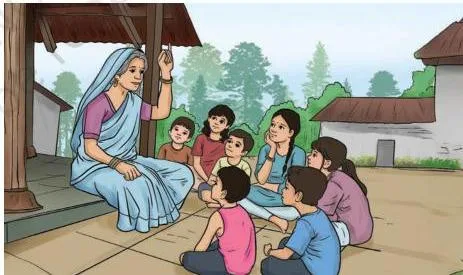
Here is the story in brief. On the banks of the river Kalindi lived Kaliya Naag, a monstrous serpent whose hissing and coiling frightened everyone — even the birds would not fly over the river, and children were scared to play by its banks.
One day Krishna arrived, climbed the tallest tree by the river and played his flute. The music was so sweet that Kaliya rose from the water, swaying to the melody. Krishna leapt on to the serpent’s hood and danced. Kaliya calmed, slipped back into the river and never troubled anyone again.
The children listen with rapt attention and ask Grandma to help them enact the story. She agrees: the whole tale must be planned and designed — choreographed with dance, music, enactment, costumes and stage design. She tells them that natya “isn’t just for entertainment; it teaches, it heals, and it brings peace”.
Grandma also sets the ritual frame. In the Indian natya tradition every play begins and ends with gratitude: the performance opens with a salutation to seek blessings, and closes with a benediction. The chapter gives one example of each prayer, and the tools to build the performance in between.
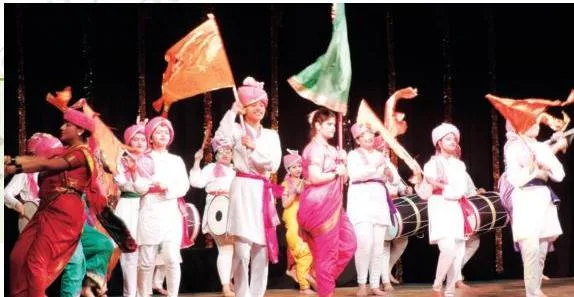
The illustration above shows where the chapter is heading: the grand finale of Activity 14.2, where every group’s choreography comes together as one full performance.
Key Ideas in Natya: Salutation, Benediction and the Performance Sections
These ideas are the building blocks a group uses to turn a story into a performance. Learn each one, and the six-section structure below becomes easy to plan.
Salutation: the Opening Prayer
The salutation is the prayer that opens a performance and seeks blessings for its success. Grandma compares it to starting the day with a prayer or singing in the morning assembly — it focuses the mind and brings a sense of calm. The chapter calls it an essential part of any play’s preliminaries in the Indian natya tradition.
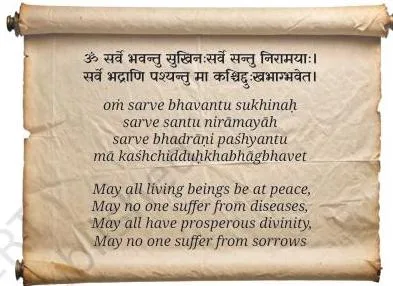
The book gives one example verse, addressed to Gajavadana, the elephant-faced god Ganesha. In flowing English it says: O elephant-faced god, son of Gowri, I pray to you; you are worshipped by all three worlds, and you are the protector of good people such as sages. Groups may use this verse or choose their own.
Benediction: Closing With Gratitude
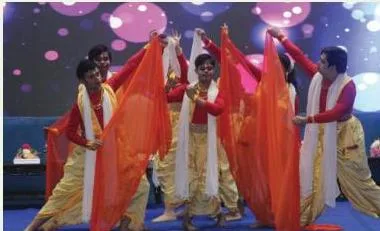
The benediction is the closing bookend. Where the salutation opens the performance by seeking blessings, the benediction closes it by bowing to the audience and thanking them for their time and attention. Grandma’s point: what is a performance without those who come to watch it? The exchange of respect is what makes natya special.
The benediction figure above shows the kind of devotional pose that can close a performance. The chapter later asks each group to compose its own benediction using hand gestures (hastas), and this illustration is a visual model of that final step.
Movement Selection: Beats, Navarasa and Hastas
Before any choreography, the group chooses from the chapter’s movement toolkit. Each element must express the emotion of its scene — nothing is used randomly. Here is the toolkit:
- Steps
- Rhythm and different beats — the chapter names 5-, 6- and 7-beat cycles, matched to the mood of each scene
- Navarasa — the emotional expressions of a performance; the chapter names bhayanaka (fear) for the frightened children, raudra (anger) for Kaliya and veera (courage) for Krishna
- Body movements — upper and lower torso, hip movements and similar
- Hand gestures, animal hastas, jumps and spins
So a fight scene wants strong steps, fast rhythm and sharp jumps, while a calming scene wants the opposite. The beat number is chosen for the scene, never for the whole performance.
The Six Sections of the Krishna–Kaliya Performance
The chapter offers a ready-made division of the Krishna–Kaliya story into six choreographable sections, each with a planning question the group must answer.
- Salutation: choose a song and choreograph it as a prayer dance.
- Dance of Krishna and friends: decide which steps and rhythms fit.
- Movements of Kaliya and the children’s reactions: try twisting and circular hip movements for Kaliya; decide how the children will show fear.
- The fight between Krishna and Kaliya: pick steps and rhythm suitable for a fight, then add jumps, spins and hastas.
- Celebration after the defeat of Kaliya: compose a celebratory dance, perhaps using a song or bandishes from the music class.
- Benediction: compose the closing gratitude using hastas.
The figure above is the chapter’s own map of the story breaking into scenes. Notice the pattern: a prayer opens, a prayer closes, and the story’s main beats — meeting, fear, fight, celebration — sit in between.
Try the same structure with a different story. The plan below uses “The Lion and the Mouse” to show how the chapter’s toolkit transfers — each scene gets its own beat cycle.
| Section of the story | Emotion | Rhythm choice | Movement choice |
|---|---|---|---|
| Salutation | Devotion | 5-beat cycle | Prayer dance with hastas |
| The lion’s proud walk | Raudra — pride and anger | 7-beat cycle | Heavy steps, strong torso movements |
| The mouse is caught | Bhayanaka — fear | 5-beat cycle | Quick, nervous steps and small jumps |
| The mouse pleads for mercy | Calm and gentle | 6-beat cycle | Slow swaying movements, soft hastas |
| The mouse frees the lion | Veera — courage | 6-beat cycle | Nibbling animal hasta, jumps and spins |
| Celebration and benediction | Joy and gratitude | 7-beat cycle | Circle dance, closing hasta pose |
Music, Costumes and Props
Music and costume decisions come next, and each one carries meaning. The group decides which sections use percussion and which use vocal music, and chooses the music or songs traditionally used in its own region. A teacher note in the chapter asks teachers to run the activity according to regional languages and practices.

The props illustration above shows the chapter’s example costume set. Every prop symbolises part of the story:
- Peacock feather and flute — mark the Krishna character
- Dhoti — the costume for the Krishna character
- Blue dupatta — symbolises the river, the Kalindi of the story
- Masks for animals — let one child play an animal
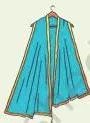
The dhoti illustration above makes the costume choice concrete: the group decides what each character wears before the performance, so the audience can read the character at a glance.
What the Natya Chapter’s Illustrations Show
Every part of this chapter’s method is shown in an illustration, so the figures are worth reading closely. In the order they appear in the book:
- “So, let us dive into this chapter…” — children dancing sets the chapter’s promise: read a story, then dance to it.
- “One lazy afternoon, Grandma gathered the children…” — the frame story; natya begins with someone telling a tale.
- “Here is an example of a benediction.” — a devotional pose that models the closing gesture of gratitude.
- “An example of how sections can be divided…” — the chapter’s six-scene map of the Krishna–Kaliya story.
- “Decide on different props and costumes…” — the costume set: feather, flute, dhoti, blue dupatta, animal masks.
- “Dhoti for Krishna character.” — a costume choice made specific.
- “Now comes the fun part…” — the grand finale of Activity 14.2, the full group performance.
Read the figures as a sequence: the story is told, the plan is drawn, the costumes are chosen, the performance is rehearsed and presented, and it opens with a salutation and closes with a benediction. That sequence is the chapter’s method.
Natya Vocabulary Explained: Verse Words and Performance Terms
The chapter explains its salutation verse word by word, and these are the words a student is expected to say back correctly. Here they are in one table.
| Verse word | Meaning |
|---|---|
| Gajavadana | One who has an elephant face — Ganesha |
| Beduve | I pray |
| Gowri Tanaya | Son of Gowri |
| Trijaga | The three worlds |
| Vanditane | Worshipped |
| Sujanara | By good people |
| Porevane | Protector |
| Sarasija Nabha | One who has a lotus in his navel |
| Sri Purandara Vittalana | Lord Vishnu — the pen name of Purandara Dasa |
| Niruta | Always |
| Neneyuvante | Make me remember |
| Nee | You |
| Dayamaado | Shower blessings |
The first seven words build the Gajavadana salutation; the last six build the closing stanza’s prayer to Purandara Vittala, asking to remember the Lord at every movement.
The chapter also uses five performance terms a student should be able to define:
- Natya — storytelling through performance
- Salutation — the opening prayer that seeks blessings
- Benediction — the closing prayer that thanks the audience
- Navarasa — the emotional expressions used in performance; the chapter names bhayanaka, raudra and veera
- Hastas — hand gestures; animal hastas use the hands to show animals
Common Mistakes Students Make in This Natya Chapter
The chapter’s own warnings point at six confusions a class most often makes. Each row gives the rule that fixes it and a quick way to check yourself.
| Mistake | Correct rule | How to check your answer |
|---|---|---|
| Confusing salutation with benediction | Salutation opens the performance, seeking blessings; benediction closes it, thanking the audience | Ask: does this prayer come before the story or after it? |
| Treating natya as dance only | Natya combines dance with dialogues, songs, instruments, costumes and make-up | Check that your performance uses non-dance elements too |
| Swapping the navarasa | Bhayanaka (fear) for the children, raudra (anger) for Kaliya, veera (courage) for Krishna | Name the character first, then choose the emotion that fits their situation |
| Using one rhythm for every scene | Different beats — 5, 6 and 7 — suit different moods and scenes | Check that each scene has its own beat choice |
| Ignoring regional music | The chapter asks for music traditional to your own region | Did your group discuss local songs and instruments? |
| Practising only the group finale | Individual tasks are assessed too — posture with hasta, rhythm sequence, sentence in hastas, project work | Rehearse each individual task as well as the group performance |
How the Natya Chapter Is Assessed: Learning Outcomes and Summative Assessment
The chapter ends with two tables that state what the performance work should achieve. The learning outcomes table works under competency group CG 3, competency 3.1. A student who has done the chapter successfully:
- Understands storytelling
- Actively participates in the making of natya
- Shares and collaborates with eagerness
- Imaginatively uses all aspects of performance in the presentation
The summative assessment table splits the check into individual and group tasks. The individual tasks are:
- Show body postures related to geometrical shapes with a hasta, like a sculpture. Prepare by practising four or five clear poses and matching each to a shape — triangle, circle, square — while holding a hand gesture.
- Perform one sequence of dance movement in rhythm. Prepare by repeating a short step pattern until it stays locked to the beat, then add one spin or jump.
- Make one sentence using hastas. Prepare by picking three or four words you can show with hand gestures and stringing them into a simple sentence.
- Project work. Prepare by keeping your group’s planning notes clear — the story choice, section division, music and prop decisions.
For a group of 3 or 4, the teacher checks comfort and coordination in hip movements and the ability to put together a complete performance with a story. The criteria are creativity and a collaborative attitude.
The table also lists the criteria behind the individual tasks: how many postures a student can show with proper understanding and accurate correlation with sculpture, whether the movement sequence follows the practised patterns, proper use of hands for conversation, and the content of the project work.
One honest note: textbook contents and the examinable syllabus are not always identical — check the current official syllabus for what is assessed this session. The book’s tables are its own assessment tools, and your school may adapt them.
The Natya Chapter’s Core Ideas in Brief
Everything essential in this chapter, in one screen:
- Definition: natya is storytelling through performance — dance, dialogues, songs, instruments, costumes and make-up together turn a story into a show.
- Frame: the Krishna–Kaliya tale is the working example, narrated by Grandma, who calls natya something that teaches, heals and brings peace.
- Rituals: every performance opens with a salutation seeking blessings (the Gajavadana verse) and closes with a benediction thanking the audience (a prayer to Purandara Vittala).
- Structure: the story is planned in six sections — salutation, Krishna and friends dancing, Kaliya’s movements and the children’s fear, the fight, celebration, benediction.
- Movement toolkit: steps, rhythm with 5/6/7 beats per scene, navarasa (bhayanaka, raudra, veera), body movements, hastas, animal hastas, jumps and spins.
- Production: percussion or vocal music per section, regional music preferred, and props — peacock feather, flute, dhoti, blue dupatta for the river, animal masks.
- Assessment: learning outcomes under CG 3 / 3.1, then summative assessment of individual tasks (posture with hasta, rhythm sequence, sentence in hastas, project work) and group tasks (hip coordination, full performance).
Related Arts Resources: More Class 7 Kriti Chapters
This listing is maintained for the 2026-27 academic session using the NCERT textbook information available to us. NCERT remains the authority for confirming the latest edition.
Natya is Chapter 14 of Kriti, the NCERT Class 7 Arts textbook. Move around the collection from here:
The Class 7 Kriti (Arts) book page lists the other chapters in this textbook, and the Class 7 NCERT books hub gathers every Class 7 book in one place.
For study help on the rest of the book, browse the Class 7 arts notes, organised chapter by chapter — including the visual arts and personalities chapters of Kriti — or start from the main CBSE notes index for every class and subject.
| What the chapter holds | Count | Where it is used |
|---|---|---|
| Printed pages | 9 | |
| Figures with NCERT captions | 7 | |
| Tables | 2 | |
| Official NCERT PDF | Download the chapter PDF | the chapter exactly as NCERT publishes it |
Reference: NCERT Class 7 Arts textbook (Kriti), chapter 14, official edition on ncert.nic.in.
Sources and Data Verification
- The chapter described here is Chapter 14, Natya, from the NCERT Class 7 Arts textbook Kriti, English edition.
- This page covers that single chapter and no other book or edition.
- The listing is maintained for the current session using the NCERT information available to us.
- NCERT settles textbook contents, editions and PDFs; CBSE settles the curriculum and examinations. Textbook contents and the examinable syllabus are not always identical — check the current official syllabus.
NCERT’s official website, ncert.nic.in, is the authority for the textbook’s editions and PDFs.
Frequently Asked Questions About the Natya Chapter
What is natya, according to the Class 7 Kriti chapter?
Natya is storytelling through performance. A story becomes a performance by combining dance and choreography with dialogues, songs and musical instruments, costumes and make-up.
What does the Gajavadana salutation verse mean, word by word?
The verse prays to Gajavadana, the elephant-faced god Ganesha: Beduve means “I pray”, Gowri Tanaya is “son of Gowri”, Trijaga is “the three worlds”, Vanditane is “worshipped”, Sujanara is “by good people” and Porevane is “protector”.
What are the six sections of the Krishna and Kaliya natya?
The chapter divides the performance into salutation, the dance of Krishna and his friends, Kaliya’s movements and the children’s fear, the fight, the celebration after Kaliya’s defeat, and the benediction. Each section asks the group to choose steps, rhythm, gestures or music that match the scene.
Which navarasa appear in this chapter, and which character uses each?
Three are named: bhayanaka (fear) for the frightened children, raudra (anger) for Kaliya and veera (courage) for Krishna.
What costumes and props does the chapter suggest, and what do they symbolise?
The chapter suggests a peacock feather and flute to mark Krishna, a dhoti as his costume, a blue dupatta symbolising the river Kalindi, and masks for animals so a child can play an animal.
How is the natya performance assessed in this chapter?
Students are assessed individually — body postures with a hasta like a sculpture, one dance sequence in rhythm, one sentence made with hastas, and project work. They are also assessed in groups of 3–4 on hip movement coordination and on putting together a full performance with a story.
The criteria include understanding, correct correlation with sculpture, pattern understanding, proper use of hands, project content, creativity and a collaborative attitude.
Explore Class 7 Arts Books
Related chapters: