
Dance Vocabulary and Techniques Class 7 — Chapter 11 of the NCERT Kriti Arts textbook — is an activity-based practical chapter. Instead of a written exercise set, it builds a dancer’s vocabulary layer by layer: foot positions, beat counts, hand gestures, jumps and spins, each one practised aloud and in movement.
The official Class 7 Kriti Chapter 11 Dance Vocabulary and Techniques PDF is right below, and the rest of this page explains what is inside it so you know what to expect before you start moving.
Download the Dance Vocabulary and Techniques Class 7 PDF
Open the official file — NCERT Class 7 Kriti Chapter 11 Dance Vocabulary and Techniques PDF — to see the chapter exactly as NCERT printed it, with the step tables, the hasta chart and all the practice images.
This is NCERT’s own Kriti textbook PDF for Class 7 Arts. Chapter 11 sits inside the file together with the rest of the book.
Chapter 11 at a glance
The table below lists what Chapter 11 holds — sections, figures, activities and question blocks — so you can see at a glance how practice-based the chapter is.
The chapter is organised around Activities 11.1 to 11.5 and its own step tables rather than a written exercise set.
What this chapter covers
Here is the chapter’s route in one look, from its first definition to its final game.
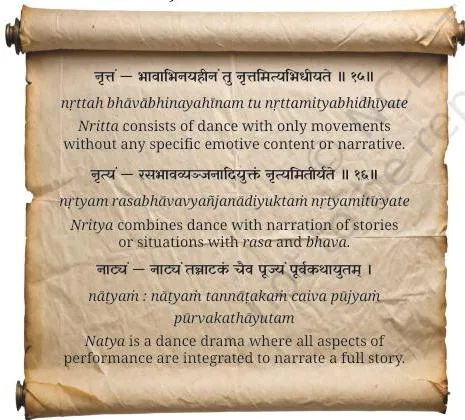
- Nritta, nritya and natya — the opening definitions from Abhinaya Darpana that name the three layers of every dance performance.
- Foot positions — the basic dance vocabulary: feet together, heel, toe, cross steps and jumps, which you string together to build steps.
- 5, 6 and 7 beat combinations — rhythm practice that treats every count as a sum of smaller counts.
- Nritya and hastas — hand gestures used to communicate specific words and even full sentences.
- Jumps, pirouettes and bhramaris — movement vocabulary for impact, used in pure dance or to enhance emotive content.
- Storytelling with your own techniques — combining everything you have learnt, ending with the wordless guessing game Mookaabhinaya.
Nritta, Nritya and Natya: pure dance, expressive dance and dance drama
The chapter opens with this distinction because every dance performance mixes the same three ingredients — movement, expression and story — and Indian dance theory gives each one a name. The definitions come from Abhinaya Darpana, a treatise widely followed by classical dancers.
| Term | Plain meaning | What it does in a performance |
|---|---|---|
| Nritta | Pure dance | Movement only, with no specific emotive content or narrative. |
| Nritya | Expressive dance | Movement combined with rasa and bhava to narrate a story or situation. |
| Natya | Dance drama | All aspects of performance integrated to narrate a full story. |
The chapter then adds the idea that makes this a vocabulary chapter: the basic steps are the most important unit of a dance form, and the various steps are strung together to make a dance.
The foot positions that make up dance vocabulary
These are the raw materials of nritta — the exact positions the chapter lists before any counting begins. You build every step combination from them.
- Feet together
- Heel — front, side
- Toe — front and back
- Cross in front
- Cross at the back
- Jump with one leg raised
- Jump with both legs
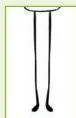
This overview figure is the chapter’s menu of movement: each small drawing shows one way the feet can be placed, and each drawing is one word in your dance vocabulary.
Four of the positions get close-ups so you can see exactly where the working foot goes.
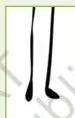
The heel close-up shows the heel carried to the front of the standing foot and then out to its side — the two directions the chapter names as one position.
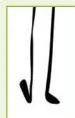
In the toe figure, the working foot points to the front and then to the back, giving the toe position its two directions.
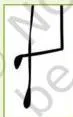
The cross-at-the-back figure places the working foot behind the standing foot — one of the two cross steps in the list, the other being cross in front.
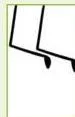
Finally, the jump-with-one-leg-raised figure shows that a jump counts as a foot position too — you will meet it again among the jumps later in the chapter.
Counting beats: why 5, 6 and 7 are built from smaller counts
The chapter treats counting as breakable: a 5-beat phrase is not five unknown beats, it is a 2-beat idea joined to a 3-beat idea. That is what the step tables rely on.
| Beat count | Built from |
|---|---|
| 5 beats | \(2 + 3\) |
| 6 beats | \(3 + 3\) |
| 7 beats | \(3 + 4\), or \(3 + 2 + 2\), or \(4 + 3\) |
Here is an original 5-beat combination built only from positions named in the chapter:
| Beat | 1 | 2 | 3 | 4 | 5 |
|---|---|---|---|---|---|
| Leg | right | right | left | right | left |
| Move | heel to the side | stamp | toe cross | stamp | stamp |
Now mirror it on the left: left heel to the side, left stamp, right toe cross, left stamp, right stamp. That mirroring is a firm rule in this chapter — every combination starts with the right leg and is then repeated with the left, so the body stays balanced.
The 6-beat and 7-beat step combinations in the PDF follow the same pattern: two combinations for each count, using moves like toe cross, heel front, heel and cross. Practise them from the chapter, then try your own variations.
The book suggests adding arm movements of your choice and using the bandishes from music class. Bols, the rhythmic syllables you say while stepping, can be decided by the teacher or by the students — and the note to the teacher even suggests aligning the counting practice with maths.
Hastas: hand gestures as communication in nritya
Once the feet can keep rhythm, the chapter moves to the hands — because in Indian dance the hands carry meaning, not decoration. The NRITYA section recaps a shloka from Abhinaya Darpana: where the hand moves, the eyes follow; where the eyes go, the mind follows; where the mind is directed, bhava is created; and where there is bhava, rasa unfolds.
That chain is exactly why gesture belongs to nritya: the hand leads the eye, the eye leads the mind, and the mind produces the emotion the audience feels. An asamyuta hasta uses one hand, and you learnt its usages in Kriti Grade 6. A samyuta hasta uses both hands, and Activity 11.2 introduces ten of them.
| Samyuta hasta | What it communicates |
|---|---|
| Anjali | Namaskar |
| Karkata | Gathering of people, showing the belly, twisting and stretching limbs |
| Pushpaputa | Offering flowers, drinking water, receiving things, performing aarti |
| Shakata | Anger, demon |
| Shankha | Blowing a conch shell |
| Pasha | Disagreement, tight knot, chain |
| Kilaka | Friendship, affection |
| Samputa | Hiding an object, rolling dice |
| Matsya | Fish |
| Garuda | Eagle, bird |
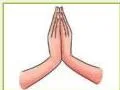
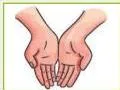
This chart is the one to practise from: each hasta is shown as the two hands actually form it, with its uses printed beside it.
A handy way to group the ten for memory — Anjali, Pushpaputa and Shankha belong to worship and offering; Shakata and Pasha carry anger, demons and disagreement; Kilaka is for friendship and affection; Karkata, Samputa, Matsya and Garuda show actions, objects and animals.
Jumps, pirouettes and bhramaris: movement vocabulary for impact
Jumps — utplavana in Sanskrit — and spins, called pirouettes or bhramaris, are the chapter’s second movement vocabulary. Both can be performed in rhythm with music beats, which enhances the overall impact of a dance. In a dance with stories, they can be performed without rhythm.
Activity 11.4 lists the jumps:
- Jump with one leg raised
- Jump with one leg to move in front
- Jump by folding both the legs back
- Jump without folding legs
and the pirouettes:
- Spin on one leg
- Spin spreading both hands in air
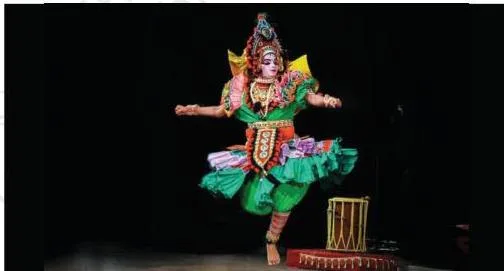
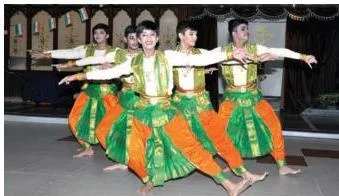
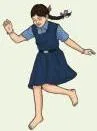
The photo above captures the idea behind the whole section: a jump done in rhythm lands as part of the music, not as an interruption.
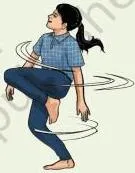
The spin-on-one-leg figure shows the body balanced on a single leg while turning — the basic pirouette you start with.
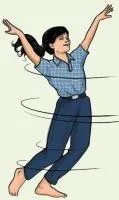
The second pirouette spreads both hands in the air as the body turns — a different shape and balance from the one-leg spin.
Indian dance forms that use jumps and spins
The chapter grounds all this vocabulary in real dance forms, so you can see jumps and spins as a living tradition rather than an abstract list.
Before the table, the chapter asks you to watch animals — a monkey jumping from tree to tree, a cat landing softly, rabbits and kangaroos bouncing as if their legs have springs, a peacock turning in circles while spreading its feathers — and points out that these movements are an integral part of our folk, traditional and classical dance forms.
| Dance form | Region | What its dancers do |
|---|---|---|
| Yakshagana | Karnataka | Perform pirouettes while standing on knees, often executing them multiple times |
| Kalbelia | Rajasthan | A traditional dance performed in a circular motion while taking pirouettes in a circular path |
| Pung Cholom | Manipur | Drummers jump and spin while holding a drum |
| Kathak | Northern India | A classical form characterised by the spins the dancer executes |
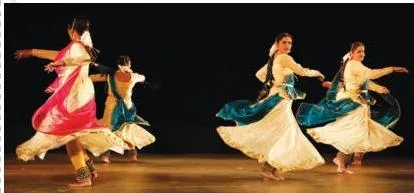
The Pung Cholom photo shows the signature move of that Manipuri form: a drummer turning in the air with the drum still in hand — jump and spin in one motion.
Activity 11.5 extends the list: Aji Lamu from Arunachal Pradesh, Cherchera from Chhattisgarh, Poykall Kuthirai from Tamil Nadu, Googa Dhamoda from Haryana, Cham from Ladakh and Fugdi from Goa. You watch each one, discuss and tick whether it has jumps, pirouettes or both, then try the moves in groups.
Key figures in Chapter 11 and how to read them
Most of Chapter 11 is visual — the diagrams and photos are your practice material, not decoration. Each kind of figure asks for a different kind of attention.
The foot position diagrams show the exact placement of the feet for each basic step: one foot stays planted while the working foot moves to the position named. The samyuta hasta chart shows both hands forming each gesture, so check your own hand shape against the drawing before you add the meaning.
The jump and spin figures show whole-body positions — compare your body to the photo in a mirror. The three jump figures below are the ones Activity 11.4 builds from.
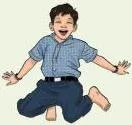
In the folding-jump figure, both legs tuck back behind the body in the air — the chapter names this as its own jump, separate from the one-leg versions.
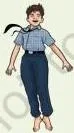
The no-fold jump keeps both legs straight as you leave the ground — the caption itself names the difference from the folded jump.
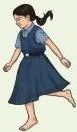
The one-leg-to-move-in-front jump uses the lift to carry you forward, showing that a jump is not just height — it can travel across the floor.
Dance terms at a glance
Keep this glossary open while you practise — every term below is used with a precise meaning in this chapter.
| Term | Meaning |
|---|---|
| Nritta | Pure dance: movement only, without specific emotive content or narrative |
| Nritya | Expressive dance: movement combined with rasa and bhava to narrate a story or situation |
| Natya | Dance drama: all aspects of performance integrated to tell a full story |
| Bols | Rhythmic syllables that mark the beats, chosen by the teacher or by students |
| Hasta | Hand gesture used to communicate meaning |
| Asamyuta hasta | A gesture made with one hand, learnt in Kriti Grade 6 |
| Samyuta hasta | A gesture made with both hands |
| Utplavana | Jumps |
| Bhramari | Spins, also called pirouettes |
| Mookaabhinaya | The game where one group acts out a situation without words and the other guesses it |
Common mistakes in this chapter and how to fix them
Four confusions come up again and again when students first work through this chapter. Name them now and you can avoid all four.
| Mistake | Correct rule | How to check your answer |
|---|---|---|
| Treating nritta and nritya as synonyms | Nritta is movement with no emotive content or narrative; nritya combines movement with rasa and bhava to narrate a story or situation, as Abhinaya Darpana defines them | Ask of any step: does it tell a story or express an emotion? If not, it is nritta; if it does, it is nritya |
| Practising a combination on only one side | Every step combination in the chapter starts with the right leg and is then repeated with the left | After your first run, mirror the whole phrase — every left becomes right and every right becomes left |
| Using hastas as vague hand-waving | Hastas communicate specific words — fishes, river, anger, friendship — and can build full sentences in Activity 11.3 | Can a classmate guess your exact sentence from your gestures alone? If not, the hasta is not precise enough |
| Thinking jumps and spins are only for pure dance | Jumps and pirouettes can also enhance emotive content in storytelling dance, where they may be done without rhythm | Try adding a jump at an emotional moment in a story — the chapter says this is exactly what the moves are for |
What to focus on for practice and assessment
This is an activity-based arts chapter, not a written exercise chapter, so your progress shows in what your body can do. Textbook contents and the examinable syllabus are not always identical, so check the current official syllabus for what this chapter contributes to assessment.
Use the chapter’s own learning outcomes table as a self-check list — you are on track when you can say yes to all six:
- Can I combine different parts of the feet to make movement?
- Do I understand the rhythmic elements used for practising basic dance steps?
- Do I use hand gestures as a tool of communication?
- Can I correlate jumps and spins in various dances?
- Do I feel comfortable practising jumps and spins?
- Can I use all these techniques to express myself?
How the activities in this chapter build the dance
The chapter is one long practice track: each activity adds one layer, and the next builds on it. Here is the order of work.
- Activity 11.1 — Basic steps and rhythms (nritta): combine the foot positions into 5, 6 and 7 beat step combinations.
- Activity 11.2 — Explore the uses of the samyuta hastas, the two-hand gestures.
- Activity 11.3 — Build conversations, then full sentences, using asamyuta and samyuta hastas while classmates guess the meaning.
- Activity 11.4 — Enhancing my dance with jumps and spins: practise the four jumps and two pirouettes.
- Activity 11.5 — Research the regional dances for jumps and pirouettes, tick the table, and try the moves in groups.
- Storytelling with your own techniques — after 11.5, create your own sequence of situations using basic steps, emotion, hastas, jumps and pirouettes together.
- Mookaabhinaya — the final game: one group acts out a situation using only expressions and hand gestures, the other guesses it.
The whole chapter on one page
If you have one minute before class, this is the chapter in six lines.
| Piece of the chapter | One-line recap |
|---|---|
| Nritta, nritya, natya | Pure movement, expressive movement and full dance drama, defined in Abhinaya Darpana |
| Beat splits | \(5 = 2 + 3\); \(6 = 3 + 3\); \(7 = 3 + 4\), \(3 + 2 + 2\) or \(4 + 3\) |
| Samyuta hastas | Ten two-hand gestures, Anjali to Garuda, each communicating specific words |
| Jumps and pirouettes | Four jumps and two spins, performed in rhythm or woven into storytelling |
| Dance forms | Yakshagana, Kalbelia, Pung Cholom and Kathak show these moves in tradition |
| Mookaabhinaya | A wordless acting game that tests everything the chapter taught |
Related resources
This listing is maintained for the 2026-27 academic session using the NCERT textbook information available to us. NCERT remains the authority for confirming the latest edition.
Move on from the chapter to practice ideas: explore the Class 7 Arts notes for the rest of Kriti, the Dance and Movement and Dance — You pages for more movement practice, and the Class 7 hub for every subject in this class. The notes home page links all of it together.
| What the chapter holds | Count | Where it is used |
|---|---|---|
| Printed pages | 14 | |
| Figures with NCERT captions | 19 | |
| Tables | 17 | |
| Worked examples | 1 | solved step by step in our NCERT Solutions |
| Activities | 3 | |
| Official NCERT PDF | Download the chapter PDF | the chapter exactly as NCERT publishes it |

Reference: NCERT Class 7 Kriti textbook, chapter 11, official edition on ncert.nic.in.
Sources and data verification
This page describes NCERT’s Kriti textbook for Class 7 Arts, Chapter 11, from the official NCERT edition published on ncert.nic.in. It covers this one chapter only, not the full arts syllabus.
NCERT settles textbook editions and official PDFs; CBSE settles curriculum, syllabus and examinations. What is examinable from this chapter is set by the current official syllabus, which may differ from the full textbook contents.
Dance Vocabulary and Techniques Class 7 FAQs
What is the difference between nritta, nritya and natya in Class 7 Kriti Chapter 11?
Nritta is pure dance — movement with no specific emotive content or narrative. Nritya combines movement with rasa and bhava to narrate a story or situation. Natya is a dance drama where all aspects of performance are integrated to narrate a full story. The chapter takes these definitions from Abhinaya Darpana.
How are 5, 6 and 7 beats split for dance steps in this chapter?
5 beats split as \(2 + 3\), 6 beats as \(3 + 3\), and 7 beats as \(3 + 4\), \(3 + 2 + 2\) or \(4 + 3\). Every step combination starts with the right leg and is repeated with the left. Bols, the rhythmic syllables, can be chosen by the teacher or by students.
Which samyuta hastas are taught in Chapter 11 and what do they express?
Ten samyuta hastas: Anjali for namaskar; Karkata for gathering of people, showing the belly and twisting and stretching limbs; Pushpaputa for offering flowers, drinking water, receiving things and aarti; Shakata for anger and demon; Shankha for blowing a conch; Pasha for disagreement, tight knot and chain; Kilaka for friendship and affection; Samputa for hiding an object and rolling dice; Matsya for fish; and Garuda for eagle and bird.
Which Indian dance forms use jumps and pirouettes in this chapter?
Karnataka’s Yakshagana, where artists pirouette while standing on knees; Rajasthan’s Kalbelia, performed in a circular motion with pirouettes; Manipur’s Pung Cholom, where drummers jump and spin holding a drum; and northern India’s Kathak, characterised by its spins.
What is the Mookaabhinaya game in Chapter 11?
Two groups play. The first group acts out a small situation using expressions and hand gestures only — no words — and the other group must guess the situation. The game continues for a few rounds and then the winning group is decided.
Explore Class 7 Arts Books
Related chapters: