
Integration of All Art Forms Class 7 is Chapter 20 of the NCERT Arts textbook Kriti — the final chapter of the book, a short activity chapter of about five printed pages built around one task: Activity 20.1, Stories in Stone.
The official NCERT PDF of the chapter is right below; underneath it, this page walks you through the activity stage by stage, introduces the sculptures it uses, and explains how the chapter is assessed.
Integration of All Art Forms Class 7: Chapter 20 PDF
Kriti is published by NCERT, and the Integration of All Art Forms Class 7 — Kriti Chapter 20 (official NCERT PDF) is hosted on the official NCERT textbook portal. Open it there to read the complete activity in the original printed layout — the five stages, the photographs of sculptures and monuments, and the Note to the Teacher at the end.
What Is Inside the Chapter: Activity 20.1, Stories in Stone
Kriti does not close with a reading passage; it closes with one classroom activity. Chapter 20 holds a single task — Activity 20.1, Stories in Stone — along with the Outcome and a Note to the Teacher.
- Activity 20.1, Stories in Stone — one group task with a printed objective: use ancient sculptures as a starting point, build a story, and bring it to life through performance with music, movement and dialogue.
- Five named stages — Preparation, Story Creation, Incorporating Art Forms, Rehearsal and Practice, and Presentation and Reflection.
- Outcome — a closing statement of what the activity is meant to achieve.
- Note to the Teacher — a suggestion that the story performances can be presented in front of a school audience or in the assembly.
For the chapter’s exact counts of sections, figures and questions, see the counts table on this page.
What the Chapter Does: Bringing Every Art Form Together
Before the stages, see the point of the exercise. The chapter opens with a claim: art is a powerful language that speaks to the mind and heart — what you feel at a concert or before a painting cannot be put into words.
The activity is the book’s way of making every art form you have learnt arrive together in one experience. Ancient sculptures are the starting point; a performed story is the end point. The printed objective says it directly: this activity inspires creativity and collaboration by building a story from sculptures and bringing it to life through music, movement and dialogue.
The chapter suggests the story can travel in several directions. Any of these four example types will work:
- A heroic adventure of a warrior statue.
- A festival scene featuring dancers and musicians.
- A divine story featuring gods and mythical creatures.
- A simple tale from the life of common people.
These four are examples the chapter prints to show the range, not a fixed list — your group can create any story that connects the sculptures meaningfully.
The Five Stages of the Activity, Explained
This walk through the five stages of Activity 20.1 shows what a group actually does at each stage. Work through them in order — each stage builds the material the next one needs.
| Stage | What your group does | What it produces |
|---|---|---|
| 1. Preparation | Collect sculpture pictures from the book, from your travels, and from your social science teacher | The image set your story will use |
| 2. Story Creation | Examine the figures, imagine their lives, and build a story that connects them | A story with a clear picture order |
| 3. Incorporating Art Forms | Add visual art, movement, dialogue, music and folk storytelling | A layered performance |
| 4. Rehearsal and Practice | Rehearse with movement, music and dialogue; keep the story clear and focused | A polished class performance |
| 5. Presentation and Reflection | Perform for the class and discuss the three reflection questions | A shared learning experience |
Stage 1 — Preparation: Finding Your Sculptures
Preparation is about gathering the raw material: the images your story will be built from. The chapter gives three sources:
- The pictures of sculptures and stone carving already in the book, spread across all four sections.
- Your own photographs — from places around you or places you have travelled — of gods, dancers, warriors, animals or everyday life scenes.
- More pictures of sculptures from your social science teacher, if you ask for them.
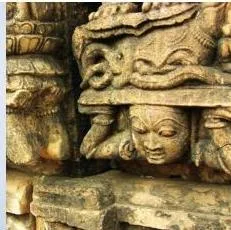
As an example, the chapter shows the carved wall inside the 7th-century temples at Pattadakal, a UNESCO World Heritage Site. A wall like that is the clearest proof that stone can carry a story.
Stage 2 — Story Creation: Building the Narrative
Story Creation turns a collection of pictures into a connected tale. The chapter’s steps are simple:
- Make small groups of 4–6 students.
- Examine the sculptures carefully and imagine the lives, emotions and actions of the figures.
- With help from your teacher, create a story that connects the sculptures in a meaningful way.
- Arrange the pictures in the order the story progresses, so it reads like a comic strip — except the frames are sculptures.
- Make it as creative and unique as possible.
The four example story types — a warrior’s adventure, a festival with dancers and musicians, a divine tale, or a story of common people — give you a starting menu, but the story most often chooses itself once the group studies the sculptures.
Stage 3 — Incorporating Art Forms: What to Add and How
This is the heart of the chapter — the stage that gives the activity its name. Five art forms arrive, and each carries a different part of the story:
| Art form | Your group’s task |
|---|---|
| Visual art | Draw the parts of the story that have no photograph, taking inspiration from Phad or Patachitra to create your own visual narrative. |
| Movement | Turn the stone figures into moving ones: use dance, body movement and hand gestures (hastas) that echo the postures of the sculptures. |
| Dialogue | Give each character a voice: short dialogues or monologues that match the expression or posture of the figure and push the story ahead. |
| Music and songs | Score the story with sound: traditional music or simple songs, with rhythm from clapping, humming or whatever instruments are available. |
| Folk storytelling | Tell the story in an older way: a folk style from this book, such as Phad storytelling or Harikathe, or a local form you have seen. |
Why five layers? Because a performance must be seen, heard and told, not just read. The drawings cover what no photograph shows, the movement brings the stone figures back to life, the dialogue gives them voices, the music sets the mood, and the folk style gives the telling its character.
Stage 4 — Rehearsal and Practice: Keeping the Story Clear
Rehearsal is where the story becomes a performance. The chapter gives each group time to rehearse the story, now with movement, music and dialogue included.
The one rule sits here: you can be creative by adding interesting parts, but the story must stay clear and focused. Every addition has to serve the story — if the tale stops making sense, the audience has nothing to watch.
Stage 5 — Presentation and Reflection: Performing and Discussing
The activity ends in front of the class. Each group performs its story, and the audience discusses how the sculptures inspired the characters, movements and actions.
After the performances, the class works through three reflection questions:
- What stories did the sculptures inspire?
- How did music, movement and dialogue enhance the story?
- What emotions or messages did the sculptures convey through the performance?
These three questions are part of the activity, not an optional extra — the discussion is where the learning becomes visible.
The Sculptures on the Page: A Mini Tour of the Photographs
The photographs in the chapter are not decoration — they are the raw material for the story. Here is a tour of them, grouped roughly by region and era.
Early Cave Architecture and a Northern Monument
The rock-cut Buddha-era cave in Mumbai shows the oldest idea in the chapter: a whole chamber carved out of the hillside. It is architecture made by cutting stone away rather than building up — the tradition the activity begins from.
The Qutub Minar in New Delhi carries the collection to the north of the country. Alongside the Buddha-era cave, it shows that the heritage this activity draws on is national, not limited to the temple towns of the south.
The Chola Temples of Tamil Nadu
The Chola Temples at Darasuram are a temple complex — several structures rather than a single building. The chapter photographs them as a complete example of Chola temple architecture.
The Brihadeeswarar Temple at Thanjavur is the chapter’s grand single-temple example — one vast structure rather than a complex.
The third image is labelled simply “Temple wall, South India”. It shows the wall itself as the canvas — a surface packed with carved figures that the activity reads like picture panels.
Sculptures from Halebidu and Kanyakumari
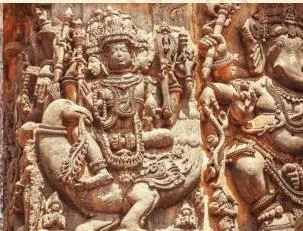
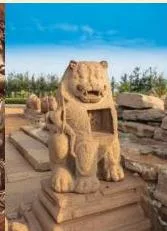
A carved figure like the 12th-century Ganesh from Halebidu can become a character in the story. A single statue asks you to imagine one life, one set of emotions, one set of actions.
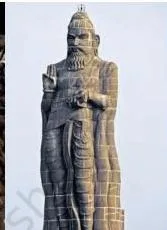
A monumental figure like the Thilluvaluvar sculpture of Kanyakumari gives a story a setting and a scale — a figure too large to be ignored, the kind that anchors a tale.
The Closing Photograph
The last photograph sits beside the Outcome, and its caption is the Outcome itself. Read it as the book’s final invitation: temple art, shared through teamwork and storytelling, is heritage you carry with you.
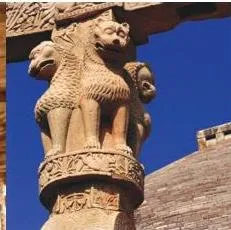
The chapter also names more sites as it moves through the activity: Mahabalipuram in Tamil Nadu, the Vijayanagara Empire at Hampi in Karnataka, the Gangaikondacholisvaram Temple at Gangaikonda Cholapuram, the Buddhist Stupa at Sanchi in Madhya Pradesh (famous for its Jataka Tale carvings), and a temple in Chhattisgarh. These names widen the pool of heritage a group can draw on.
Art Terms You Need for the Activity
Stage 3 uses art-form names, and some of them ask you to recall things you have already studied in this book. Here is what each term means for this activity:
- Phad and Patachitra — visual storytelling traditions introduced in earlier chapters of Kriti. In Stage 3 you take inspiration from their style to create your own visual narrative.
- Hastas — hand gestures used in Indian dance. Here they are the bridge between stone and performance: your movements and gestures represent the hastas and postures of the sculptures.
- Harikathe — a traditional storytelling form named alongside Phad storytelling in the chapter. Using it means telling your story in that style rather than in plain narration.
- Folk storytelling — any local narrative tradition you have seen around you. The chapter explicitly allows “any other local form” you know, making this the most flexible layer of the five.
If any of these names feel unfamiliar, the earlier Kriti chapters that introduced them are your real preparation for Chapter 20.
Where Groups Lose the Story (and How to Fix It)
The chapter’s own warning is the key to the whole activity: you can be creative by adding interesting parts, but keep the story clear and focused. Groups that struggle lose exactly that thread. The table below names the usual failure points and the fix for each.
| Mistake | Correct rule | How to check your answer |
|---|---|---|
| Choosing sculptures that cannot connect into one narrative | Pick figures that can plausibly share a single story | Can the class follow one storyline from the first image to the last? |
| Arranging pictures out of story order | Put them in the order the story progresses, like a comic strip made of sculptures | Read the images in sequence — does the story make sense at every step? |
| Writing dialogue that contradicts a sculpture’s expression or posture | Let the lines be inspired by what the figure actually shows | Would an audience believe this character is the statue we just saw? |
| Leaving gaps where a scene has no photograph | Draw those scenes — that is exactly what the visual-art layer is for | Does every gap in the image sequence have a drawing? |
| Adding creative parts until the story is unfocused | Keep the story clear and focused; every addition must serve it | Can you say the whole story in one sentence? |
| Skipping the audience discussion after performing | Treat the three reflection questions as a required stage | Were all three questions actually discussed after the performance? |
How This Chapter Is Assessed: Performance, Not a Written Test
Chapter 20 has no written exercise questions, so it is assessed differently from the rest of Kriti. The chapter is one classroom activity; the assessment is the performance itself and the reflection discussion that follows it — the three questions listed in Stage 5.
The Note to the Teacher adds one more possibility: the story performances can be presented in front of the school audience or in the assembly. That lets the chapter reach beyond the classroom, but it does not change what the group must do — rehearse, perform, reflect.
One honest caution: textbook contents and the examinable syllabus are not always identical. Check the current official CBSE academic curriculum to confirm how this activity is assessed in your session.
The Chapter in Five Sentences
If you have one minute before class, these five sentences carry the whole chapter:
- Activity 20.1, Stories in Stone, is the closing activity of Kriti: a group task that turns ancient sculptures into a performed story.
- A group of 4–6 students moves through five stages — preparation, story creation, incorporating art forms, rehearsal, and presentation with reflection.
- The story is layered with five art forms: visual art, movement, dialogue, music and songs, and folk storytelling.
- The activity ends with a class performance followed by a discussion of three reflection questions.
- Its stated aim is to let students feel the richness of India’s temple art heritage while practising teamwork, storytelling and creativity — and to bring history to life by integrating music, movement and dialogue.
Related Chapters and Resources
This listing is maintained for the 2026-27 academic session using the NCERT textbook information available to us. NCERT remains the authority for confirming the latest edition.
The real preparation for Chapter 20 sits earlier in the same book. Phad, Patachitra, hastas and Harikathe are all introduced in earlier Kriti chapters, and Stage 3 assumes you can recall them. If you need to refresh any of them, use these pages:
- Class 7 Arts (Kriti) notes — the book’s page on this site.
- Notes for the earlier Kriti chapters that introduce visual storytelling, hastas and folk forms.
- The Class 7 hub — all of Class 7 in one place.
- The main CBSE notes section — for other classes and subjects.
Sources and Data Verification
This page describes the NCERT Class 7 Arts textbook Kriti, Chapter 20, “Integration of All Art Forms”, as published on ncert.nic.in.
- Edition: the current NCERT edition of Kriti (Class 7 Arts), as published on the official NCERT site.
- Coverage: this chapter of this book only — not other Class 7 subjects, and not the rest of Kriti.
- Session: this listing is maintained for the current academic session using the NCERT edition available to us.
- Authority: NCERT settles textbooks, editions and PDFs; CBSE settles curriculum, syllabus and examinations. A chapter appearing in the textbook does not by itself prove that every part of it is examinable this session — check the current official syllabus.
| What the chapter holds | Count | Where it is used |
|---|---|---|
| Printed pages | 5 | |
| Figures with NCERT captions | 8 | |
| Official NCERT PDF | Download the chapter PDF | the chapter exactly as NCERT publishes it |
Reference: NCERT Class 7 Arts textbook, chapter 20, official edition on ncert.nic.in.
Frequently Asked Questions about Integration of All Art Forms Class 7
What is Activity 20.1 Stories in Stone in Kriti Chapter 20?
Activity 20.1, Stories in Stone, is the single activity that makes up Chapter 20 of the Class 7 Arts book Kriti. Groups of 4–6 students study photographs of ancient Indian sculptures, build a story that connects them, add visual art, movement, dialogue, music and a folk storytelling style, and perform the result for the class. The activity then closes with a reflection discussion.
Which art forms does Chapter 20 of Class 7 Kriti combine?
Five: visual art, movement, dialogue, music and songs, and folk storytelling. Visual art draws the parts of the story with no photograph; movement uses dance and hastas to echo the sculptures’ postures; dialogue voices the characters; music adds rhythm; and folk storytelling — Phad, Harikathe or a local form — gives the telling its style.
Which Indian sculptures and monuments appear in this chapter?
The photographs include a rock-cut Buddha-era cave in Mumbai, a 12th-century Ganesh sculpture from Halebidu, the Chola Temples at Darasuram, a South Indian temple wall, the Thilluvaluvar sculpture of Kanyakumari, the Brihadeeswarar Temple at Thanjavur and the Qutub Minar in New Delhi.
The text also names Mahabalipuram, the Vijayanagara Empire at Hampi, Gangaikondacholisvaram, the Sanchi Stupa and a temple in Chhattisgarh.
Do I need earlier chapters of Kriti to do this activity?
Yes. Stage 3 asks you to recall visual storytelling traditions (Phad and Patachitra), hastas and forms like Harikathe that earlier chapters of the same book introduce. Those chapters are the real preparation for Chapter 20, which is why the activity works best as the book’s final chapter.
Is there an exam question in Chapter 20 of Kriti?
There are no written exercise questions in this chapter. It is a single classroom activity, and its assessment is the performance and the class’s discussion of the three reflection questions. The Note to the Teacher also allows the performances to be presented to a school audience or in the assembly.
Explore Class 7 Arts Books
Related chapters: