
This is the NCERT Class 7 Kriti (Creative Arts) textbook, Chapter 13, Personalities — the chapter that profiles two Indian dance masters: Shambhu Maharaj of the Lucknow Gharana of Kathak and Kedar Nath Sahu of Seraikella Chhau.
The official Personalities Class 7 Kriti chapter PDF is published on the NCERT portal, and the sections below map both profiles, the key terms, and the one activity the chapter asks you to do.
If you want the official file, the Personalities Class 7 Kriti chapter PDF is published on the NCERT portal, where the full classwise textbook collection is available free — open it to read both profiles, the photograph, and Activity 13.1 in the original layout.
Chapter 13 at a glance: two profiles and one activity
The chapter table for this page shows the chapter’s size at a glance — its sections, figures, activities and exercise questions.
The shape of the chapter is simple: two artist profiles, one research activity, and a closing table of learning outcomes. Nothing in it is a theory test — the work is the activity at the end.
What the chapter is really about: two dance traditions, one task
This section explains why the two artists sit together in one chapter, then lays out each profile’s facts. The two profiles are followed by one task — Activity 13.1 — which turns the reading into your own research.
Shambhu Maharaj: the Lucknow Gharana of Kathak
Shambhu Maharaj was the scion of the Lucknow Gharana of Kathak, born into a family of traditional Kathak dancers. His forefathers were gurus and dancers at the court of Nawab Wajid Ali Shah of Awadh; his father was the famous Kalka Prasad, and his uncle Binda Deen consolidated the Lucknow Gharana.
He trained under his uncle Binda Deen and, after independence, built a dance repertoire with his elder brother Acchan Maharaj. He made his debut in Lucknow in 1926 at the All India Music Conference, performing regularly as a soloist and with his elder brothers Acchan and Lacchu Maharaj.
He moved to Delhi in 1955 and taught Kathak at the Shriram Bharatiya Kala Kendra, establishing the tradition of the Lucknow Gharana in Delhi. The chapter says he was very famous for his abhinaya and bhav batana — the expressive side of Kathak, which he performed in the court style of sitting and enacting.
He taught his nephew, the famous Birju Maharaj, and many other noted Kathak dancers of India. His sons Ram Mohan and Kishan Mohan are also accomplished dancers and gurus. The family line runs: court dancers under Wajid Ali Shah → Kalka Prasad and Binda Deen → Shambhu Maharaj → his nephew Birju Maharaj → his sons.
His awards were the Padma Shri in 1958 and the Sangeet Natak Akademi Award in 1967.
Kedar Nath Sahu: Seraikella Chhau
Kedar Nath Sahu was one of the leading exponents of Seraikella Chhau. He came from a traditional family of Chhau dancers of the Kanasari caste, who carried these dance practices alongside their main occupation of making household utensils.
That detail matters: Seraikella Chhau survived as a family craft beside the family trade. The form followed the Guru-Shishya Parampara, and the art was orally transmitted from generation to generation — Kedar Nath Sahu started learning at a very early age, from his father and grandfather.
He first performed in the troupe of Kumar Bijoy Pratap Singh Deo and later formed his own troupe with his disciples. His performances received acclaim both in India and around the world.
Many illustrious dancers trained under him; the chapter names Shashadhar Acharya, Gopal Prasad Dubey and Sharon Lowen among his notable students.
His awards were the Sangeet Natak Akademi Award in 1981 and the Padma Shri in 2005. The chapter’s single task, Activity 13.1, then asks you to research one of four named dancers — Balasaraswati, Pandit Hazarilal, Keermane Shivaram Hedge or Gulabo Sapera — and present your work to the class as a project.
Key ideas that connect the two profiles
Before memorising facts, see the shared idea: this is not two random biographies. Both profiles show how dance knowledge travels through families, courts and teachers.
- A gharana is a family-based school of a dance tradition. Both artists come from hereditary dance families — Shambhu from the Lucknow Gharana of Kathak, Kedar from a traditional Chhau family.
- Royal courts patronised these traditions. Shambhu Maharaj’s forefathers were gurus and dancers at the court of Nawab Wajid Ali Shah of Awadh.
- Knowledge passed orally through Guru-Shishya Parampara. Kedar Nath Sahu learned from his father and grandfather, and Shambhu Maharaj trained under his uncle Binda Deen.
- Both artists trained the next generation and received national honours. Kedar’s students included Shashadhar Acharya, Gopal Prasad Dubey and Sharon Lowen; Shambhu taught his nephew Birju Maharaj. Both received the Padma Shri and the Sangeet Natak Akademi Award, in different years.
The chapter’s photograph: Kedar Nath Sahu
Here is the chapter’s own photograph of the second dancer. Read it as evidence, not decoration — it puts a face to the name you are studying.
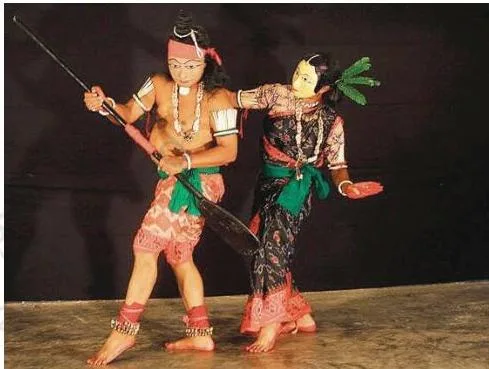
The caption tells you exactly who he is: one of the leading exponents of Seraikella Chhau, from a Kanasari-caste family, taught by his father and grandfather, acclaimed in India and around the world.
The chapter also carries a plate titled “Seraikella Chhau Masks”, which points to the place of masks in the form. The portrait and the mask plate work together: one gives the person, the other gives the tradition he represents.
Dance terms in this chapter, explained
You meet several Hindi and dance terms here for the first time. The table below gives each one in plain words, exactly as the chapter uses it.
| Term | What it means in this chapter | Where it appears |
|---|---|---|
| Kathak | The dance tradition of the first profile; the Lucknow Gharana is a school of it. | Shambhu Maharaj’s profile |
| Lucknow Gharana | The family-based school of Kathak consolidated by Binda Deen; its early dancers served Nawab Wajid Ali Shah’s court. | Shambhu Maharaj’s profile |
| Abhinaya | Expressive acting — the chapter says Shambhu Maharaj was very famous for his abhinaya. | Shambhu Maharaj’s profile |
| Bhav batana | The enactment of emotion, performed in the court style of sitting and enacting. | Shambhu Maharaj’s profile |
| Chhau | The dance tradition of the second profile; Seraikella Chhau is the form Kedar Nath Sahu led. | Kedar Nath Sahu’s profile |
| Seraikella Chhau | The Chhau form Kedar Nath Sahu carried; the plate “Seraikella Chhau Masks” shows the place of masks in it. | Kedar Nath Sahu’s profile |
| Guru-Shishya Parampara | The master–disciple tradition in which the art was orally passed from generation to generation. | Kedar Nath Sahu’s profile |
| Kanasari caste | The traditional family of Chhau dancers who practised dance alongside making household utensils. | Kedar Nath Sahu’s profile |
| Padma Shri | A national honour; the chapter records Shambhu Maharaj receiving it in 1958 and Kedar Nath Sahu in 2005. | Both profiles |
| Sangeet Natak Akademi Award | A national award for the performing arts; the chapter records Shambhu Maharaj in 1967 and Kedar Nath Sahu in 1981. | Both profiles |
Common mix-ups: which dancer did what
Four confusions trip students on this chapter, and all four are about mixing one dancer with the other. The table names each mistake before you make it.
| Mistake | Correct rule | How to check your answer |
|---|---|---|
| “Birju Maharaj was Shambhu Maharaj’s son.” | Birju Maharaj was Shambhu Maharaj’s nephew, not his son. The chapter says Shambhu taught his nephew, the famous Birju Maharaj. | Ask who taught whom: the relation word in the chapter is “nephew”. |
| “Shambhu Maharaj trained under his father Kalka Prasad.” | He trained under his uncle Binda Deen. His father Kalka Prasad was a famous dancer in the same gharana, but it was the uncle who trained him. | Look for the chapter’s sentence: “trained under his uncle Binda Deen”. |
| “Both dancers were Kathak masters.” | Shambhu Maharaj is Kathak (Lucknow Gharana); Kedar Nath Sahu is Seraikella Chhau — two different forms. | Match the form to the name: gharana with Kathak → Shambhu; masks and Chhau → Kedar. |
| “Shambhu received the Akademi Award in 1981, Kedar in 1967.” | Shambhu: Padma Shri 1958, Akademi Award 1967. Kedar: Akademi Award 1981, Padma Shri 2005. | The earlier years (1958, 1967) belong to Shambhu; the later years (1981, 2005) belong to Kedar. |
Now a quick matching check — cover the answer column, match each pair, then reveal.
| Match these pairs | Answer |
|---|---|
| Shambhu Maharaj — Kathak or Seraikella Chhau? | Kathak, Lucknow Gharana |
| Kedar Nath Sahu — Kathak or Seraikella Chhau? | Seraikella Chhau |
| Shambhu Maharaj’s award years — 1958 + 1967 or 1981 + 2005? | Padma Shri 1958; Sangeet Natak Akademi Award 1967 |
| Kedar Nath Sahu’s award years — 1981 + 2005 or 1958 + 1967? | Sangeet Natak Akademi Award 1981; Padma Shri 2005 |
How this chapter is assessed: Activity 13.1 and the learning outcomes
This is a project chapter, not a theory unit. The chapter itself tells you what it checks, in its closing learning-outcomes table.
The single formal task is Activity 13.1: research and write about any one personality — the great dancer Balasaraswati, Pandit Hazarilal, Keermane Shivaram Hedge or Gulabo Sapera — and present it to the class as a project work.
Work through the activity in steps:
- Choose one of the four dancers named in Activity 13.1.
- Research the same things the chapter’s profiles cover: family background, dance form, training, achievements.
- Write a short profile in your own words, using those headings.
- Present the write-up to the class as a project, and keep the written version for your journal.
The closing table lists three learning outcomes, with Teacher and Self columns — both you and your teacher can mark whether each outcome is met:
- Shows interest in learning about dance personalities.
- Actively researches at least one other dance personality.
- Makes a creative presentation in a project work or journal.
The chapter prints no marks or question paper; the work it asks of you is the activity itself, and the learning outcomes define what a completed project should show.
Recap: the two dance masters side by side
Use this one-screen table the night before presenting: every chapter fact a teacher can ask, side by side.
| Dancer | Dance form | Family and training | Landmark event | Awards |
|---|---|---|---|---|
| Shambhu Maharaj | Kathak — Lucknow Gharana | Hereditary Kathak family at Nawab Wajid Ali Shah’s court; father Kalka Prasad, uncle Binda Deen; trained under Binda Deen. | Debut in Lucknow in 1926; taught Kathak at the Shriram Bharatiya Kala Kendra, Delhi, from 1955. | Padma Shri 1958; Sangeet Natak Akademi Award 1967 |
| Kedar Nath Sahu | Seraikella Chhau | Kanasari-caste Chhau family who also made household utensils; learned from father and grandfather. | Performed with Kumar Bijoy Pratap Singh Deo’s troupe; later formed his own troupe. | Sangeet Natak Akademi Award 1981; Padma Shri 2005 |
Related chapters and where the PDF comes from
For more help with the rest of this book, the Class 7 Arts notes hub is where this book’s chapters live, including the related dance pages Dance You and Natya. The Class 7 notes page gathers your other subjects this year, and the CBSE notes library is the index to notes across classes.
This chapter is Chapter 13 of the NCERT Class 7 Kriti textbook, and the official PDF is published on the NCERT textbook portal, the authoritative source for NCERT editions. Textbook contents and the examinable syllabus are not always identical — check the current official syllabus before assuming any chapter will be tested.
Sources and data verification
This listing is maintained for the 2026-27 academic session using the NCERT textbook information available to us. NCERT remains the authority for confirming the latest edition.
The facts on this page describe the NCERT Class 7 Kriti (Creative Arts) textbook, Chapter 13, “Personalities”, in its current NCERT edition — including the photograph of Kedar Nath Sahu and the closing learning-outcomes table.
This page covers that one chapter of the Kriti book. It does not cover other Class 7 subjects or other NCERT books.
NCERT publishes the textbooks, editions and official PDFs; CBSE settles the curriculum, syllabus and examinations. Where the two differ, the official sources are the final authority.
| What the chapter holds | Count | Where it is used |
|---|---|---|
| Printed pages | 3 | |
| Figures with NCERT captions | 1 | |
| Tables | 1 | |
| Activities | 1 | |
| Official NCERT PDF | Download the chapter PDF | the chapter exactly as NCERT publishes it |
Frequently asked questions about the Personalities Class 7 chapter
Which two dance personalities does Kriti Chapter 13 cover?
It covers Shambhu Maharaj of the Lucknow Gharana of Kathak and Kedar Nath Sahu of Seraikella Chhau. Each profile explains the dancer’s family, training, career and awards.
Who is Shambhu Maharaj and what is the Lucknow Gharana of Kathak?
Shambhu Maharaj was a scion of the Lucknow Gharana of Kathak, a family of traditional Kathak dancers whose forefathers served Nawab Wajid Ali Shah’s court. The Lucknow Gharana is the family-based school of Kathak consolidated by his uncle Binda Deen.
Shambhu trained under Binda Deen, debuted in Lucknow in 1926, taught at the Shriram Bharatiya Kala Kendra in Delhi from 1955, and taught his nephew Birju Maharaj.
Who is Kedar Nath Sahu and what is Seraikella Chhau?
Kedar Nath Sahu was one of the leading exponents of Seraikella Chhau, from a traditional Kanasari-caste family of Chhau dancers. He learned the form as a child from his father and grandfather, performed with Kumar Bijoy Pratap Singh Deo’s troupe and later formed his own, and trained dancers such as Shashadhar Acharya, Gopal Prasad Dubey and Sharon Lowen.
How is Birju Maharaj related to Shambhu Maharaj?
Birju Maharaj was Shambhu Maharaj’s nephew, not his son. The chapter says Shambhu taught his nephew, the famous Birju Maharaj.
What awards did Shambhu Maharaj and Kedar Nath Sahu receive?
Shambhu Maharaj received the Padma Shri in 1958 and the Sangeet Natak Akademi Award in 1967. Kedar Nath Sahu received the Sangeet Natak Akademi Award in 1981 and the Padma Shri in 2005.
What does Activity 13.1 ask students to do?
It asks you to research and write about any one of four named dancers — Balasaraswati, Pandit Hazarilal, Keermane Shivaram Hedge or Gulabo Sapera — and present it to the class as a project work.
Reference: NCERT Class 7 Kriti textbook, chapter 13, official edition on ncert.nic.in.
Explore Class 7 Arts Books
Related chapters: