
Dance and Movement Class 7 is Chapter 10 of the NCERT Kriti textbook, the Arts book for Class 7. It teaches you to read the dancing body in sculpture, spot geometrical shapes in postures, speak through hand gestures (hastas) and perform the nine emotions known as navarasa.
The official NCERT Class 7 Kriti Chapter 10 Dance and Movement PDF is right below, and the rest of this page explains what the chapter contains and how to work through it.
Download the official NCERT Class 7 Kriti Chapter 10 Dance and Movement PDF
The file NCERT publishes for this chapter is the only official copy of the text, diagrams and activities. Open the NCERT Class 7 Kriti Chapter 10 Dance and Movement PDF on the official NCERT website at ncert.nic.in, the single authoritative source for every NCERT textbook, so you read the chapter exactly as the book prints it.
Chapter 10 at a glance: what is inside the file
The chapter table on this page lists how much of Chapter 10 the file holds, so you can see its size at a glance before opening it. What the contents actually teach, in a quick scan:
- An opening verse from the Vishnudharmottara Purana, which says that without the knowledge of dance, the principles of sculpture are very difficult to understand.
- A page of pedagogical principles and the four curricular goals, CG-1 to CG-4, each with its competencies.
- Body work: geometrical shapes in dance, the five upper-torso bhangas, arms and angles, five knee-bend levels and four foot-distance positions.
- Hand gestures: the asamyuta hastas (single hand) and samyuta hastas (double hand) tables.
- Navarasa: nine emotions, each linked to a scene from nature.
- Three numbered activities plus an emotion enactment game with bowls of chits.
- A closing learning outcomes grid with Teacher and Self columns.
What this chapter covers, section by section
This map follows the chapter in the order you meet it, so you can jump to any topic without reading the whole file.
- The Purana verse and the dance–sculpture idea: the epigraph, followed by the section that explains the verse through a conversation between King Vajra and the sage Markandeya.
- Pedagogical principles and curricular goals: twelve principles and four goals with competencies, placed before the body work begins.
- Geometrical shapes and upper torso bhangas: triangles, circles and lines in postures, with the five bhangas named: samabhang, dwibhang, abhang, tribhang and atibhang.
- Arms and angles: using arms in circles, half circles and diagonals.
- Lower torso: knee bends from no bend to full seating on toes, and foot distances from equal weight to maximum width.
- Activities 10.1 and 10.2: making body shapes friends can identify, and spotting dance in temple sculptures.
- Hand gestures: the asamyuta and samyuta hasta tables, recalling what you learnt in Kriti, Grade 6.
- Activity 10.3: matching hastas seen in sculptures and creating new mudras.
- Navarasa: the nine emotions read through one continuous garden story.
- The emotion game: two bowls of chits that cross nine emotional states with daily activities.
- Learning outcomes: the closing grid that maps what you should be able to do after the chapter.
Key concepts: the ideas that hold the chapter together
Four ideas run through Chapter 10. Understand these and every posture, table and activity in the book makes sense.
Dance and sculpture: one art form explains the other
This is the oldest idea in the chapter, and it explains why the book opens with a verse instead of a posture. The Vishnudharmottara Purana, dated in the book around 400 to 600 CE at the end of the Gupta period, contains a discussion between King Vajra and the sage Markandeya on painting and drama.
Markandeya’s point is that the arts are connected, not separate. The chapter quotes him saying that one who does not know the laws of painting (chitra) can never understand the laws of image-making (shilpa), and that painting is hard to understand without knowledge of the technique of dancing (nritya).
That is the reason the verse leads the chapter: dance knowledge is the key that unlocks sculpture and painting.
The book adds that the precision of geometrical shapes in dance and sculpture was probably worked out because of this interdisciplinary understanding, and it points to Dancing Shiva carvings at the Ellora caves in Maharashtra as an example of the idea cut in stone.
The body as geometry: bhangas, knee bends and feet
Dance and mathematics share shapes. When you hold a pose, your body makes triangles, circles and lines, and noticing those shapes is what makes a movement balanced and visually appealing.
The chapter names five upper-torso postures, the bhangas:
- samabhang
- dwibhang
- abhang
- tribhang
- atibhang
The book lists the names and leaves the shapes to your observation. The prefixes hint at the idea — sam- suggests straight, dwi- two-fold, ab- no bend, tri- three-fold, ati- exaggerated — but do not memorise definitions the book does not give.
Below the waist, the chapter gives five knee-bend levels:
- standing on both feet, no knee bend
- one-fourth knee bend
- half knee bend
- three-fourth bend
- full seating on toes
And four foot-distance positions:
- standing on both feet with equal weight
- half-bent from the knees with heels near each other
- standing with feet apart, making a square shape
- placing the feet at maximum width
A note to the teacher in the book suggests connecting these actions to geometry lessons on lines and angles, and even involving the geometry teacher. That tells you how seriously the chapter takes the dance–maths link.
Hastas: speaking without words
A hasta is a hand gesture, and in this chapter the hand does the talking. You learnt asamyuta hastas (single hand gestures) and samyuta hastas (double hand gestures) in Kriti, Grade 6, and Chapter 10 asks you to recall them.
- Asamyuta hasta: one hand alone makes the whole gesture.
- Samyuta hasta: both hands work together, as in Anjali, Swastika or Shankha.
- The chapter’s Activity 10.3 section explains that hastas in sculpture convey emotions effectively without the use of words.
- The book also uses the term hasta mudras for gestures made with the hands.
Two principles from the opening pages run under all of this: dance is a team effort (the book talks of teamwork and collaborative effort in producing dance), and role-play should be learnt and understood irrespective of gender, especially in traditional dances.
Navarasa: nine emotions through a garden story
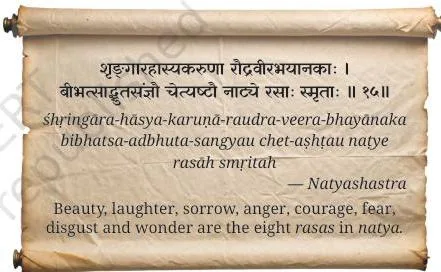
This picture opens the section that introduces the chapter’s emotion work. Rasa is the emotive ambience that basic emotions create and everyone enjoys — that is how the book defines it. A shloka from the Natyashastra lists eight rasas, and the ninth, shanta (peace), was added later by Abhinava Gupta in the 10th century CE.
The chapter presents the nine emotions as one story set in a garden. Each emotion has a nature-based trigger:
| Emotion | Meaning in this chapter | Nature scene that triggers it |
|---|---|---|
| śhringara | love and attraction | smelling the fragrance of flowers |
| hāsya | laughter, joy | squirrels and their activities bringing a smile |
| karuṇā | sorrow | someone destroying the flowers |
| raudra | anger | someone cutting down the trees in the garden |
| veera | valour, courage | bravely rising in protest to stop the destruction |
| bhayānaka | fear | a snake in the branches of a tree |
| bibhatsa | disgust | decaying plants giving out a pungent smell |
| adbhuta | wonder | the wondrous beauty of nature |
| śānta | peace, calm | finding peace in nature |
To keep the order straight, try the mnemonic: She Has Kept Ravi’s Very Beautiful Blue And Shiny Bag. The first letters run S–H–K–R–V–B–B–A–S, which is the exact order the chapter presents: śhringara, hasya, karuna, raudra, veera, bhayānaka, bibhatsa, adbhuta, shanta.
Figure walkthrough: reading the postures and emotions in your book
The figures below are the diagrams in your own copy of Kriti. Work through them in order — each one is asking you to try something, not just to look.
Arms and angles: circles, half circles and diagonals

The caption tells you that you have already used your arms this way in earlier classes, so this is not new movement — it is the same movement seen as geometry. Now observe how the arms create various geometrical angles when used in dance, and connect what you see to the lines and angles you learn in geometry class.
Knee bends: five levels of the lower torso
The lower torso carries the weight of the body, and how far you bend the knees changes the whole shape of a pose.

The first knee-bend figure is the starting point: standing on both feet with no knee bend, the body at its full height.

The second figure lowers the body by a quarter. From here the book adds three more levels in words: half knee bend, three-fourth bend and full seating on toes. Each time you lower further, the geometrical shape your torso makes changes.
Distance between the feet: three stances, plus a fourth
The second thing the lower torso controls is how far apart the feet are, and where the weight sits.

Here the weight is shared equally between both feet, so the stance is balanced. Note that this figure is about weight distribution, not about bending the knees.

This stance combines a half knee bend with heels near each other, so knee work and foot placement are practised together.

Standing with feet apart so the legs make a square shape is the chapter’s clearest invitation to see geometry in your own body. A fourth position — placing the feet at maximum width — is listed in words; try it and watch the square turn into a wider base.
Navarasa: a garden story in nine pictures
The chapter reads the nine emotions as one continuous story set in a garden. Each picture pairs an emotion with a nature scene; try saying the emotion out loud before you read the caption.

Smelling the fragrance of flowers is the trigger for śhringara. Notice that a scent, not a person, sets off the emotion of love and attraction.
The playful squirrels bring a smile, and that is hāsya. The trigger is the animals’ activity, not a joke.

The same flowers, now destroyed, bring karuṇā. One object can carry two opposite emotions — that is the point of comparing this picture with the first one.

Cutting down the trees turns sorrow into raudra, anger at the act of destruction.

The anger rises into courage: veera, the brave protest. Raudra is the feeling; veera is the action that follows it.

A snake in the branches introduces danger, and the emotion is bhayānaka, fear.

Decaying plants with a pungent smell bring bibhatsa, disgust. This is the emotion most easily confused with karuna, because both feel unpleasant — but one is sadness and the other is revulsion.

Despite the perils, the beauty of nature remains wondrous, and that is adbhuta, wonder.

The story ends in calm: śānta, peace in nature, the ninth rasa added to the Natyashastra’s eight.
The four activities in the chapter and what each one trains
This chapter is learned by doing. The four activities are the practice that the postures, hand gestures and emotions are built for.
- Activity 10.1 — My body in various shapes: combine your upper torso, lower torso and arms to make shapes and let friends identify them — squares, triangles, rectangles, parallelograms or rhombuses. This trains shape vocabulary and teamwork.
- Activity 10.2 — Dancing sculptures: look at the dance pictures and temple photographs, try the postures shown, identify the angles in them, and pick one simple posture and one challenging one to attempt. This trains observation of sculpture and matching it to your own body.
- Activity 10.3 — Hastas in sculptures: find hastas in the sculpture pictures, match them with the hasta illustrations in the chapter, discuss with friends, try the hasta mudras and create new ones. This trains hand-gesture recognition and creativity.
- The Navarasa game: two bowls of chits — bowl 1 has nine emotional states (happiness, sadness, anger, surprise, fear, excitement, calm, confused, proud) and bowl 2 has daily activities (brushing teeth, dressing, going to school, eating lunch, doing homework, doing yoga). Pick one chit from each bowl and enact that daily activity in that emotional state, including hand gestures. This trains emotion, body and hands together.
The chapter gives one full worked example of the game, shown below: confused from bowl 1 and do homework from bowl 2.
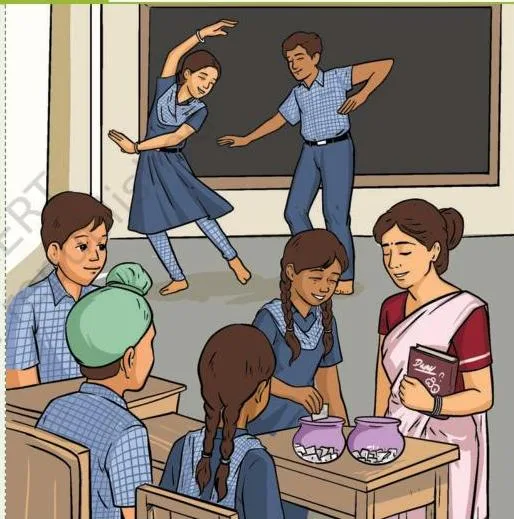
Read the example carefully because it is the model for every combination. Confused homework looks like this: you are willing to do the work but not right now — so you scratch your head, leave your pen and hold it again, close the book and open it.
The emotion changes how an ordinary action is performed, which is the whole point of the game.
Build your own shapes: a worked movement sequence
Try this sequence, which combines the chapter’s own building blocks in combinations the book never lists:
- Start in standing on both feet, no knee bend, with your arms making a circle.
- Lower into a one-fourth knee bend and keep the circle.
- Move into a half knee bend with your heels near each other, and drop one arm into a diagonal.
- Hold the pose and let a friend name the geometrical shape your body now makes.
Second idea: stand with feet apart making a square shape, keep the torso straight (samabhang) and raise one arm as a diagonal. The lower body makes the square base while the upper body draws a triangle. Every element here — the knee-bend levels, the foot placements and the arm lines — comes from the book’s own lists.
Definitions: the terms used in Chapter 10
Chapter 10 carries several Sanskrit terms. This glossary puts each one in plain words, in the sense the chapter uses it.
| Term | What it means in this chapter |
|---|---|
| nṛityaśhāstra | the study and technique of dance; the epigraph says painting cannot be understood without it |
| śhilpaśhatra | the principles of sculpture |
| chitra | painting; a key term in the Purana discussion |
| bhanga | a bend or posture of the upper torso; five are named: samabhang, dwibhang, abhang, tribhang, atibhang |
| hasta | a hand gesture in dance |
| mudra | a gesture or sign; the chapter uses ‘hasta mudras’ for gestures made with the hands |
| asamyuta hasta | a gesture formed by one hand |
| samyuta hasta | a gesture formed by two hands |
| rasa | the emotive ambience that basic emotions create and audiences enjoy |
| navarasa | the set of nine emotions used in Indian dance |
Common mistakes students make in this chapter
Each of these confusions is built into the chapter’s own material, so meet them before they trip you.
| Mistake | Correct rule | How to check yourself |
|---|---|---|
| Mixing up karuṇā and bibhatsa because both feel unpleasant | karuṇā is sorrow at something destroyed (the flowers); bibhatsa is disgust at something decaying (the pungent plants) | Ask: do I feel sad about a loss, or revulsed by a smell? Loss → karuṇā; decay → bibhatsa |
| Confusing raudra with veera because both rise against the same trees | raudra is anger at the cutting; veera is the brave protest that follows | Anger at an act = raudra; courage to act = veera |
| Forgetting that asamyuta is ONE hand and samyuta is TWO | The prefixes carry the meaning: asa- (single) and sam- (joined or double) | Anjali, Swastika and Shankha need both hands, so they are samyuta; Pataka and Suchi use one hand, so they are asamyuta |
| Treating the body shapes as arm shapes only | The chapter deliberately separates upper torso, arms, lower torso and feet | To ‘make a square’, use feet apart plus a straight torso — name which body part creates each shape before you move |
| Confusing standing on both feet with equal weight with half-bent knees with heels together | The first is about weight distribution; the second is about knee bend and foot position | Check your knees: straight in the first figure, bent in the second |
How this chapter is assessed at school
There are no written sums in Chapter 10, but the work is still checked.
The chapter closes with a learning outcomes grid that maps each outcome to a curricular goal (CG) and competency (C), with a Teacher column and a Self column — so assessment is practical and reflective: you demonstrate a posture, your teacher observes it, and you also tick your own honest self-check.
The four curricular goals from the opening pages, in one line each:
- CG-1: openness to explore and express yourself through art forms — confident self-expression in dance and movement.
- CG-2: imagination and creativity that challenge stereotypes around you, such as gender roles in dance.
- CG-3: applying artistic elements and techniques, including stage etiquette and care for stage equipment, props and costumes.
- CG-4: familiarity with local and regional dance forms, and with the work of notable dancers and movement artists.
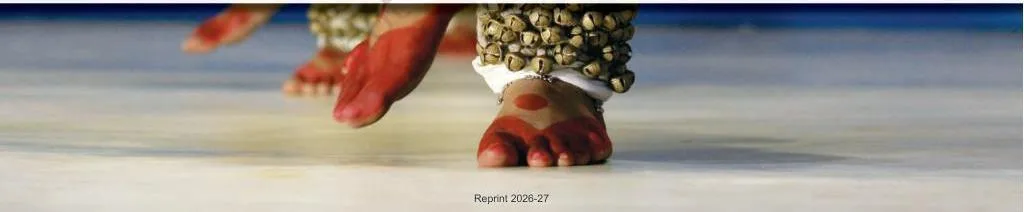
Beside CG-4, the book places the figure above, whose caption carries competency C-4.2 — describing the life and work of local dancers and movement artists in your region and across India.
Read the closing grid in plain words. By the end of the chapter you should be able to:
- use the upper and lower torso deliberately in dance (CG-1, C-1.1);
- see the geometric shapes your body creates (CG-1, C-1.2);
- confidently express emotions through movement (CG-1, C-1.2);
- correlate dance with sculpture, connecting a posture to a carved figure (CG-2, C-2.1);
- recognise hastas in sculpture (CG-2, C-2.2).
One honest note: Kriti is an arts education textbook, so this page makes no promise of board-exam weightage for Chapter 10. Textbook contents and the examinable syllabus are not always identical, so check the current official CBSE syllabus if your school assesses arts formally.
The chapter in five lines: what to remember
Everything in Chapter 10 compresses into these five points, drawn from the chapter’s own learning outcomes:
- The body can be read as geometry — from the straight samabhang to the exaggerated atibhang, with knee bends and foot distances adding new shapes below.
- Every knee-bend level (none, one-fourth, half, three-fourth, full seating on toes) and every foot position creates a different lower-body shape.
- The hands speak through asamyuta (single) and samyuta (double) hastas.
- Nine emotions — navarasa — carry meaning, and one emotion can transform an ordinary action like doing homework.
- Dance and sculpture explain each other — the oldest idea in the chapter, from the Vishnudharmottara Purana.
Related resources: the Kriti book and the official NCERT source
This listing is maintained for the 2026-27 academic session using the NCERT textbook information available to us. NCERT remains the authority for confirming the latest edition.
You are here: NCERT Books › Class 7 › Arts › Dance and Movement (Chapter 10).
Related pages on this site:
- Class 7 Arts notes — study help for the whole arts subject.
- Class 7 notes hub — every subject in one place.
- Performance arts notes for Class 7 — dance, drama and performance practice.
- Dance vocabulary and techniques notes — the terms used across dance chapters.
- CBSE revision notes home — the full notes index.
Every NCERT textbook, including Kriti, is published at ncert.nic.in — the same official source as the download at the top of this page.
Sources and data verification
- The chapter described is Chapter 10, Dance and Movement, of the NCERT Kriti Class 7 Arts textbook, English edition, published on ncert.nic.in.
- This page describes that book only. It does not cover other Class 7 arts materials or later revisions of Kriti.
- This listing is maintained for the current academic session using the NCERT information available to us; section names and figure captions are taken from the printed textbook.
- NCERT settles textbooks, editions and official PDFs; CBSE settles the curriculum, syllabus and examinations. Textbook contents and the examinable syllabus are not always identical, so check the current official CBSE syllabus before relying on any chapter for exam preparation.
| What the chapter holds | Count | Where it is used |
|---|---|---|
| Printed pages | 13 | |
| Figures with NCERT captions | 18 | |
| Tables | 2 | |
| Official NCERT PDF | Download the chapter PDF | the chapter exactly as NCERT publishes it |
Frequently asked questions about Dance and Movement Class 7
What is the difference between asamyuta and samyuta hastas?
Asamyuta hastas are single-hand gestures — one hand makes the whole shape. Samyuta hastas are double-hand gestures — both hands work together, as in Anjali (two palms joined) or Swastika. The hand gestures section of Chapter 10 presents them as two separate tables and asks you to recall them from Kriti, Grade 6.
What are the nine rasas and who added the ninth one?
The Natyashastra lists eight rasas, and the ninth — shanta, peace — was added by Abhinava Gupta in the 10th century CE. The chapter presents the nine as navarasa, each tied to a scene in the garden story: śhringara, hasya, karuna, raudra, veera, bhayānaka, bibhatsa, adbhuta and shanta.
Which temples and sculptures appear in Activity 10.2?
Activity 10.2 names the Chidambaram Temple in Tamil Nadu, the Konark Sun Temple in Odisha, the Dilwara Temple in Rajasthan and the Elephanta Caves in Maharashtra.
It also shows six photographs: a Dancing Hindu Goddess at the Hoysaleshwara Temple in Halebidu, a Lady Dancer at Konark, Dancing Shiva at the Kedareshwara Temple in Halebidu, the Hoysaleshwara Temple itself, Dancers from Hampi and a Jain Temple in Haridwar. The questions to ask about each are: which torso parts are combined, and what angles do you see?
How are geometrical shapes connected to dance in this chapter?
The body-work section opens with the idea that dance and mathematics intertwine: postures create triangles, circles, lines, squares and rhombuses. Activity 10.1 asks you to combine upper torso, lower torso and arms so friends can identify the shape, and the knee-bend and foot-distance figures create the same shapes in the lower body.
Is Class 7 Arts Chapter 10 Dance and Movement part of the board exam?
Class 7 Kriti is an arts education textbook, not a board-exam subject, so this page makes no weightage promise. The chapter is assessed practically and reflectively through its closing learning outcomes grid, with Teacher and Self columns. Textbook contents and the examinable syllabus are not always identical, so check the current official CBSE syllabus for your school’s requirements.
Reference: NCERT Class 7 Kriti textbook, chapter 10, official edition on ncert.nic.in.
Explore Class 7 Arts Books
Related chapters: