
The Music of the People is Chapter 8 of the NCERT Class 7 Kriti (Arts) textbook, and it is a chapter about folk songs, the singers behind them, and the instruments of India’s regions. The official PDF of the Music of the People Class 7 chapter is in the download section right below.
The rest of this page tells you what the chapter holds before you open it — its songs, activities, figures and learning outcomes — so you know where the chapter is going and what you will be asked to do.
Download the Music of the People Class 7 chapter PDF
This section is for students who came straight for the file. You can take the official chapter now and come back to this page when you start reading.
Open the official NCERT textbook portal to download the Music of the People Class 7 chapter PDF. The portal lists NCERT textbooks by class, subject and language, so the same page can also take you to the rest of the Kriti book and the other Class 7 subjects.
What is inside the Music of the People chapter
The chapter table on this page gives you the size of Chapter 8 at a glance — how many sections, figures and activities it holds. Use that table for the totals; this section and the ones after it are about the order and the meaning.
The chapter moves in one clear arc:
- An opening true-or-false checklist about songs from different regions, then the meaning of lok sangeet.
- Folk songs and community, built around an Assamese Bihu song that the class sings, claps and dances to together.
- Unique voices and breaking stereotypes — unconventional singers, lullabies and qawwali.
- Women in music — Mirabai’s bhajan and Lal Ded’s vakhs.
- Music and social reform — Annamacharya and Mukunda Das.
- Instruments and regions — a verse from the Sangeet Ratnakar, a map activity and a musician interview.
- A learning outcomes table that closes the chapter.
What the chapter teaches, section by section
This walk-through follows the chapter’s own order, so you can keep a finger on the same pages. Each block starts with one sentence saying what it is for.
1. The opening checklist and the meaning of lok sangeet
This block prepares you for the whole chapter. It opens with a true-or-false checklist about songs from different regions: are their tunes almost the same, is rhythmic structure varied, do they lack themes, do they tell about life and nature?
Working through the checklist leads to the chapter’s central term. Lok means the people, so lok sangeet is the music of and by the people of India. It expresses different emotions or rasas and, through its lyrics, tells you about festivals, rituals, traditions, occupations, beliefs and faith.
2. Folk songs and community: the Bihu song
This block teaches folk song as a shared act — you read, clap and dance, not just listen. The song is Bihu Bihu Lagise Gaat, an Assamese song in the Bihu form by Bhupen Hazarika, whose music earned him the Bharat Ratna.
The chapter tells you to read the words carefully, clap while singing to feel the rhythm, and stand and dance in Bihu style. The song captures the spirit of Bohag Bihu, a popular festival — its summary points to joy, celebration and a deep connection to nature, rhythm and tradition.
For more on Bihu, the chapter points you to your Grade 6 Hindi textbook, Malhar.
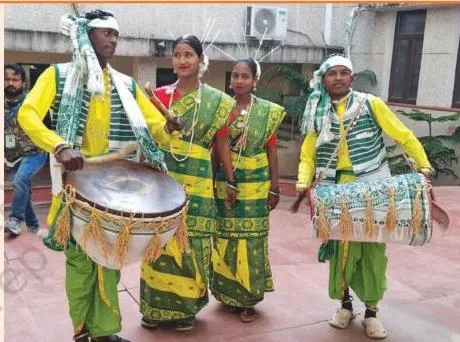
Activity 8.1 asks you to learn a folk song or celebration song from your own region, name the instruments it uses, and present it in class and in the school assembly.
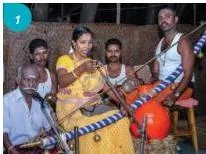
The photograph above shows what such a presentation looks like. The chapter identifies it as people of Jharkhand playing the Nagada, and its caption is the activity’s final step — use appropriate movements along with the song.

A note to the teacher sits beside this activity: share such projects with other schools in your cluster, and hold discussions and presentations on bagless days.
3. Unique voices and breaking stereotypes
This block is about listening. It asks you to notice that no two voices sound exactly alike, just as no two faces look alike, and that the idea of one “normal” voice is wrong.
The chapter makes a specific correction: the assumption that male voices are always low-pitched and female voices always high-pitched is not always true. You will get a fair idea of different voice types by listening to your classmates.
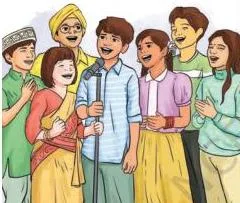
The photograph carries the section’s instruction: listen carefully to your friends’ voices, and you will hear a variety of tones — sharp and clear, rich and deep, soft and gentle.
Then comes the key point. Unconventional voices are strengths, not flaws. Activity 8.2 presents four renowned artists with unusual voices — Usha Uthup, Teejan Bai, Kumar Gandharv and D K Pattammal — and asks you to listen to their music online. Their portraits appear in the pictures section below.
The block then turns to song types. A lullaby, or lori, is a song sung to help a child fall asleep; it is usually sung by a mother, but the chapter asks who else in the family could sing one.
Activity 8.3 asks you to learn a family lullaby and notes Geeta Dutt’s film lullaby Nanhee kali soney chali hawa dheerey aana.
Activity 8.4 introduces the qawwali, a form of devotional music from the Sufi Islamic tradition. Traditionally performed by a group of male musicians, qawwali is now performed by female musicians too — the chapter’s example is Roshanara Begum, born in Kolkata — showing that musical forms can evolve and adapt over time.
4. Women in music
This block is about the mark Indian women have left on music through poetry and composition.
Mirabai was a 15th-century CE poet and devotee of Shree Krishna. Born a princess in a royal family of Rajasthan, she married Prince Bhojraj of Mewar and later travelled to Dwarka and Vrindavan, composing hundreds of bhajans — devotional songs in praise of Krishna. She is remembered as a great saint of the Bhakti movement.
Her bhajan in the chapter, Payoji Maine, expresses devotion: she has found the most precious treasure through her guru, worldly possessions no longer matter, and she will happily sing her lord’s praise.
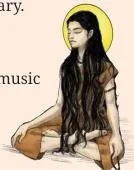
Activity 8.5 introduces Lal Ded, also called Lalleshwari, a Kashmiri mystic and poet who created many vakhs — short poems rich in philosophical meaning.
The picture beside the activity marks its task: find which century she lived in, what her poems were about and how she contributed to music, then read one translated poem and discuss your feelings about it.
5. Music and social reform
This block makes the chapter’s biggest claim: songs can carry a point of view and the urge for change.
Annamacharya, a 15th-century Telugu musician, composer and saint, is said to have composed 32,000 sankirtanas — devotional songs — in praise of Lord Venkateshwara of Tirupati. He was among the earliest to oppose social stigma against untouchables, and his songs preach brotherhood and morality.
His well-known composition Brahmam Okate says God is one. There are no class distinctions of high or low, because God dwells in all beings.
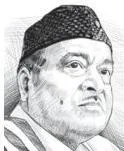
In Bengal, Charankavi Mukunda Das, also known as Jogeshwar Datta and living in the 19th or 20th century, preached the objectives of the Swadeshi movement through his songs and plays in villages.
His song Baan Eshechey uses a rising tide as a symbol of life’s flow: “Do not sleep — arise!” The oars must be taken in your own hands, or all opportunities are lost and only regret remains.
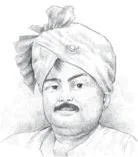
The image above shows Mukunda Das; its caption is the block’s summary in one line — village songs and plays carried the Swadeshi movement’s message.
Activity 8.6, Voice for Change, turns the idea on you: name a change you want in your school or community and write an 8-line poem or rap that convinces others why it matters. The shape is simple — the change, why it matters, the call to act. Here is a sample:
Bags and bottles dot the floor, By the gate and by the door.
Class 7, come, let us all agree — A dustbin is where the litter should be.
The birds that peck will stay safe too, A yard that is clean is a yard that is true.
One small habit, done each day, Keeps our school shining all the way.
Your rap can be about any change — a quieter corridor, a greener garden, saving water — as long as it states the change, shows why it matters and asks for action.
6. Instruments and regions
This block links music to geography. It opens with a verse from the Sangeet Ratnakar: the song, playing and dance that please the heart of a region’s people is called deshi — regional.
The chapter’s meaning section says the diverse tastes of people across regions create music, instruments and dance that resonate with local traditions, beliefs and ways of life.
Different regions have different characteristic instruments, and the chapter prints a warning before the activities: some instruments are played in more than one state, and the same instrument can be known by different names.
Activity 8.7 asks you to sort five instruments — Mohuri, Noot, Damamatu, Chimta and Tarpo — into the instrument categories you learned in Grade 6. Activity 8.8 is the map work, and Activity 8.9, Know Your Musician, closes the practice: interview a musician near you using ten sample questions, then make a collage of regional musicians for the notice board.
Activity 8.8’s list, turned into a quick table, pairs each instrument with the region the chapter names — from Mohuri in Chhattisgarh to Jhanjh in Assam and Odisha.
| Instrument | Region in the chapter |
|---|---|
| Mohuri | Chhattisgarh |
| Noot | Jammu and Kashmir |
| Kopong | Ladakh |
| Dholak / Dholaki | Punjab |
| Damamatu | Himachal Pradesh |
| Chimta | Chandigarh |
| Nafiri | Uttarakhand |
| Pepa | Assam |
| Pung | Manipur |
| Pipahi (like Shehnai) | Bihar |
| Khuang | Meghalaya |
| Madal | Jharkhand |
| Khanjira | Karnataka |
| Pavri | Dadra and Nagar Haveli |
| Ghummat | Goa |
| Pepa | Arunachal Pradesh |
| Tarpo | Daman and Diu, Lakshadweep |
| Jhanjh | Assam, Odisha |
Notice in the table how the same instrument can appear twice — Pepa in Assam and Arunachal Pradesh, Jhanjh in Assam and Odisha. That is exactly the chapter’s warning about instruments and state boundaries.
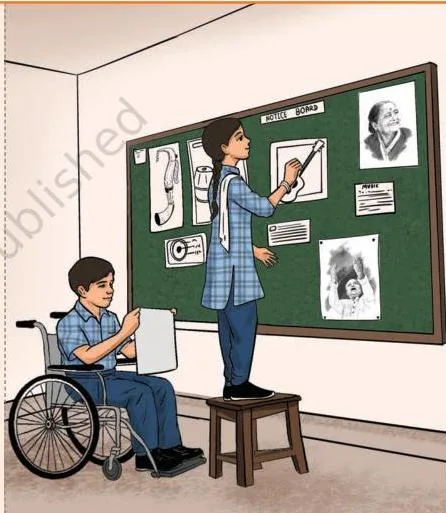
The final image of the chapter carries Activity 8.9’s last step: make a collage of musicians from your region and post it on your notice board.
Key ideas: what the chapter wants you to understand
This section gathers the ideas that connect the songs, singers, activities and instruments. The chapter is not about memorising songs; it is about hearing how music carries community, identity and change.
- Lok sangeet is everyone’s music. Music of and by the people, its lyrics carry festivals, rituals, traditions, occupations, beliefs and faith — the opening section sets this up.
- Music is a shared community act. The Bihu section makes you clap, sing and dance together, because the song lives in the community performing it.
- Every voice is unique. The Unique Voices section proves it with Usha Uthup, Teejan Bai, Kumar Gandharv and D K Pattammal — unconventional voices made them special.
- Musical forms can change. The qawwali, traditionally male, is now performed by women — forms evolve and adapt over time.
- Music can carry social reform. Annamacharya’s Brahmam Okate preaches equality, and Mukunda Das’s Baan Eshechey carries the Swadeshi message.
Reading the pictures in The Music of the People
This section walks through the chapter’s photographs and its map, so the figures do the teaching they were printed to do.
The first image of the chapter stamps the meaning of the central term on the page: lok means the people, so lok sangeet is the music of and by the people of India. Keep this figure in mind for every song that follows — they are all examples of the people’s own music.
The photograph beside the Bihu song shows the dance the chapter wants you to join. Its caption is the song’s own line — nasaniye naasi jaay bihu geet epaki gaay, the dancer dances away singing a Bihu song — and the lesson is in the doing: clap for rhythm, then stand and dance in Bihu style.
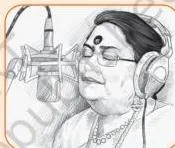
This panel of four portraits is the visual proof for the Unique Voices section. The artists — Usha Uthup, Teejan Bai, Kumar Gandharv and D K Pattammal — have voices that are unconventional, and the chapter’s point is that this is exactly what makes them unique and special. Activity 8.2 asks you to listen to their music online.
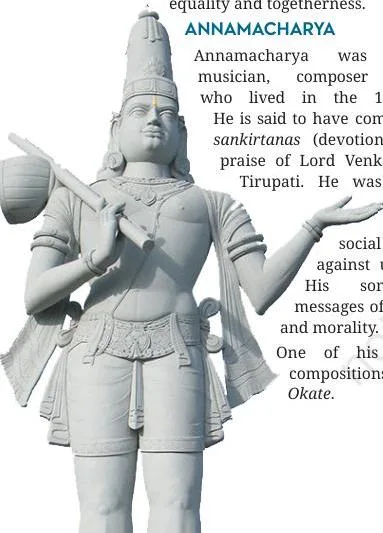
This image places Annamacharya with his well-known composition Brahmam Okate. The song summary gives the message: God is one, with no class distinctions of high or low, because God dwells in all beings. Read the figure as the bridge from the composer to his message of equality.
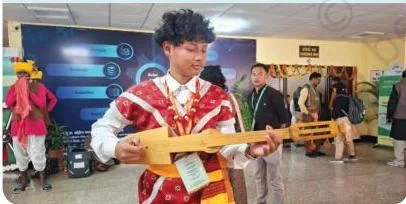
This photograph shows the Kopong, called out in the chapter as a musical instrument of Ladakh. Its caption carries the section’s point: the diverse tastes and choices of people across different regions of India reflect the country’s rich cultural mosaic. Instruments grow out of local traditions and ways of life.
The map is the heart of Activity 8.8. You paste a picture of each instrument on the region it comes from — Mohuri on Chhattisgarh, Noot on Jammu and Kashmir, Nafiri on Uttarakhand, Pepa on both Assam and Arunachal Pradesh, Jhanjh on Assam and Odisha, and the rest.
The finished map is the chapter’s whole argument in one picture: music maps onto geography.
Music words you need to know
The chapter drops several musical terms without a glossary, so here is each term in the exact sense the chapter uses it.
| Term | What it means in this chapter |
|---|---|
| Lok sangeet | Music of and by the people of India; expresses different emotions or rasas and tells of festivals, rituals, traditions, occupations, beliefs and faith through lyrics. |
| Form | The style of singing or playing musical instruments; Bihu is the form of the chapter’s Assamese song. |
| Bihu geet | An Assamese folk song in Bihu form; the chapter’s example captures the spirit of Bohag Bihu with joy, celebration and a deep connection to nature, rhythm and tradition. |
| Lullaby (lori) | A song sung to help a child fall asleep; usually sung by a mother, but other family members can sing one too. |
| Qawwali | A form of devotional music from the Sufi Islamic tradition; traditionally performed by male groups, now also by female musicians. |
| Bhajan | A devotional song; Mirabai composed hundreds of bhajans in praise of Krishna. |
| Vakh | A short poem, rich in philosophical meaning, created by Lal Ded. |
| Sankirtana | A devotional song; Annamacharya is said to have composed 32,000 sankirtanas in praise of Lord Venkateshwara. |
| Swadeshi movement | The movement whose objectives Mukunda Das preached through songs and plays in Bengal’s villages. |
Where students usually go wrong with this chapter
The chapter itself points out where readers jump to conclusions. Watch for these five before you meet them.
| Mistake | Correct rule | How to check your answer |
|---|---|---|
| Skipping the opening true-or-false checklist as unimportant. | The checklist introduces the chapter’s idea: songs have themes, varied rhythm and links to region and nature. | After the Bihu song, test each statement again — the song clearly has a theme and a festival behind it. |
| Assuming male voices are always low and female voices always high. | The chapter says this is not always true. | Listen to Usha Uthup, Teejan Bai, Kumar Gandharv and D K Pattammal — the point of the panel is that voices cross the usual expectations. |
| Thinking folk songs have no theme. | Folk songs carry festivals, nature, rituals and tradition in their lyrics. | The Bihu summary names joy, celebration and connection to nature as the song’s themes. |
| Assuming a musical form is fixed forever. | Forms evolve and adapt; qawwali was traditionally male and is now performed by women. | Activity 8.4’s note on Roshanara Begum and female qawwali groups shows the change. |
| Assuming one instrument belongs to only one state. | Some instruments are played in more than one state, and the same instrument can have different names. | Check the map list: Pepa appears in Assam and Arunachal Pradesh, Jhanjh in Assam and Odisha. |
Learning outcomes: what the chapter expects you to do
The chapter closes with a learning outcomes table, not an exercise set — which tells you this is an activity-based chapter. Each outcome is practised by a specific activity.
| Learning outcome | Where the chapter practises it |
|---|---|
| Speak about the role of music in social reform | Annamacharya and Mukunda Das sections, then Activity 8.6 (Voice for Change) |
| Appreciate the importance of diversity in music | Opening checklist, the qawwali evolution note and the regional instruments activities |
| Express thoughts clearly in the form of a poem or rap | Activity 8.6 — an 8-line poem or rap about a change you want |
| Sing a local folk song | Activity 8.1 — learn a folk song of your region and present it |
| Present information about a musician | Activity 8.9 — interview a musician and make a collage |
One honest note: textbook contents and the examinable syllabus are not always identical, so check the current official syllabus to see how this chapter is assessed in your session.
The Music of the People in one look
A 60-second recap of the chapter’s arc, in the order the chapter builds it.
- Lok sangeet is everyone’s music — music of and by the people.
- Folk songs like the Bihu geet carry celebration and community.
- Voices are unique; unconventional voices (Usha Uthup, Teejan Bai, Kumar Gandharv, D K Pattammal) are strengths.
- Lullabies and qawwali show that song types and forms can be carried by anyone and can change.
- Mirabai and Lal Ded show women’s contribution to music.
- Annamacharya and Mukunda Das show music as social reform.
- Instruments map India’s regions — from Mohuri to Jhanjh.
- The chapter ends with learning outcomes, not exercises: you sing, write, interview and present.
Related chapters and books for The Music of the People
This section points you to what to read next. The chapter itself names one cross-reference: your Grade 6 Hindi textbook Malhar, for more on Bihu and its festivities — an official NCERT cross reference worth chasing if you enjoyed the song.
On this site, the natural next stops are the Class 7 arts notes, the Ragas and Talas (Taal) chapter for musical vocabulary, the performance chapter for stage and presentation work, and the main Class 7 hub.
For any other class or subject, browse the full notes directory. The official chapter file stays available on the NCERT textbook portal.
Sources and data verification
This section tells parents and teachers exactly which textbook this page describes.
- The contents and figures on this page describe the NCERT Class 7 Kriti (Arts) textbook, Chapter 8, “The Music of the People”, official edition on ncert.nic.in.
- This page covers that one chapter of Kriti. It does not cover other Class 7 books or the rest of this book.
- This listing is maintained for the 2026-27 academic session.
- NCERT settles textbook editions and official PDFs; CBSE settles the curriculum, syllabus and examinations. Textbook contents and the examinable syllabus are not always identical, so check the current official syllabus.
The Music of the People Class 7: questions students ask
These are the questions students type when they are stuck on this chapter. Each answer comes straight from the chapter’s text.
What is lok sangeet in The Music of the People Class 7 chapter?
Lok sangeet is the music of and by the people of India. The word lok means “the people”, and lok sangeet expresses different emotions or rasas while telling you about festivals, rituals, traditions, occupations, beliefs and faith through its lyrics. The chapter’s opening checklist leads directly to this definition.
Who composed the songs in NCERT Class 7 Kriti Chapter 8?
The chapter prints four songs. Bihu Bihu Lagise Gaat is an Assamese Bihu song by Bhupen Hazarika; Payoji Maine is a bhajan by Mirabai; Brahmam Okate is a sankirtana by Annamacharya; and Baan Eshechey is by Bengal’s Charankavi Mukunda Das, also known as Jogeshwar Datta.
What does Annamacharya’s song Brahmam Okate teach?
The song’s summary is plain: God is one, there are no class distinctions like high or low, and God dwells in all beings. Annamacharya, a 15th-century Telugu composer, was among the earliest to oppose social stigma against untouchables, so the song carries a message of equality and brotherhood.
Which instruments are named in the chapter and which states do they come from?
The full list sits in a table in the Instruments and Regions section above, running from Mohuri in Chhattisgarh to Jhanjh in Assam and Odisha. A few to remember: Kopong (Ladakh), Pepa (Assam and Arunachal Pradesh), Pung (Manipur), Madal (Jharkhand), Khanjira (Karnataka) and Ghummat (Goa).
Why does the chapter show unconventional singers like Usha Uthup and Kumar Gandharv?
To break a stereotype. The chapter says the assumption that male voices are low and female voices are high is not always true, and that many renowned artists have unconventional voices — which is what makes them unique and special. The four examples are Usha Uthup, Teejan Bai, Kumar Gandharv and D K Pattammal.
Is this chapter tested in the exam or is it activity based?
The chapter is activity based. It closes with a learning outcomes table instead of an exercise set, and its practice is built into activities such as singing a local folk song and interviewing a musician.
Textbook contents and the examinable syllabus are not always identical, so check the current official CBSE syllabus for how this chapter is assessed in your session.
| What the chapter holds | Count | Where it is used |
|---|---|---|
| Printed pages | 12 | |
| Figures with NCERT captions | 12 | |
| Tables | 2 | |
| Activities | 5 | |
| Official NCERT PDF | Download the chapter PDF | the chapter exactly as NCERT publishes it |
Reference: NCERT Class 7 Kriti textbook, chapter 8, official edition on ncert.nic.in.
Explore Class 7 Arts Books
Related chapters: