
Looking for ragas and talas/taal class 7 — the seventh chapter of the NCERT Class 7 Arts book Kriti? The official NCERT PDF is right here, and below it a plain-English walkthrough of every tala table, raga profile and exercise in the chapter.
The chapter teaches two systems of Indian classical music side by side: Carnatic talas and alankaras on one side, Hindustani talas and Raga Bhairavi on the other. You sing most of it, so the walkthrough below explains the notation before the music.
Use the chapter at a glance to see what the file holds, then jump to any idea from the table of contents.
Ragas and Talas/Taal Class 7 PDF: official NCERT download
The file below is the government’s own PDF of Chapter 7, published by NCERT on ncert.nic.in. What you download is the printed book’s pages — the same verse, notation tables and exercises, with no third-party layer on top.
Open the NCERT Class 7 Arts Kriti Chapter 7: Ragas and Talas/Taal PDF from ncert.nic.in to read the chapter in its original printed layout — the Sanskrit verse, the alankara tables, the Bhairavi notation and the exercises all in one file.
If the direct chapter link ever changes, the full Kriti (Arts) Class 7 textbook is also on ncert.nic.in as the official Kriti Class 7 book PDF — a reliable fallback that contains the same chapter.
Chapter 7 at a glance
A table on this page lists how much Chapter 7 holds — its sections, figures and exercises — so you know the size of the file before you open it. Here is what those pages actually teach:
- The opening page: a Sanskrit verse from the Natyashastra (28.21) naming the seven notes, a Do You Know box on how three Samaveda chanting notes (Udatta, Anudatta, Svarita) grew into the sapta swara, and a photograph of Hindustani vocalist Gangubai Hangal.
- The Carnatic half: the sapta tala alankaras — the three angas (laghu, drutam, anudrutam) and the alankara tables for Dhruva, Matya and Rupaka.
- The swarajati ‘Ra Ra Venu’ in Adi Tala: raga Bilahari, Telugu text by composer Patnam Subramania Iyer, with pallavi, anupallavi and charanam laid out beat by beat.
- The Hindustani half: the talas Jhaptala, Rupak and Ektaal with their matras, bols and chinha signs; the 12-note system (shuddha, komal, teevra); and the samay chakra page with its Raga Mala painting.
- Raga Bhairavi: its full printed profile, plus three compositions in it — a sargam geet in Ektaal, a chota khayal in Teentaal and a tarana in Teentaal.
- The closing pages: a profile of Ustad Zakir Hussain, Activity 7.1 on learning simple rhythms from a tabla teacher, and the short exercise set.
What Chapter 7 covers, from the opening verse to the exercises
This section maps where each idea sits in the chapter, so you can open the PDF at the right place. If you already have the book, follow along page by page.
- Opening page. A Sanskrit verse from the Natyashastra (28.21) lists the seven notes: Sadaj, Rishabh, Gandhar, Madhyam, Pancham, Dhaivat and Nishad. The Do You Know box explains that the Vedas were first chanted with three notes — Udatta, Anudatta, Svarita — which gradually evolved into today’s sapta swara. The page opens with the photograph of Gangubai Hangal.
- Carnatic pages. The chapter introduces the sapta tala alankaras: the seven talas of Carnatic music and the three angas that build them. It then teaches the first three alankaras — Dhruva, Matya and Rupaka — as rising-and-falling note tables.
- The swarajati. After the alankaras comes the complete composition ‘Ra Ra Venu’ in Adi Tala, with its arohanam and avrohanam printed above the notation and its pallavi, anupallavi and charanam in full.
- Hindustani pages. The chapter swings to Hindustani music: the talas Jhaptala, Rupak and Ektaal with their bols and chinha signs, then the 12-note system, then the samay chakra page with the Raga Mala painting.
- Raga Bhairavi. The rest of the chapter is built on this one raga: its printed profile, then three compositions in it — a sargam geet (Ektaal), a chota khayal (Teentaal) and a tarana (Teentaal).
- Closing pages. A profile of Ustad Zakir Hussain, Activity 7.1 on playing the tabla, and the closing exercise set.
The sections below teach every term these pages use, in the order the chapter meets them.
Key concepts: notes, talas and ragas
This chapter is practical — you sing most of it. These concepts are what you need to read the notation tables and keep tala, in the order the chapter teaches them.
The seven notes and their journey from the Samaveda
Both music systems in this chapter share one seven-note base, so this is the right place to start.
As the chapter’s opening page explains, the Vedas were first chanted with three notes: Udatta (normal or medium tone), Anudatta (lower note) and Svarita (raised or higher note). Over time these three grew into the seven notes — the sapta swara — used in music today.
A Sanskrit verse from the Natyashastra (28.21) already lists them: Sadaj, Rishabh, Gandhar, Madhyam, Pancham, Dhaivat and Nishad. In the notation used later, these are the syllables S R G M P D N.
The same seven syllables appear in the Carnatic alankaras and in the Hindustani compositions below. Learning them first makes the rest of the chapter much easier.
How a Carnatic tala is built: laghu, drutam, anudrutam
Every Carnatic tala in this chapter is a string of three building blocks called angas. Learn the three, and every tala table decodes itself.
- Laghu — a clap plus counted finger counts; notated I. The number of beats in a laghu is its jathi; at this level every laghu has four beats, written \( I_4 \).
- Drutam — a clap and a wave; notated \( O \).
- Anudrutam — a single beat; notated \( U \).
Read a tala from left to right. Rupaka tala is \( O\ I_4 \): one drutam, then a four-beat laghu. Counting the drutam’s two actions and the laghu’s four counts, Rupaka runs \( 2 + 4 = 6 \) beats.
This is the bridge between the alankara tables and Exercise 2, which asks you to identify talas from their angas alone.
The seven Carnatic talas and the alankaras you sing
The seven main Carnatic talas are the full family; this chapter sings the first three as alankaras.
The seven talas are Dhruva, Matya, Rupaka, Jhampa, Triputa, Ata and Eka. An alankara is a pattern-based vocal exercise: it climbs and descends through the notes, which builds vocal strength and fixes the tala in your pulse (the page with the sapta tala alankaras makes the same point).
| Tala | Angas | Beat count |
|---|---|---|
| Dhruva | \( I_4\ O\ I_4\ I_4 \) | \( 4 + 2 + 4 + 4 = 14 \) |
| Matya | \( I_4\ O\ I_4 \) | \( 4 + 2 + 4 = 10 \) |
| Rupaka | \( O\ I_4 \) | \( 2 + 4 = 6 \) |
The Dhruva table’s first row shows the pattern in action: S R G M climbs four notes, then G R covers the drutam, then S R G R and S R G fill the two laghus.
The next row shifts the whole pattern up one note (R G M P, then M G, and so on). The table keeps climbing until it reaches the upper S, then descends all the way back to S.
As you can see, every alankara is built on a pattern. The chapter invites you to try making your own sargam patterns as vocal exercises — a useful trick for practice.
The swarajati ‘Ra Ra Venu’ in Adi Tala
This is the chapter’s one complete Carnatic composition — the moment the talas become music.
A swarajati is a very old Carnatic form made of swaras and sometimes lyrics. It has three parts: pallavi (the refrain), anupallavi (the section after the pallavi) and one or more charanams (verses) — as the Do You Know box on the composition page defines it.
‘Ra Ra Venu’ is printed with its full details: raga Bilahari, tala Adi, language Telugu, composer Patnam Subramania Iyer. Adi Tala is a rhythm cycle of 8 beats.
Above the composition the chapter prints the scale: arohanam S R2 G3 P D2 S (ascending) and avrohanam S N3 D2 P M1 G3 R2 S (descending). The caption beside Aruna Sairam’s photograph tells you what to do before you sing: sing the arohana and the avarohana, then sing the composition keeping tala.
Reading the notation is simple: swaras sit above the Telugu syllables, and a comma holds the previous note for another beat. The pallavi’s first line is S , , R G , P , D … over the syllables Ra …
Ra Ve Nu Go …: hold S through the first three beats while the first ‘Ra’ is stretched, then sound R on the second ‘Ra’ and G on ‘Ve’.
Hindustani talas: Jhaptala, Rupak and Ektaal
This is the chapter’s central comparison: Hindustani music uses the same rhythm-cycle idea as Carnatic music, but with different names, bols and beat counts.
A Hindustani tala is counted in matras (units). The theka row gives the bols you recite aloud; the chinha row gives the signs (x, 0, 1, 2, 3, 4) that mark where each section begins. The page with the Hindustani tala tables prints all three:
| Tala | Matras | Bols (theka) | Chinha signs at matras |
|---|---|---|---|
| Jhaptala | 10 | Dhee Naa Dhee Dhee Naa Tee Naa Dhee Dhee Naa | x (1), 2 (3), 0 (5), 3 (7) |
| Rupak | 7 | Tee Tee Naa Dhee Naa Dhee Naa | 0 (1), 1 (3), 2 (5) |
| Ektaal | 12 | Dhin Dhin Dhage Tirkit Tu Naa Kat Taa Dhage Tirkit Dhi Naa | x (1), 0 (3), 2 (5), 0 (7), 3 (9), 4 (11) |
Now a worked example. The chapter’s Teentaal — the 16-beat cycle used by its compositions — splits into four sections of four beats each: Dha Dhin Dhin Dha | Dha Dhin Dhin Dha | Dha Tin Tin Ta | Ta Dhin Dhin Dha.
The signs X, 2, 0 and 3 sit above the first beat of each section (matras 1, 5, 9 and 13). Knowing these four sections is what makes the 16-beat composition tables readable.
Now the counter-example that tests understanding: Ektaal has twelve matras but only six chinha markers (x, 0, 2, 0, 3, 4). The signs cannot be individual beats — there are twice as many beats as signs. They mark sections.
The 12 notes: shuddha, komal and teevra
Hindustani notation uses 12 notes, and Bhairavi depends on four of the “soft” ones. This is the vocabulary behind the underlined notes in the notation.
- Seven shuddha (natural) notes: S R G M P D N.
- Four komal (lowered) notes: R, G, D and N — underlined in the book.
- One teevra (raised) note: M, written with a bar above it, \( \bar{M} \).
In this system only M has a teevra form; the other notes adjust downward. The underlined komal notes in Bhairavi’s notation are exactly the ones that give the raga its colour, so spot them before you sing.
Samay Chakra: the time theory of ragas
Ragas are tied to times of day, and this theory explains why a morning scale sounds wrong at night.
The chapter calls classical music a dharohar — a treasure passed from one generation to another. Ragas express emotions and create moods, so a pattern of notes sounds effective when sung at the right time of day.
Its examples: Raga Bhairav is a morning raga, while Raga Yaman is generally sung in the evening. This time theory is called samay chakra, and the Raga Mala painting on the same page shows ragas as moods.
Samay chakra is why Bhairavi’s profile ends with “Singing time — early morning”.
Raga Bhairavi: the raga the second half is built on
The chapter prints Bhairavi’s profile as a data card; here is every term on it, decoded.
| Field | Bhairavi profile (as printed) |
|---|---|
| Thaat | Bhairavi |
| Aroh | S R G M P D N S |
| Avroh | S N D P M G R S |
| Pakad | M G S R S D N S |
| Varjit swar | no swar |
| Jati | Sampoorna–Sampoorna |
| Komal swar | R, G, D, N |
| Vadi swar | Madhyam (M) |
| Samvadi swar | Shadaj (S) |
| Singing time | Early morning |
Aroh and avroh are the ascending and descending scales. Pakad is the short catch-phrase that identifies the raga. Varjit swar names any note the raga avoids — here, none. Jati describes the scale type: Sampoorna means all seven notes are present, so this is a seven-note to seven-note raga.
The key point: Raga Bhairavi uses all seven notes even though four of them (R, G, D, N) are komal. Its vadi (most important note) is Madhyam, and its samvadi (second most important) is Shadaj.
Three compositions in Bhairavi: sargam geet, chota khayal, tarana
The same raga takes three forms in this chapter, each with its own text style and tala.
First, the shared shape: most of these compositions split into a sthayi (the first section) and an antara (the upper section that follows it).
| Composition | Tala | What you sing | Sections |
|---|---|---|---|
| Sargam geet | Ektaal (12 matras) | Note syllables only | Sthayi, antara |
| Chota khayal | Teentaal (16 matras) | A lyrical bandish | Sthayi, antara |
| Tarana | Teentaal (16 matras) | Rhythmic syllables | Sthayi, antara |
The sargam geet is sung entirely on note syllables. Its 12 columns align with Ektaal’s bol row (Dhin Dhin Dhage Tirkit…), and its sthayi and antara trace the same scale shape you read in the aroh.
The chota khayal carries words — a bandish. The sthayi begins “Kaisi ye bhalai rey kanhai…” and the antara “Sanad kahe aiso dheeta…”. Its table lines up swaras, lyrics and the 16-beat bol row in one grid, so the four Teentaal sections from the earlier worked example are the columns you read against.
The tarana abandons lyrics for rhythmic syllables: “Dir Dir Ta Na De Re Na…” for the sthayi and “Alali Alali Tom Tan…” for the antara, ending in the descending run S N D P / N D P M / D P M G / R R S S.
The four figures in Chapter 7, and what each shows
Music chapters use pictures to connect you to the people and traditions behind the notes. Four figures are reproduced below, and each is tied to an idea in the text.
Figure 1: Gangubai Hangal sets up the chapter’s two traditions
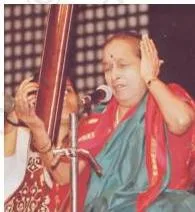
The chapter opens with a portrait of the Hindustani vocalist Gangubai Hangal, named beside the photograph on the chapter’s first page. The caption under it states the chapter’s approach: each year the book builds on both styles of Indian classical music.
Keep that in mind as you read. It explains why a single chapter moves from a Carnatic swarajati to Hindustani talas, and why both halves share the same seven notes.
Figure 2: Aruna Sairam and the arohana–avarohana warm-up
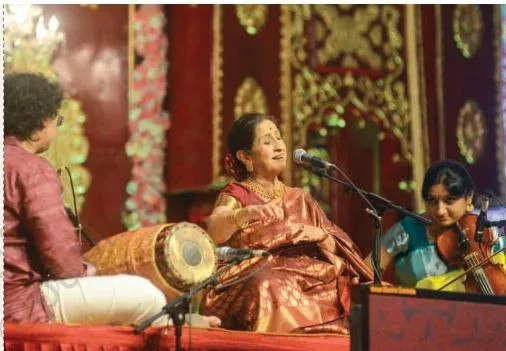
The photograph shows the Carnatic vocalist Aruna Sairam at a concert. Its caption is instruction as much as description: before singing ‘Ra Ra Venu’, you sing its scale upward (arohana) and downward (avarohana).
That is why the lines S R2 G3 P D2 S and S N3 D2 P M1 G3 R2 S are printed above the composition — and why you keep the 8-beat Adi Tala going as you sing.
Figure 3: Raga Mala painting — ragas as mood
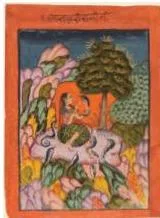
The Samay Chakra page carries a Raga Mala painting — a traditional miniature style that gives each raga a visible form. The caption says why the painting belongs there: classical music is a dharohar, and ragas express emotions and create moods.
Because a raga carries a mood, a pattern of notes sounds effective at a particular time of day — Bhairav in the morning, Yaman in the evening. The painting is the visual version of that idea.
Figure 4: Ustad Zakir Hussain, the tabla voice
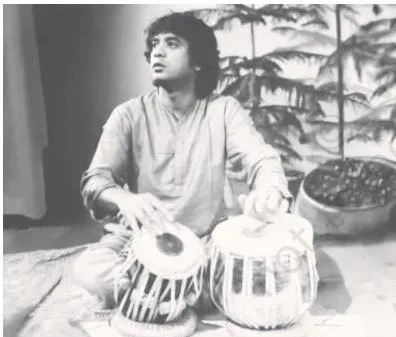
The portrait closes the tala section, and it connects the chapter’s notation to the instrument that voices it: the tabla is what plays the bols you learn to recite — Dha Dhin Dhin Dha and the rest.
Zakir Hussain (1951–2024) was the son of the tabla player Ustad Alla Rakha and grew up inside the tradition. “You grow up in a musical atmosphere,” he said. He performed from about age seven, toured from twelve, and accompanied Hindustani legends such as Pandit Ravi Shankar.
He was a founding member of the world-music band Shakti, and his awards included the Padma Vibhushan, the Sangeet Natak Akademi Award and three Grammy awards.
Definitions: the terms Chapter 7 expects you to know
Most of Chapter 7 is vocabulary plus notation, and this is where any term can be checked in seconds. The three groups follow the chapter’s own order — rhythm first, then raga, then the forms and people.
Rhythm terms
| Term | Meaning |
|---|---|
| tala / taal | The repeating rhythm cycle of a composition; Carnatic talas are built from angas, Hindustani talas are counted in matras with bols. |
| matra | A single unit (beat) of a tala; Jhaptala has 10, Rupak 7, Ektaal 12, Teentaal 16 and Adi Tala 8. |
| theka | The row of bol syllables you recite to keep the tala. |
| bol | A spoken syllable in a tala’s rhythm, such as Dha, Dhin or Naa. |
| chinha | The signs (x, 0, 1, 2, 3, 4) printed above a tala table that mark where each section begins. |
| laghu | An anga notated I: a clap plus finger counts; at this level it has four beats (\( I_4 \)). |
| drutam | An anga notated O: a clap and a wave. |
| anudrutam | An anga notated U: a single beat. |
| jathi | The number of beats in a laghu. |
| alankara | A pattern-based vocal exercise that climbs and descends through the notes. |
| Adi Tala | The 8-beat Carnatic rhythm cycle used for the swarajati ‘Ra Ra Venu’. |
| Teentaal | The 16-beat Hindustani rhythm cycle used for the chota khayal and the tarana. |
Raga terms
| Term | Meaning |
|---|---|
| raga | A melodic framework of notes with a characteristic mood and time of day. |
| sapta swara | The seven notes S R G M P D N. |
| shuddha | A natural (unaltered) note. |
| komal | A lowered note; the chapter’s komal swaras are R, G, D and N, underlined in notation. |
| teevra | A raised note; only M has a teevra form here, written \( \bar{M} \). |
| aroh / arohana | The ascending scale of a raga. |
| avroh / avarohana | The descending scale of a raga. |
| pakad | The short catch-phrase that identifies a raga. |
| varjit swar | A note a raga avoids; Bhairavi’s varjit swar is “no swar”. |
| jati | The scale type; Sampoorna means all seven notes are used. |
| thaat | The parent scale family a raga belongs to; Bhairavi’s thaat is Bhairavi. |
| vadi | The most important note of a raga; Bhairavi’s vadi is Madhyam. |
| samvadi | The second most important note; Bhairavi’s samvadi is Shadaj. |
| samay chakra | The time theory of Hindustani ragas, linking ragas to times of day. |
Forms and people
| Term | Meaning |
|---|---|
| swarajati | An old Carnatic form of swaras, sometimes with lyrics, in three parts. |
| pallavi | The refrain of a swarajati. |
| anupallavi | The section that follows the pallavi. |
| charanam | A verse section of a swarajati; there may be several. |
| sthayi | The first section of a composition. |
| antara | The upper section that follows the sthayi. |
| khayal | The lyrical Hindustani vocal form; the chapter’s example is a chota khayal (short khayal) in Teentaal. |
| tarana | A Hindustani composition built on rhythmic syllables. |
| sargam | Singing on the note syllables instead of words. |
| dharohar | A treasure passed from one generation to another. |
| Gangubai Hangal | The Hindustani vocalist whose photograph opens the chapter. |
| Aruna Sairam | The Carnatic vocalist photographed at a concert. |
| Patnam Subramania Iyer | The composer of ‘Ra Ra Venu’. |
| Ustad Zakir Hussain | The tabla maestro (1951–2024) profiled at the chapter’s end. |
| Ustad Alla Rakha | The tabla player, Zakir Hussain’s father. |
Common mistakes in ragas and talas (and how to avoid them)
Most errors in this chapter come from one cause: the two systems share vocabulary. Name the system before you answer, and almost every mistake below disappears.
| Mistake | Correct rule | How to check your answer |
|---|---|---|
| Treating Rupaka and Rupak as the same tala | Rupaka is Carnatic — \( O\ I_4 \), 6 beats. Rupak is Hindustani — 7 matras, bols Tee Tee Naa Dhee Naa Dhee Naa. | Ask which half of the chapter the question comes from; match the bols, not the name. |
| Reading chinha numbers (x, 0, 2, 3, 4) as beats | The signs mark where sections begin, never individual beats. | Count the columns and count the signs: Ektaal has 12 matras but only six markers. |
| Thinking Bhairavi drops notes because it has komal swaras | Komal means lowered, not omitted. Bhairavi’s varjit swar is “no swar” and its jati is Sampoorna–Sampoorna. | The aroh and avroh on the Bhairavi profile page both list all seven notes S R G M P D N. |
| Swapping arohana and avarohana | Arohana climbs from S upward; avarohana descends back down. | The first note of arohana is S, the first of avarohana is the upper S. |
| Ordering swarajati parts wrongly | The order is fixed: pallavi, then anupallavi, then charanams. | Check the section labels printed above the ‘Ra Ra Venu’ notation. |
| Counting sections from the bols instead of the signs | Sections come from the chinha row, not from how the bols repeat. | Teentaal’s bols repeat four times, and the signs X, 2, 0, 3 confirm four sections; Rupak’s signs 0, 1, 2 confirm three. |
How the closing exercises check your understanding
The chapter ends with a short exercise set that tests exactly what the tables taught. Each question is a signature of one idea — tala sections, angas or raga names.
Exercise 1 has three multiple-choice questions, all answerable by reading the Hindustani tala tables directly:
- 1(a) — How many sections in teentala? The chinha row X, 2, 0, 3 marks four sections, so the answer is (iv) 4.
- 1(b) — How many sections in rupak? Its signs are 0, 1, 2, so the answer is (iii) 3.
- 1(c) — The bols of rupak: option (ii) Ti Ti Na Dhi Na Dhi Na is the only one with seven bols matching the book’s Tee Tee Naa Dhee Naa Dhee Naa (a spelling variant of the same syllables).
Exercise 2 reverses the alankara tables: given the angas, name the tala. I O I I = Dhruva; I O I = Matya; O I = Rupaka. Read the angas left to right exactly as the tables print them.
Exercise 3 unscrambles six raga names: Bhairavi, Yaman, Khamaj, Mohana, Bilahari and Shankarabharanam. Of the six, three are taught or named in this chapter — Bhairavi (the raga it teaches), Yaman (named on the samay chakra page) and Bilahari (the raga of ‘Ra Ra Venu’). The other three are ragas you will meet in other chapters.
Practice tip: recite the bols aloud while tapping each matra; use hand gestures at the chinha (a clap at X, a wave where 0 appears); and always sing aroh and avroh before a composition. Activity 7.1 — learning simple rhythms from a tabla teacher at school — is the practical companion to all of it.
One honest note: textbook contents and the examinable syllabus are not always identical. Chapter 7 is in the current NCERT Kriti book, but what your school tests from it is set by the official CBSE syllabus, so check that syllabus before the exam.
Quick revision: the whole chapter on one screen
This is Chapter 7 in miniature — everything below is what the book itself teaches, compressed for a ten-minute revision.
- The seven notes S R G M P D N grew from the three Samaveda chanting notes (Udatta, Anudatta, Svarita); the Natyashastra verse (28.21) already lists them.
- Hindustani notes: 12 in all — 7 shuddha, 4 komal (R G D N), 1 teevra (M).
- Carnatic tala building blocks: laghu (I, 4 beats here), drutam (O), anudrutam (U).
- Seven Carnatic talas: Dhruva, Matya, Rupaka, Jhampa, Triputa, Ata, Eka. This chapter sings Dhruva (\( I_4\ O\ I_4\ I_4 \)), Matya (\( I_4\ O\ I_4 \)) and Rupaka (\( O\ I_4 \)).
- A swarajati is pallavi + anupallavi + charanam; ‘Ra Ra Venu’ is in raga Bilahari, Adi Tala (8 beats), composed by Patnam Subramania Iyer.
- Hindustani talas: Jhaptala 10, Rupak 7, Ektaal 12, Teentaal 16 matras. Chinha signs (x, 0, 2, 3, 4) mark sections, not beats.
- Samay chakra: Bhairav — morning, Yaman — evening, Bhairavi — early morning.
- Bhairavi: all seven notes present, komal R G D N, varjit swar none, vadi Madhyam, samvadi Shadaj.
- Bhairavi’s three forms: sargam geet (Ektaal), chota khayal (Teentaal), tarana (Teentaal, ending S N D P / N D P M / D P M G / R R S S).
- Profile: Ustad Zakir Hussain (1951–2024), son of Ustad Alla Rakha; Padma Vibhushan, Sangeet Natak Akademi Award, three Grammy awards.
Related resources
This listing is maintained for the 2026-27 academic session using the NCERT textbook information available to us. NCERT remains the authority for confirming the latest edition.
If you are working through the whole book, start at the NCERT Class 7 Arts Kriti book page for the full contents, or go up to all Class 7 NCERT books.
For shorter revision help, the Class 7 arts notes and the wider CBSE notes section organise the same topics by class, with Class 7 study resources grouped in one place. The chapters on music and emotions and the music of the people connect most directly to the ideas in this one.
Sources and data verification
This page is a teaching companion to the official textbook, and the facts here come from that book. Four things, plainly:
- This page describes the current NCERT edition of Kriti (Arts) for Class 7, Chapter 7, ‘Ragas and Talas/Taal’.
- It covers only that chapter of that book — not other chapters of Kriti, and not other Class 7 arts books.
- It is maintained for the current academic session using the textbook NCERT publishes.
- NCERT settles textbooks, editions and PDFs; CBSE settles curriculum, syllabus and examinations. Because textbook contents and the examinable syllabus are not always identical, check the current official CBSE syllabus for what your school will examine.
| What the chapter holds | Count | Where it is used |
|---|---|---|
| Printed pages | 13 | |
| Figures with NCERT captions | 4 | |
| Tables | 16 | |
| Exercise questions | 3 | answered in our NCERT Solutions |
| Official NCERT PDF | Download the chapter PDF | the chapter exactly as NCERT publishes it |
Frequently asked questions about Ragas and Talas/Taal
What is the difference between a raga and a tala in Chapter 7?
A raga is a melodic framework — a set of notes with a scale (aroh/avroh), a catch-phrase (pakad) and a mood, sung at a particular time of day. A tala is a rhythmic cycle: Carnatic talas are built from angas (laghu, drutam, anudrutam), while Hindustani talas are counted in matras with bols.
In short, the raga decides which notes you sing; the tala decides the beat you sing them on.
How many sections does teentaal have, and where are they marked?
Four. The chinha row marks them with X, 2, 0 and 3 above matras 1, 5, 9 and 13, splitting the 16 matras into four sections of four beats: Dha Dhin Dhin Dha | Dha Dhin Dhin Dha | Dha Tin Tin Ta | Ta Dhin Dhin Dha.
Is Rupaka tala the same as Rupak?
No — this is the chapter’s easiest trap. Rupaka is a Carnatic tala, \( O\ I_4 \) (a drutam followed by a four-beat laghu, 6 beats in all). Rupak is a Hindustani tala of 7 matras with bols Tee Tee Naa Dhee Naa Dhee Naa. Same name family, different systems, different counts.
Which ragas does the chapter say are sung in the morning?
Raga Bhairav is a morning raga, and Raga Yaman is generally sung in the evening. The chapter’s own raga, Bhairavi, carries the note “Singing time — early morning”, so Bhairav and Bhairavi are the early-day ragas here.
Who was Ustad Zakir Hussain, and why does the chapter include him?
Ustad Zakir Hussain (1951–2024) was a renowned tabla maestro, the son of Ustad Alla Rakha. He performed from about age seven, toured from twelve, accompanied Pandit Ravi Shankar, and co-founded the world-music band Shakti. He received the Padma Vibhushan, the Sangeet Natak Akademi Award and three Grammy awards.
The chapter profiles him because the tabla is the instrument that voices the bols students learn to recite.
Is everything in this chapter examinable in Class 7?
Textbook contents and the examinable syllabus are not always identical. Chapter 7 is in the current NCERT Kriti book, but what is tested from it is decided by the official CBSE syllabus, so check the current syllabus rather than assuming every composition and tala carries equal weight.
Reference: NCERT Class 7 Arts textbook, chapter 7, official edition on ncert.nic.in.
Explore Class 7 Arts Books
Related chapters: