
Here is the Music chapter — Chapter 5 of the NCERT Class 7 Kriti (Arts) textbook, published under the heading Making Music. The official music class 7 chapter PDF is right below; it runs 10 pages in NCERT’s file.
Underneath the download is a plain-language guide to what the chapter teaches — the five foundation terms, the layers inside a song, and how a canon gets a whole class singing together in harmony.
Download the Music Class 7 (Kriti) Chapter PDF
The NCERT Class 7 Kriti Arts Music chapter PDF lives on NCERT’s official textbook portal — open it, choose Class 7, select the Kriti (Arts) book, and Chapter 5, Music, opens as the chapter file for reading or saving. This is the official edition published by NCERT on ncert.nic.in, so the text, activities and images are exactly what the board prescribes.
Chapter at a Glance: What the Music Chapter Contains
This is an activity-based chapter: there are no end-of-chapter questions to solve. Instead it builds understanding through two activities — exploring songs and measuring your own accuracy — and a story about Vedic chanting as a team.
- Opening verse: a shloka from Sharangdeva’s Sangita-ratnakara on how nada (musical sound) is created.
- Foundation terms: aadhara shruti, swara, raga, tala and laya, defined near the start and used everywhere after.
- Note to the Teachers: the chapter’s frame — music as sur, laya and shabd, and music’s place in school and society.
- Making Music: the idea of layers, with listening questions that work on any song.
- Activity 5.1 (Exploring Songs): analyse three songs in groups and compare styles.
- Activity 5.2 (Measure Your Accuracy): record yourself, compare, get feedback, improve.
- Harmony and Canon: how groups sing the same melody at different times.
- Music as Teamwork: the Sama-gana story of four Vedic singers with separate roles.
- Closing table: the chapter’s learning outcomes, with teacher and self columns.
What This Chapter Covers: Five Terms, Two Activities, One Team
The chapter moves in one direction: from a single note to a whole song to a team of voices. Here is the route in order, so you know where each idea lives.
- It begins with sound itself. The Sanskrit verse says nada is born from nā (prana, life force) meeting da (agni, fire). The chapter starts here because everything after it — swara, raga, singing — is treated as living sound produced by a human body, not as a machine’s noise.
- Then the vocabulary. The five terms — aadhara shruti, swara, raga, tala, laya — are defined up front, so read them before anything else.
- Then the frame. The Note to the Teachers explains that music is built from sur, laya and shabd, expresses emotions, and can carry messages about occupations, social reforms and health in society.
- Then listening. Making Music introduces layers — vocals, instruments, melody, harmony, lyrics — and asks what you hear in a film song versus a devotional song.
- Then doing. Activity 5.1 asks you to dissect three songs; Activity 5.2 asks you to record your own singing and improve it.
- Then togetherness. Harmony and canon show how voices combine, and the Sama-gana story shows the same teamwork in Vedic chanting.
- It ends with outcomes. The last table lists what the chapter expects you to be able to do.
Key Concepts: The Ideas Behind the Music Chapter
Everything in this chapter rests on a small set of musical ideas. Understand these four before you do the activities, and the rest of the chapter becomes simple.
The five foundation terms: aadhara shruti, swara, raga, tala, laya
These five terms are the chapter’s working vocabulary — they reappear in every section, so they come first. The table gives each term a one-line plain meaning.
| Term | Plain meaning |
|---|---|
| Aadhara shruti (adhar swar) | The base note everything is tuned to; music is played or sung in relation to it. |
| Swara | A note in music. Indian music uses seven — Sa Ri/Re Ga Ma Pa Dha Ni. |
| Raga | A group of notes that come together by certain rules to create a melody. |
| Tala | A rhythm cycle made of a set number of beats. |
| Laya | Tempo or speed — it can vary from slow to fast. |
To fix the order of the swaras, sing them as a climb: Sa Re Ga Ma Pa Dha Ni, each one a step higher, and the next note after Ni lands back on Sa.
Running the notes in order like this is called a sargam — the teachers’ note in this chapter names practising sargams as a basic skill to build on.
Layers: What Your Ear Hears in a Song
When you listen to a song you hear several things at once — each of those is a layer, and every layer has its own job in the song.
- Vocals
- Musical instruments
- Melody
- Harmony
- Lyrics
- Plus the drumbeats and the separate voices the chapter’s own questions point out
The chapter’s listening questions train you to separate layers: what layers do you hear in a film song that you do not hear in a devotional song? Different styles carry different layers — a film song may be dense with instruments, while a devotional song may be mostly voice and rhythm.
Harmony and Canon: Singing Together, Differently
“Singing together” does not always mean “singing the same thing”. Harmony is what you get when several voices sing different notes at the same time and the blend sounds pleasing.
A canon is the easy way to start: different groups sing the same melody but begin at different times, and the song is written so that the overlapping notes sound good together.
The chapter works this on Hum Honge Kamyaab, which most students already know from Grade 3 (the other suggested song, Kuṭṭanadan punjayile kochu peṇṇe kuyilale, comes from Grade 6). Group 1 sings the first line and continues to the next line. The moment Group 1 starts the third line, Group 2 starts the first line.
After that the groups stay one line apart, so you hear the same melody twice, slightly offset — and that offset, repeated over and over, is the canon. If it feels easy, the book suggests four groups, each starting one line later than the one before.
Sāma-gāna: Vedic Chanting as a Team
The chapter closes with an ancient Indian example of music as teamwork: a team of Vedic priests, each with a separate job, whose parts combine into one chant called Sāma-gāna. The chant is divided into five sections called bhaktis, and each section has its own singer.
| Section (bhakti) | What it does | Sung by |
|---|---|---|
| Prastava | The introduction of the composition | The Prastotā |
| Udgītha | The core, primary section of the recitation | The head ritvij, the Udgātā |
| Pratihāra | Continues from the last line of the Udgītha | The Pratihartā |
| Upadrava | The connective interlude — instruments and rhythmic interpretation | The Udgātā |
| Nidhana | The concluding section, sung in unison | All ritvijs together |
Two more roles complete the team: the fourth Sāma-Vēda ritvij, Subrahmanyā, chants the Subrahmanyāhvāna, and the Yajamāna-patnī plays the śhatatantrī vīṇā and sings important sections.
The point of the story is not the detail — it is that five sections, five voices and five separate jobs add up to one unified chant, which the chapter calls the Vedic pursuit of unity in diversity.
Activity 5.1 and Activity 5.2: What the Chapter Asks You to Do
This chapter is learned by doing, and the two activities are the doing. Try them — they are designed for a classroom, but both work on your own.
Activity 5.1: Exploring Songs
The chapter asks you to work in groups (four groups, each with a musical name), choose three songs of different styles, and fill the same template for each song: title, year of release, theme, form/style/genre, artist, composer and lyricist. Then compare the three side by side with your classmates.
Underneath the template, the chapter gives a listening checklist. These questions work on any song you choose:
- Is it a male voice, a female voice or a duet?
- Which instruments can you hear?
- Is the tempo fast or slow — and does it change during the song?
- Is the pitch mostly high, medium or low — and does it change?
- What is the mood of the song?
- Is the arrangement heavy (lots of instruments and beats) or light?
- How many layers and different lines can you hear at the same time?
Two extra questions from the chapter make the comparison interesting: what layers do you hear in a film song, and what layers in a devotional song?
Activity 5.2: Measure Your Accuracy
This one is personal. The chapter’s steps in order:
- Sing a song you are comfortable singing — a karaoke track is fine if you have one.
- Record yourself and listen back: notice where you are in pitch and rhythm, and where you are not.
- Compare your version with the original audio and note the areas of improvement.
- Ask someone — a classmate, friend, teacher or family member — to listen and give you constructive feedback.
- Use that information to improve your performance.
The teacher’s note says this can be an individual or group activity, with self-assessment or peer assessment.
Figure Walkthrough: Reading the Four Chapter Images
The chapter’s images belong to two moments: Activity 5.2’s self-assessment loop and the two-group canon. Read them in pairs.
Pair one: the two steps of Activity 5.2
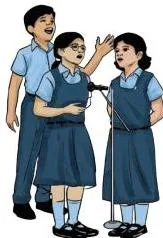
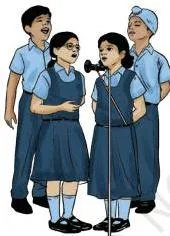
The first two images show the same process at two moments. One carries the instruction to identify someone else — a classmate, friend, teacher or family member — to listen and give constructive feedback; the other says to use that information to improve your performance. Together they are the loop: record, get feedback, improve, sing again.


Pair two: the two groups in the canon
The other two images print the lines of the canon arrangement as the class reads them. One is captioned Group 1: Hum Honge Kamyaab ek din, the other Group 2: Hum Honge Kamyaab (2).
Both groups sing the same melody; the difference is not the tune but the timing — Group 2 starts after Group 1 has moved ahead, and the offset you hear is exactly what makes the canon. The chapter then extends the same idea to four groups, each entering one line later.
Common Mistakes: Where Students Slip in This Chapter
These are the points where a quick reading of the chapter goes wrong. Each mistake is named first, then the correction.
| Mistake | Correct rule | How to check your answer |
|---|---|---|
| Tala confused with laya | Tala is the rhythm cycle of beats; laya is tempo, the speed | Ask: am I counting the beat pattern (tala) or describing how fast it goes (laya)? |
| Harmony confused with canon | Harmony is different notes blending pleasantly; a canon is the same melody started at different times | If voices sing different notes at once, that is harmony; if the same tune is offset in time, that is a canon |
| Melody confused with the whole song | The melody is one layer; drums, instruments and other voices are separate layers | Name every sound you hear one by one before you describe the song as a whole |
| Raga confused with any tune | A raga is notes that come together by rules to form a melody; not every sequence of notes is a raga | Ask whether the notes follow a rule-bound raga structure or just a free tune |
There is also an attitude trap in Activity 5.2. Comparing your recording to the original is for finding where to improve — the chapter’s word is constructive feedback. It is not a test of whether you are “good at music”; every singer uses the same record-compare-improve loop to get better.
Definitions: Quick Glossary of Chapter 5 Terms
The chapter expects you to know a small set of terms. This table collects them in one line each, with the section where each appears.
| Term | Meaning | Where it appears |
|---|---|---|
| Nada | Musical sound, created from nā (prana, life force) and da (agni, fire) | Opening verse |
| Aadhara shruti | The base note everything else is tuned to | Foundation terms |
| Swara | A note; seven in Indian music | Foundation terms |
| Raga | Notes grouped by rules to make a melody | Foundation terms |
| Tala | Rhythm cycle of a number of beats | Foundation terms |
| Laya | Tempo or speed, slow to fast | Foundation terms |
| Layers | All the different sounds in a song — vocals, instruments, melody, harmony, lyrics | Making Music |
| Harmony | Different notes sung together that blend pleasingly | Harmony and Canon |
| Canon | Same melody sung by groups starting at different times | Harmony and Canon |
| Sargam | Singing the swaras in order — named as a practice skill (an explanation here, not the book’s definition) | Note to the Teachers |
| Ritvij | A Vedic priest in the chanting team | Sama-gana story |
| Udgata | Head ritvij of the Sama-Veda group, leads the chant | Sama-gana story |
| Prastota | The ritvij who begins the Prastava | Sama-gana story |
| Pratiharta | The ritvij who sings the Pratihara | Sama-gana story |
| Subrahmanya | The fourth Sama-Veda ritvij, chants the Subrahmanyahvana | Sama-gana story |
| Prastava | The introduction section | Sama-gana story |
| Udgitha | The core section of the chant | Sama-gana story |
| Pratihara | The section continuing the last line of the Udgitha | Sama-gana story |
| Upadrava | The instrumental and rhythmic interlude | Sama-gana story |
| Nidhana | The concluding section, sung in unison | Sama-gana story |
| Upagayak | Listed among the chapter’s important concepts; the chapter does not define it | Important concepts |
How This Chapter Is Assessed: Competencies, Not Marks
This chapter is assessed by competencies, not by a fixed question paper. Here is what the book itself says.
The Note to the Teachers lists four competency groups, each with two sub-competencies:
| Competency group | What it checks |
|---|---|
| CG-1 | Openness to explore and express through music: expressing everyday-life experiences in musical activities; working flexibly in collaborative music-making |
| CG-2 | Imagination and creativity: creating songs and compositions that challenge stereotypes (such as gender roles); connecting musical elements with experiences, emotions and imagination |
| CG-3 | Artistic elements and techniques: stage etiquette, care for instruments, informed choices of resources; refining ideas from planning to final performance |
| CG-4 | Familiarity with local and regional arts: knowing local and regional music forms; describing the life and work of local musicians and performers |
The closing table maps those competencies to three learning outcomes for the chapter, with columns for teacher and self assessment:
- Participating in chanting shlokas with clear enunciation and coordination
- Understanding the concept of a canon, and participating in singing a simple canon
- Analysing a song of one’s choice and identifying its musical elements
On assessment, the chapter is explicit: formative assessments should be conducted in a relaxed and engaged manner, mainly through classroom observation, and the aim is to see whether a child reaches the competency or needs more support — children should receive qualitative feedback. Suggestions for summative assessment are provided at the end of the music section.
The chapter states no marks or weightage, and none are claimed here. Textbook contents and the examinable syllabus are not always identical — check the current official syllabus at cbse.gov.in.
Quick Recap: What to Remember from the Music Chapter
For a night-before read, hold onto these.
- Five foundation terms: aadhara shruti (the base note), swara (a note; Sa Ri/Re Ga Ma Pa Dha Ni), raga (notes by rules → melody), tala (beat cycle), laya (tempo).
- A song is layers: vocals, instruments, melody, harmony, lyrics — listen for each one separately.
- Harmony versus canon: harmony is different notes together; a canon is the same melody offset in time — Group 2 enters when Group 1 starts the third line.
- Sama-gana runs: Prastava (Prastota) → Udgitha (Udgata) → Pratihara (Pratiharta) → Upadrava (Udgata) → Nidhana (all ritvijs), with Subrahmanya chanting the Subrahmanyahvana.
- The chapter’s own important-concepts list: layers, harmony, canon, chanting, ritvij, upagayak.
- The big idea: music is teamwork — separate jobs, one harmony.
Related Resources: Where This Chapter Fits
This listing is maintained for the 2026-27 academic session using the NCERT textbook information available to us. NCERT remains the authority for confirming the latest edition.
This chapter is part of the NCERT Class 7 Arts (Kriti) book page, and the book belongs to the Class 7 hub with the rest of the subjects. You can move back to the previous chapter of the Kriti book or forward to the next Kriti chapter, which continues with music and emotions.
More Class 7 help sits in the CBSE Class 7 notes library.
Sources and Data Verification
- The chapter described here is Chapter 5 — Music (Making Music) — of the NCERT Class 7 Kriti arts textbook, as published in NCERT’s official edition on ncert.nic.in.
- This page covers that one chapter only. It does not cover other Class 7 subjects, and it is not the full CBSE arts education scheme.
- This listing is maintained for the current academic session, following the NCERT edition published on ncert.nic.in.
- NCERT settles textbooks, editions and PDFs; CBSE settles curriculum, syllabus and examinations.
| What the chapter holds | Count | Where it is used |
|---|---|---|
| Printed pages | 10 | |
| Figures with NCERT captions | 4 | |
| Tables | 1 | |
| Official NCERT PDF | Download the chapter PDF | the chapter exactly as NCERT publishes it |
Frequently Asked Questions About the Music Class 7 Chapter
Where can I download the NCERT Class 7 Kriti Music chapter PDF?
The official music class 7 chapter PDF is on NCERT’s textbook portal at ncert.nic.in — open the portal, choose Class 7, select the Kriti (Arts) book, and Chapter 5, titled Music, opens for reading or saving. The same chapter opens from the download link at the top of this page.
What is the difference between harmony and a canon?
Harmony is multiple voices singing different notes that blend together pleasingly. A canon is the same melody sung by different groups that start at different times. In the chapter’s Hum Honge Kamyaab arrangement, Group 2 begins the first line when Group 1 starts the third line, so the same tune is heard twice, offset in time.
What are the seven swaras in Indian music?
The seven swaras are Sa, Ri (also written Re), Ga, Ma, Pa, Dha and Ni. They are the seven notes of Indian music; underneath them sits the aadhara shruti, the base note the chapter says all music is tuned to.
What is the difference between tala and laya?
Tala is a rhythm cycle made of a set number of beats; laya is tempo, the speed of the music, which can range from slow to fast. Both are about time, but tala is the beat pattern while laya is how fast or slow that pattern moves.
Does the Class 7 Kriti Music chapter have to be prepared for an exam?
The chapter itself says formative assessments should be conducted in a relaxed and engaged manner, mainly through classroom observation, and it lists the competencies and learning outcomes it checks.
Whether your school examines it, and how, depends on your school and the current syllabus — textbook contents and the examinable syllabus are not always identical, so check the official syllabus at cbse.gov.in.
Reference: NCERT Class 7 Kriti (Arts) textbook, chapter 5, official edition on ncert.nic.in.
Explore Class 7 Arts Books
Related chapters: