
Say More without Speech — Mime Class 7 is Chapter 2 of NCERT’s Kriti (Arts) textbook, English-medium edition. It is a do-it chapter: you start by rescuing an umbrella in total silence and finish by performing a full group scene with no words and no props.
The official NCERT PDF of this chapter is right here, and below it this page explains the activities and ideas the chapter expects you to try.
Get the official NCERT Class 7 Kriti Chapter 2 PDF
Download NCERT Class 7 Kriti Chapter 2 PDF — Say More without Speech (Mime) from the official NCERT textbook portal: select Class 7, open Kriti, and choose Chapter 2 to read the chapter in its original printed layout while you work through the activities below.
Chapter at a glance: what sits inside the PDF
The table below shows how much of the chapter there is — its sections, figures and activities — so you can see the chapter’s shape before you open the file.
What this chapter teaches: mime as silent communication
The chapter opens with a problem that words cannot solve. You are at a big event where talking is not allowed. You remember that your umbrella is still outside, and your friend is sitting near the entrance door — you must get the friend to fetch it.
Sit in pairs and pass this message with no sound at all. Use actions and expressions, and keep the conversation going: the friend replies that walking out is impossible, you insist it is important. What you just did was a mime bit.
“Mime as an art form speaks the universal language of silence. It can make the invisible become visible and make silence the most powerful and loudest form of communication.” — Marcel Marceau, the French mime artist whose words open this chapter
In India this art of silent acting is called Mukaabhinaya. The chapter’s “You will learn” list sets the agenda: what mime is, the basic features of mime, the advantages of mime, and preparing for a show.

The opening picture, captioned “Preparing for a show”, tells you what kind of chapter this is. Everything here is stage work: from the first imaginary-object warm-up to the final group performance, you are preparing a show, not just reading about one.
Key terms in Chapter 2: mime, pantomime, interactive, facial expression, body language, energy
Before any activity, the chapter builds your working vocabulary. Three performance basics describe how a mime communicates; three technique-based terms define the art forms themselves.
| Basic performance term | What it means |
|---|---|
| Facial expression | The emotion and reaction shown on the face |
| Body language | Hand gestures, body postures and actions made |
| Energy | Intensity and focus behind each action |
The three technique-based terms are the ones students mix up most often, so read them carefully.
- Mime — a form of acting that uses no words or sound. It can be part of a bigger play with dialogues. The person performing mime is also called a mime.
- Pantomime — a theatrical performance with multiple actors and music, mostly in comedy.
- Interactive — bringing in audience participation so the audience becomes “a part of the illusion” for more impact.
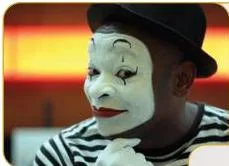
The illustration beside the basic terms is the chapter’s way of telling you to connect each word to a visible action. Facial expression lives on the face; body language lives in the hands and posture; energy is the intensity behind every movement.
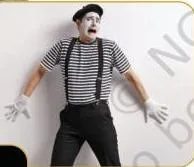
This picture is body language itself — the hands, postures and actions that replace your voice. In the activities that follow, these three items are the raw material of everything you perform.
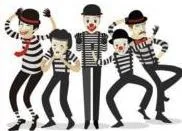
The pantomime picture marks the difference between the two art forms. Mime is one silent performer; pantomime is a full theatrical show — several actors, music, mostly comedy. This mime-versus-pantomime distinction is the point students get wrong most often.
Activity 2.1: the first rule of imaginary objects
Mime performs without sets or props, so the first skill is making an audience see something that is not there. Activity 2.1 teaches exactly that.
Start with your everyday pencil box. Hold it in your hand and fix its size and shape in your mind. Now show the same pencil box as if it were filled with iron — same size, same shape, but heavy. Then show it empty. Try different options to experience an object without touching it.
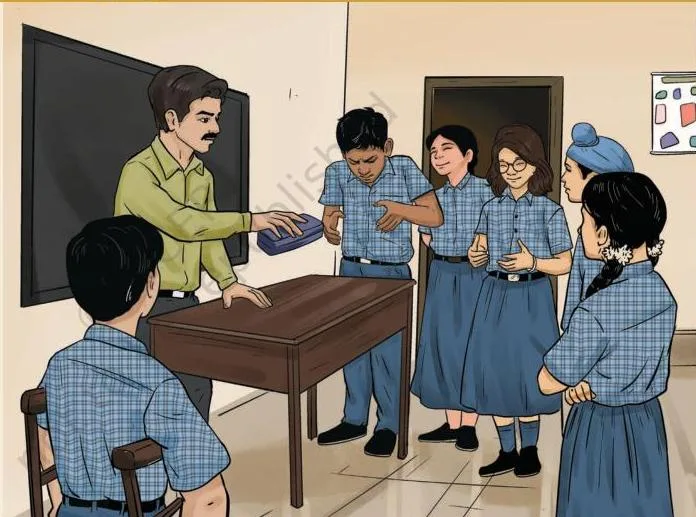
The picture under this caption is the goal of Activity 2.1: a performer whose imaginary world is clear enough for the audience to believe. Everything that follows — the circle pass, the group scene — depends on this one skill.
Tip 1: use the object, do not become the object
This is the chapter’s first rule of mime: show how you hold the object, and never make your hand into the object. Pointing two fingers and moving them like a pair of scissors is the classic mistake. If your hand can become a pair of scissors, how would you show a train, a car or a fridge?
The rule scales to anything. To show a heavy school bag, let your shoulder drop and your body lean into the weight. To show an empty glass, cup a light open hand. To show a balloon, press against the springy air around your hands.
Tip 2: establish the space (size) and weight of the object
A mime’s actions must match the quality of the object being handled. A cricket ball, a basketball and a balloon — the size, weight and feel of each is completely different. Practise holding each one separately.

This illustration is the size-and-weight rule in action: an invisible object becomes believable when your hands treat it as small and hard, big and heavy, or light and floating.
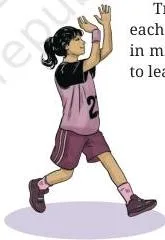
Work through this figure like a drill: cricket ball, basketball, balloon, one after another. The difference between the three holds is the performance.
Activity 2.2: circle-time object pass, basic and advanced
This full-class game turns the Activity 2.1 skill into a shared challenge. Everyone sits in a circle. One volunteer starts with an imaginary object and does an action showing its shape, size and weight. The object passes to the next person, who adds a new action and passes it on.
Two rules hold the game together: nobody uses sound or speech, and nobody announces the object’s name. The object’s identity is carried only by the actions, and each student reads and responds.
Basic version
Everyday objects like a pen, a pair of scissors or a watch. Each receiver must do a unique action that no one has done before, then pass the object on.
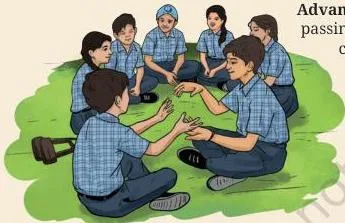
The basic-version picture shows how simple the starting objects are — things from your pencil case. The challenge is not the object; it is finding a fresh action for it every time.
Advanced version
The same passing game, but now the object changes with time. A huge ice cube slowly melts as it travels, so the first person’s action and the last person’s action cannot be the same. A handful of sand keeps reducing as it slips through the fingers. This is the chapter’s edge case: size and weight are not always constant.

The advanced picture pairs with the basic one: same circle, same rules, but the object everyone shares is no longer a fixed thing — it shrinks, melts or drains away as it moves.
Circle Time
The chapter pauses here for two discussion questions meant for the whole class:
- What is the most enjoyable aspect of performing without speech or props?
- What is more difficult — going without speech, or going without props?
There are no printed answers; the discussion itself is the learning.
Three pillars of a mime show: imagination, exaggeration, costume and make up
This is the chapter’s organising idea: any successful mime show must have three aspects, and all three must be practised individually and as a group.
1. Imagination
Body language and expressions are entirely the performer’s effort, but imagination pulls the audience in. Unless the audience joins in imagining the objects, the situations and the environment, the show cannot succeed. This give-and-take between audience and actor is what makes a mime show unique — and imagination creates it.
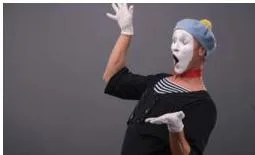
Notice what this picture says: imagination is listed with body language and expressions, but it is called the most crucial. The other two are about the performer; imagination is about the performer and the audience.
2. Exaggeration
Exaggeration makes movement, actions and expressions larger than life. Because mime relies on silent communication, subtle details must stay visible — especially for a large audience. The chapter links this to the Natyadharmi style of acting from Chapter 1: dramatic, stylised techniques like slow motion, repetition and over-expression.
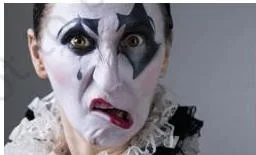
This is the exaggeration picture: a movement so big and clear that a large audience can read it. When you rehearse, practise the same action twice — once at everyday scale, once larger — and feel the difference.
3. Costume and make up
Unlike drama or dance, mime costume does not directly depict the character. It is primarily neutral, with small differences for variation.
- Costume: fully black shirt and pants when the backdrop is white, or a black-and-white mix — stripes on the shirt, or accessories such as gloves, socks or suspenders.
- Make-up: facial features highlighted with contrasting white, black and red, so expressions stay visible and exaggerated.
- Character: only subtle indications appear in the make-up, never a full character costume.

The costume picture pinpoints the difference from drama: the mime in neutral black-and-white dress is any person, any society. The character comes from the body, not the clothes.
Mime as a universal language for equality
Why does the chapter call mime universal? The first reason is no speech. Speech creates language barriers; silence removes them, because emotions are universal. A situation mimed in any state of India — or any country — is understood by a person from any corner of the world.
The second reason is visual equality. Black-and-white costumes and a common white make-up eliminate the bias that comes from stereotyping people by their clothes. The result is pure storytelling by people who could be from any society.
This can even break gender stereotypes: a mining or building-construction scene can show women carrying heavy loads, because everyone in mime wears the same costume.
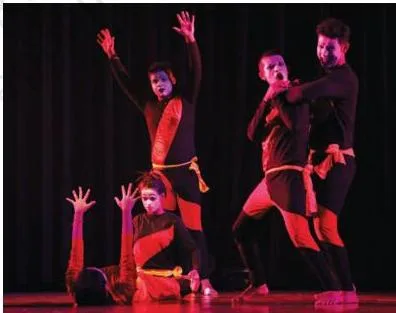
The picture under this caption is the emotional side of mime. The chapter says mime helps people come out of trauma or get over bad experiences, because it gives them freedom to express and share without fear of being judged.
Activity 2.3: taking a group scene from props to pure mime
The final activity moves from individual skill to a group of 5–10 and a full scene. It is rehearsed in three stages, and each stage takes one thing away.
- With sets and props — enact the scene normally, like a regular play, using all the properties and sets you need.
- Without sets — mark the set placements in your minds, then remove the chairs and tables. Handheld props like a walking stick or a bow and arrow can still be used.
- Without props — once the set is familiar, remove the props too and enact the whole scene in pure mime.

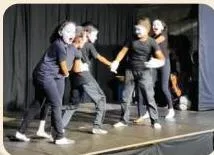
This picture shows stage 2: the furniture is gone, but the team still moves around the remembered positions. The set exists in the performers’ minds before it exists on stage.
Practice and music
The chapter suggests a practice piece: perform your daily routine from waking up to going to bed, keeping the minor details in your actions. For music, use instrumental background music that suits the situation of the act — but no lyrics and no speech.
The music picture shows the allowed support: instruments only. The music sets the mood, and the performers’ silence stays unbroken.
Note to the teacher: groups may also create their own scenes, and the chapter encourages scenes that break stereotypes or promote inclusivity.
Make Up Magic: from drawn expressions to a short mime story
Make Up Magic is the chapter’s final link between its three pillars and a real performance. It starts with a facial expression, exaggerates it, and carries it into a story.
- Make teams of two.
- Show expressions for four situations: opening a stuck jar lid, lifting a heavy suitcase, eating a sour lemon, pulling a heavy rope.
- Your partner draws your expression in the space given — observe the details of eyebrows, forehead, cheeks and eyes.
- Discuss how to exaggerate the expression more and improve it.
- Enact the situation with your entire body.
- Make a small story around it and enact it with your friends.

This picture is the end point of the chapter: an expression, drawn and exaggerated, now lives inside a scene shared with friends. Exaggeration from the three pillars is what connects the drawing to the stage.
Figure walkthrough: what the illustrations in Chapter 2 show
The illustrations you met in the sections above are collected here as a quick index, grouped by the activity they belong to. Use it to find any picture again while rehearsing.
| Illustration | What to notice and copy |
|---|---|
| Preparing for a show | The chapter’s mood setter: a mime is a performer preparing a silent act, not a spoken one. |
| Basic terms illustration | Learn the three basics — facial expression, body language, energy — before any activity. |
| Body language illustration | Body language is your voice in mime; practise hands, posture and actions together. |
| Pantomime illustration | The contrast with mime: several actors, music, comedy — a full show, not one silent performer. |
| Imaginary-world illustration | The target of Activity 2.1: an imaginary world the audience believes exists. |
| Size-and-weight illustration | Actions must match the object’s quality — size and weight are part of the object. |
| “Holding each one separately” figure | Drill: cricket ball, basketball, balloon — each feels different in the hands. |
| Basic circle-pass figure | Fixed everyday objects; each receiver adds a unique action. |
| Advanced circle-pass figure | The object changes over time, so the first and last actions differ. |
| Imagination figure | Imagination involves performer and audience together; the other pillars are performer-led. |
| Exaggeration figure | Larger-than-life movement for large audiences, like the Natyadharmi techniques of Chapter 1. |
| Costume and make-up figure | Neutral black or black-and-white costume with white, black and red make-up. |
| Powerful-tool figure | The therapeutic side of mime: expression without fear of being judged. |
| Group-mime set placements | Stage 2 of group mime: furniture removed, positions remembered. |
| Music figure | Instrumental music only; lyrics and speech stay out. |
| Make Up Magic story figure | From a drawn expression to a full enacted story. |
Common mistakes in mime (and what to do instead)
Five mistakes show up again and again in these activities. Naming them before rehearsal saves a whole class period.
| The mistake | Correct rule | How to check yourself |
|---|---|---|
| Making your hand into the object (two fingers as scissors) | Use the object — show how you hold it, don’t become it | Would this action still work for a train or a fridge? If not, you are becoming the object. |
| Ignoring size and weight | Fix the object’s space and weight before performing | Hold a cricket ball, then a basketball, then a balloon — each must look different. |
| Announcing the object’s name or making sound in the circle pass | No sound, no speech, no names — the action carries the object | If any sound or name slips out, pause and restart the pass. |
| Treating mime costume as a character costume | Keep the costume neutral — black or black-and-white; character stays subtle | Would the same outfit suit every performer and every role in the show? |
| Acting at everyday scale | Exaggerate so subtle details reach a large audience | Perform the action twice, near and far; the far version must be bigger and still readable. |
Assessment and classwork notes: learning outcomes CG 2.1 to 2.5
The chapter ends with its own learning outcomes — five skills, coded 2.1 to 2.5, that together define what it means to understand mime.
| CG | Code | Learning outcome | What it means in class |
|---|---|---|---|
| 2 | 2.1 | Understands the uniqueness of mime and its difference and similarities with drama | You can say what makes mime different from a spoken play and where the two overlap. |
| 2 | 2.2 | Can visualise objects accurately in shape, size and weight, and use it in performance | An invisible object in your hands has a fixed size, shape and weight that the audience can read. |
| 2 | 2.3 | Can bring in stories from personal experience to interpret in mime | Your own daily routine — waking up, eating, studying, sleeping — becomes material for a scene. |
| 2 | 2.4 | Uses the advantages of mime and its universality to perform on themes based on inclusivity or breaking gender stereotypes | Your group scene can show any person doing any work, because the costume is common. |
| 2 | 2.5 | Can put together group performance integrating music and humour | You can rehearse and present a group mime with instrumental music and comic exaggeration. |
The book’s version of this table leaves a Teacher column and a Self column open beside each outcome.
Textbook contents and the examinable syllabus are not always identical — check the current official syllabus if you need exam details.
Five things to remember from Chapter 2
- Mime is acting without words or sound, and the performer is also called a mime. In India the art is Mukaabhinaya.
- The first rule of mime is to use the object, not become it — show how you hold a thing, never turn your hand into the thing.
- Fix the size and weight of every imaginary object — a cricket ball, a basketball and a balloon each feel different.
- A successful mime show rests on three pillars: imagination, exaggeration, and neutral costume with make-up.
- Mime is a universal language — no speech removes language barriers, and a common costume can break gender stereotypes.
Related resources: the Class 7 Arts book and hub
This listing is maintained for the 2026-27 academic session using the NCERT textbook information available to us. NCERT remains the authority for confirming the latest edition.
This chapter belongs to Kriti, the NCERT Arts textbook for Class 7. The exaggeration pillar reaches back to the Natyadharmi style of acting from Chapter 1 of the same book.
- Browse the Class 7 Arts notes hub for more around this chapter.
- Find your other Class 7 subjects from the Class 7 hub.
- Mime is a performance art — the theatre section of the Class 7 Arts notes covers allied stage work.
- For stage and design work, see Let’s Design — Stage Technicals 2.
Sources and data verification
This page describes the NCERT Kriti (Arts) Class 7 English-medium textbook, Chapter 2, “Say More without Speech — Mime”. Only this chapter is covered here; the rest of the book is described on its own pages.
NCERT owns the textbook, its editions and its official PDFs. CBSE owns the curriculum, the syllabus and the examinations. This page is maintained for the current session using the NCERT information available to us.
| What the chapter holds | Count | Where it is used |
|---|---|---|
| Printed pages | 10 | |
| Figures with NCERT captions | 16 | |
| Tables | 2 | |
| Official NCERT PDF | Download the chapter PDF | the chapter exactly as NCERT publishes it |
Reference: NCERT Class 7 Kriti textbook, chapter 2, official edition on ncert.nic.in.
Frequently asked questions about mime (Chapter 2)
Is mime the same as pantomime?
No. Mime is a form of acting that uses no words or sound, and can even be part of a bigger play with dialogues; the performer is also called a mime. Pantomime is a theatrical performance with multiple actors and music, mostly in comedy.
Can a mime performance use music or sound?
A mime itself uses no words or sound. For the group scene in Activity 2.3 you may add instrumental background music to suit the situation — but no lyrics and no speech.
What should a performer wear for a mime show?
A neutral costume: fully black shirt and pants when the backdrop is white, or a black-and-white mix such as stripes, gloves, socks or suspenders. Make-up highlights the face with white, black and red so expressions stay visible and exaggerated. It is not a character costume.
What is the first rule of showing an imaginary object in mime?
Use the object, don’t become it. Show how you hold the object. Pointing two fingers like a pair of scissors is wrong, because that trick cannot show a larger object such as a train, a car or a fridge.
Why is mime called a universal language?
Because it needs no speech, and emotions are universal — any situation from any country is understood anywhere. The common black-and-white costume and make-up also remove clothing-based stereotypes, so mime can even break gender stereotypes, such as women carrying heavy loads in a mining or construction scene.
Does Class 7 Kriti Chapter 2 have written exercises?
No. This is a practice chapter built around activities: Activity 2.1 (imaginary objects), Activity 2.2 (circle object pass), Activity 2.3 (group mime) and Make Up Magic. The two Circle Time prompts are discussion questions to talk over in class, not written work.
Explore Class 7 Arts Books
Related chapters: