
The line joining the centre to the midpoint of a chord is perpendicular to the chord — that is the claim of Theorem 4 of the NCERT Class 9 Mathematics textbook (Ganita Manjari), chapter 5, I’m Up and Down, and Round and Round.
This page gives the theorem exactly as the book prints it on page 101, the book’s own figure (Fig. 5.12), and a numbered proof, with the reason for every step, that you can reproduce in an exam.
The proof sticks to the book’s construction: the two radii to the chord’s endpoints plus the midpoint join. The same chain of reasoning sits behind all three questions of Exercise Set 5.3 on the same page.
The theorem, exactly as NCERT prints it
Theorem 4 comes on printed page 101 of chapter 5 of the NCERT Class 9 Mathematics book. The book’s own statement:
Theorem 4 (NCERT Class 9 Mathematics, page 101) The line joining the centre of a circle and the midpoint of a chord of the circle is perpendicular to the chord.
New: practise this theorem. Drag the book’s figure and watch the numbers change, try to break the theorem on purpose, then solve fresh questions with hints.
That is the sentence a question may ask you to state. Notice what it claims: the midpoint is pinned to the chord, the centre is pinned to the circle, and the line between the two is declared to be at a right angle to the chord.
What the theorem means in plain words
A chord is any straight segment whose two endpoints lie on the circle — here, the segment \(AB\). Its midpoint is the point that splits the chord into two equal halves; the book calls it \(M\), so \(AM = BM\).
The theorem claims that the segment drawn from the circle’s centre \(C\) to that midpoint \(M\) meets the chord at a right angle. In symbols: \(CM \perp AB\), which means \(\angle CMA = \angle CMB = 90^\circ\).
The intuition is symmetry: the circle folds onto itself along the line \(CM\), so the two halves of the chord land exactly on top of each other, and the fold line cannot be slanting. The formal proof below reaches the same conclusion with congruent triangles, not folding.
Figure 5.12 from the book
Fig. 5.12 on page 101 is the book’s figure for Theorem 4, and it already contains every segment the proof will use.
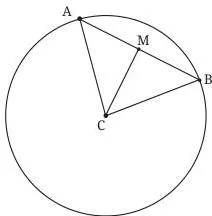
Read the labels left to right:
- C — the centre of the circle, where the theorem’s line starts.
- A and B — two points on the circle; the segment \(AB\) joining them is the chord.
- M — the midpoint of the chord, marked on \(AB\) itself, so \(AM = BM\).
- CM — the segment from the centre to the midpoint; the theorem claims this segment is perpendicular to \(AB\).
The figure also shows the radii \(CA\) and \(CB\), one to each end of the chord. Those three drawn segments — \(CA\), \(CB\), \(CM\) — are everything the proof needs, which is why the book adds no further construction line.
Given, to prove, and what the figure already gives us
The book opens the proof informally on page 101: draw a circle with centre C, draw any chord AB, let M be the midpoint of AB, and set the target — show that CM is perpendicular to AB. Written in the standard exam format, that becomes:
Given: a circle with centre \(C\), a chord \(AB\) of the circle, and \(M\) the midpoint of \(AB\), so \(AM = BM\).
To prove: \(CM \perp AB\), that is, \(\angle CMA = \angle CMB = 90^\circ\).
Construction: join \(C\) to \(A\), \(C\) to \(B\), and \(C\) to \(M\). All three segments are already drawn in Fig. 5.12, so the proof introduces no new line.
Proof of Theorem 4, step by step
The book’s proof on page 101 moves through three facts: the two radii are equal, the two triangles made by joining the centre to the chord are congruent, and the two equal angles it produces lie on a straight line. Here are the same steps with the reason for each one written out.
One note on notation: inside \(\triangle CAB\), the book writes \(\angle A\) and \(\angle B\) for the base angles at A and at B. Keep that shorthand in mind through the steps.
- \(CA = CB\). Both are radii of the same circle, and all radii of a circle are equal.
- \(\triangle CAB\) is isosceles, with base \(AB\). Since \(CA = CB\), the base angles are equal: the book writes \(\angle A = \angle B\).
- \(AM = BM\). \(M\) is the midpoint of \(AB\), so it cuts the chord into two equal halves — this is the definition of a midpoint.
- \(\triangle CMA \cong \triangle CMB\) by SAS congruence. In \(\triangle CMA\) and \(\triangle CMB\): \(CA = CB\) from step 1, \(AM = BM\) from step 3, and the angle between those two sides in each triangle is a base angle of \(\triangle CAB\), which step 2 showed equal. The matching vertices are \(C \leftrightarrow C\), \(M \leftrightarrow M\), \(A \leftrightarrow B\), so write the congruence in that order.
- \(\angle CMB = \angle CMA\). Corresponding parts of congruent triangles are equal; these two are the angles at \(M\) in the two triangles.
- \(\angle CMB + \angle CMA = 180^\circ\). The two angles stand side by side on the straight line \(AB\), sharing the side \(CM\) — angles on a straight line add up to \(180^\circ\).
- Therefore each angle is \(90^\circ\), so \(CM \perp AB\). Two equal angles whose sum is \(180^\circ\) must both be right angles.
That completes the proof: \(CM\) is perpendicular to the chord \(AB\). The whole argument hangs on the isosceles triangle \(CAB\) — join the apex to the midpoint of the base, and the equal sides of the triangle do the rest.
Try it yourself: a live practice figure
Where the chapter uses this theorem next
Theorem 4 is not an isolated result. Exercise Set 5.3 is printed on the same page (NCERT, p. 101), and every question there connects to it:
- Q1 asks for the converse — the claim that the perpendicular from the centre bisects the chord. It is treated in the next section.
- Q2 inscribes an isosceles triangle \(ABC\) with \(AB = AC\) and asks you to show that the altitude from \(A\) to \(BC\) passes through the centre: the altitude meets the base at its midpoint, and joining the centre to that midpoint is exactly the line Theorem 4 makes perpendicular.
- Q3 gives two parallel chords, 6 cm and 8 cm, on opposite sides of the centre, with radius 5 cm, and asks for the distance between their midpoints. The perpendicular from the centre to each chord is the tool that starts the solution.
The same perpendicular-to-chord idea feeds the next result in the book: Theorem 6 — equal chords are equidistant from the centre — which compares these perpendicular distances for two chords at once.
Habit to adopt: whenever a chord’s midpoint appears in a circle problem, join it to the centre — a right angle appears with it. That right angle completes a right triangle, and right triangles can be measured with Pythagoras.
Worked example: distance of a chord from the centre (original numbers, not from the book)
A circle of radius 13 cm has a chord of length 24 cm. Find the distance of the chord from the centre.
Step 1: the midpoint splits the chord into two halves, each \(\frac{24}{2} = 12\) cm. Call the midpoint \(M\).
Step 2: join the centre \(C\) to \(M\). By Theorem 4, \(CM \perp AB\), so the triangle made by \(C\), \(A\) and \(M\) is right-angled at \(M\). Its hypotenuse \(CA\) is the radius, 13 cm, and one leg \(AM\) is 12 cm.
Step 3: apply Pythagoras to find the other leg, the distance \(CM\):
\[ CM = \sqrt{CA^2 – AM^2} = \sqrt{13^2 – 12^2} = \sqrt{169 – 144} = \sqrt{25} = 5\text{ cm} \]
Answer: the chord is 5 cm from the centre. This radius–half-chord–distance pattern is exactly the shape Q3 of Exercise Set 5.3 works with.
The converse: a perpendicular from the centre bisects the chord
A converse swaps the given and the conclusion. Theorem 4 takes the midpoint as given and concludes a right angle. Its converse gives the right angle and concludes the midpoint — and the book asks you to explain it as Exercise Set 5.3 Q1 (page 101).
The hint points back at Fig. 5.12: you are told that \(\angle CMA = \angle CMB = 90^\circ\), and you must show that \(AM = BM\).
The reasoning idea uses the same two triangles. \(\triangle CMA\) and \(\triangle CMB\) are now right-angled at \(M\), they share the side \(CM\), and their hypotenuses \(CA\) and \(CB\) are equal radii. Two right triangles with an equal hypotenuse and one equal leg are congruent — the RHS congruence rule — so the remaining matching parts match, and \(AM = BM\).
The formal answer to Q1 (given, to prove, the two triangles, the conclusion) is yours to assemble from these pieces.
| What is given | What you may conclude | Where it comes from |
|---|---|---|
| \(M\) is the midpoint of the chord \(AB\) | \(CM \perp AB\) | Theorem 4 |
| \(CM \perp AB\), with \(M\) on the chord | \(AM = BM\), so \(M\) is the midpoint | Converse — Exercise Set 5.3 Q1 |
Read both directions together and a single fact appears: in \(\triangle CAB\), the segment \(CM\) joins the apex \(C\) to the base \(AB\). With the midpoint given, \(CM\) is the median and the theorem shows the median is also the altitude; with the right angle given, \(CM\) is the altitude and the converse shows the altitude is also the median.
The theorem and its converse are the same isosceles-triangle property read upside down.
Common mistakes in this proof, and how to fix them
These are the errors that actually cost marks when the proof is written out in an exam, with the rule that fixes each one.
| Mistake | Correct rule | How to check your answer |
|---|---|---|
| Congruence written backwards, e.g. \(\triangle CMA \cong \triangle CBM\) | Corresponding vertices must match: \(C \leftrightarrow C\), \(M \leftrightarrow M\), \(A \leftrightarrow B\), so write \(\triangle CMA \cong \triangle CMB\) | The equal angles after congruence should be \(\angle CMA = \angle CMB\), both at \(M\) |
| SAS used without naming the included angle | The equal angle must sit between the two equal side pairs — here, the base angles of \(\triangle CAB\) | The sides \(CA, AM\) and \(CB, BM\) meet at the angles step 2 proved equal |
| \(CA = CB\) written with no reason | Both are radii of the same circle | Every equality in a proof needs a reason after it |
| “Perpendicular bisector” assumed as one fact | Theorem 4 gives the perpendicular because the midpoint is given; the bisection is the given \(AM = BM\) | Spot which fact you were given, and conclude only the other one |
| \(\angle A = \angle B\) written with no home triangle | These are the base angles of isosceles \(\triangle CAB\) | Add the triangle name to the sentence |
| Circular reasoning in Q1 — assuming \(AM = BM\) | The converse must derive the midpoint from the right angle | Never restate the conclusion as a given |
| No reason given for the \(180^\circ\) | \(\angle CMA\) and \(\angle CMB\) stand side by side on the straight line \(AB\), sharing the side \(CM\) | Find the line \(AMB\) and the two adjacent angles standing on it |
Questions students ask about this theorem
What is Theorem 4 in Class 9 Maths chapter 5?
It is the theorem in the box at the top of this page: the line joining the centre of a circle and the midpoint of a chord of the circle is perpendicular to the chord. The book numbers it Theorem 4, prints it on page 101 of chapter 5 (I’m Up and Down, and Round and Round), and illustrates it with Fig. 5.12.
Why is the line from the centre to the midpoint of a chord perpendicular?
Because \(\triangle CAB\) is isosceles: \(CA\) and \(CB\) are equal radii. The line from the apex \(C\) to the midpoint \(M\) of the base is the median of the triangle, and in an isosceles triangle the median to the base is also the altitude, meeting the base at \(90^\circ\).
The SAS proof on this page proves the same fact without appealing to symmetry.
Is the converse true — does the perpendicular from the centre of a circle bisect the chord?
Yes. If the perpendicular from the centre meets the chord at \(M\), then \(\triangle CMA\) and \(\triangle CMB\) are right-angled at \(M\), share the side \(CM\), and have equal hypotenuses \(CA = CB\) (radii). Equal hypotenuse and equal leg give RHS congruence, so \(AM = BM\). NCERT sets exactly this as Exercise Set 5.3 Q1 on page 101.
How do I find the distance of a chord from the centre of a circle?
Join the centre to the chord’s midpoint (or drop the perpendicular from the centre to the chord); either way, Theorem 4 supplies the right angle. Then apply Pythagoras to the right triangle whose hypotenuse is the radius, one leg is half the chord, and the other leg is the distance you want.
The worked example above — radius 13 cm, chord 24 cm — gives the distance 5 cm.
Where is the line-from-centre-to-midpoint theorem used later in Class 9 circles?
In the same chapter: all three questions of Exercise Set 5.3 (page 101) connect to it, and the later theorem, equal chords are equidistant from the centre, extends the same perpendicular-to-chord idea to two chords at once. The converse, as Q1 shows, is the fact behind most chord-distance calculations.
Related resources and source
This listing is maintained for the 2026-27 academic session using the NCERT textbook information available to us. NCERT remains the authority for confirming the latest edition.
This theorem sits inside a chain of circle results. The Class 9 maths theorems hub collects the theorem pages of this book, and the chapter page for I’m Up and Down, and Round and Round holds the chapter as a whole.
The result just before this one is Theorem 3 — chords subtending equal angles at the centre are equal, and Theorem 4 feeds Theorem 6 — equal chords are equidistant from the centre.
For revision around this topic, the Class 9 mathematics notes gather the chapter-wise material, Class 9 notes covers the subjects of the class, and the notes hub is the entry point to every class.
The textbook itself is published by NCERT, and the current Class 9 Mathematics book (Ganita Manjari) — in which Theorem 4 sits on printed page 101 of chapter 5 — is available at ncert.nic.in, the official source to check the exact wording of the statement and Fig. 5.12.
One last note: textbook contents and the examinable syllabus are not always identical — check the current official syllabus before deciding what to revise.
Reference: NCERT Class 9 Mathematics textbook, chapter 5, Theorem 4, official edition on ncert.nic.in.
Explore Class 9 Mathematics
Related chapters:
Official source: download the NCERT textbook free from ncert.nic.in.