
The official I’m Up and Down, and Round and Round Class 9 PDF — Chapter 5 of the NCERT Ganita Manjari Part I textbook — is right here, ready to open.
Below it you get a working map of the chapter: the 12 theorems in the order they build on each other, the definitions and formulas you need, the figures that carry the proofs, and the mistakes students make with chords, arcs and cyclic quadrilaterals.
Download the I’m Up and Down, and Round and Round Class 9 PDF
The chapter runs 26 pages in the official edition, from the definition of a circle to the properties of cyclic quadrilaterals. Open the official I’m Up and Down, and Round and Round Class 9 PDF on ncert.nic.in to read the full chapter text, its figures and the exercise sets exactly as printed.
NCERT hosts the file itself on ncert.nic.in, so this is the edition the book follows.
Chapter 5 at a Glance: What the PDF Contains
The table below shows what the official PDF holds — numbered sections, figures, worked examples and exercise questions — so you can judge the chapter’s size before you open it.
Chapter 5 is organised as one continuous argument, section by section:
- 5.1 Definitions
- 5.2 Symmetries of a Circle
- 5.3 How Many Circles?
- 5.4 Chords and the Angles They Subtend
- 5.5 Midpoints and Perpendicular Bisectors of Chords
- 5.6 Distance of Chords from the Centre
- 5.7 Angles Subtended by an Arc
- 5.8 Concyclicity of Points
Each section ends with an exercise set, and the chapter closes with End-of-Chapter Exercises and a Chapter Summary.
What This Chapter Covers: From Raindrops to Cyclic Quadrilaterals
This section is a reading map. It shows where the chapter starts, where it ends, and why each part sits where it does, so the twelve theorems in the middle never feel random.
Chapter 5 opens with circles in nature. Raindrops falling on water send out circular ripples; a plant stem’s cross-section, a sunflower’s inflorescence, the full moon and the sun during a total solar eclipse all look circular. The chapter even mentions early cave paintings at Gudahandi in Odisha, where circles, triangles, squares and ovals appear among the geometric patterns.
Figure 5.1 is the image the chapter starts from — the perfect circles a raindrop draws on still water.
From these observations the chapter makes its central move. It turns “every point of a circle is at the same distance from its centre” into the formal definition of a circle (section 5.1).
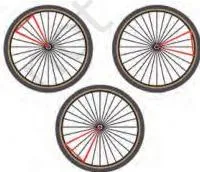
Then come the symmetries (section 5.2): reflection across any diameter, and complete rotational symmetry, so a rotating wheel looks identical at every moment.
Section 5.3 asks the counting questions. How many circles pass through two points, and how many through three? The answers — infinitely many through two, exactly one through three non-collinear points — introduce the perpendicular bisector as a locus and lead to the circumcircle of a triangle.
From there the chapter works through the properties of chords (sections 5.4 to 5.6): equal chords and the angles they subtend, the perpendicular from the centre to a chord, and the distance of chords from the centre.
Section 5.7 turns to arcs and the angles they subtend, ending with the result that the angle in a semicircle is \( 90^\circ \). Section 5.8 closes the chapter by answering the question that opened it — when do four points lie on the same circle? — and derives the cyclic quadrilateral rule.
Why this order matters: later theorems lean on earlier ones. Theorem 5 (the perpendicular from the centre bisects a chord) is used inside the proof of Theorem 6. Theorem 1 (a unique circle through three non-collinear points) is the starting point of the proof of Theorem 10.
Theorem 11 is then used to prove its own converse, Theorem 12.
The chapter builds its intuition through hands-on activities: folding a paper circle to find its centre, tying a thread across a wheel to model a chord, and rotating tracing paper to watch equal chords stay equidistant from the centre. Short “Think and Reflect” prompts appear between sections — for instance, locating the centre of a circular paper by folding it.
Two words may be new to you. The book calls the Pythagorean theorem the Baudhāyana–Pythagoras theorem, and it uses 4-gon for quadrilateral. Older notes may use different names.
Key Concepts: The 12 Theorems in Learning Order
This table is the skeleton of the chapter. Each theorem appears in plain words, with the section where it is proved and the theorem it pairs with — half of these results are converses of the other half.
| No. | What the theorem says (plain words) | Section | Pairs with |
|---|---|---|---|
| 1 | Through three non-collinear points there is exactly one circle. | 5.3 | — |
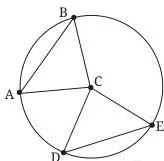
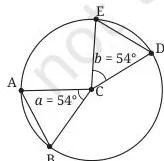
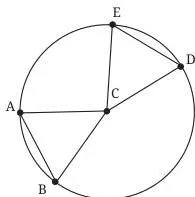
| 2 | Equal chords subtend equal angles at the centre. | 5.4 | 3 |
| 3 | Chords that subtend equal angles at the centre are equal in length. | 5.4 | 2 |
| 4 | The line from the centre to the midpoint of a chord is perpendicular to the chord. | 5.5 | 5 |
| 5 | The perpendicular from the centre to a chord bisects the chord. | 5.5 | 4 |
| 6 | Chords of equal length are at the same distance from the centre. | 5.6 | 7 |
| 7 | Chords at the same distance from the centre are equal in length. | 5.6 | 6 |
| 8 | Of two unequal chords, the longer one is closer to the centre. | 5.6.1 | — |
| 9 | The angle an arc subtends at the centre is double the angle it subtends at any point on the remaining part of the circle. | 5.7 | — |
| 10 | If segment AB subtends equal angles at two points C and D on the same side of AB, then A, B, C and D lie on one circle. | 5.8 | — |
| 11 | Opposite angles of a cyclic quadrilateral sum to \( 180^\circ \). | 5.8 | 12 |
| 12 | If two opposite angles of a quadrilateral sum to \( 180^\circ \), the quadrilateral is cyclic. | 5.8 | 11 |
Read the “Pairs with” column as a two-way street. Theorems 2 and 3, 4 and 5, 6 and 7, and 11 and 12 are converse pairs: each condition runs in both directions.
The logic of the chapter is simple — equal chords give equal central angles, and the same ideas run backward. Theorem 1 guarantees the circle exists, Theorem 8 compares chord lengths, Theorem 9 connects the central angle with the angle on the circle, and Theorem 10 is the test for concyclicity.
Figure Walkthrough: Reading the Diagrams That Prove the Chapter
This section reads the NCERT diagrams for you. Each figure below appears in the book; the explanation says what to look for and which definition or theorem it supports.
The figure that defines the circle
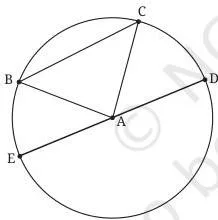
Figure 5.3 is the chapter’s first working diagram. A is the centre, and every point of the circle is at distance AB from A, so AB is a radius. B and C are two points on the circle, and the segment BC joining them is a chord.
The angle BAC — the angle the chord subtends at the centre — is what Theorems 2 and 3 are about.
How many circles through two points and three points
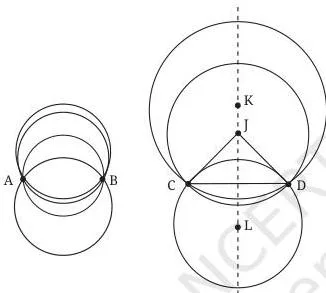
Figure 5.4 shows circles passing through the same pair of points. Their centres K, J and L all lie on the perpendicular bisector of the segment joining the two points — every point of that bisector is the centre of some circle through both points, which is why there are infinitely many such circles.
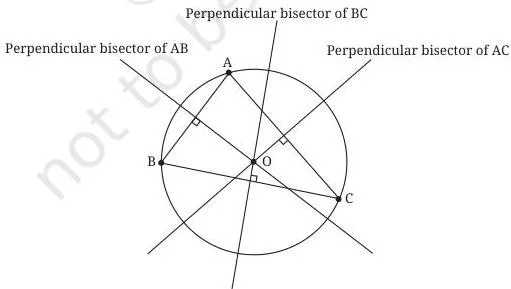
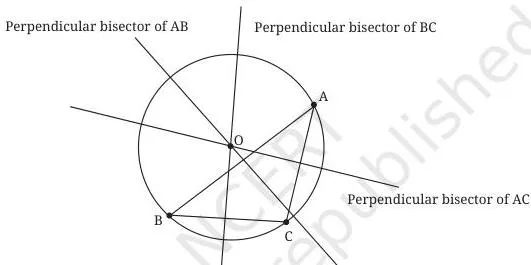
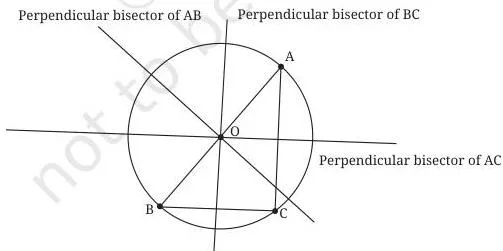
Figures 5.5, 5.6 and 5.7 answer the question “where does the circumcentre lie?” in one sweep. For an acute-angled triangle, the circumcentre is inside the triangle (Fig 5.5). For an obtuse-angled triangle, it lies outside (Fig 5.6). For a right-angled triangle, it sits exactly at the midpoint of the hypotenuse (Fig 5.7).
That last fact matters later: it means the hypotenuse of a right triangle is a diameter of its circumcircle.
Chords: the perpendicular from the centre
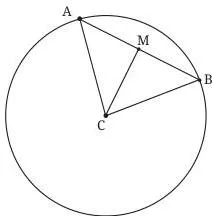
Figure 5.12 is the diagram for Theorem 4. Triangle CAB is isosceles because CA and CB are both radii, and M is the midpoint of the chord AB.
The proof shows that triangles CMA and CMB are congruent, which forces the two angles at M to be equal. Since the two angles lie on a straight line, each is \( 90^\circ \).
So the line from the centre to the midpoint of a chord always meets the chord at a right angle. Running the argument backward gives Theorem 5: the perpendicular from the centre bisects the chord.
Which chord is closer to the centre
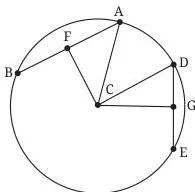
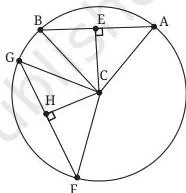
Figure 5.16 carries Theorem 8. From the centre C, perpendiculars CF and CG are dropped to two chords AB and DE.
Applying the Baudhāyana–Pythagoras theorem to the two right triangles shows that when AB is the longer chord, its half-length AF is larger, so CF must be smaller.
Reading the figure: the longer chord is the one closer to the centre. Push a chord away from the centre and it shrinks — at distance equal to the radius, its length becomes zero.
Arcs and the angles they subtend
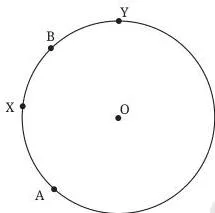
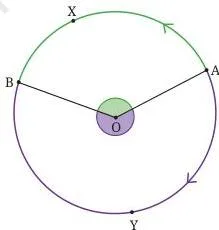
Figure 5.17 defines the vocabulary of arcs. Two points A and B split the circle into two connected pieces: the smaller piece, via X, is the minor arc AXB, and the larger piece, via Y, is the major arc AYB.
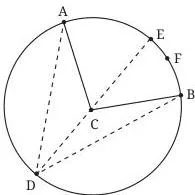
Figure 5.21 is the diagram for Theorem 9. The arc AFB subtends angle ACB at the centre C, and D is any point on the remaining part of the circle.
The proof splits the angle at the centre using the exterior angle theorem on two isosceles triangles. The result is that the central angle is exactly double the angle at D, wherever D sits on the circle.
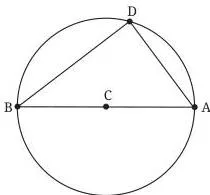
Figure 5.24 turns Theorem 9 into its most famous corollary. Take the diameter AB; the arc from A to B that does not contain D is a semicircle, and it subtends a straight angle of \( 180^\circ \) at the centre.
Half of \( 180^\circ \) is \( 90^\circ \), so the angle at any point on the circle standing on a diameter is a right angle — the angle in a semicircle.
The cyclic quadrilateral
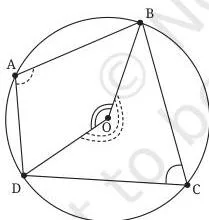
Figure 5.28 proves Theorem 11. In the cyclic quadrilateral ABCD, angle BAD is half the reflex angle BOD, while angle BCD is half the remaining angle BOD.
The two halves together cover a complete rotation of \( 360^\circ \), so the two opposite angles sum to \( \frac{1}{2} \times 360^\circ = 180^\circ \).
Definitions You Need Before the Exercises
These are the exact terms the chapter uses. Learn them as one set, because the theorems are written in this vocabulary.
| Term | Meaning in plain words |
|---|---|
| Circle | All the points in a plane at the same distance from one fixed point. |
| Locus | The set of all points that satisfy a given condition. A circle is the locus of points equidistant from a given point. |
| Centre | The fixed point from which every point of the circle is equidistant. |
| Radius | The distance from the centre to any point on the circle. |
| Chord | A line segment joining two points on the circle. |
| Diameter | A chord that passes through the centre. It is the longest chord of the circle. |
| Arc | A connected portion of the circle between two points on it. The larger piece is the major arc; the smaller is the minor arc. |
| Circumcircle | The unique circle that passes through the three vertices of a triangle; it circumscribes the triangle. |
| Circumcentre | The centre of the circumcircle — the single point where the perpendicular bisectors of the sides meet. |
| Inscribed triangle | A triangle whose vertices lie on a circle; the circle circumscribes it. |
| Concyclic | Points that all lie on the same circle. |
| Cyclic quadrilateral | A quadrilateral (the book says 4-gon) whose four vertices are concyclic. |
| Collinear points | Points that lie on a single straight line; no circle passes through three collinear points. |
Two of these terms do extra work in the proofs. Locus is how the chapter explains where the centres of circles through two points live — on the perpendicular bisector. Collinear is the condition that rules out a circle through three points on a line.
Formulas and Distance Relations That Solve the Problems
The chapter has one main numerical tool — the chord-length formula — and one useful shortcut. Both come from the same right triangle hidden inside the circle.
The chord-length formula
For a circle of radius r, a chord whose perpendicular distance from the centre is d has length:
\[ \text{Chord length} = 2\sqrt{r^2 – d^2} \]
Why this is true: the perpendicular from the centre to the chord bisects the chord (Theorem 5). So the radius r, the distance d and half the chord form a right triangle.
The Baudhāyana–Pythagoras theorem gives \( r^2 = d^2 + (\text{half-chord})^2 \), so half the chord is \( \sqrt{r^2 – d^2} \), and the whole chord is twice that.
Worked example with fresh numbers: a circle has radius 10 cm, and a chord sits 6 cm from the centre. Substitute r = 10 and d = 6:
\[ \text{Chord} = 2\sqrt{10^2 – 6^2} = 2\sqrt{100 – 36} = 2\sqrt{64} = 2 \times 8 = 16\ \text{cm} \]
Final answer: the chord is 16 cm long.
The 60-degree shortcut
If a chord subtends a \( 60^\circ \) angle at the centre, the chord equals the radius.
Why: the two radii to the chord’s end points are equal, so the triangle is isosceles. With the included angle \( 60^\circ \), the other two angles are also \( 60^\circ \), making the triangle equilateral. Exercise Set 5.6’s first question applies exactly this fact.
Common Mistakes in This Chapter and How to Avoid Them
These are the errors this chapter actually produces in class. Each row names the mistake, the correct rule, and a quick way to check your answer.
| Mistake | Correct rule | How to check your answer |
|---|---|---|
| Putting the whole chord into the right triangle instead of half of it. | The perpendicular from the centre bisects the chord (Theorem 5), so the right triangle uses half the chord. | Compute half-chord = \( \sqrt{r^2 – d^2} \), then double it. If your chord is longer than the diameter \( 2r \), it is wrong. |
| Assuming any three points determine a circle. | Only three non-collinear points do (Theorem 1). Three collinear points have parallel perpendicular bisectors, so no centre exists. | Before drawing, check the three points are not on one straight line. |
| Confusing the central angle with the angle at a point on the circle. | The central angle is double the on-circle angle subtending the same arc (Theorem 9). | If the central angle is \( 70^\circ \), the angle at a point on the circle is \( 35^\circ \), not \( 70^\circ \). |
| Applying “opposite angles sum to 180 degrees” to any quadrilateral. | The rule holds only for cyclic quadrilaterals (Theorem 11) — the four vertices must lie on one circle. | First verify the quadrilateral is cyclic, or use the converse (Theorem 12) only when a \( 180^\circ \) sum is given. |
| Assuming chord length changes in proportion to distance from the centre. | The formula is \( \text{chord} = 2\sqrt{r^2 – d^2} \) — not a straight-line relationship, so doubling d does not halve the chord. | Substitute real numbers. Doubling d changes the chord by much less than a factor of two. |
| Forgetting that “distance from the centre to a chord” means perpendicular distance. | Distance is measured along the perpendicular from the centre to the chord (Theorem 5) — the shortest path. | Always drop a perpendicular and measure that segment; a slanted segment to an end point is not the distance. |
Exam Notes: How This Chapter Asks You to Work
This section is about how the chapter trains you to work. It makes no promises about marks or questions — it names the three task types the exercises actually set.
- Construction. Exercise Set 5.1 asks you to draw circumcircles. Draw two perpendicular bisectors of the triangle’s sides; their intersection is the circumcentre; then draw the circle through the three vertices.
- Numerical. Chord-length and distance problems (Exercise Sets 5.4, 5.5 and the End-of-Chapter Exercises) are one substitution into \( 2\sqrt{r^2 – d^2} \) or one right-triangle application.
- Proof. Several questions ask you to show a statement using the theorems — for example, that the perpendicular bisector of a chord passes through the centre. These are short arguments using triangle congruence or the arc theorem.
A reliable routine for all three types: draw the figure first; mark the given data on it; state the theorem that applies; then compute or prove. Most numerical errors come from skipping the figure and misreading which segment is the perpendicular distance.
A full answer to a proof question states what is given, what is to be shown, and the theorem or congruence rule used at each step.
One honest caution: textbook contents and the examinable syllabus are not always identical. Check the current official CBSE syllabus to see what is examinable this session.
The Core Results: What to Revise Before Moving On
This list comes from the chapter’s own Chapter Summary, reworded. If you can state each item and apply it, you have the chapter.
- A circle is the set of all points in a plane at a fixed distance (the radius) from a fixed point (the centre).
- A circle has reflection symmetry across every diameter and rotational symmetry about its centre through any angle.
- Infinitely many circles pass through two given points; their centres lie on the perpendicular bisector of the segment joining the points.
- Exactly one circle — the circumcircle — passes through three non-collinear points; its centre is where the perpendicular bisectors of the sides meet.
- Equal chords subtend equal angles at the centre, and chords that subtend equal angles at the centre are equal.
- The line from the centre to the midpoint of a chord is perpendicular to the chord, and the perpendicular from the centre to a chord bisects it.
- Equal chords are equidistant from the centre, and chords equidistant from the centre are equal.
- Of two unequal chords, the longer one is closer to the centre; the diameter, passing through the centre, is the longest chord.
- The angle an arc subtends at the centre is twice the angle it subtends at any point on the remaining part of the circle.
- The angle subtended by a diameter at any point on the circle is \( 90^\circ \).
- If a segment subtends equal angles at two points on the same side of it, the four points are concyclic.
- In a cyclic quadrilateral, opposite angles sum to \( 180^\circ \), and a quadrilateral whose opposite angles sum to \( 180^\circ \) is cyclic.
Related Resources for Class 9 Maths
This listing is maintained for the 2026-27 academic session using the NCERT textbook information available to us. NCERT remains the authority for confirming the latest edition.
The pages below belong to the same NCERT Class 9 Mathematics book on this site — use them to move between chapters and notes.
- Class 9 Mathematics notes — the hub for this subject.
- Class 9 study hub — the landing page for Class 9.
- CBSE notes — the index of class and subject pages.
- Exploring Algebraic Identities — the previous chapter of this book.
- Measuring Space: Perimeter and Area — the next chapter of this book.
Sources and Data Verification
This page describes the NCERT Class 9 Mathematics textbook Ganita Manjari Part I, Chapter 5 — I’m Up and Down, and Round and Round — in its official edition on ncert.nic.in.
It covers this one chapter only, not the whole book and not the full CBSE syllabus. The page is maintained for the current academic session using the NCERT information available to us.
NCERT settles textbook editions and official PDFs; CBSE settles the curriculum and examinations. Because a chapter appearing in a textbook does not by itself prove every part of it is examinable, always check the current official CBSE syllabus for this class.
| What the chapter holds | Count | Where it is used |
|---|---|---|
| Printed pages | 26 | |
| Sections in the chapter | 10 | |
| Figures with NCERT captions | 26 | |
| Tables | 1 | |
| Exercise questions | 17 | answered in our NCERT Solutions |
| Official NCERT PDF | Download the chapter PDF | the chapter exactly as NCERT publishes it |
Frequently Asked Questions
How many circles can be drawn through two points and through three points?
Through two points, infinitely many — every point on the perpendicular bisector of the segment can serve as a centre. Through three non-collinear points, exactly one: the circumcircle (Theorem 1). Through three collinear points, none, because a circle can meet a straight line in at most two points.
Why is the angle in a semicircle always 90 degrees?
The arc of the semicircle that does not contain the point subtends a straight angle of \( 180^\circ \) at the centre. By Theorem 9, the angle at any point on the remaining circle is half of that: \( 90^\circ \). This is the corollary NCERT draws right after Theorem 9.
How do I find the length of a chord when I know its distance from the centre?
Use \( \text{chord} = 2\sqrt{r^2 – d^2} \), where r is the radius and d is the perpendicular distance from the centre to the chord. Example: for r = 10 cm and d = 6 cm, the chord is \( 2\sqrt{100 – 36} = 16 \) cm.
What does it mean for points to be concyclic?
It means all the points lie on the same circle. The chapter’s test (Theorem 10): if a segment AB subtends equal angles at two points C and D on the same side of AB, then A, B, C and D are concyclic.
What is the difference between a chord and an arc?
A chord is the straight line segment joining two points on the circle. An arc is the curved portion of the circle between the same two points. Two points define one chord and two arcs — the smaller minor arc and the larger major arc.
When do opposite angles of a quadrilateral add up to 180 degrees?
When the quadrilateral is cyclic — all four vertices on one circle (Theorem 11). The converse also holds (Theorem 12): if one pair of opposite angles sums to \( 180^\circ \), the quadrilateral is cyclic, and so does the other pair.
Reference: NCERT Class 9 Mathematics textbook, chapter 5, official edition on ncert.nic.in.
Explore Class 9 Mathematics Books
- Previous: Exploring Algebraic Identities
- Next: Measuring Space: Perimeter and Area
Related chapters:
- Orienting Yourself: The Use of Coordinates
- Introduction to Linear Polynomials
- The World of Numbers