
This is the page for NCERT Class 9 Mathematics Chapter 8, “Predicting What Comes Next: Exploring Sequences and Progressions”, from the Ganita Manjari (Part I) textbook. The chapter is about finding the rule behind a list of numbers — a sequence — and then using that rule to predict terms that come later.
The official NCERT PDF is below, and this page walks through everything the chapter teaches.
Get the official file straight from NCERT — it contains the complete chapter text, every figure, the three exercise sets and the end-of-chapter exercises. Download the NCERT Class 9 Maths Chapter 8 Predicting What Comes Next: Exploring Sequences and Progressions PDF from ncert.nic.in and keep it open beside this page while you study.
Predicting What Comes Next: Chapter 8 at a Glance
The chapter covers two families of numbered lists — arithmetic progressions, where each term adds a fixed number, and geometric progressions, where each term multiplies by a fixed number — and finishes with fractals, which generate sequences in both count and area. This table maps the chapter section by section.
For the chapter’s totals — how many sections, figures and exercise questions it holds — see the chapter counts table on this page.
| Section | What it covers |
|---|---|
| 8.1 Introduction to Sequences | Ordered lists of numbers, the definition of a term, and the notation \( t_1, t_2, \dots, t_n \) |
| 8.2 Explicit Rule for a Sequence | A formula that gives the nth term directly from the position n, and the “is this a term?” check |
| 8.3 Recursive Rule for a Sequence | Rules that build the next term from earlier terms, including the Virahānka–Fibonacci sequence |
| Exercise Set 8.1 | Practice on explicit and recursive rules |
| 8.4 Arithmetic Progressions | A fixed common difference, the nth term \( t_n = a + (n-1)d \), and the straight-line graph of an AP |
| 8.5 Sum of the First n Natural Numbers | The reverse-and-add derivation of \( S_n = \frac{n(n+1)}{2} \) |
| Exercise Set 8.2 | Practice on APs, word problems and natural-number sums |
| 8.6 Geometric Progressions | A fixed common ratio, the nth term \( t_n = ar^{n-1} \), and fractals such as the Sierpiński triangle |
| Exercise Set 8.3 | Practice on GPs, bouncing-ball problems and the Sierpiński square carpet |
| End-of-Chapter Exercises | Mixed problems that combine APs and GPs |
| Chapter Summary | The key definitions and formulas of the chapter |
Sequences, Terms and Notation: What the Chapter Builds On
Before any formula, the chapter fixes the vocabulary. A sequence is an ordered list of numbers, and each number in the list is a term. The three dots … mean the sequence carries on indefinitely, and a sequence may be finite (like 6, 12, 24, 48, 96) or infinite. (NCERT, §8.1)
| Sequence | Name | What to notice |
|---|---|---|
| 1, 2, 3, 4, 5, 6, … | Natural numbers | each term is one more than the previous |
| 1, 3, 5, 7, 9, 11, … | Odd numbers | each term is 2 more than the previous |
| 1, 3, 6, 10, 15, 21, … | Triangular numbers | differences 2, 3, 4, 5, 6; each term is a sum of natural numbers |
| 1, 4, 9, 16, 25, 36, … | Square numbers | differences 3, 5, 7, 9, 11; each term is a sum of consecutive odd numbers |
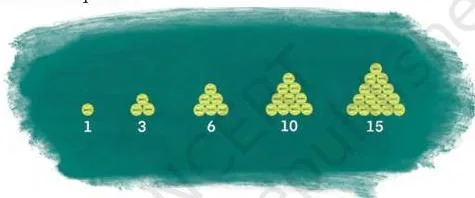
Each triangular number is a running sum of natural numbers: \( 3 = 1+2 \), \( 6 = 1+2+3 \), \( 10 = 1+2+3+4 \). Fig. 8.1 shows this as triangular arrays of dots — every row adds one more dot, so the fifth triangular number, 15, is \( 1+2+3+4+5 \).
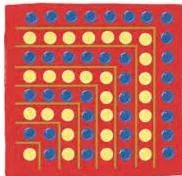
Square numbers hide a parallel pattern: \( 4 = 1+3 \), \( 9 = 1+3+5 \), \( 16 = 1+3+5+7 \). Each square is the sum of consecutive odd numbers, and Fig. 8.2 makes the pairing visible.
The chapter’s notation connects a term to its position: \( t_1 \) is the first term, \( t_2 \) the second, and \( t_n \) the term in the \( n \)th position. For the odd numbers, \( t_1 = 1 \), \( t_2 = 3 \), \( t_3 = 5 \). If you work with several sequences at once, use different letters — \( s_1, s_2, s_3, \dots \) for one, \( u_1, u_2, u_3, \dots \) for another.
One caveat the book stresses: \( n \) is always a non-negative integer, but the term itself can be negative, a fraction, or any real number, as in \( 1, \frac{1}{2}, \frac{1}{3}, \frac{1}{4}, \dots \) or \( -7, -3, 1, 5, 9, \dots \). (NCERT, §8.1)
Explicit Rule vs Recursive Rule: The Two Ways to Define a Sequence
The chapter is built around a choice: how do you write the rule of a sequence? An explicit formula gives any term directly from its position \( n \). A recursive rule gives the next term from one or more earlier terms. Both can describe the same sequence, but they ask different questions.
Explicit rule: value from position
Take \( u_n = 4n + 1 \). Substituting \( n = 1, 2, 3, \dots \) gives \( 5, 9, 13, 17, \dots \), the sequence the rule defines. The payoff of an explicit formula is that you can jump to any term directly: the 25th term is \( u_{25} = 4(25)+1 = 101 \), with no earlier term needed. (NCERT, §8.2) The same formula answers “is this number a term?” — the check-and-position method the chapter uses throughout. Is 89 in the sequence?
Solve \( 4n + 1 = 89 \), getting \( 4n = 88 \), so \( n = 22 \). Since 22 is a natural number, 89 is the 22nd term.
Is 120 in the sequence? Then \( 4n + 1 = 120 \) gives \( 4n = 119 \), so \( n = 29.75 \) — not a natural number. That fractional \( n \) is the proof that 120 does not appear: a term position is always a natural number.
Recursive rule: next term from previous terms
A recursive rule needs a starting term plus a recipe for the next term. For \( t_1 = 2 \) and \( t_n = 2t_{n-1} + 1 \):
\[ t_2 = 2(2) + 1 = 5, \quad t_3 = 2(5) + 1 = 11, \quad t_4 = 2(11) + 1 = 23 \]
giving the sequence 2, 5, 11, 23, …. You cannot jump to \( t_{50} \) here without first computing the 49 terms before it — each step depends on the previous one. (NCERT, §8.3)
The Virahānka–Fibonacci sequence
Recursive rules can reach further back. The best-known example uses the previous two terms: \( V_1 = 1 \), \( V_2 = 2 \), and \( V_n = V_{n-1} + V_{n-2} \), producing 1, 2, 3, 5, 8, 13, 21, 34, ….
NCERT names it the Virahānka–Fibonacci sequence: Virahānka first wrote it down in the 7th century CE while studying Prakrit metre in his work Vṛttajātisamuchaya, Gopāla and Hemachandra studied it around 1135–1150 CE, and Fibonacci took it up around 1200 CE.
Worked problem. Start from the recursive rule \( t_1 = 4 \), \( t_n = t_{n-1} + 5 \). The terms are 4, 9, 14, 19, 24, …. To find which term equals 54, convert to an explicit rule: each step adds 5, so \( t_n = 4 + (n-1)\times 5 = 5n – 1 \). Solving \( 5n – 1 = 54 \) gives \( n = 11 \), so 54 is the 11th term. Now try 53: \( 5n – 1 = 53 \) gives \( 5n = 54 \), so \( n = 10.8 \).
Since 10.8 is not a natural number, 53 is not a term of this sequence.
Arithmetic Progressions: The nth Term and the Visual Story
An arithmetic progression (AP) is the sequence you get by adding the same number over and over. The number added is the common difference \( d \), and the starting value is the first term \( a \).
So the general form is \( a, a+d, a+2d, a+3d, \dots, a+(n-1)d \), and the nth term is \( t_n = a + (n-1)d \). Why \( (n-1) \) and not \( n \)? Because the first term is \( a \) itself — no \( d \) added yet. You add \( d \) exactly \( n-1 \) times to walk from the first term to the nth.
The test \( n = 1 \) checks it: \( t_1 = a + 0\times d = a \). (NCERT, §8.4) The common difference can be negative, and a decreasing sequence is still a perfectly good AP. The book’s example 11, 7, 3, −1, −5, … has \( a = 11 \) and \( d = -4 \).
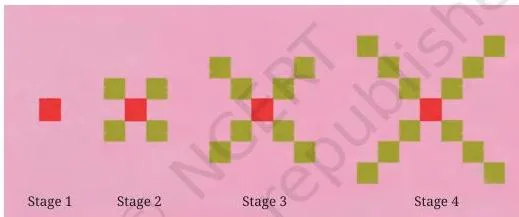
The growing pattern of squares in Fig. 8.3 is how the chapter introduces APs. Stage 1 has 1 square; every later stage adds 4 squares at the corners. The counts are 1, 5, 9, 13, and the nth stage has \( t_n = 1 + (n-1)\times 4 = 4n – 3 \) squares.
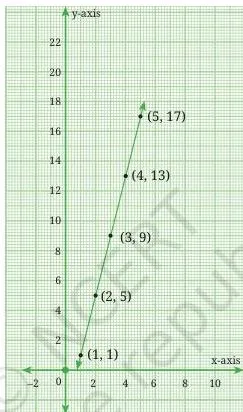
Now pair each stage number with its count: (1, 1), (2, 5), (3, 9), (4, 13), (5, 17). Fig. 8.4 plots these ordered pairs, and all five points lie on a straight line. That line is the visual signature of an AP: equal steps forward in the stage number give equal jumps in the count. (NCERT, §8.4.1)
An AP can also be written recursively: \( t_1 = a \), \( t_n = t_{n-1} + d \) for \( n \geq 2 \).
Worked example (original numbers). A plumber charges a ₹150 call-out fee plus ₹60 per hour. The total fares after 1, 2, 3, … hours are 210, 270, 330, 390, … — an AP with \( a = 210 \) and \( d = 60 \). The charge for 8 hours is \[ t_8 = 210 + (8-1)\times 60 = 210 + 420 = 630 \]
so 8 hours costs ₹630. Written differently, \( 150 + 60n \) is the same rule with the call-out fee separated from the hourly rate.
Sum of the First n Natural Numbers: The Reverse-and-Add Trick
Can you add the numbers 1 to 10 without adding them one at a time? The chapter’s trick is to write the sum twice, once forwards and once backwards, and then add the two lines.
Let \( S = 1 + 2 + 3 + \dots + 10 \). Reversed, \( S = 10 + 9 + 8 + \dots + 1 \). The first column gives \( 1 + 10 = 11 \), the second \( 2 + 9 = 11 \), and so on — ten columns, each summing to 11. So \( 2S = 10 \times 11 = 110 \), giving \( S = 55 \).
The same pairing works for any \( n \):
\[ S = 1 + 2 + \dots + n, \quad S = n + (n-1) + \dots + 1 \]
\[ 2S = n(n+1), \quad \text{so} \quad S_n = \frac{n(n+1)}{2} \]
Fig. 8.5 is the picture behind the formula. Two copies of \( 1+2+3+4+5+6 \) sit above and below a zigzag partition, and together they fill a \( 7 \times 6 \) rectangle — so \( 2 \times (1+2+3+4+5+6) = 7 \times 6 \).
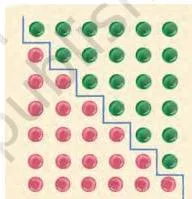
Original shortcut example. The sum of consecutive numbers from 15 to 40 is \( S_{40} – S_{14} \):
\[ S_{40} – S_{14} = \frac{40 \times 41}{2} – \frac{14 \times 15}{2} = 820 – 105 = 715 \]
The book ties this back to Section 8.1: the nth triangular number is exactly the sum of the first n natural numbers, so \( t_n = \frac{n(n+1)}{2} \) — the 10th triangular number is 55.
NCERT also records that the first known written mention of this result appears in Āryabhaṭa’s Āryabhaṭīya, which describes it as the average of the first and last terms multiplied by the number of terms. (NCERT, §8.5)
Geometric Progressions: Multiplying Instead of Adding
An AP adds a fixed number; a geometric progression (GP) multiplies by a fixed number. That fixed multiplier is the common ratio \( r \), and the starting value is the first term \( a \).
The general form is \( a, ar, ar^2, ar^3, \dots, ar^{n-1} \), and the nth term is \( t_n = ar^{n-1} \). You multiply by \( r \) exactly \( n-1 \) times to reach the nth term, in the same way you add \( d \) exactly \( n-1 \) times in an AP. (NCERT, §8.6) The growing pattern of green squares in Fig. 8.6 doubles at every stage: 3, 6, 12, 24.
So \( t_n = 3 \times 2^{n-1} \), and the recursive rule is \( t_1 = 3 \), \( t_n = 2t_{n-1} \). Compare this with Fig. 8.3: that pattern added a fixed 4 each stage (an AP), while this one multiplies by 2 each stage (a GP).
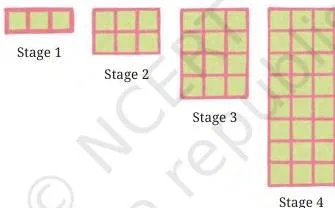
To test whether a sequence is a GP, divide each term by the one before it. For 2, 10, 50, 250, the ratios are \( \frac{10}{2} = 5 \), \( \frac{50}{10} = 5 \), \( \frac{250}{50} = 5 \) — constant, so it is a GP with \( a = 2 \), \( r = 5 \), and \( t_n = 2 \times 5^{n-1} \).
The sequence 1, 4, 9, 16 fails the test: the ratios \( \frac{4}{1} = 4 \), \( \frac{9}{4} \), \( \frac{16}{9} \) are all different. Subtracting consecutive terms tests an AP; dividing them tests a GP.
The graphs make the difference unforgettable. Plotting the points from the GP table — (1, 3), (2, 6), (3, 12), (4, 24), (5, 48) — gives Fig. 8.9, where the points curve upward instead of lying on a straight line. Fig. 8.4 was a line; Fig. 8.9 is a curve. Adding a constant produces a line; multiplying by a constant produces a curve.
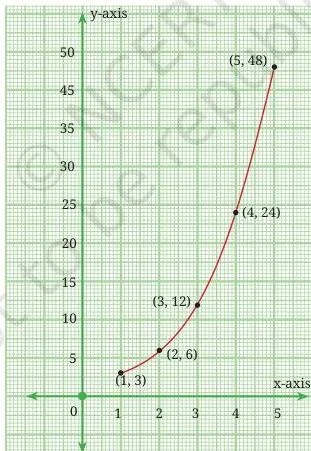
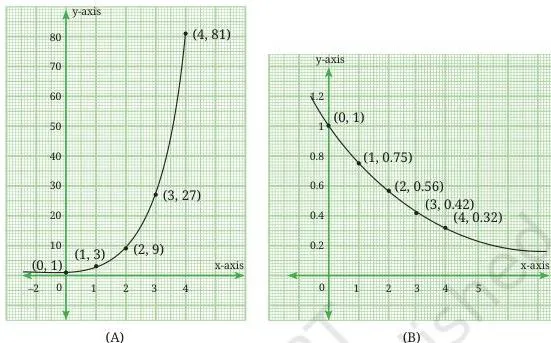
Fig. 8.10 shows both behaviours at once for the Sierpiński triangle. Graph A plots stage number against the number of black triangles, and the values shoot upward. Graph B plots stage number against the black area, and the values sink toward 0. Both are GPs — one growing, one shrinking.
Worked example (original numbers). A ball dropped from 36 m rebounds to \( \frac{2}{3} \) of its previous height each time. The maximum heights after successive bounces are \( 36 \times \frac{2}{3} = 24 \) m, \( 24 \times \frac{2}{3} = 16 \) m, \( 16 \times \frac{2}{3} = \frac{32}{3} \) m, \( \frac{32}{3} \times \frac{2}{3} = \frac{64}{9} \) m.
These form a GP with first term 24 and common ratio \( \frac{2}{3} \), so the height after the nth bounce is \( t_n = 24 \times \left(\frac{2}{3}\right)^{n-1} \) metres. NCERT’s own bouncing-ball example, Fig. 8.11, works the same way with a ball that keeps \( \frac{3}{4} \) of its height.
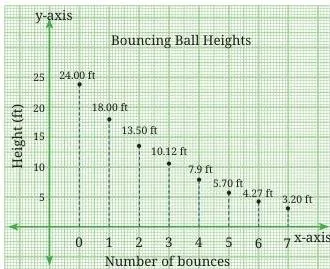
The table below puts the two progressions side by side — this is the contrast the chapter is built around.
| Feature | Arithmetic progression | Geometric progression |
|---|---|---|
| Operation | add the same \( d \) each time | multiply by the same \( r \) each time |
| General form | \( a, a+d, a+2d, \dots \) | \( a, ar, ar^2, \dots \) |
| nth term | \( t_n = a + (n-1)d \) | \( t_n = ar^{n-1} \) |
| Membership test | subtract: differences constant | divide: ratios constant |
| Graph shape | straight line (Fig. 8.4) | curve (Fig. 8.9) |
| Typical example | 1, 5, 9, 13, 17, … | 3, 6, 12, 24, 48, … |
Fractals: Where Sequences Meet Geometry
Fractals belong in a sequences chapter because every stage of a fractal is made by repeating one simple rule — so the stages form sequences you can predict. A fractal is a shape that repeats itself at different scales: zoom into part of it and the part resembles the whole.
Start with an equilateral triangle (Stage 0). Join the midpoints of its three sides to form four smaller triangles and remove the central one — that is Stage 1, a triangle with a triangular hole. Repeat the same step on every remaining black triangle to get Stage 2, then Stage 3, and so on forever.
The result is the Sierpiński triangle, one of the earliest and most famous fractals. (NCERT, §8.6.1)
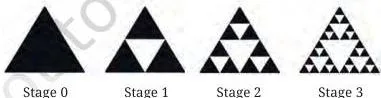
The two sequences hiding inside Fig. 8.7 pull in opposite directions. The black-triangle count multiplies by 3 at every stage: 1, 3, 9, 27, 81, 243, …. Since \( 1 = 3^0 \), \( 3 = 3^1 \), \( 9 = 3^2 \), the count at stage \( n \) is \( t_n = 3^n \).
The black area does the reverse: each stage keeps only \( \frac{3}{4} \) of the previous black region, so the areas are \( 1, \frac{3}{4}, \left(\frac{3}{4}\right)^2, \dots \), a GP with formula \( s_n = \left(\frac{3}{4}\right)^n \). The number of triangles explodes while the total area approaches 0.
| Stage \( n \) | 0 | 1 | 2 | 3 | 4 | 5 | … | \( n \) |
|---|---|---|---|---|---|---|---|---|
| Black triangles | \( 1 = 3^0 \) | \( 3 = 3^1 \) | \( 9 = 3^2 \) | \( 27 = 3^3 \) | \( 81 = 3^4 \) | \( 243 = 3^5 \) | … | \( 3^n \) |
| Black area | 1 | \( \frac{3}{4} \) | \( \left(\frac{3}{4}\right)^2 \) | \( \left(\frac{3}{4}\right)^3 \) | \( \left(\frac{3}{4}\right)^4 \) | \( \left(\frac{3}{4}\right)^5 \) | … | \( \left(\frac{3}{4}\right)^n \) |
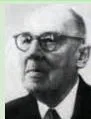
Wacław Sierpiński (1882–1969), the Polish mathematician who created the gasket, is one of the pioneers of fractal geometry.
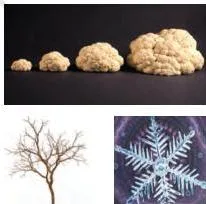
Fractals are not just a classroom construction. NCERT points to broccoli, cauliflower, snowflakes, coastlines and the branching of trees (Fig. 8.8) as shapes that repeat the same pattern at smaller and smaller scales — simple rules producing very complex designs.
The Sierpiński square carpet (Fig. 8.12) runs the same two sequences in parallel, and it is the subject of Question 7 of Exercise Set 8.3. Stage 0 is one red square. In Stage 1, trisect the sides to cut the square into a \( 3 \times 3 \) grid of nine squares, then remove the centre square — 8 red squares remain.
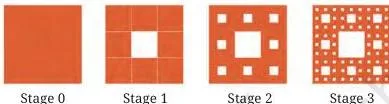
Repeating on each of the eight squares gives Stage 2 with 64, Stage 3 with 512, and so on. The counts 1, 8, 64, 512, … form a GP with \( r = 8 \): stage \( n \) has \( 8^n \) red squares. The red area follows \( 1, \frac{8}{9}, \left(\frac{8}{9}\right)^2, \dots \), a GP with \( r = \frac{8}{9} \) that shrinks toward 0. Count up, area down — the same signature as the triangle.
Try the chapter’s own Think and Reflect challenge: predict Stages 4 and 5 of the Sierpiński triangle before drawing them. The formula \( t_n = 3^n \) gives 81 and 243 without counting a single triangle.
Key Formulas at a Glance
These are the formulas the chapter’s summary lists. Use this table for last-minute checks.
| Concept | Rule | Meaning of the symbols |
|---|---|---|
| Sequence notation | \( t_1, t_2, t_3, \dots, t_n \) | subscript = position; \( t_1 \) is the first term |
| Explicit formula | \( t_n \) computed from \( n \) | gives any term directly from its position |
| Recursive formula | \( t_n \) from earlier terms | needs the previous term(s) first |
| Triangular numbers / sum of first n naturals | \( t_n = S_n = \frac{n(n+1)}{2} \) | 1, 3, 6, 10, 15, …; pairs sum to \( n+1 \) |
| AP general form | \( a, a+d, a+2d, \dots \) | \( a \) = first term, \( d \) = common difference |
| AP nth term | \( t_n = a + (n-1)d \) | add \( d \) exactly \( n-1 \) times |
| GP general form | \( a, ar, ar^2, \dots \) | \( r \) = common ratio |
| GP nth term | \( t_n = ar^{n-1} \) | multiply by \( r \) exactly \( n-1 \) times |
| Sierpiński triangle | count \( = 3^n \), area \( = \left(\frac{3}{4}\right)^n \) | \( n \) = stage number, starting at Stage 0 |
| Sierpiński square carpet | count \( = 8^n \), area \( = \left(\frac{8}{9}\right)^n \) | \( n \) = stage number |
Common Mistakes to Avoid in This Chapter
These six mistakes are the ones this chapter’s material almost invites. Name them now and you will not make them tonight.
| Mistake | Correct rule | How to check your answer |
|---|---|---|
| “Every sequence must have a rule.” | The primes 2, 3, 5, 7, 11, … show no predictable pattern — some sequences simply have no simple rule. | Ask: can I write one formula that produces every term? If not, there is no rule to find. |
| Reading \( t_n = a + (n-1)d \) as \( a + nd \). | The first term uses no \( d \); you add \( d \) only \( n-1 \) times. | Put \( n = 1 \): the formula must return exactly \( a \). |
| Forgetting that \( d \) can be negative. | 11, 7, 3, −1, −5, … is an AP with \( d = -4 \). | Subtract consecutive terms; a constant negative difference is still an AP. |
| Testing a GP by subtracting. | Divide each term by the previous one; a constant ratio means a GP. | Check \( \frac{t_2}{t_1} = \frac{t_3}{t_2} = \dots \) — all equal. |
| Accepting a fractional \( n \) as a position. | Solving \( t_n = \text{number} \) must give a natural number \( n \), or the number is not a term. | Finish with “\( n \) is / is not a natural number” — the test is the last line of working. |
| Expecting the Sierpiński area to grow with the count. | Each stage keeps only \( \frac{3}{4} \) of the region, so the area shrinks toward 0. | Track both sequences at once: count \( \times 3 \), area \( \times \frac{3}{4} \). |
How to Use This Chapter for Exams
The exercise sets reveal the question types this chapter expects, so practise the set that targets your weakest skill. The table maps each set to what it tests. No marks or question predictions are implied — the official CBSE syllabus decides what is examinable.
| Exercise set | Skills it tests | Sample question types |
|---|---|---|
| Exercise Set 8.1 | Generating terms from explicit rules, checking whether a number is a term, finding positions; recursive rules using one or three previous terms | First five terms of \( t_n = 3n – 4 \); is 97 a term of \( t_n = 5n – 3 \)?; which term is 607?; \( T_n = T_{n-1} + T_{n-2} + T_{n-3} \) |
| Exercise Set 8.2 | AP nth term, “which term is −81?”, word problems (salary, marbles), sums of natural numbers | 10th and 26th terms of 3, 8, 13, …; AP with 3rd term 12 and last term 106; 2-digit numbers divisible by 3; marbles in 25 rows |
| Exercise Set 8.3 | GP nth term, “which term is 4374?”, bouncing-ball problems, fractal counting | 12th term given the 8th is 192; GP 2, 6, 18, …; ball from 80 m at 60%; red squares of the Sierpiński square carpet |
| End-of-Chapter Exercises | Mixed AP/GP reasoning: two equations for \( a \) and \( d \), divisibility counts, consecutive-number sums, bacteria growth, proving terms in GP | 31st term from the 11th and 16th; three-digit numbers divisible by 7; all ways to write 100 as consecutive natural numbers |
One skill transfers across every set: the “is this a term?” check. Solve the explicit rule for \( n \), then verify that \( n \) is a natural number. It appears in all three exercise sets in different disguises, and it is the final step students most often drop.
If you are revising more of the subject, the Class 9 Mathematics notes, the Class 9 study notes index and the main CBSE notes hub group the chapters by topic. The same prediction idea returns in the Class 9 chapter The Mathematics of Maybe: Introduction to Probability.
Revision Summary: What to Remember Tonight
From the chapter’s own summary, in shorter words:
- A sequence is an ordered list of numbers; each number is a term.
- An explicit formula uses the position \( n \) to give the term directly; a recursive formula builds each term from previous terms.
- Triangular numbers 1, 3, 6, 10, 15, … have \( t_n = \frac{n(n+1)}{2} \), the same expression as the sum of the first n natural numbers.
- An AP adds a fixed common difference \( d \): general form \( a, a+d, a+2d, \dots \), nth term \( t_n = a + (n-1)d \).
- A GP multiplies by a fixed common ratio \( r \): general form \( a, ar, ar^2, \dots \), nth term \( t_n = ar^{n-1} \).
- Fractal attributes — the Sierpiński triangle and the Sierpiński square carpet — lead to geometric progressions in count and area.
Sources and Data Verification
This listing is maintained for the 2026-27 academic session using the NCERT textbook information available to us. NCERT remains the authority for confirming the latest edition.
The facts on this page come from the NCERT textbook Ganita Manjari, Grade 9, Part I (Mathematics), Chapter 8, official NCERT edition — the same edition linked in the PDF download above. This page covers Chapter 8 only and is maintained for the current academic session using the NCERT information available to us.
NCERT settles textbooks, editions and the official PDFs on ncert.nic.in. CBSE settles the curriculum, syllabus and examinations. A textbook chapter and the examinable syllabus are not always identical, so check the current official CBSE syllabus for what is examinable this session.
| What the chapter holds | Count | Where it is used |
|---|---|---|
| Printed pages | 27 | |
| Sections in the chapter | 9 | |
| Figures with NCERT captions | 13 | |
| Tables | 4 | |
| Exercise questions | 19 | answered in our NCERT Solutions |
| Official NCERT PDF | Download the chapter PDF | the chapter exactly as NCERT publishes it |
Reference: NCERT Class 9 Mathematics textbook, chapter 8, official edition on ncert.nic.in.
Frequently Asked Questions
What is the difference between an explicit rule and a recursive rule for a sequence?
An explicit rule like \( u_n = 4n + 1 \) gives any term directly from its position \( n \), so you can find the 100th term without knowing the 99th. A recursive rule like \( t_1 = 2 \), \( t_n = 2t_{n-1} + 1 \) builds each term from the previous one, so you must compute the terms in order.
How do I check whether a number is a term of a sequence?
Set the explicit formula equal to the number and solve for \( n \). If \( n \) is a natural number, the number is a term at that position; if \( n \) comes out fractional, it is not. For example, \( 4n + 1 = 89 \) gives \( n = 22 \), so 89 is the 22nd term, while \( 4n + 1 = 120 \) gives \( n = 29.75 \), so 120 is not a term.
What is the formula for the sum of the first n natural numbers, and where does it come from?
The formula is \( S_n = \frac{n(n+1)}{2} \). Write the sum forwards and backwards, pair the columns — each pair totals \( n+1 \), and there are \( n \) pairs — so \( 2S = n(n+1) \). NCERT traces the first written mention of the result to Āryabhaṭa’s Āryabhaṭīya.
How is a geometric progression different from an arithmetic progression?
An AP adds a fixed common difference \( d \), so the nth term is \( a + (n-1)d \) and the graph is a straight line. A GP multiplies by a fixed common ratio \( r \), so the nth term is \( ar^{n-1} \) and the graph curves upward or downward.
What is the Virahānka–Fibonacci sequence, and why is it named that?
It is the sequence 1, 2, 3, 5, 8, 13, 21, 34, …, where each term is the sum of the previous two. It carries both names because Virahānka first wrote it down in the 7th century CE while studying Prakrit metre, and Fibonacci studied it around 1200 CE, with Gopāla and Hemachandra in between.
Why does the Sierpiński triangle give both a growing sequence and a shrinking sequence?
One construction produces two different GPs. The number of black triangles multiplies by 3 each stage — 1, 3, 9, 27, … — because every black triangle is replaced by three smaller ones. The black area multiplies by \( \frac{3}{4} \) each stage — \( 1, \frac{3}{4}, \left(\frac{3}{4}\right)^2, \dots \) — because each stage removes one of every four pieces.
Explore Class 9 Mathematics Books
- Previous: The Mathematics of Maybe: Introduction to Probability
Related chapters:
- Orienting Yourself: The Use of Coordinates
- Introduction to Linear Polynomials
- The World of Numbers