
Measuring Space: Perimeter and Area Class 9 is Chapter 6 of the NCERT Class 9 Mathematics book, Ganita Manjari, Part I. It covers perimeters, the constant circumference-to-diameter ratio \( \pi \), arc length, and areas from rectangles to sectors of a circle. The official chapter PDF is right here, with a section-by-section guide below it.
Open the Measuring Space: Perimeter and Area Class 9 chapter PDF — the official NCERT file published on ncert.nic.in, identical to the chapter in the printed Ganita Manjari book. Keep the PDF open while you use the guide on this page.
Chapter 6 at a glance
Use this section to orient yourself inside the file before reading. The table on this page lists how much of each kind of content the chapter holds — sections, figures, worked examples and exercise questions — so you can see the chapter’s shape at a glance.
The order of ideas runs like this:
- Perimeter of straight shapes — square, rectangle, triangle (Section 6.1).
- The circumference-to-diameter ratio \(C/D\), the story of \( \pi \), and why \( \pi \) is irrational (Sections 6.2–6.3).
- Arc length as a fraction of a full turn, applied to a 400 m athletics track (Section 6.4).
- Area of a rectangle, a parallelogram and a triangle, then Heron’s formula and Brahmagupta’s formula (Sections 6.6–6.8).
- Baudhāyana’s construction for squaring a rectangle (Section 6.9).
- Area of a circle, then sectors and segments (Sections 6.10–6.10.1).
Three exercise sets — Exercise Set 6.1, Exercise Set 6.2 and Exercise Set 6.3 — sit inside the chapter, and a final block of end-of-chapter exercises closes it. This chapter teaches mainly through figures and proofs rather than through tables, so expect to read carefully, not just skim.
What Measuring Space: Perimeter and Area Class 9 covers
This section is a route map in the order the book presents it. When you are stuck on one idea, you can see what leads into it and where it lives.
The relay race question that opens the chapter
The chapter opens with a photograph of a 4 × 100 m relay start (Fig. 6.1). Outer-lane runners begin ahead of inner-lane runners even though the finish line is the same. The distance between the starting points of adjacent lanes is called the stagger.
The reason is perimeter. On the straights every runner covers the same distance, but outer lanes sit on curves with larger radii, so their curved portions are longer. Moving the starting line forward compensates for that extra curve; the stagger question is the circumference question in disguise.
The first Think and Reflect asks whether a 200 m school track needs a smaller stagger than a 400 m track. You can answer it only with the perimeter of a circle, which is why the chapter goes straight from the relay to the \(C/D\) ratio.
The story of pi told inside the chapter
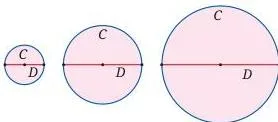
Section 6.2 asks one question: is the ratio of circumference \(C\) to diameter \(D\) the same for every circle? The answer is yes, and the chapter tells how that constant was pursued across civilisations before Mādhava captured it exactly as an infinite series.
| Mathematician / culture | Value used | What matters about it |
|---|---|---|
| Mesopotamia, c. 1900 BCE | \(3 + \frac{1}{8} = 3.125\) | The first recorded move beyond the integer 3. |
| Archimedes, 250 BCE | \(3\frac{10}{71} \lt \pi \lt 3\frac{1}{7}\) | Trapped \( \pi \) between inscribed and circumscribed 96-gons. |
| Ptolemy, c. 150 CE | \(\frac{377}{120} \approx 3.14167\) | Refined value for astronomical tables. |
| Zu Chongzhi, 480 CE | \(\frac{22}{7}\) and \(\frac{355}{113}\) | \(\frac{355}{113}\) stayed the most accurate value for over 800 years. |
| Āryabhaṭa, 499 CE | \(\frac{62832}{20000} = 3.1416\) | Called it asanna, meaning ‘approaching’ — a hint the exact value is not a simple fraction. |
| Brahmagupta, 628 CE | \(\sqrt{10} \approx 3.1622\) | Chosen for elegance and ease of manipulation in equations. |
| Mādhava of Sangamagrāma | \(\frac{\pi}{4} = 1 – \frac{1}{3} + \frac{1}{5} – \frac{1}{7} + \dots\) | The first exact formula for \( \pi \), given as an infinite series. |
Section 6.3 then warns you about the single most common slip in the chapter: \( \pi \) is an irrational number, so no fraction equals it. In calculations we use \( \pi \approx \frac{22}{7} \), but \( \pi \neq \frac{22}{7} \).
The Fun Fact box gives a way to remember the digits: count the letters in How I wish I could recollect pi to get 3.141592. Since \( \pi \approx 3.14 \), 14 March is Pi Day, and since \( \pi \approx \frac{22}{7} \), 22 July is Pi Approximation Day.
Area formulas: what is revision and what is new
Most of the area formulas are Grade 8 revision, but the book re-proves them because the proofs, not the formulas, are what is new. Rectangles, parallelograms and triangles are all handled by cutting a shape and pasting its pieces into a shape whose area you already know.
- Revision: rectangle \(ab\), parallelogram base × height, triangle \( \frac{1}{2}bh \).
- New: Heron’s formula, Brahmagupta’s formula for a cyclic 4-gon, the arc-length and sector formulas, and the proof that the area of a circle is \( \pi r^2 \).
Section 6.8 ends with a result the book calls a surprise: a median divides a triangle into two equal-area triangles that are not congruent. Equal area means the same amount of surface, not the same shape — keep those separate and many exercise proofs become short.
Brahmagupta’s formula and how it generalises Heron’s
This is the chapter’s most advanced idea, so go slowly. A triangle’s area is fixed by its three sides, but a 4-gon’s area is not fixed by its four sides — Fig. 6.27 shows three rhombuses with sides 3, 3, 3, 3 and different areas.
- Extra information is needed: one angle, one diagonal, or a geometric property.
- The property the book uses is cyclic — all four vertices lie on one circle.
- Brahmagupta’s formula: area \( = \sqrt{(s-a)(s-b)(s-c)(s-d)} \), where \( s = \frac{1}{2}(a+b+c+d) \).
- The book verifies it for a rectangle and for an isosceles trapezium.
- Now the generalisation: set \( d = 0 \) and the 4-gon collapses into a triangle, turning Brahmagupta’s formula into Heron’s formula.
The book frames this as special case and generalisation: a square is a rectangle with \(a = b\), and \((a+b)^2\) is \((a+b+c)^2\) with \(c = 0\). Brahmagupta’s formula generalises Heron’s formula in exactly the same way.
Key concepts and formulas: the chapter’s toolkit
This section collects the formulas the chapter builds, so you can find any one of them without rereading the book. Every symbol is named once; the table is the whole toolkit in one place.
The chapter’s formulas in one table
| Concept | Formula | Section | When to use |
|---|---|---|---|
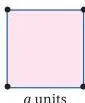
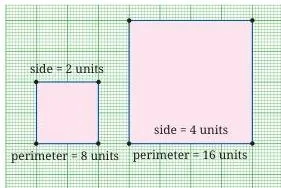
| Perimeter of a square | \(4a\) | 6.1 | Side \(a\); a special case of the rectangle formula with \(a = b\). |
| Perimeter of a rectangle | \(2(a+b)\) | 6.1 | Length \(a\), width \(b\). |
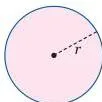
| Circumference of a circle | \(C = 2\pi r = \pi d\) | 6.4 | The perimeter of a circle of radius \(r\) or diameter \(d\). |
| Arc length | \(l = 2\pi r \times \frac{\theta^\circ}{360^\circ}\) | 6.4 | Arc subtends \(\theta^\circ\) at the centre. |
| Area of a rectangle | \(ab\) | 6.6 | Sides \(a\) and \(b\). |
| Area of a parallelogram | base × height \(= bh\) | 6.7 | Base \(b\), perpendicular height \(h\). |
| Area of a triangle | \(\frac{1}{2}bh\) | 6.8 | Base \(b\), height \(h\) known or easy to draw. |
| Heron’s formula | \(\sqrt{s(s-a)(s-b)(s-c)}\), \(s = \frac{1}{2}(a+b+c)\) | 6.8.1 | All three sides known, height unknown. |
| Area by circumradius | \(\frac{abc}{4R}\) | 6.8.1 | \(R\) is the radius of the circle through the three vertices. |
| Area by inradius | \(\frac{r(a+b+c)}{2}\) | 6.8.1 | \(r\) is the radius of the circle touching the three sides. |
| Area of a circle | \(\pi r^2\) | 6.10 | Radius \(r\). |
| Area of a sector | \(\pi r^2 \times \frac{\theta^\circ}{360^\circ}\) | 6.10.1 | Sector subtends \(\theta^\circ\) at the centre. |
| Brahmagupta’s formula | \(\sqrt{(s-a)(s-b)(s-c)(s-d)}\), \(s = \frac{1}{2}(a+b+c+d)\) | after 6.8.1 | A cyclic 4-gon with sides \(a,b,c,d\). |
Circumference, arc length and the fraction of a full turn
One idea sits behind every circle formula in the chapter: an arc is the circumference multiplied by the fraction of a full turn it spans.
- A semicircle is a half-turn: \(\frac{180}{360} = \frac{1}{2}\), so its length is \(2\pi r \times \frac{180}{360} = \pi r\).
- A quarter circle is a quarter-turn: \(\frac{90}{360} = \frac{1}{4}\), so its length is \(2\pi r \times \frac{90}{360} = \frac{\pi r}{2}\).
- Any arc AB subtending \(\theta^\circ\) at the centre has length \(2\pi r \times \frac{\theta}{360}\).
The book reaches these by symmetry, not memorisation: reflection in a diameter swaps the two semicircles (Fig. 6.8), and a quarter-turn rotation swaps the four quarter circles (Fig. 6.9). The \( \pi r \) and \( \pi r/2 \) results are the special cases the exercises reuse constantly.
Area of rectangle, parallelogram and triangle
The straight-edged area formulas are revision, but the median theorem and the circle-based triangle formulas are new.
- Rectangle: \(ab\) sq. units (Section 6.6).
- Parallelogram: base × height. Cutting a copy and sliding the pieces makes a rectangle with the same base and height (Fig. 6.17) — the thin-parallelogram gap is explained in the figure walkthrough below.
- Triangle: \( \frac{1}{2}bh \). Two congruent copies fit together to make a parallelogram, so the triangle is half of it.
- Median theorem: a median divides a triangle into two equal-area triangles that are not congruent (Section 6.8).
The chapter’s Think and Reflect asks whether a parallelogram’s area can be found from its side lengths alone. It cannot, because flexing a parallelogram changes its height while the sides stay fixed. That same idea returns with 4-gons and Brahmagupta’s formula.
Heron’s formula and two circle-based area formulas
Heron’s formula earns its keep when you know all three sides of a triangle but no height. Compute \(s\), the semi-perimeter, first; then substitute. Here is a triangle the book does not use, with sides 13 cm, 14 cm and 15 cm.
- Step 1: Compute the semi-perimeter \(s = \frac{1}{2}(13+14+15) = 21\) cm.
- Step 2: Subtract each side from \(s\): \(21-13=8\), \(21-14=7\), \(21-15=6\).
- Step 3: Apply Heron’s formula:
\[ \text{area} = \sqrt{21 \times 8 \times 7 \times 6} = \sqrt{7056} \]
Final answer: \(\sqrt{7056} = 84\) cm², since \(84^2 = 7056\). The triangle with sides 13 cm, 14 cm, 15 cm has area 84 cm².
Section 6.8.1 also gives two elegant circle-based formulas: area \( = \frac{abc}{4R} \), where \(R\) is the circumradius (the circle through the three vertices), and area \( = \frac{r(a+b+c)}{2} \), where \(r\) is the inradius (the circle touching the three sides). The book says their proofs come in Grade 10, so do not hunt for a proof that is not there.
Area of a circle, sector and segment
Two routes lead to \(A = \pi r^2\), and both are worth knowing because they explain why the same \( \pi \) appears in perimeter and area.
- Archimedes: the circle’s area equals the area of a right triangle with legs equal to the radius and the circumference: \(\frac{1}{2} \times C \times r = \frac{1}{2} \times 2\pi r \times r = \pi r^2\) (Section 6.10).
- Nilakanṭha: cut the circle into thin slices and interleave them into a parallelogram-like shape with base \( \pi r \) and height \(r\), again giving \( \pi r^2 \) (Fig. 6.37).
A sector uses the same fraction idea as arc length: sector area \( = \pi r^2 \times \frac{\theta}{360} \). Here is a quick numeric check the book does not use — a \(90^\circ\) sector of a circle of radius 8 cm:
- Step 1: The sector is \(\frac{90}{360} = \frac{1}{4}\) of the full circle.
- Step 2: Sector area \( = \pi r^2 \times \frac{90}{360} = \frac{3.14 \times 64}{4}\).
\[ \frac{3.14 \times 64}{4} = \frac{200.96}{4} = 50.24\ \text{cm}^2 \]
Final answer: A \(90^\circ\) sector of a circle of radius 8 cm has area approximately 50.24 cm².
Keep sector and segment apart: a sector is bounded by an arc and the two radii at its ends; a segment is bounded by an arc and its chord (Section 6.10.1).
Estimating the C/D ratio at home
The book’s HOME MEASUREMENT is a genuine experiment you can do tonight. Wrap thin thread tightly around a cotton reel 20 times, measure the total length \(L\) and the reel’s diameter \(D\), then compute \(\frac{L}{20D}\).
Thin thread matters because the wrap must follow the circumference closely. Expect a ratio between 3 and 4, usually between 3.1 and 3.2. The book then asks whether the ratio can be found by pure geometry with no measurement at all — that is exactly what the Archimedes hexagon figures do.
Walkthrough of the chapter’s key figures
Each of these diagrams carries an idea the text alone does not make obvious — the book repeatedly asks ‘do you see why?’. Read the caption, then the explanation, then look again at the figure.
Fig. 6.1 and Fig. 6.11: the relay stagger and the 400 m track
Fig. 6.1 shows the staggered starts. The stagger is the distance between the starting points of adjacent lanes, and it continues all the way to the outermost lane.
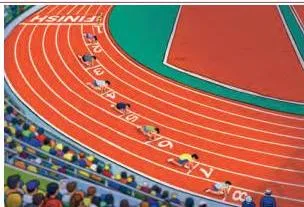
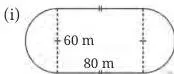
Fig. 6.11 is the schematic the chapter computes with: two straights of 84.39 m each, two semicircular ends with a common centre, innermost radius 36.5 m, and lane width 1.22 m.
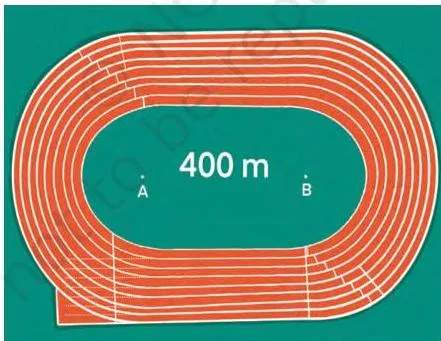
Follow the book’s calculation for a runner 0.3 m from the inner border: straights total \(2 \times 84.39 = 168.78\) m; the two semicircles make one full circle of radius \(36.5 + 0.3 = 36.8\) m; its circumference is \(2 \times 3.1416 \times 36.8 = 231.22\) m; total distance \(168.78 + 231.22 = 400\) m.
Now the stagger: on the straights all lanes are equal, but the lane-2 semicircle has radius \(36.5 + 1.22 + 0.3 = 38.02\) m, so its curve is longer and the starting line must move forward. The book leaves the exact stagger value to the Think and Reflect — you compute it from this figure.
Fig. 6.6 and Fig. 6.7: trapping pi between hexagons
Why does an inscribed hexagon show \( \pi \gt 3\)? A regular hexagon’s side equals the circle’s radius, so its perimeter is \(6r = 3 \times 2r = 3D\). Since the circle’s circumference is larger than the inscribed hexagon’s perimeter, \(C/D \gt 3\).
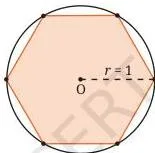
Fig. 6.7 completes the trap: an inscribed hexagon forces \( \pi \gt 3 \), while a circumscribed hexagon forces \( \pi \lt 2\sqrt{3} \approx 3.46\) — the hint is the Baudhāyana–Pythagoras theorem. The value of \( \pi \) is trapped between two known bounds. Repeat the same method with 96-gons and you reach \(3\frac{10}{71} \lt \pi \lt 3\frac{1}{7}\).
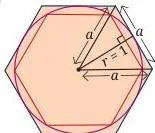
Fig. 6.8 and Fig. 6.10: arcs from symmetry and angle
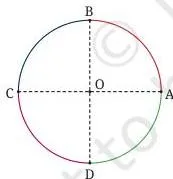
Fig. 6.8 answers ‘what is half a circle’s perimeter?’ by symmetry: reflect the circle in the diameter AB and the red and blue semicircles exchange places, so each has length \(2\pi r \div 2 = \pi r\).
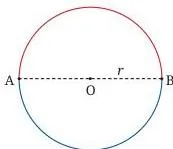
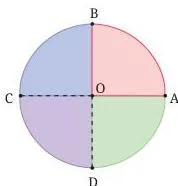
Fig. 6.10 generalises the idea: an arc AB subtending \(\theta^\circ\) at the centre has length \(2\pi r \times \frac{\theta}{360}\). The same rotation argument gives the quarter circle \(\frac{\pi r}{2}\) (Fig. 6.9) from a quarter-turn.
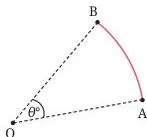
Fig. 6.17 and Fig. 6.19: a parallelogram becomes a rectangle
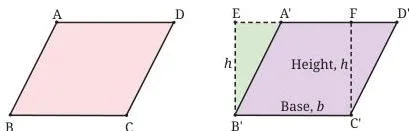
Fig. 6.17 proves area = base × height: a copy A’B’C’D’ of the parallelogram is cut and slid so the two pieces form a rectangle EB’C’F with the same base \(b\) and height \(h\). Different shape, same area.
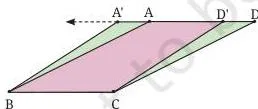
Then the gap. If the parallelogram is thin (Fig. 6.19), the perpendicular from C to AD lands outside the side and the obvious cut fails. The fix: choose D’ on DA and A’ on the extension with A’A = D’D. Then A’BCD’ is a parallelogram, \(\Delta CDD’ \cong \Delta BAA’\), and its area equals that of ABCD.
Repeat this step as many times as needed.
This is the chapter’s clearest ‘the first argument has a hole — here is the patch’ moment, and a common source of confusion.
Fig. 6.20A: a triangle inside a rectangle
Fig. 6.20A encloses the triangle in a rectangle of the same base and height. Split the base as \(b = b_1 + b_2\); the triangle is exactly half of the rectangle, so its area is \(\frac{1}{2}bh\).
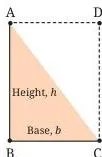
The book flags a gap: for an obtuse triangle the perpendicular falls outside the base (Fig. 6.20B). The same half-rectangle argument still works — enclose the obtuse triangle in a larger rectangle and subtract the extra pieces.
Fig. 6.27: four equal sides, three different areas
Fig. 6.27 is the chapter’s answer to ‘can a formula from side lengths alone give a 4-gon’s area?’. Three rhombuses, all with sides 3, 3, 3, 3, have visibly different areas.
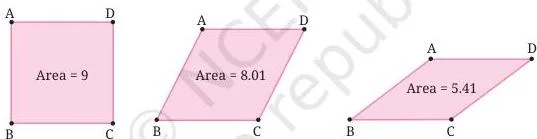
Same perimeter, different shapes, different areas: a Heron-style formula cannot exist for a general 4-gon. You need an angle, a diagonal, or a property — the book chooses cyclic, and that is what makes Brahmagupta’s formula possible. Try it with four rods joined at their ends; the frame collapses and changes area as you flex it.
Fig. 6.30: Baudhāyana squares a rectangle
Section 6.9 gives Baudhāyana’s construction from the Śhulbasūtra (800 BCE): build a square equal in area to a given rectangle ABCD with \(AD = a\), \(AB = b\), where \(a \gt b\). The steps, in the book’s order:
- Locate E on AD so that \(AE = AB\).
- Take F the midpoint of ED.
- Draw square AFGH with side AF, with vertex H on AB produced.
- Draw arc AG with centre H; let it cut BC at K.
- Through K draw a line parallel to AH; let it cut GH at P.
- Draw square HPQS with side HP. It has the same area as rectangle ABCD.
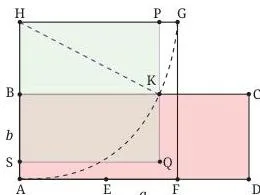
Why it works: \(AE = AB = b\), so \(AF = \frac{AE + AD}{2} = \frac{a+b}{2}\), and \(HG = HK = \frac{a+b}{2}\) because HK is a radius. Then \(BH = AH – AB = AF – AB = \frac{a+b}{2} – b = \frac{a-b}{2}\).
In the right-angled triangle HKP, the Baudhāyana–Pythagoras theorem gives \[ HP^2 = HK^2 – BH^2 = \left(\frac{a+b}{2}\right)^2 – \left(\frac{a-b}{2}\right)^2 = ab. \]
So the square’s area \(HP^2\) equals the rectangle’s area \(ab\). The construction is a geometrical translation of the identity \(\left(\frac{a+b}{2}\right)^2 – \left(\frac{a-b}{2}\right)^2 = ab\).
Fig. 6.36 and Fig. 6.37: two views of the area of a circle
Fig. 6.36 states the shared property: the area of a regular polygon is \(\frac{1}{2} \times\) perimeter \( \times\) the radius of the circle that fits tightly inside it. Archimedes’ thought experiment: as the number of sides grows, the polygon approaches the circle, so the circle’s area is \(\frac{1}{2} \times C \times r = \pi r^2\).
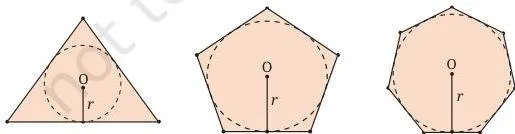
Fig. 6.37 is Nilakanṭha’s visual proof: cut the circle into thin slices, then interleave them into a parallelogram-like shape whose base is half the circumference, \( \pi r \), and whose height is \(r\). The thinner the slices, the closer the shape comes to a true parallelogram — again area \( \pi r^2\).
Together the two arguments show why the same \( \pi \) governs both perimeter and area.
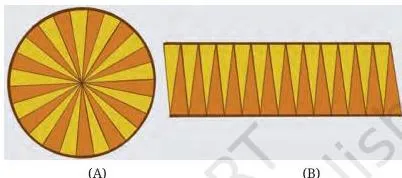
Fig. 6.38, 6.39 and 6.40: sectors from half and quarter discs
Fig. 6.38 is the definition of a sector: the region bounded by an arc and the two radii containing its endpoints.
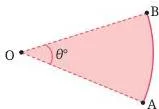
Fig. 6.39: by reflection symmetry, the semicircular disc is \(\frac{180}{360} = \frac{1}{2}\) of the circle, so its area is \(\frac{1}{2}\pi r^2\).
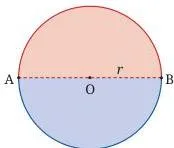
Fig. 6.40: by quarter-turn symmetry, the quarter disc is \(\frac{90}{360} = \frac{1}{4}\), so its area is \(\frac{1}{4}\pi r^2\). Generalising gives the sector formula \(\pi r^2 \times \frac{\theta}{360}\).
The related segment — the region bounded by an arc and its chord — is what the exercises mean when they ask for a segment area: a sector minus the triangle inside it (Exercise Set 6.3 Q5).
Definitions to get exactly right
This chapter introduces a cluster of terms that sound similar — circumference, arc, sector, segment, cyclic — and the exercises test whether you keep them separate.
- Perimeter — the total length around a shape’s border (Section 6.1).
- Circumference — the perimeter of a circle (Section 6.2).
- \(C/D\) ratio, \( \pi \) — the constant ratio of circumference to diameter, the same for every circle (Section 6.2).
- Irrational number — a number that cannot be written as a ratio of two integers; \( \pi \) is one (Section 6.3).
- Semi-perimeter \(s\) — half the perimeter, used by Heron’s formula (Section 6.8.1).
- Arc — a part of a circle (Section 6.4).
- Sector — the region bounded by an arc and the two radii at its ends (Section 6.10.1).
- Segment — the region bounded by an arc and its chord (Section 6.10.1).
- Median — the segment from a vertex to the midpoint of the opposite side (Section 6.8).
- Cyclic 4-gon — a quadrilateral whose four vertices lie on one circle (Brahmagupta’s formula box).
- Circumcircle — the unique circle through a triangle’s three vertices (Section 6.8.1).
- Incircle — the unique circle that touches a triangle’s three sides (Section 6.8.1).
- Squaring a shape — constructing a square equal in area to the shape (Section 6.9).
- Stagger — the distance between the starting points of adjacent lanes on a track (chapter opening).
Common mistakes students make in this chapter
Every mistake below comes from a place where the chapter itself warns you. Fix them now and the exercises stop leaking marks.
| Mistake | Correct rule | How to check your answer |
|---|---|---|
| Writing \( \pi = \frac{22}{7} \) | \( \pi \) is irrational: write \( \pi \approx \frac{22}{7} \) and \( \pi \neq \frac{22}{7} \) (Section 6.3). | Does your working treat \(\frac{22}{7}\) as exact? If the question says ‘use \(\frac{22}{7}\)’, say ‘taking \( \pi \approx \frac{22}{7}\)’. |
| Dropping \(\frac{\theta}{360}\) from arc length or sector area | Arc \( = 2\pi r \times \frac{\theta}{360} \); sector \( = \pi r^2 \times \frac{\theta}{360} \). | Is your answer smaller than the full circle? A semicircle must give \(\frac{180}{360} = \frac{1}{2}\). |
| Using the perimeter instead of the semi-perimeter in Heron’s formula | Compute \(s = \frac{1}{2}(a+b+c)\) first. | Check that \(s\) is half the perimeter and that each \(s – \text{side}\) is positive. |
| Treating equal-area triangles as congruent | The median theorem gives equal areas from differently shaped halves (Section 6.8). | If the question asks only for area, congruence is not needed. |
| Assuming a 4-gon’s area follows from its sides | Fig. 6.27 shows three areas from sides 3, 3, 3, 3; use Brahmagupta only for a cyclic 4-gon. | If only side lengths are given, check for an angle, a diagonal, or a cyclic condition. |
| Confusing sector with segment | Sector = arc + two radii; segment = arc + chord (Section 6.10.1). | Which boundary does the question name — radii or chord? |
| Clock-angle mistakes | 60 minutes sweep \(360^\circ\), so 10 minutes sweep \(\frac{10}{60} \times 360 = 60^\circ\). | Take the minutes as a fraction of an hour, then multiply by \(360^\circ\). |
Using Exercise Sets 6.1–6.3 and the end-of-chapter problems
This section maps the chapter’s own exercises to the skills they test, so you can practise on purpose rather than in order.
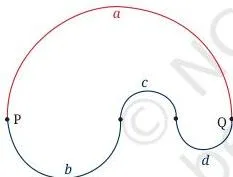
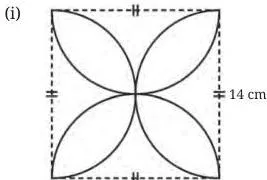
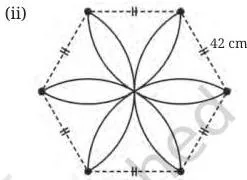
- Exercise Set 6.1 drills circumference, radius from circumference, arc length, the perimeter of a sector, compound arc shapes (quarter, half, three-quarter circles), car-tyre revolutions, flower-petal perimeters, and the ratio of perimeters to radii. Q2 asks for answers correct to 3 significant figures.
- Exercise Set 6.2 drills areas: a triangle inside a figure, a trapezium whose parallel sides are known, triangles best solved by Heron’s formula, rhombus diagonals, and proof-type questions built on the median theorem and equal-area arguments.
- Exercise Set 6.3 drills sector areas, quadrants, the area swept by a clock’s minute hand, and minor/major sectors and segments. The starred questions (marked *) prove results about an inscribed equilateral triangle, square and hexagon.
- End-of-chapter exercises mix area models of algebra identities, isosceles-triangle area problems, wheel revolutions, the trapezium and kite formulas, scaling (doubling every side quadruples the area), and shaded-region proofs.
Every exercise set carries the same standing instruction: unless stated otherwise, use \(\frac{22}{7}\) for \( \pi \). The starred questions are the hardest — segments, inscribed shapes and shaded regions. One caution: textbook contents and the examinable syllabus are not always identical, so check the current official CBSE syllabus before deciding what to skip.
One-page recap of the chapter’s results
The chapter closes with its own CHAPTER SUMMARY; here is the same list in plainer words. Use it as a last-pass checklist.
- \( \pi \) is the constant circumference-to-diameter ratio for every circle, approximately \(\frac{22}{7}\) or 3.14.
- Circumference: \(C = 2\pi r\).
- Arc length: \(l = 2\pi r \times \frac{\theta^\circ}{360^\circ}\), where \(\theta\) is the central angle.
- Area of a triangle: \(\frac{1}{2} \times\) base × height.
- Heron’s formula: area \( = \sqrt{s(s-a)(s-b)(s-c)}\), with \(s = \frac{1}{2}(a+b+c)\).
- Area of a circle: \(A = \pi r^2\).
- Area of a sector: \(\pi r^2 \times \frac{\theta^\circ}{360^\circ}\).
- Brahmagupta’s formula: area \( = \sqrt{(s-a)(s-b)(s-c)(s-d)}\), with \(s = \frac{1}{2}(a+b+c+d)\), for a cyclic 4-gon.
- \( \pi \) is irrational.
- Key historical values: Archimedes \(3\frac{10}{71} \lt \pi \lt 3\frac{1}{7}\); Zu Chongzhi \(\frac{355}{113}\); Āryabhaṭa 3.1416; Mādhava \( \pi = 4\left(1 – \frac{1}{3} + \frac{1}{5} – \frac{1}{7} + \cdots\right)\).
- Median theorem: a median divides a triangle into two equal-area triangles that are not congruent.
Related chapters and official resources
This listing is maintained for the 2026-27 academic session using the NCERT textbook information available to us. NCERT remains the authority for confirming the latest edition.
Continue with the rest of the book, or go to the official source for the complete set of Class 9 textbooks.
If you are revising the whole book, start at the Class 9 Mathematics page or the Class 9 hub. This chapter follows on from the previous chapter and leads into the next chapter; the CBSE Class 9 notes index is the fastest way to any chapter.
The current official editions are published on the NCERT textbook portal, where you can verify the chapter numbering and download every book PDF directly. Remember that textbook contents and the examinable syllabus are not always identical — check the current official CBSE syllabus.
| What the chapter holds | Count | Where it is used |
|---|---|---|
| Printed pages | 37 | |
| Sections in the chapter | 12 | |
| Figures with NCERT captions | 44 | |
| Exercise questions | 25 | answered in our NCERT Solutions |
| Official NCERT PDF | Download the chapter PDF | the chapter exactly as NCERT publishes it |
Reference: NCERT Class 9 Mathematics textbook (Ganita Manjari, Part I), chapter 6, official edition on ncert.nic.in.
Sources and data verification
- The figures and descriptions on this page describe Chapter 6 of the NCERT Class 9 Mathematics textbook (Ganita Manjari, Part I), as published by NCERT at ncert.nic.in.
- This page covers only that one chapter of that book; it does not cover other Class 9 subjects or the full CBSE scheme of studies.
- The listing is maintained for the current academic session from the NCERT edition available on the official portal.
- NCERT settles textbook titles, editions and PDFs; CBSE settles the curriculum, syllabus and examinations.
Frequently asked questions
Why do runners in the outer lanes start ahead in a relay race?
The stagger compensates for the longer curves of outer lanes. On the straights every runner covers the same distance, but the lane-2 semicircle has a radius 1.22 m larger than lane 1, so its curved portions are longer. Moving the start forward restores fairness — each runner still covers 400 m. Fig. 6.11 shows the geometry.
Is pi exactly equal to 22/7?
No. Section 6.3 is explicit: \( \pi \) is irrational, so no fraction equals it. Write \( \pi \approx \frac{22}{7} \) and \( \pi \neq \frac{22}{7} \).
What is the difference between a sector and a segment of a circle?
A sector is the region bounded by an arc and the two radii at its ends; a segment is the region bounded by an arc and its chord (Section 6.10.1). Picture a pizza slice for a sector, and the part left when you cut across with a straight chord for a segment.
When should I use Heron’s formula instead of 1/2 × base × height?
Use Heron’s formula when you know all three sides but cannot easily find a height, since it needs only \(s = \frac{1}{2}(a+b+c)\) and the three side lengths. Use \(\frac{1}{2} \times\) base × height when the base and height are known or easy to draw. The book checks both formulas on a 3-4-5 triangle and gets 6 either way.
Why can’t the area of a quadrilateral be found from its four side lengths alone?
Because a 4-gon can flex. Fig. 6.27 shows three rhombuses with sides 3, 3, 3, 3 and different areas, so side lengths alone do not determine the area. You need an angle, a diagonal, or a property such as cyclic — which is exactly the condition Brahmagupta’s formula requires.
How do I find the area swept by the minute hand of a clock in a given time?
The minute hand sweeps a sector, so take the minutes as a fraction of a full turn: area \( = \pi r^2 \times \frac{\text{minutes}}{60} \). For 10 minutes with a 7 cm hand, that is \(\frac{22}{7} \times 49 \times \frac{10}{60} \approx 25.7\) cm² — this is Exercise Set 6.3 Q3.
Explore Class 9 Mathematics Books
- Previous: I'm Up and Down, and Round and Round
- Next: The Mathematics of Maybe: Introduction to Probability
Related chapters:
- Orienting Yourself: The Use of Coordinates
- Introduction to Linear Polynomials
- The World of Numbers