
This is Chapter 4, Exploring Algebraic Identities Class 9, from NCERT’s Class 9 Mathematics textbook (Ganita Manjari, Part I). The official Exploring Algebraic Identities Class 9 chapter PDF is available on this page, and the map below shows its sections, figures and exercise sets before you open the file.
Download the Exploring Algebraic Identities Class 9 PDF
The chapter file is the official NCERT edition of Ganita Manjari Part I, with the original diagrams and exercises in print layout. Download the official NCERT Exploring Algebraic Identities Class 9 chapter PDF from the NCERT portal whenever you want the chapter exactly as printed.
The Exploring Algebraic Identities chapter at a glance
The table below summarises what the chapter file holds — its sections, figures, exercise sets and question count.
| Chapter content | What the file contains |
|---|---|
| Book and chapter | NCERT Class 9 Mathematics (Ganita Manjari, Part I), Chapter 4 |
| Main sections | 4.1 Introduction through 4.8 Simplifying Rational Expressions |
| Figures | 11 diagrams, including area models, algebra tiles and cube models |
| Exercise sets | Five numbered exercise sets plus an end-of-chapter exercise set |
| Exercise questions | Numbered questions in each exercise set and in the end-of-chapter set |
| Chapter summary | A summary section with a list of 11 identities |
How the chapter builds from number patterns to identities
This chapter takes the identities you met in earlier grades and turns them into tools for expanding, factorising and simplifying. Section 4.1 starts with a number pattern, and each later section adds one new identity.
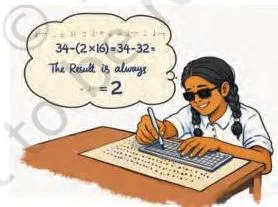
- 4.1 Introduction — the opening puzzle: for any three consecutive square numbers, adding the smallest and largest and subtracting twice the middle gives 2.
- 4.2 Visualising Identities — the area model for \((a+b)^2\), the definition of an identity, and the comparison \((a+b)^2\) versus \(a^2+b^2\).
- 4.3 Factorisation of Algebraic Expressions Using Identities — matching trinomials such as \(x^2+4x+4\) to \((x+2)^2\); the book also returns to the square-number pattern and proves it here.
- 4.4 More Identities — \((a+b+c)^2\) and Śhrīdharāchārya’s quick-squaring identity from 750 CE.
- 4.5 Factorisation Using Algebra Tiles — \(x^2\)-tiles, \(x\)-tiles and unit tiles arranged into rectangles show products and factors.
- 4.6 Factorisation Without Using Algebra Tiles — comparing \(x^2+7x+12\) with \(x^2+(a+b)x+ab\), the algebraic version of splitting the middle term.
- 4.7 Finding New Identities — cube identities, \(x^3+y^3\), \(x^3-y^3\), and \(x^3+y^3+z^3-3xyz\).
- 4.8 Simplifying Rational Expressions — factor the numerator and denominator, then cancel common factors when the denominator is not zero.
The consecutive-square pattern, proved
Any three consecutive numbers are \(n-1\), \(n\), \(n+1\), so their squares are \((n-1)^2\), \(n^2\), \((n+1)^2\). Add the smallest and largest, then subtract twice the middle:
\[ (n-1)^2+(n+1)^2-2n^2=(n^2-2n+1)+(n^2+2n+1)-2n^2=2. \]
The \(n^2\) terms cancel completely, so the result is always 2.
Key concepts in Exploring Algebraic Identities
An identity is a rule that stays true for every value of the variable. This chapter uses identities for three jobs: expanding brackets, factorising expressions and simplifying fractions.
Identity versus equation
The book defines an algebraic identity as an equation true for all values of the variables. An equation need only be true for some values.
For example, \(x+5=9\) is an equation: only \(x=4\) satisfies it. But \((x+2)^2=x^2+4x+4\) is an identity: every \(x\) works.
The Think and Reflect in section 4.2 asks when \((a+b)^2\) can be \(a^2+b^2\). The deciding term is \(2ab\). If \(a\) and \(b\) have opposite signs, \(2ab\lt 0\) and \((a+b)^2\lt a^2+b^2\). If \(ab=0\), the two sides are equal. If \(ab\gt 0\), \((a+b)^2\gt a^2+b^2\).
The square identities
These three identities let you expand brackets and square numbers quickly. The table shows which terms each expansion contains.
| Identity | Expanded form | What the expansion contains |
|---|---|---|
| \((a+b)^2\) | \(a^2+2ab+b^2\) | two squares and the middle term \(2ab\) |
| \((a-b)^2\) | \(a^2-2ab+b^2\) | two squares and the middle term \(-2ab\) |
| \((a+b+c)^2\) | \(a^2+b^2+c^2+2ab+2bc+2ca\) | three squares and three doubled products |
To factor a perfect-square trinomial, match it to \((a+b)^2\). For \(16x^2+40xy+25y^2\), check \((4x)^2=16x^2\), \((5y)^2=25y^2\) and \(2(4x)(5y)=40xy\). So \(16x^2+40xy+25y^2=(4x+5y)^2\).
The identities also square numbers without long multiplication:
\[ 62^2=(60+2)^2=60^2+2(60)(2)+2^2=3600+240+4=3844. \]
\[ 39^2=(40-1)^2=40^2-2(40)(1)+1^2=1600-80+1=1521. \]
\[ 112^2=(100+10+2)^2=100^2+10^2+2^2+2(100)(10)+2(100)(2)+2(10)(2)=12544. \]
The Śhrīdharāchārya identity and quick squaring
In 750 CE, Śhrīdharāchārya proposed rewriting \(a^2-b^2=(a+b)(a-b)\) as \(a^2=(a+b)(a-b)+b^2\). This gives a quick way to square numbers ending in 5 or near a round number.
\[ 75^2=(75+5)(75-5)+5^2=80\times70+25=5625. \]
Splitting the middle term
To factor a quadratic like \(x^2+7x+12\), compare it with \(x^2+(a+b)x+ab\). The numbers \(a\) and \(b\) must satisfy both \(a+b=7\) and \(ab=12\); here they are 3 and 4.
Worked example: factor \(x^2-9x+20\). You need \(a+b=-9\) and \(ab=20\). Both numbers must be negative, so \(a=-4\), \(b=-5\), giving \((x-4)(x-5)\).
For \(x^2+5x-14\), you need \(a+b=5\) and \(ab=-14\). One number is positive and one negative; \(7\) and \(-2\) work, so \(x^2+5x-14=(x+7)(x-2)\).
Cube identities and sums of cubes
Multiplying \((a+b)(a^2+2ab+b^2)\) gives the first cube identity:
\[ (a+b)^3=a^3+3a^2b+3ab^2+b^3. \]
Replacing \(b\) by \(-b\) gives the alternating-sign identity:
\[ (a-b)^3=a^3-3a^2b+3ab^2-b^3. \]
The chapter also derives the sum and difference of cubes:
\[ x^3-y^3=(x-y)(x^2+xy+y^2),\quad x^3+y^3=(x+y)(x^2-xy+y^2). \]
And the three-variable identity:
\[ x^3+y^3+z^3-3xyz=(x+y+z)(x^2+y^2+z^2-xy-xz-yz). \]
Worked example: \(8a^3+27b^3=(2a)^3+(3b)^3=(2a+3b)(4a^2-6ab+9b^2)\).
Simplifying rational expressions
A rational expression is a fraction whose numerator and denominator are algebraic expressions. To simplify it, factor both parts completely and cancel a common factor — but only when that factor is not zero.
Worked example: simplify \(\frac{x^2+2x-3}{x^2+6x+9}\), given that \(x^2+6x+9\neq 0\).
Factor the numerator as \((x+3)(x-1)\) and the denominator as \((x+3)^2\). Since \(x\neq -3\), the factor \(x+3\) is not zero, so it cancels:
\[ \frac{(x+3)(x-1)}{(x+3)^2}=\frac{x-1}{x+3}. \]
Reading the chapter’s figures
The book proves identities by area and volume, so each figure is a proof you can see. Read the labels as areas: squares stand for \(a^2\) or \(b^2\), and rectangles stand for products such as \(ab\).
The opening figure — consecutive square numbers
The first figure asks you to repeat the opening process on another set of three consecutive square numbers. Trying it with \(16,25,36\) gives \((16+36)-2\times25=52-50=2\), which the algebra later proves for every set.
Figures 4.1 and 4.2 — the area model for (a + b)^2
Fig. 4.1 joins segments of lengths \(a\) and \(b\). Fig. 4.2 divides the square of side \(a+b\) into one square \(a^2\), one square \(b^2\) and two rectangles \(ab\). Their areas add to the whole square, giving \((a+b)^2=a^2+2ab+b^2\).
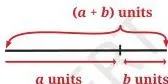
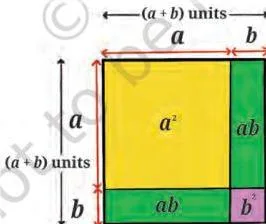
Figure 4.3 — the area model for (a − b)^2
Start with a square of area \(a^2\). Remove a rectangle \(ab\) and a rectangle \(b(a-b)\); the square left behind has area \((a-b)^2\). So \((a-b)^2=a^2-2ab+b^2\).
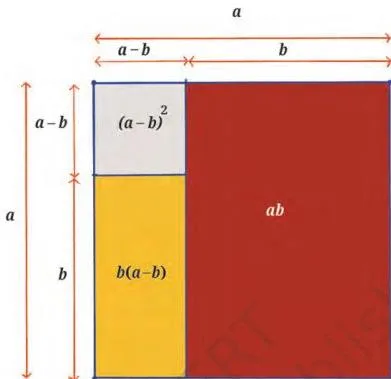
Figure 4.4 — the square model for (a + b + c)^2
The construction figure first shows how the square of side \(a+b+c\) is built from the three segments. The labelled model then splits it into nine regions: three squares \(a^2,b^2,c^2\) and six rectangles \(2ab,2bc,2ca\).
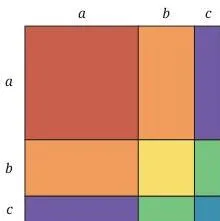
Figure 4.5 — Śhrīdharāchārya’s quick-square diagram
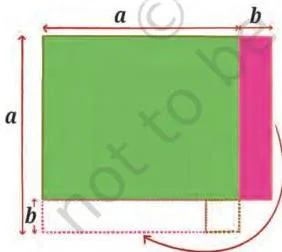
The figure justifies \(a^2=(a+b)(a-b)+b^2\): the big square can be rearranged into a rectangle of sides \(a+b\) and \(a-b\), plus a small square \(b^2\). Section 4.4 uses this identity to compute squares like \(75^2\) quickly.
Figures 4.7 and 4.8 — what algebra tiles show
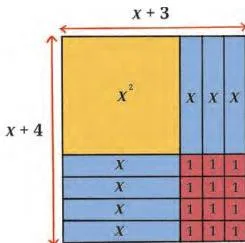
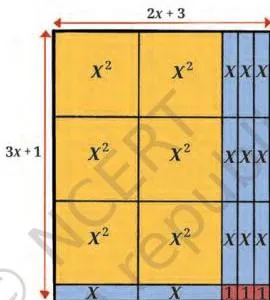
In Fig. 4.7 the edges of the rectangle are \(x+3\) and \(x+4\). Inside are one \(x^2\)-tile, seven \(x\)-tiles and twelve unit tiles, so \((x+3)(x+4)=x^2+7x+12\). Reading the same picture backwards factors \(x^2+7x+12\). Fig. 4.8 does the same for \((2x+3)(3x+1)\).
Figures 4.9 and 4.10 — the cube of edge (a + b)
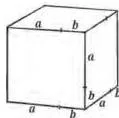
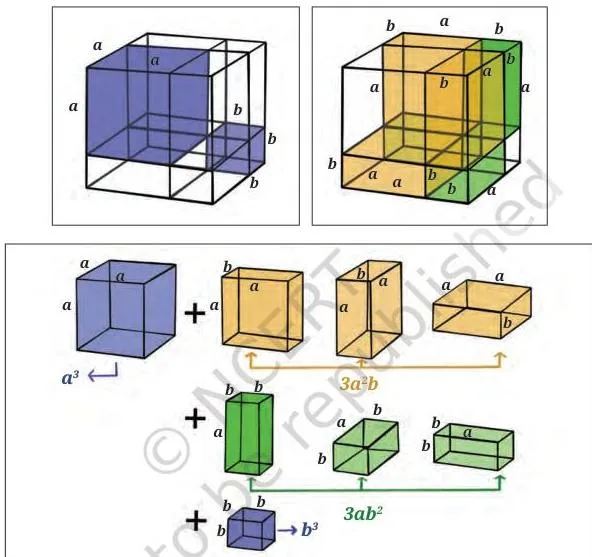
Fig. 4.9 shows a cube of edge \(a+b\). Fig. 4.10 splits it into two cubes, \(a^3\) and \(b^3\), and six cuboids: three of volume \(a^2b\) and three of volume \(ab^2\). The volumes add to \((a+b)^3=a^3+3a^2b+3ab^2+b^3\).
Definitions the chapter uses
The chapter uses a small set of exact terms. The one definition that matters most is the difference between an equation and an identity.
| Term | Meaning as the chapter uses it |
|---|---|
| Algebraic identity | An equation that is true for all values of the variables. |
| Equation | A statement that is true only for some values of the variable. |
| Factorisation | Writing an algebraic expression as a product of factors. |
| Factor | One of the expressions being multiplied. |
| Linear expression | An expression in which the variable appears only to the first power. |
| Algebra tiles | Physical models for algebra: an \(x^2\)-tile, \(x\)-tiles and unit tiles. |
| Common factor | A factor that divides every term of an expression. |
| Rational expression | A fraction whose numerator and denominator are algebraic expressions. |
| Denominator not zero | The condition under which cancelling a common factor is valid. |
Mistakes to avoid in this chapter
Most wrong answers here come from a few repeated slips. Several of the chapter’s Think and Reflect prompts are designed to expose exactly these.
| Mistake | Correct rule | How to check your answer |
|---|---|---|
| Expanding \((a+b)^2\) as \(a^2+b^2\), dropping \(2ab\) | \((a+b)^2=a^2+2ab+b^2\) | Try \(a=5\), \(b=1\): \(36\), not \(26\). |
| Writing \((a-b)^2\) with a positive middle term | \((a-b)^2=a^2-2ab+b^2\) | Expand \((a-b)(a-b)\) term by term. |
| Choosing \(a\) and \(b\) that fit only the product | Both \(a+b\) and \(ab\) must match | For \(x^2+7x+12\), check \(3+4=7\) and \(3\times4=12\). |
| Not taking out a common factor first | Pull out the common factor, then match an identity | Look for a number dividing every coefficient before matching a square identity. |
| Cancelling terms instead of factors, or cancelling a zero factor | Cancel only a common factor with a non-zero denominator | Factor both numerator and denominator fully first. |
| Misplacing signs in \((a-b)^3\) | \((a-b)^3=a^3-3a^2b+3ab^2-b^3\) | Expand \((a-b)(a-b)(a-b)\) once to check. |
James and Reshma’s discussion in section 4.6 has the same moral. James expands \((a-b)^2(a+b)\) directly; Reshma groups \((a-b)[(a-b)(a+b)]\), which is \((a-b)(a^2-b^2)\). Multiplication is associative, so both groupings give the same product, \(a^3-a^2b-ab^2+b^3\).
What the exercise sets in this chapter ask you to do
Each exercise set practises one skill, and the end-of-chapter exercises mix everything together.
- Exercise Set 4.1 — expanding with \((a+b)^2\) and using it to square numbers such as 64 and 105 without long multiplication.
- Exercise Set 4.2 — factorising perfect-square trinomials and squaring with \((a-b)^2\); the starred items need a common factor taken out first.
- Exercise Set 4.3 — choosing among the three square identities, expanding \((a+b+c)^2\), and the distinctive question type “Is this an identity?”, where you verify by expansion.
- Exercise Set 4.4 — filling blanks in identities, choosing an identity to compute products like \(23\times17\) without multiplying, and factorising.
- Exercise Set 4.5 — simplifying rational expressions, plus word problems that convert areas into factors, such as Saira’s rectangle and the rectangular pool.
- End-of-chapter exercises — mixed questions; questions 10 to 13 are starred extension reasoning, including proving \(n^3-n\) is divisible by 6 for all natural numbers \(n\).
Textbook contents and the examinable syllabus are not always identical. Check the current CBSE Class 9 Mathematics syllabus on the official CBSE website to see which parts of this chapter are examinable this session.
Exam notes for this chapter
These habits keep small sign errors out of your answer sheet.
- Name the identity you are using before you substitute. Write \((a+b)^2=a^2+2ab+b^2\), then show what \(a\) and \(b\) are.
- When factorising, state which square identity the expression matches and show the two square terms.
- When simplifying a rational expression, write the denominator-not-zero condition before cancelling.
- After factorising or expanding, multiply your factors back once to check the answer.
The chapter summary in brief
This restates the chapter’s own summary for fast revision.
- Identities are equations true for all values of the variables.
- Geometrical models and algebra tiles make identities visible.
- Identities can factor algebraic expressions.
- Algebra tiles show why the middle term of a quadratic is split.
- Identities speed up calculations such as squaring numbers and finding products.
- Rational expressions simplify by cancelling common factors, provided the factor exists and is not zero.
The eleven identities printed in the chapter summary are:
| Identity | What it is used for |
|---|---|
| \((x+y)^2=x^2+2xy+y^2\) | expanding and squaring |
| \((x-y)^2=x^2-2xy+y^2\) | expanding and squaring |
| \((x+y+z)^2=x^2+y^2+z^2+2xy+2yz+2zx\) | expanding a three-term square |
| \((x+y)(x-y)=x^2-y^2\) | difference of squares and quick products |
| \((x+a)(x+b)=x^2+(a+b)x+ab\) | factorising quadratics |
| \((ax+b)(cx+d)=acx^2+(ad+bc)x+bd\) | product of two linear factors |
| \(x^3-y^3=(x-y)(x^2+xy+y^2)\) | difference of cubes |
| \(x^3+y^3=(x+y)(x^2-xy+y^2)\) | sum of cubes |
| \((x+y)^3=x^3+3x^2y+3xy^2+y^3\) | cube of a sum |
| \((x-y)^3=x^3-3x^2y+3xy^2-y^3\) | cube of a difference |
| \(x^3+y^3+z^3-3xyz=(x+y+z)(x^2+y^2+z^2-xy-xz-yz)\) | three-variable factorisation |
Related resources
This listing is maintained for the 2026-27 academic session using the NCERT textbook information available to us. NCERT remains the authority for confirming the latest edition.
Use these pages to move between the book, the class and the neighbouring chapters.
- Class 9 Mathematics (Ganita Manjari) book page
- Class 9 study hub
- CBSE notes home
- The World of Numbers chapter notes
- I’m Up and Down and Round and Round chapter notes
Sources and data verification
- This page describes NCERT’s Ganita Manjari, Class 9 Mathematics, Part I, Chapter 4, in the official NCERT edition on ncert.nic.in.
- It covers this one chapter, not the full CBSE curriculum.
- The listing is maintained for the academic session for which this NCERT edition is current.
- NCERT settles textbooks, editions and PDFs; CBSE settles curriculum, syllabus and examinations.
| What the chapter holds | Count | Where it is used |
|---|---|---|
| Printed pages | 24 | |
| Sections in the chapter | 7 | |
| Figures with NCERT captions | 11 | |
| Tables | 1 | |
| Exercise questions | 12 | answered in our NCERT Solutions |
| Official NCERT PDF | Download the chapter PDF | the chapter exactly as NCERT publishes it |
Frequently asked questions about Exploring Algebraic Identities
What is the difference between an identity and an equation?
An identity is true for every value of the variable; an equation is true only for some values. For example, \(x^2-1=24\) is an equation because only \(x=5\) and \(x=-5\) work, while \((x+y)^2=x^2+2xy+y^2\) is an identity because it works for all \(x\) and \(y\).
Is (a + b)^2 ever equal to a^2 + b^2?
Yes, when \(ab=0\) — that is, when at least one of \(a\) or \(b\) is zero. The extra term is \(2ab\). If \(a\) and \(b\) have opposite signs, \(2ab\) is negative, so \((a+b)^2\lt a^2+b^2\); if they have the same sign, \((a+b)^2\gt a^2+b^2\).
Why does the pattern with three consecutive square numbers always end at 2?
Let the consecutive numbers be \(n-1\), \(n\), \(n+1\). Then \((n-1)^2+(n+1)^2-2n^2=2\). The \(n^2\) terms cancel, leaving exactly 2.
How do you decide how to split the middle term when factorising x^2 + 7x + 12?
Compare \(x^2+7x+12\) with \(x^2+(a+b)x+ab\). You need \(a+b=7\) and \(ab=12\). The pair \(3\) and \(4\) satisfies both, so split \(7x\) as \(3x+4x\) and factor as \((x+3)(x+4)\). Always check the sum as well as the product.
When is it correct to cancel a factor in a rational expression?
Only cancel a common factor of the whole numerator and the whole denominator, and only when that factor is not zero. For example, \(\frac{x^2+2x-3}{x^2+6x+9}\) becomes \(\frac{(x+3)(x-1)}{(x+3)^2}\). With \(x\neq -3\), cancel \((x+3)\) to get \(\frac{x-1}{x+3}\).
Is x – y always a factor of x^n – y^n?
The chapter shows \(x-y\) as a factor of \(x^2-y^2\), \(x^3-y^3\) and \(x^4-y^4\), and asks you to check \(x^5-y^5\). The pattern continues because putting \(x=y\) makes \(x^n-y^n=0\).
Reference: NCERT Class 9 Mathematics (Ganita Manjari) textbook, chapter 4, official edition on ncert.nic.in.
Explore Class 9 Mathematics Books
- Previous: The World of Numbers
- Next: I'm Up and Down, and Round and Round
Related chapters:
- Orienting Yourself: The Use of Coordinates
- Introduction to Linear Polynomials
- Measuring Space: Perimeter and Area