
Looking for the official Orienting Yourself: The Use of Coordinates class 9 chapter PDF? This page has it: the NCERT Class 9 Mathematics book (Ganita Manjari, Part I) opens with this 15-page chapter, and the official file is right below.
Keep reading for a plain-language map of what the chapter teaches — axes, quadrants, coordinates and the distance formula — so you can open the book knowing exactly what to look for.
Download Orienting Yourself: The Use of Coordinates Class 9 PDF
This is the official NCERT file — not a scanned copy or a third-party version — and it is the textbook the school year works from.
Open the official NCERT PDF of Grade 9 Mathematics Part I (Ganita Manjari), Chapter 1, published directly on ncert.nic.in; this is the same official edition the curriculum is based on and it prints cleanly for offline study: Orienting Yourself: The Use of Coordinates class 9 PDF.
Chapter at a Glance: What’s Inside
The chapter table on this page shows how much the file holds — sections, diagrams, worked examples and exercise questions — in one place. The map below shows where each idea sits inside the printed chapter; every page number refers to the NCERT PDF.
- 1.1 Introduction (p. 1). What a coordinate system is, plus the history of grid-based thinking.
- 1.2 Settling In (pp. 2–3). Reiaan’s room, mapped with pins and wool.
- 1.3 The 2-D Cartesian Coordinate System (pp. 3–7). Axes, origin, quadrants; Exercise Set 1.1 (pp. 4–5) and Exercise Set 1.2 (pp. 7–8).
- 1.4 Distance Between Two Points in the 2-D Plane (pp. 8–11). The distance formula, built on the Baudhāyana–Pythagoras theorem.
- End-of-Chapter Exercises (pp. 12–14). Reasoning problems that go beyond plotting.
- Chapter Summary (pp. 14–15). The chapter’s conclusions, condensed into bullet points.
What This Chapter Covers, Section by Section
This chapter introduces coordinates slowly: a story first, then the formal system, then one formula. Each section has a clear job to do.
- 1.1 Introduction (p. 1). Coordinates are a structured framework — like map or graph-paper grid lines — that lets numbers describe locations. The book traces the idea through the Sindhu-Sarasvati city grids, the Ujjayinī meridian, Brahmagupta’s zero and negative numbers, and Descartes’s formalisation of two perpendicular axes in 1637.
- 1.2 Settling In (pp. 2–3). The chapter opens with Reiaan, who cannot see, being guided through a new room using a pin-and-wool map of its floor. The point is practical: a map delivers location information without needing sight.
- 1.3 The 2-D Cartesian Coordinate System (pp. 3–7). The formal framework: a horizontal x-axis, a vertical y-axis, an origin, and four quadrants. Exercise Set 1.1 (pp. 4–5) has you read coordinates off the room plan; Exercise Set 1.2 (pp. 7–8) has you plot furniture on a graph sheet.
- 1.4 Distance Between Two Points (pp. 8–11). The chapter’s single formula: find the distance between any two points using the Baudhāyana–Pythagoras theorem. It starts with horizontal and vertical shifts, then handles the slanted case, then negative coordinates, via a reflected triangle.
- End-of-Chapter Exercises (pp. 12–14). Sixteen problems that move from reading coordinates to reasoning: collinearity, midpoints, a circle centred at the origin, a city street grid, a computer screen, and a square.
- Chapter Summary (pp. 14–15). The book’s own closing summary, re-explained later on this page.
Key Concepts: Axes, Coordinates and Quadrants
Why does the chapter need two lines? One number locates a point on a single line, like a mile marker. A plane has two independent directions, so you need two perpendicular rulers to pin down one point. The important idea is that coordinates are perpendicular distances, not diagonal ones.
| Concept | Meaning | Where |
|---|---|---|
| x-axis | The horizontal axis. Distances to the right of the origin are positive, to the left negative. | p. 3 |
| y-axis | The vertical axis. Distances above the origin are positive, below negative. | p. 3 |
| Origin | The point where the axes meet, written O = (0, 0). | p. 3 |
| Coordinates (x, y) | x is the perpendicular distance of the point from the y-axis, measured along the x-axis; y is the perpendicular distance from the x-axis, measured along the y-axis. | p. 6 |
| Point on the x-axis | Has the form (x, 0). | pp. 3, 15 |
| Point on the y-axis | Has the form (0, y). | pp. 3, 15 |
The axes divide the plane into four quadrants. The sign pattern below is worth memorising exactly as printed in the chapter summary.
| Quadrant | x-coordinate | y-coordinate | Sign pattern | Example |
|---|---|---|---|---|
| I | positive | positive | \( (+, +) \) | (2, 3) |
| II | negative | positive | \( (-, +) \) | (-5, 3) |
| III | negative | negative | \( (-, -) \) | (-2, -3) |
| IV | positive | negative | \( (+, -) \) | (3, -5) |
Memory tip: x comes before y in the alphabet, and it is written first. The x-coordinate is the sideways number, so picture yourself standing on the y-axis and walking parallel to the x-axis; the y-coordinate is the up-down number, measured from the x-axis. Get the order right and most of this chapter is done.
Formulas in This Chapter: Distance Between Points
The chapter’s one real calculation is the distance between two points. It appears in three forms, and the general formula is simply the first two combined.
| Case | Points | Distance |
|---|---|---|
| Horizontal segment (same y-coordinate) | \( (x_1, y) \) and \( (x_2, y) \) | \( |x_2 – x_1| \) |
| Vertical segment (same x-coordinate) | \( (x, y_1) \) and \( (x, y_2) \) | \( |y_2 – y_1| \) |
| General (slanted segment) | \( (x_1, y_1) \) and \( (x_2, y_2) \) | \( \sqrt{(x_2 – x_1)^2 + (y_2 – y_1)^2} \) |
In the general formula, \( x_2 – x_1 \) is the horizontal shift between the points and \( y_2 – y_1 \) is the vertical shift. Because the shifts are squared, signs vanish: a shift of -3 and a shift of +3 both contribute 9, so negative coordinates cause no trouble.
Why square and add? The horizontal and vertical shifts meet at right angles, so they act as the two legs of a right triangle and the distance is the hypotenuse. That is exactly the Baudhāyana–Pythagoras theorem from Grade 8 (NCERT, p. 8).
Example — distance between P(2, -3) and Q(-1, 5).
- Step 1: Label the points: \( (x_1, y_1) = (2, -3) \) and \( (x_2, y_2) = (-1, 5) \).
- Step 2: Horizontal shift: \( x_2 – x_1 = -1 – 2 = -3 \).
Its square is 9.
Step 3: Vertical shift: \( y_2 – y_1 = 5 – (-3) = 8 \).
Subtracting a negative adds: \( 5 + 3 = 8 \).
Its square is 64.
\[ PQ = \sqrt{(x_2 – x_1)^2 + (y_2 – y_1)^2} = \sqrt{(-3)^2 + 8^2} = \sqrt{9 + 64} = \sqrt{73} \]
Final answer: \( PQ = \sqrt{73} \) units, which is about 8.5 units.
The reflected triangle in Fig. 1.9 shows the same calculation with negative coordinates: the shifts stay 4 and 3, so side AD is still 5 units (NCERT, p. 11). Worked in the opposite order — \( x_1 – x_2 \) instead of \( x_2 – x_1 \) — the answer is identical, because the square fixes the sign.
Figure Walkthrough: Reading the Chapter’s Diagrams
The chapter keeps sending you back to its diagrams. Learn to read the five below and the exercises answer themselves.
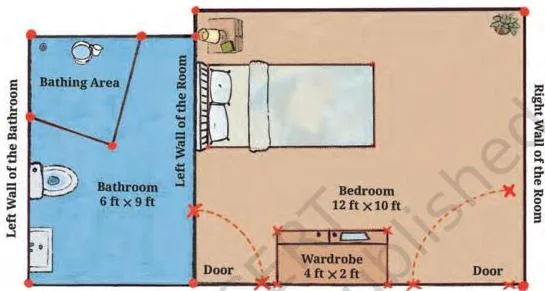
Look at Fig. 1.1 first. Pins mark the key points of the room and thick wool connects the corners of objects, so the map can be read with fingers. The scale is 1 cm : 1 foot, turning every grid distance into a real measurement.
The map shows only the floor — which is why the book asks why the windows cannot be marked on it: windows sit on walls, so a floor-only plan has no place for them.
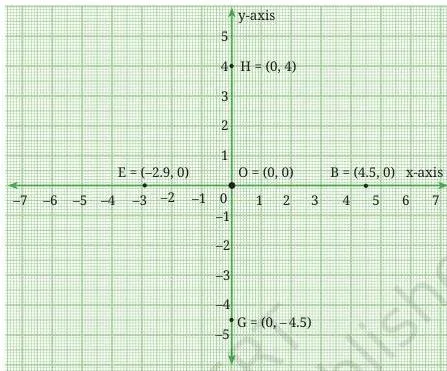
Fig. 1.2 is the whole system in one drawing: the horizontal x-axis, the vertical y-axis, the origin O where they cross, and the four arrows showing the positive directions (right and up) and negative directions (left and down). Every later figure assumes you can see this grid behind it.
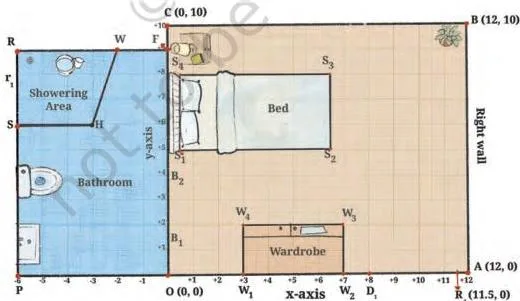
Fig. 1.5 puts axes onto Reiaan’s room so every object gains coordinates. Exercise Set 1.2 uses it for furniture: the study table’s three feet sit at (8, 9), (11, 9) and (11, 7), and the fourth foot is at (8, 7) because the opposite corners of a rectangle share the same x- and y-values. To read any point, move along the x-axis first, then move parallel to the y-axis.
On this graph, 1 cm = 1 unit, and the room’s real measurements (like the dining room’s 18 ft by 15 ft) are read directly from these coordinates.
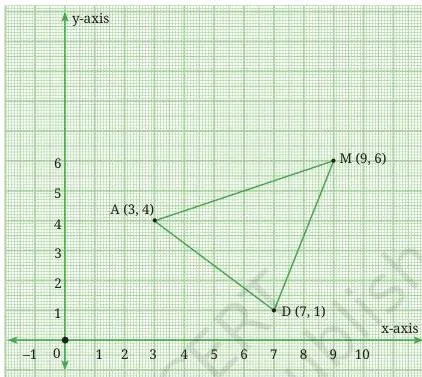
Fig. 1.6 is the triangle on which the distance formula is developed: A(3, 4), D(7, 1) and M(9, 6). No side runs parallel to an axis, so you cannot simply count grid steps. The book’s trick is to break each side into a horizontal and a vertical shift, then apply the Baudhāyana–Pythagoras theorem; for side AD that gives \( \sqrt{4^2 + 3^2} = 5 \) units (NCERT, p. 9).
The same method gives \( DM = \sqrt{29} \) and \( MA = \sqrt{40} \) units.
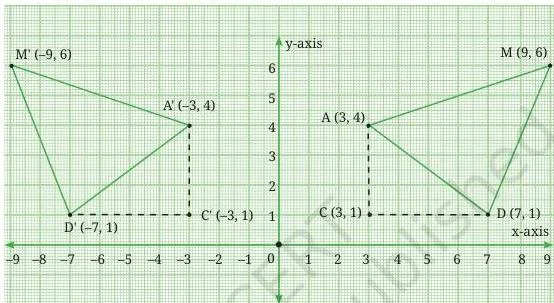
Fig. 1.9 answers the question “what if the coordinates take negative values?” by reflecting triangle AMD in the y-axis. A’ is (-3, 4), D’ is (-7, 1) and M’ is (-9, 6): only the sign of each x-coordinate changes. When you compute a shift such as \( -3 – (-7) \), you are really adding: \( -3 + 7 = 4 \).
Every side length comes out the same as before — \( \sqrt{29} \), \( \sqrt{40} \) and 5 — which is the chapter’s point: reflection preserves distance (NCERT, p. 11).
Definitions to Keep Straight
These are the terms the chapter uses, in the order it introduces them. Learn them as one family, not as isolated words.
| Term | Plain meaning | Where |
|---|---|---|
| Coordinate system | A structured framework, like the grid lines on a map or graph paper, that uses numbers to describe locations. | p. 1 |
| Cartesian plane | The plane in which the axes sit; also called the coordinate plane or the xy-plane. | pp. 3, 6 |
| x-axis | The horizontal coordinate line. | p. 3 |
| y-axis | The vertical coordinate line. | p. 3 |
| Origin | The point of intersection of the axes, O = (0, 0). | p. 3 |
| x-coordinate | The perpendicular distance of the point from the y-axis, measured along the x-axis. | p. 6 |
| y-coordinate | The perpendicular distance of the point from the x-axis, measured along the y-axis. | p. 6 |
| Coordinates of a point | The ordered pair (x, y); the order matters. | pp. 6–7 |
| Quadrant | One of the four parts into which the axes divide the plane. | p. 6 |
| Distance formula | \( \sqrt{(x_2 – x_1)^2 + (y_2 – y_1)^2} \), the distance between the points \( (x_1, y_1) \) and \( (x_2, y_2) \). | p. 10 |
Think and Reflect: Questions the Chapter Asks You to Answer
The book’s Think and Reflect boxes are where it puts its trickiest ideas. Try each question before reading the answer.
- Door widths and wheelchairs (p. 5). Measure the door on the plan and compare it with doors at home and school, then ask whether a person in a wheelchair could enter comfortably. There is no fixed answer in the book — the point is to notice that spaces are designed for people, and to check whether they serve everyone.
- The x-coordinate of a point on the y-axis (p. 7). It is 0. A point on the y-axis has not moved sideways at all, so its first coordinate is always zero; such points have the form (0, y). The matching rule for the x-axis: points there have the form (x, 0).
- Does Q(y, x) ever coincide with P(x, y)? (p. 7) Only when x = y. If x and y differ, the two pairs name different points — (3, 5) and (5, 3) are two different places, which is why the order of coordinates matters.
- What does reflection change? (p. 11) A reflection in the y-axis flips the sign of every x-coordinate and leaves every y-coordinate unchanged. All side lengths and the overall shape stay the same. Reflecting in the x-axis works the other way round: y-coordinates change sign, x-coordinates stay put.
Common Mistakes in This Chapter
Nearly everything that goes wrong in this chapter is an order problem or a sign problem. The table names each mistake before you make it.
| Mistake | Correct rule | How to check your answer |
|---|---|---|
| Writing (y, x) when you mean (x, y). | x is written first. The two orders name the same point only when x = y (NCERT, p. 7). | Test with numbers: (3, 5) and (5, 3) are different points. |
| Giving a point on the y-axis a non-zero x-coordinate. | Points on the y-axis have the form (0, y); the x-coordinate is always 0 (NCERT, p. 7). | The first coordinate of the point must read 0. |
| Subtracting a negative incorrectly inside the distance formula, e.g. treating \( -3 – (-7) \) as -10. | \( -3 – (-7) = -3 + 7 = 4 \). Subtracting a negative means adding (NCERT, p. 11). | Rewrite the subtraction as addition before you calculate. |
| Thinking reflection changes distances. | Reflection flips only the sign of one coordinate; the squared differences, and so the distance, stay unchanged (NCERT, p. 11). | Compute the distance for both the original and the reflected triangle and compare. |
| Mixing up quadrant sign patterns. | Quadrant I: \( (+, +) \); II: \( (-, +) \); III: \( (-, -) \); IV: \( (+, -) \) (NCERT, p. 6). | Plot one test point in each quadrant and look at the signs of its coordinates. |
How the Exercises Build: From Reading to Reasoning
The exercise sets move from “read the grid” to “reason with coordinates”. Each set has a different job, and the starred questions expect a method, not a drawing.
- Exercise Set 1.1 (pp. 4–5) — reading. Pull coordinates and distances straight off Fig. 1.3: how far the door sits from each wall, the coordinates of D₁, and whether the door widths are comfortable. Part (iv) compares the bathroom door with the room door.
- Exercise Set 1.2 (pp. 7–8) — plotting. Mark the axes on a graph sheet and place the furniture yourself: the study table’s fourth foot lands at (8, 7), the shower area SHWR has four corners to write down, and a 5 ft by 3 ft dining table must be centred in the 18 ft by 15 ft dining room.
- End-of-chapter exercises (pp. 12–14) — reasoning. Predict which sides of RAMP are perpendicular or parallel before plotting (Q3); check collinearity without plotting (Q6–7); decide whether M is the midpoint of ST from coordinates alone (Q9–10); test whether points lie on a circle centred at the origin (Q12); model a city street grid where (2, 5) names an intersection (Q14); simulate a computer graphics screen with circular icons (Q15); and verify that points A(2, 1), B(-1, 2), C(-2, -1), D(1, -2) form a square, finding its area (Q16).
Method for the starred collinearity questions: compute all three distances. If the largest distance equals the sum of the other two, the three points lie on one straight line, and the point that splits the line is the middle one.
For M(-3, -4), A(0, 0) and G(6, 8), the three distances are \( MA = \sqrt{3^2 + 4^2} = 5 \), \( AG = \sqrt{6^2 + 8^2} = 10 \) and \( MG = \sqrt{9^2 + 12^2} = 15 \). Since 5 + 10 = 15, M, A and G lie on one straight line.
An equally valid check is to compare the ratios of vertical to horizontal shift between pairs of points.
One honest note: textbook contents and the examinable syllabus are not always identical — check the current official syllabus for what is examinable this session. This page makes no claims about exam weight or marks.
The Chapter’s Closing Points, in Plain Words
The PDF ends with a one-page summary on pages 14–15. Here is that list re-explained:
- To locate a point in a plane you need two perpendicular lines — one horizontal (the x-axis), one vertical (the y-axis).
- The plane they sit in is the Cartesian plane, also called the coordinate plane or the xy-plane.
- The axes divide the plane into four quadrants.
- The origin is where the axes meet; its coordinates are (0, 0).
- The x-coordinate of a point is its distance from the y-axis; the y-coordinate is its distance from the x-axis.
- Points on the x-axis have the form (x, 0); points on the y-axis have the form (0, y).
- Quadrant sign patterns: \( (+, +) \), \( (-, +) \), \( (-, -) \), \( (+, -) \) in quadrants I to IV.
- \( (x, y) = (y, x) \) exactly when \( x = y \).
- Horizontal distance is \( |x_2 – x_1| \); vertical distance is \( |y_2 – y_1| \); the general distance is \( \sqrt{(x_2 – x_1)^2 + (y_2 – y_1)^2} \), by the Baudhāyana–Pythagoras theorem.
Related NCERT Resources
This listing is maintained for the 2026-27 academic session using the NCERT textbook information available to us. NCERT remains the authority for confirming the latest edition.
If the chapter makes sense, keep going with these related pages.
- NCERT Class 9 Mathematics notes — the rest of the book in the same format.
- Class 9 study resources hub — all subjects in one place.
- CBSE notes collection — if you are revising across classes.
- The next chapter, Introduction to Linear Polynomials — continue straight into Chapter 2.
Bookmark the official Grade 9 Mathematics Part I (Ganita Manjari) PDF on ncert.nic.in so you always open the same current edition NCERT publishes: the NCERT textbook page for this book.
Sources and Data Verification
This page describes NCERT Class 9 Mathematics (Ganita Manjari, Part I), Chapter 1, Orienting Yourself: The Use of Coordinates, in the official edition published on ncert.nic.in.
- It covers this single chapter only — not the whole book, and not the whole CBSE curriculum.
- It is maintained for the current academic session using the NCERT information available to us.
- NCERT settles textbooks, editions and PDFs; CBSE settles curriculum, syllabus and examinations. Where the two differ, the official syllabus is the authority.
| What the chapter holds | Count | Where it is used |
|---|---|---|
| Printed pages | 15 | |
| Sections in the chapter | 4 | |
| Figures with NCERT captions | 5 | |
| Tables | 1 | |
| Exercise questions | 12 | answered in our NCERT Solutions |
| Official NCERT PDF | Download the chapter PDF | the chapter exactly as NCERT publishes it |
Reference: NCERT Class 9 Mathematics textbook, chapter 1, official edition on ncert.nic.in.
Frequently Asked Questions
What are the coordinates of the origin in the Cartesian plane?
The origin is (0, 0): it is the point where the axes intersect, so it sits zero units from both the x-axis and the y-axis (NCERT, p. 3).
Why do the signs of coordinates change in each quadrant?
Because positive means right or up, and negative means left or down. Each quadrant combines one direction from each axis, giving the four patterns (+, +), (-, +), (-, -), (+, -) (NCERT, p. 6).
When is (x, y) the same point as (y, x)?
Only when x = y. If the two numbers differ, the pair in the opposite order names a different point, which is why coordinates are called an ordered pair (NCERT, p. 7).
How do you find the distance between two points using the distance formula?
Square the difference of the x-coordinates and the difference of the y-coordinates, add them, and take the square root: \( \sqrt{(x_2 – x_1)^2 + (y_2 – y_1)^2} \) (NCERT, p. 10). For (2, -3) and (-1, 5) that is \( \sqrt{(-3)^2 + 8^2} = \sqrt{73} \) units.
Does reflecting a triangle across the y-axis change the distance between its corners?
No. Reflection changes only the sign of each x-coordinate. The squared differences — and therefore the distances — stay exactly the same, so the reflected triangle has identical side lengths (NCERT, p. 11).
Explore Class 9 Mathematics Books
- Next: Introduction to Linear Polynomials
Related chapters:
- The World of Numbers
- Exploring Algebraic Identities
- I'm Up and Down, and Round and Round