
Equal chords of a circle subtend equal angles at the centre of the circle — that is Theorem 2 of Chapter 5, “I’m Up and Down, and Round and Round”, in the NCERT Class 9 Mathematics textbook, printed on page 99.
This page gives you the book’s exact statement, its Fig 5.9, and the full SSS proof in numbered steps, so you can write the theorem in an exam without reopening the chapter.
The proof is short: name four radii, apply the SSS congruence rule to two triangles, and read off the equal angles. Everything you need is below.
Theorem 2: The Statement as NCERT Prints It
The theorem is printed on page 99 of the NCERT Class 9 Mathematics textbook, right after the book shows what happens when a fixed thread is moved around the circle.
Theorem 2 (NCERT Class 9 Mathematics, page 99) Equal chords of a circle subtend equal angles at the centre of the circle.
New: practise this theorem. Drag the book’s figure and watch the numbers change, try to break the theorem on purpose, then solve fresh questions with hints.
That is the entire statement — two equal chords, one circle, and the angles they make at the centre. No condition about chord length, and nothing about the circumference.
What the Statement Means in Plain Words
A chord is the straight segment joining two points of a circle. Unless it passes through the centre, it sits inside the circle like a bridge between two points on the rim.
To say that a chord subtends an angle at the centre means: put the vertex of the angle at the centre and let the two arms pass through the two ends of the chord. The chord “holds open” that angle.
The force of the theorem is that position does not matter. Two equal chords may lie on completely different parts of the circle, yet the angles they subtend at the centre are equal.
Picture sliding a chord of fixed length around the circle: the angle it makes at the centre never changes.
Fig 5.9: Reading the Book’s Figure
NCERT supplies one figure for this theorem, Fig 5.9 on page 99, and the whole proof is visible in it.
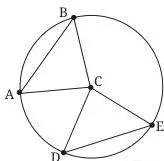
The circle has centre C. AB and DE are two chords marked with equal length — that is the given \(AB = DE\). The two angles compared are \(\angle ACB\) and \(\angle DCE\), with the shared vertex at the centre C.
The detail that carries the proof: CA, CB, CD and CE are all radii of the same circle, so all four have one common length r. The figure already contains every segment the proof uses; nothing has to be drawn.
Given, To Show, and What the Figure Already Supplies
As the book sets it up:
- Given: \(AB = DE\).
- To show: \(\angle ACB = \angle DCE\).
Notice what is absent: a construction. Unlike most circle proofs, this one draws no new line and no new point. The segments CA, CB, CD and CE are already in Fig 5.9 because they are radii.
The work of the proof is only to name those four segments as radii and then apply the SSS congruence rule.
Proof: Why One SSS Congruence Settles Both Angles
Follow the book’s order, with a reason on every line.
- Radii: \(CA = CB = r\) and \(CD = CE = r\), since all four are radii of the same circle. Hence \(CA = CD\) and \(CB = CE\).
- Given: \(AB = DE\).
- The sides of \(\triangle CAB\) and \(\triangle CDE\) pair up as \(CA = CD\), \(CB = CE\), \(AB = DE\). Three pairs of equal sides, so by the SSS congruence rule, \(\triangle CAB \cong \triangle CDE\).
- Corresponding parts of congruent triangles are equal: \(\angle ACB = \angle DCE\). These are precisely the angles subtended at the centre by the equal chords.
The vertex order is decisive. The congruence \(\triangle CAB \cong \triangle CDE\) matches C with C, A with D and B with E. That matching is what makes \(\angle ACB = \angle DCE\) a pair of corresponding angles. Any shuffled order, such as \(\triangle CAB \cong \triangle EDC\), pairs the wrong vertices and the conclusion no longer follows from CPCT.
Why SSS and not SAS. SAS requires two sides and the angle between them. The angle between CA and CB is exactly \(\angle ACB\) — the very angle the theorem sets out to compare with \(\angle DCE\). Using SAS would assume the result before proving it. SSS needs only the three side lengths: the given chord equality and the common radius.
Quick check with fresh numbers. In a circle of radius 5 cm, take two equal chords. If one chord subtends \(70^\circ\) at the centre, the other chord subtends exactly \(70^\circ\) at the centre as well — the theorem transfers the angle from one equal chord to the other without any measurement.
Try it yourself: a live practice figure
Where the Book Goes Next: The Converse Preview on Page 99
On printed page 99, immediately after the proof, the book reverses the question: if two chords subtend equal angles at the centre, are the chords necessarily equal?
To test intuition, the book runs a thought experiment. Stand at the centre C with your arms stretched at a fixed angle, your hands touching the circle at A and B. The straight distance between your hands is the chord AB.
Now let the floor rotate while you keep the arm angle fixed — your hands keep landing on the circle, and the chord between them keeps its length, because the angle between your arms never changed.
That experiment sets up the converse, which the book proves as the very next result, Theorem 3: chords subtending equal angles at the centre are equal.
Converse and Related Theorems in Chapter 5
Theorem 2 sits inside a chain of chord and angle results. Each is named below with a link so you can see the chapter’s shape around this theorem.
- Theorem 1 — a unique circle passes through three non-collinear points, the result just before this one.
- Theorem 3 — the converse, proved right after this one.
- Theorem 4 — the line from the centre to the midpoint of a chord is perpendicular to the chord.
- Theorem 6 — equal chords are equidistant from the centre.
- Theorem 8 — the longer chord is nearer the centre.
- Theorem 9 — the angle at the centre is double the angle on the circle.
The pattern: Theorem 2 and its converse open the chord-properties part of the chapter, and the results that follow reuse the same moves — name the radii, match equal sides, and let triangle congruence settle equal angles.
Mistakes That Cost Marks in This Proof
- Wrong congruence order. Writing \(\triangle CAB \cong \triangle EDC\), or any shuffled order, pairs the wrong vertices. The correct matching is C with C, A with D, B with E — only that order makes \(\angle ACB = \angle DCE\) follow as corresponding angles.
- Omitting the reason “radii of the same circle”. The equality \(CA = CB = CD = CE\) is not given; it needs one line of justification. Without it the first step of the proof has no basis.
- Quoting the converse inside this proof. “Equal angles give equal chords” is Theorem 3, a separate result. Using it to prove Theorem 2 is circular reasoning.
- Transferring the claim to the circumference. This theorem is exclusively about the angle at the centre. The angle a chord subtends at a point on the circle itself is handled later, by Theorem 9.
- Applying the claim across two circles. The proof uses r, the same radius, four times. Two chords in two different non-congruent circles share no such common radius, so the theorem as stated does not cover them.
Frequently Asked Questions
What does subtend mean in the theorem equal chords subtend equal angles at the centre?
Subtend means the two ends of the chord hold open the angle. Put the vertex at the centre, let one arm pass through one end of the chord and the other arm through the other end — the chord subtends that angle at the centre.
How do I write the proof of equal chords subtend equal angles at the centre in an exam?
Write the four lines from the Proof section in order: \(CA = CB = CD = CE\) (radii of the same circle); \(AB = DE\) (given); \(\triangle CAB \cong \triangle CDE\) (SSS); hence \(\angle ACB = \angle DCE\) (corresponding parts of congruent triangles). Give a reason for every line.
Is the converse of equal chords subtend equal angles at the centre also true?
Yes. If two chords of a circle subtend equal angles at the centre, the chords are equal. The book proves this as Theorem 3, the result that immediately follows this theorem in Chapter 5.
Do equal chords subtend equal angles anywhere on the circle, or only at the centre?
Only at the centre, as the theorem states. A chord subtends different angles at different points on the circle; that geometry is covered separately later in the chapter by Theorem 9, the angle at the centre being double the angle on the circle.
Do I need to draw any construction for this proof?
No. The segments CA, CB, CD and CE are already present in Fig 5.9 because they are radii. The proof only names them and applies SSS — nothing extra is drawn.
Related Pages and Sources
This listing is maintained for the 2026-27 academic session using the NCERT textbook information available to us. NCERT remains the authority for confirming the latest edition.
Next steps: the full chapter I’m Up and Down, and Round and Round walks through the same circle results in order, and the Class 9 Maths theorems hub lists every theorem page for this book.
For revision material around this theorem, use the Class 9 Mathematics notes, the Class 9 notes index, or the full notes directory.
The theorem appears on printed page 99 of the NCERT Class 9 Mathematics textbook (Ganita Manjari), Chapter 5. You can open it in the official NCERT textbook viewer for the chapter and flip to page 99 to confirm the statement, Fig 5.9 and the proof in the printed edition.
Because textbook contents and the examinable syllabus are not always identical, check the current official syllabus published by CBSE before final revision. NCERT settles the textbook and its editions; CBSE settles the curriculum, the syllabus and the examinations.
Reference: NCERT Class 9 Mathematics textbook, chapter 5, Theorem 2, official edition on ncert.nic.in.
Explore Class 9 Mathematics
Related chapters: