
Looking for the exact NCERT statement of Theorem 3 from Chapter 5 of the Class 9 Mathematics textbook (Ganita Manjari)? This page gives the statement as NCERT prints it on page 100, the book’s own figure (Fig. 5.11), and the SAS proof you can reproduce in an exam.
The proof needs no construction line — it reads directly from the four radii already drawn in the figure.
The Exact Statement of Theorem 3 (NCERT Page 100)
This is Theorem 3 of Chapter 5, “I’m Up and Down, and Round and Round”, in the current NCERT Class 9 Mathematics textbook. The statement below is the book’s own wording, printed on page 100, and that same page carries the figure, the Given–To show setup and the complete proof (NCERT, p. 100).
Theorem 3 (NCERT Class 9 Mathematics, page 100) Chords of a circle that subtend equal angles at the centre are equal.
New: practise this theorem. Drag the book’s figure and watch the numbers change, try to break the theorem on purpose, then solve fresh questions with hints.
This is the second chord-and-circle result in the chapter, and it works like the exact reverse of the theorem that comes just before it — more on that below.
What the Statement Means in Plain Words
Three words carry the meaning of this theorem: chord, subtend and angle at the centre. Here is what each one says (NCERT, p. 100):
| Word | What it means in Theorem 3 |
|---|---|
| Chord | A straight line joining two points on the circle — here \( AB \) and \( ED \). |
| Subtend | The chord is “seen” from a point under an angle; the chord \( AB \) subtends \( \angle ACB \) at the centre. |
| Angle at the centre | The angle between the two radii drawn to the ends of the chord, such as \( \angle ACB \). |
So the theorem says: if two chords of the same circle are seen from the centre under equal angles, then the chords themselves are equal. The equal central angles are the given; the equal chord lengths are the conclusion.
A quick application: in the same circle, two equal central angles force their chords to have equal length, so measuring one chord immediately gives the length of the other.
Fig. 5.11: The Figure the Proof Reads
The proof is read entirely from the figure below, so the order of the points matters.
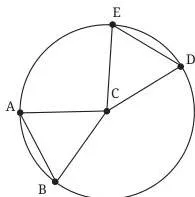
In Fig. 5.11, C is the centre of the circle and A, B, D, E are four points on the circle. The marked angles \( \angle ACB \) and \( \angle DCE \) are the equal angles, and the segments \( AB \) and \( ED \) are the chords under comparison.
The correspondence the proof needs is: A matches D, B matches E, and C matches itself. That makes side \( AB \) correspond to side \( ED \) — the two sides the theorem declares equal.
Given, To Prove and the Construction
The book sets the proof up in three lines (NCERT, p. 100):
- Given: \( \angle ACB = \angle DCE \).
- To show: \( AB = ED \).
- Construction: none. The proof uses only the segments already drawn — the four radii \( AC \), \( BC \), \( EC \) and \( DC \).
Because A, B, D and E all lie on the same circle, the segments \( AC \), \( BC \), \( EC \) and \( DC \) are all radii, and every radius of a circle has the same length. That single fact does all the work in the proof.
Proof of Theorem 3, Step by Step
The whole proof is one SAS congruence argument, in five steps (NCERT, p. 100).
- Step 1: In \( \triangle ACB \), the sides \( AC \) and \( BC \) are both radii, so \( AC = BC \).
- Step 2: In \( \triangle DCE \), the sides \( DC \) and \( EC \) are also radii, so \( EC = DC \).
- Step 3: Every radius has the same length, so the radii can be matched across the triangles: \( AC = DC \) and \( BC = EC \).
- Step 4: The given equality \( \angle ACB = \angle DCE \) is the included angle — in each triangle it lies between the two sides just matched.
Two sides and their included angle match, so by SAS, \( \triangle ACB \cong \triangle DCE \).
Step 5: Corresponding parts of congruent triangles are equal, so the remaining matching sides give \( AB = ED \).
Hence proved.
SAS is the right rule because the equal angle at C is the included angle between the two radius sides in each triangle. SSS would be circular: \( AB = ED \) is the conclusion, not a known side. ASA and AAS do not fit because no second angle of either triangle is known.
Try it yourself: a live practice figure
Where the Chapter Takes This Theorem Next
The proof on page 100 is followed immediately by two questions, and both reuse the same pair of triangles from this proof (NCERT, p. 100):
- Question 1 asks you to show that the triangle formed by a chord and the centre of the circle is isosceles.
- Question 2 asks you to show that if two such isosceles triangles have equal base lengths, they are congruent to each other.
The chapter then moves to Section 5.5, “Midpoints and Perpendicular Bisectors of Chords”, which asks what happens when a line is drawn from the centre of a circle to the midpoint of a chord — that is where Theorem 4 appears.
The Converse and the Chapter’s Other Theorems
Theorem 3 is the converse of Theorem 2, which comes just before it in the chapter. Read together, the two statements form one two-way rule in a circle: equal chords if and only if equal angles at the centre.
The later theorems of Chapter 5 continue the same chord-and-centre story:
- Theorem 4: Line from the Centre to the Midpoint of a Chord Is Perpendicular
- Theorem 6: Equal Chords Are Equidistant from the Centre
- Theorem 8: The Longer Chord Is Nearer the Centre
- Theorem 9: Angle at the Centre Is Double the Angle on the Circle
Mistakes Students Make in This Proof
This proof is short, and the marks are lost in the matching. The four most common errors:
- Trying SSS. The equality \( AB = ED \) is the conclusion, not a known side, so using it makes the proof circular.
- Forgetting the “included” condition. SAS needs the equal angle to lie between the two equal sides: \( \angle ACB \) between \( AC \) and \( BC \), and \( \angle DCE \) between \( DC \) and \( EC \).
- Matching the radii in the wrong order. Pair \( AC \) with \( DC \) and \( BC \) with \( EC \), not \( AC \) with \( BC \).
- Using the theorem for the wrong angle. The statement holds only for equal angles at the centre; equal angles at the circumference are a separate result.
| Mistake | Correct rule | How to check your answer |
|---|---|---|
| Using SSS with \( AB = ED \) as a known side | SSS needs three known equal side pairs; here the third pair is the conclusion | You must not assume the length the theorem asks you to prove |
| Applying SAS without saying the angle is included | The equal angle at C must lie between the two matched radius sides in each triangle | Trace \( \angle ACB \): its arms are exactly the two sides you matched |
| Matching radii as \( AC \) with \( BC \) | Match across triangles: \( AC \) with \( DC \), \( BC \) with \( EC \) | Read the congruence \( \triangle ACB \cong \triangle DCE \) in that letter order |
| Using the theorem for equal angles anywhere in the circle | The statement is stated only for angles at the centre | Check that the vertex of the equal angles is the centre C |
Questions Students Ask About Theorem 3
Why does the proof compare AC with DC and BC with EC instead of just saying all four segments are radii?
Because congruence is about matching, not just equality of lengths: saying “all four are radii” gives equal lengths, but SAS still needs a pairing of sides across the two triangles.
The pairing follows from the equal angles: the arms of \( \angle ACB \) are \( AC \) and \( BC \), while the arms of \( \angle DCE \) are \( DC \) and \( EC \), so \( AC \) matches \( DC \) and \( BC \) matches \( EC \).
Is Theorem 3 the converse of the equal-chords theorem?
Yes. The theorem just before it in the chapter says that equal chords subtend equal angles at the centre; this theorem says that chords which subtend equal angles at the centre are equal. Together they form one two-way rule.
Which congruence rule proves Theorem 3 and why can we not use SSS?
SAS. The proof matches two pairs of radii (\( AC = DC \) and \( BC = EC \)) and the equal included angle at C. SSS cannot be used because the third side pair, \( AB \) and \( ED \), is the conclusion of the proof, not information we are given.
Does the theorem work if the equal angles are anywhere inside the circle, not at the centre?
No. The theorem is stated only for equal angles at the centre, where the vertex is the centre C and the arms are radii. Equal angles at the circumference are a separate result, which the chapter treats in a later theorem.
How many lines should I write for this proof in the exam?
About five, matching the steps above: state \( AC = BC \) and \( EC = DC \) as radii; cross-match them as \( AC = DC \) and \( BC = EC \); name the equal included angle; apply SAS to write \( \triangle ACB \cong \triangle DCE \); and conclude \( AB = ED \). Writing the congruence in that letter order shows the correspondence in a single line.
Related Resources and the Textbook Source
This listing is maintained for the 2026-27 academic session using the NCERT textbook information available to us. NCERT remains the authority for confirming the latest edition.
Revise the theorem in context with the Chapter 5 page — “I’m Up and Down, and Round and Round”, or browse the Class 9 Mathematics notes, the Class 9 resources and the main CBSE notes index.
The statement, figure and proof on this page are taken from the official NCERT Class 9 Mathematics textbook (Ganita Manjari), Chapter 5, page 100. The current edition is available on the official NCERT website, where you can verify the statement, Fig. 5.11 and the proof against the printed book.
Note that textbook contents and the examinable syllabus are not always identical — check the current official CBSE syllabus to see what is examinable.
Reference: NCERT Class 9 Mathematics textbook, chapter 5, Theorem 3, official edition on ncert.nic.in.
Explore Class 9 Mathematics
Related chapters: