
This page carries Theorem 10 of NCERT Class 9 Mathematics (Ganita Manjari, Grade 9, Part I), chapter 5 “I’m Up and Down, and Round and Round” — the concyclic points theorem — exactly as the book prints it on page 111. You get the verbatim statement, the complete proof from pages 111–112, both book figures, and the mistakes students make when reproducing the proof.
Everything here follows the current NCERT edition.
The Exact NCERT Statement
The theorem is printed in section 5.8, “Concyclicity of Points”, on page 111 (NCERT, p. 111). Section 5.8 opens by posing the question — when do four points lie on the same circle — and then prints the theorem. The statement below is the book’s own.
Theorem 10 (NCERT Class 9 Mathematics, page 111) If a line segment AB joining two points A, B subtends equal angles at two other points C, D that lie on the same side of AB, then the four points lie on a circle.
New: practise this theorem. Drag the book’s figure and watch the numbers change, try to break the theorem on purpose, then solve fresh questions with hints.
What the Theorem Means in Plain Words
Fix a segment AB. Two further points, C and D, both lie on the same side of AB, and neither lies on the line AB. Both see the segment under the same angle: \(\angle ACB = \angle ADB\). The theorem says that in this situation a single circle passes through A, B, C and D.
“Subtends” is the book’s word for this: the segment AB subtends an angle at a point when you join that point to A and to B and measure the angle between the two joins.
The result feels natural because along one arc of a circle, a fixed chord keeps subtending the same angle at every point of the arc. Equal viewing angles therefore put two viewers on the same arc of the same circle — provided they watch from the same side.
Keep this memory aid in mind: same side and equal angles give one circle. With that one line, the proof’s two cases become much easier to follow.
The book introduces the word on page 111: “We call points that are on the same circle concyclic” (NCERT, p. 111). A fourth point joins the circle through A, B, C exactly when the same-side equal-angle condition holds.
The Book’s Figures: Fig 5.27A and Fig 5.27B
The book draws the proof’s two cases as Fig. 5.27A and Fig. 5.27B (both on NCERT p. 111). In each picture, the circle through A, B and C is already drawn, and D is the point being tested.
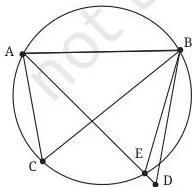
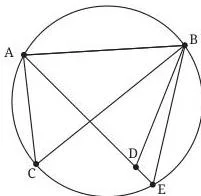
In Fig. 5.27A, D lies outside the circle. The segment AD therefore crosses the circle once more at E, and the order on the line is A, E, D — E sits between A and D.
In Fig. 5.27B, D lies inside the circle. The line AD must be extended beyond D to reach the circle at E, giving the order A, D, E.
The position of E is what the whole proof turns on: it decides which angle of \(\triangle BED\) is the exterior angle — \(\angle AEB\) in Fig. 5.27A, \(\angle ADB\) in Fig. 5.27B. The concyclic points theorem figures are the two pictures you should redraw before writing the proof.
Given, To Prove, and the Idea of the Proof
- Given. A segment AB; points C and D on the same side of AB; neither C nor D lies on the line AB; \(\angle ACB = \angle ADB\).
- To prove. A, B, C, D lie on the same circle.
- Construction. Draw the circle through A, B and C (it exists by Theorem 1), then join AD and test whether D lies on this circle.
The idea behind the proof: a circle through four points cannot be drawn directly, but a circle through three points can. So the proof draws the circle through A, B, C — the three points that are certainly non-collinear — and then shows the fourth point, D, cannot be anywhere else (NCERT, p. 111).
The Proof, Step by Step
The book’s proof is a contradiction proof, run separately for the two positions D can take, as in Fig. 5.27A and Fig. 5.27B (NCERT, pp. 111–112).
- Step 1 — the circle through A, B, C exists. Since C is not on the line AB, the points A, B, C are non-collinear. By Theorem 1, a unique circle passes through A, B and C. Draw it.
- Step 2 — suppose D is not on that circle. Then D is either outside the circle or inside it. Join AD.
- Step 3 — D outside (Fig. 5.27A). Because A is on the circle and D is outside, the segment AD meets the circle once more at E, with the order A, E, D. Points C and E lie on the same side of chord AB, hence in the same segment, so \(\angle ACB = \angle AEB\) (angles in the same segment are equal). In \(\triangle BED\), the angle \(\angle AEB\) is an exterior angle, so it is greater than the remote interior angle \(\angle ADB\): \(\angle AEB \gt \angle ADB\). But \(\angle AEB = \angle ACB = \angle ADB\). Therefore \(\angle ACB \gt \angle ACB\) — an angle greater than itself, impossible.
- Step 4 — D inside (Fig. 5.27B). Extend AD beyond D to meet the circle at E, giving the order A, D, E. Again C and E lie on the same side of chord AB, so \(\angle ACB = \angle AEB\). This time \(\angle ADB\) is the exterior angle of \(\triangle BED\) at D, so \(\angle ADB \gt \angle AEB\). With \(\angle AEB = \angle ACB = \angle ADB\), we reach \(\angle ADB \gt \angle ADB\) — impossible again.
- Step 5 — conclude. Both possibilities under the assumption “D is not on the circle” lead to an angle being greater than itself. The assumption is false, so D lies on the circle through A, B, C. Hence A, B, C, D lie on the same circle — they are concyclic.
Revision checklist — the earlier results this proof depends on, so you know what to revise first:
- Angles in the same segment are equal — used twice, once per case, to get \(\angle ACB = \angle AEB\). It follows from Theorem 9.
- Exterior angle theorem — an exterior angle of a triangle is greater than each remote interior angle; used twice to create the contradiction.
- Theorem 1, the unique circle — guarantees the circle through A, B, C exists before D is tested.
| Case | Where E sits on line AD | Exterior angle used | Contradiction reached |
|---|---|---|---|
| D outside (Fig. 5.27A) | Between A and D: order A, E, D | \(\angle AEB\), at E | \(\angle ACB \gt \angle ACB\) |
| D inside (Fig. 5.27B) | Beyond D: order A, D, E | \(\angle ADB\), at D | \(\angle ADB \gt \angle ADB\) |
Each row names its exterior angle and the exact contradiction reached, so you can reproduce either case in an exam without mixing up the two figures.
Try it yourself: a live practice figure
Where the Book Uses This Theorem Next
Theorem 10 answers the warm-up task the book poses just before section 5.8 (NCERT, p. 111). The task lets A and B be two points on a circle and asks about points X and Y: if \(\angle AXB = \angle AYB\), and X and Y are not on the circle, must the circle through A, B and X also pass through Y?
That last part is exactly what Theorem 10 settles when the points lie on the same side of AB.
Immediately after the theorem, on page 112, the book names a quadrilateral whose four vertices are concyclic a cyclic quadrilateral (the book also calls a quadrilateral a 4-gon) (NCERT, p. 112). It then states Theorem 11, whose proof follows on the same page, with Theorem 12 as its converse.
| Stage | What the book does |
|---|---|
| Exploratory task (p. 111) | Asks whether the circle through A, B and X must pass through Y when \(\angle AXB = \angle AYB\). |
| Theorem 10 (p. 111) | Settles the same-side version: equal angles on the same side force the four points onto one circle. |
| Cyclic quadrilateral (p. 112) | Names a quadrilateral whose vertices are concyclic. |
| Theorem 11 (link) | States the opposite-angles property of a cyclic quadrilateral; the proof is on the same page. |
| Theorem 12 (link) | Gives its converse. |
The Converse and Related Theorems
Theorem 10 is the reverse of the same-segment property. The same-segment property starts from a circle: points on the same side of a chord see it under equal angles. This theorem starts from the angles: equal angles on the same side force the points onto one circle.
Neither direction needs its proof repeated here — but notice that the proof of Theorem 10 uses the same-segment property twice, the very fact it reverses.
The same-segment property itself follows from Theorem 9, and the proof’s first move uses Theorem 1. The theorems that follow this one in the book are Theorem 11 and Theorem 12, the cyclic quadrilateral pair.
Common Mistakes in Proving This Theorem
These are the errors that actually appear in exam attempts of this proof. Each row names the mistake, the rule that fixes it, and a way to check your own work.
| Mistake | Correct rule | How to check your answer |
|---|---|---|
| Dropping the same-side condition | “C, D on the same side of AB” is part of the theorem; without it, equal angles need not force one circle. The opposite-side arrangement belongs to the cyclic quadrilateral pair, Theorem 11 and Theorem 12. | Write first: “C and D lie on the same side of AB, and neither lies on AB.” |
| Placing E in the wrong position | Fig. 5.27A (D outside): E lies between A and D. Fig. 5.27B (D inside): E lies beyond D, order A, D, E. | State the order on line AD before writing any angle equality. |
| Naming the wrong exterior angle | Outside case: \(\angle AEB\) is exterior at E. Inside case: \(\angle ADB\) is exterior at D. | The exterior angle sits at the vertex of \(\triangle BED\) on the ray from A through D. |
| Proving only one case | “D is not on the circle” splits into inside and outside; one case leaves the assumption alive. | End with: both cases are impossible, so D is on the circle. |
| Using the circle through A, B, C without justification | The circle exists because A, B, C are non-collinear (C is not on AB), by Theorem 1. | Open the proof with the non-collinearity sentence. |
| Quoting \(\angle ACB = \angle AEB\) without a reason | The equality holds because C and E lie on the same side of chord AB — angles in the same segment, a consequence of Theorem 9. | Write “angles in the same segment are equal” beside the equality. |
| Stopping at \(\angle AEB = \angle ACB = \angle ADB\) | The chain must end at the contradiction: one angle greater than itself, which is impossible. | Finish the case with “so \(\angle ACB \gt \angle ACB\), which is impossible.” |
Sources and Data Verification
This listing is maintained for the 2026-27 academic session using the NCERT textbook information available to us. NCERT remains the authority for confirming the latest edition.
The theorem statement, proof and both figures on this page come from the NCERT Class 9 Mathematics textbook, Ganita Manjari, Grade 9, Part I, chapter 5, “I’m Up and Down, and Round and Round” — Theorem 10 is printed on pages 111–112 of that edition.
This page is maintained for the current academic session against the NCERT edition published on ncert.nic.in. The official NCERT textbook page for this chapter, where you can open the printed pages and check the theorem exactly as published, is the Class 9 Mathematics book’s chapter 5 page on the NCERT website.
NCERT settles the textbook text; CBSE settles the examinable syllabus. Textbook contents and the examinable syllabus are not always identical, so check the current official syllabus on the CBSE website for what is examinable this session.
Questions Students Search
What does concyclic mean in the NCERT Class 9 circles chapter?
In section 5.8 of chapter 5 (NCERT, p. 111) the book says: “We call points that are on the same circle concyclic.” So a collection of points is concyclic when one single circle passes through all of them. Four concyclic points A, B, C, D share one circle, and the quadrilateral with those vertices is called cyclic.
What are the conditions for four points to be concyclic?
Three of them must be non-collinear so a circle exists at all — any three non-collinear points determine a unique circle by Theorem 1. The fourth point joins that circle when the segment joining two of the points subtends equal angles at the other two on the same side of the segment — that is this theorem.
In practice: check the equal-angle condition and the same-side condition, then the four points are concyclic.
Does the concyclic points theorem work if C and D are on opposite sides of AB?
No — the same-side condition is part of the theorem, and with C, D on opposite sides, equal angles alone do not force one circle. The book’s related arrangement for four points round a circle is its cyclic quadrilateral pair, Theorem 11 and Theorem 12; use those results for that arrangement instead.
Is the concyclic points theorem the reverse of “angles in the same segment are equal”?
Yes. The same-segment property moves from circle to angles: points on the same side of a chord see it under equal angles. Theorem 10 moves the other way: equal angles on the same side put the four points on one circle. Notice that the proof itself uses the same-segment equality twice.
How do I use the concyclic points theorem to prove four points lie on a circle?
Use this one-line template: since \(\angle ACB = \angle ADB\) and C, D lie on the same side of AB, the four points A, B, C, D are concyclic. Then continue with circle results on the four points — for example, once the quadrilateral is cyclic, the opposite-angle property (Theorem 11) becomes available.
Three checks before applying the template: the two angles are equal (given or proven), C and D are on the same side of AB, and neither lies on AB.
Related Resources
- The full chapter page: “I’m Up and Down, and Round and Round” — chapter 5 of Class 9 Maths (Ganita Manjari)
- Class 9 mathematics notes and theorems hub
- Class 9 hub
- CBSE notes directory
- Theorem 1 — the unique circle
- Theorem 9 — the angle-doubling
- Theorem 11 — cyclic quadrilateral angles
- Theorem 12 — its converse
Reference: NCERT Class 9 Mathematics textbook, chapter 5, Theorem 10, official edition on ncert.nic.in.
Explore Class 9 Mathematics
Related chapters:
Official source: download the NCERT textbook free from ncert.nic.in.