
The cyclic quadrilateral theorem is the Class 9 result that opposite angles of a cyclic quadrilateral add up to 180°. This page gives the exact NCERT statement from page 112 of the Ganita Manjari textbook, the book’s own Fig. 5.28, and the proof in exam-ready steps — plus the converse and the mistakes that lose marks.
The exact NCERT statement
Theorem 11 is printed near the end of page 112 of the NCERT Class 9 Mathematics textbook (Ganita Manjari), chapter 5. Quote the statement exactly as the book prints it.
Theorem 11 (NCERT Class 9 Mathematics, page 112) The sum of two opposite angles of a cyclic quadrilateral is \(180^\circ\).
New: practise this theorem. Drag the book’s figure and watch the numbers change, try to break the theorem on purpose, then solve fresh questions with hints.
The statement is compact — the next section unpacks each word.
What the theorem means in plain words
Three terms carry the meaning:
- Cyclic quadrilateral: a quadrilateral whose four vertices all lie on one circle. The book defines it on page 112, just before the theorem. That circle is the quadrilateral’s circumcircle.
- Opposite angles: the angles at opposite vertices. In quadrilateral ABCD, the opposite pairs are the angle at A with the angle at C, and the angle at B with the angle at D.
- Add up to 180°: the two angles are supplementary — together they make a straight line’s worth of angle.
| Opposite pair of vertices | Angles whose sum is 180° |
|---|---|
| A and C | \( \angle BAD + \angle BCD \) |
| B and D | \( \angle ABC + \angle CDA \) |
The practical consequence: in a cyclic quadrilateral, knowing any three angles gives the fourth — subtract the angle opposite the missing one from \( 180^\circ \).
Memory aid: opposite corners of a cyclic quadrilateral add up to a straight line — \( 180^\circ \).
The book’s figure (Fig. 5.28)
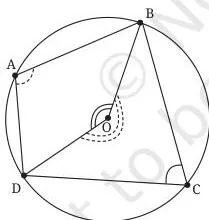
This is Fig. 5.28 from NCERT page 112, and the whole proof is read from it. The circle has centre O, and quadrilateral ABCD sits with all four vertices on the circumference. Two marked angles at O matter:
- The dotted angle is the reflex angle \( \angle BOD \) — the central angle of arc BCD, the long way from B to D through C.
- The double-arc angle is the smaller \( \angle BOD \) — the central angle of arc BAD, the short way from B to D through A.
Both central angles share the same rays, OB and OD; between them they cover the whole turn around O. That single observation finishes the proof.
Given, to prove, and the set-up
The book opens the proof with three pieces only (NCERT, pp. 112–113):
- Given: A, B, C, D are the vertices of a cyclic quadrilateral — the book calls it a “4-gon” — so one circle passes through all four points. Let its centre be O.
- To prove (the book writes “to show”): \( \angle BAD + \angle BCD = 180^\circ \).
- Construction: none. The proof needs no auxiliary line, because the centre O and both arcs BCD and BAD are already marked in Fig. 5.28 (NCERT, p. 112).
Both angle names start with B and end with D: \( \angle BAD \) has its vertex at A and \( \angle BCD \) has its vertex at C, so these are the angles at the two opposite vertices, both standing on the diagonal BD.
Proof, step by step as the book builds it
The proof runs across NCERT pages 112–113. Follow the book’s order. The whole proof is one pairing move, which you can read off Fig. 5.28:
| Angle at the vertex | Arc it stands on | Central angle it is half of |
|---|---|---|
| \( \angle BAD \) (vertex A) | arc BCD — long way from B to D through C | reflex \( \angle BOD \) (dotted) |
| \( \angle BCD \) (vertex C) | arc BAD — short way from B to D through A | \( \angle BOD \) (double arc) |
- Pair \( \angle BAD \) with the reflex angle at O. The rays OB and OD cut the circle into two arcs: the long one passes through C (arc BCD) and the short one passes through A (arc BAD). Vertex A lies outside arc BCD. Applying Theorem 9, the angle at A is half the angle that arc BCD subtends at the centre. Travelling from OB to OD through C sweeps the dotted reflex angle, so \( \angle BAD = \frac{1}{2}(\text{reflex } \angle BOD) \).
- Pair \( \angle BCD \) with the small angle at O. Vertex C lies outside arc BAD. Applying Theorem 9 again, \( \angle BCD \) is half the angle that arc BAD subtends at the centre. Travelling from OB to OD through A gives the smaller \( \angle BOD \), marked with the double arc, so \( \angle BCD = \frac{1}{2}(\angle BOD) \).
- Add the two central angles to a full turn. The dotted reflex angle and the double-arc angle share the same rays OB and OD — one is the long way round and the other the short way round. Together they fill the space around O with no gap and no overlap: one complete rotation, \( 360^\circ \).
- Add the two equations. The factor \( \frac{1}{2} \) comes out of both terms:
\[ \angle BAD + \angle BCD = \frac{1}{2}(\text{reflex } \angle BOD + \angle BOD) = \frac{1}{2} \times 360^\circ = 180^\circ. \]
Hence proved: opposite angles of a cyclic quadrilateral add up to \( 180^\circ \).
Steps 1 and 2 each apply Theorem 9 — naming it in an exam answer shows the examiner exactly which tool you are using.
Try it yourself: a live practice figure
Where the book uses this theorem next
Theorem 11 is not the end of the story (NCERT, p. 113). The book immediately announces that the converse also holds, states it as Theorem 12, and proves it: it constructs a circle through three vertices and reaches a contradiction, and at the heart of that argument it applies this very theorem to the cyclic quadrilateral ABED.
Theorem 11 is the engine inside the proof of Theorem 12.
The same page ends with a check question: a quadrilateral is claimed to have angles \( 80^\circ, 110^\circ, 100^\circ \) and \( 70^\circ \), and you are asked whether such a quadrilateral can be drawn, with an explanation. Try it yourself before reading on — the question tests whether you can turn this theorem around.
The converse and the theorems around it
Theorem 12 is the converse — it reverses this theorem. Use Theorem 11 only after concyclicity is established; when you must prove that four points lie on a circle, Theorem 12 is the tool.
This proof leans on Theorem 9, used twice in this proof. Theorem 10, the preceding theorem of the chapter, sits right before this pair. The Class 9 Mathematics theorems hub lists the chapter’s full set.
Common mistakes when proving this theorem
These five slips are the ones students make when writing this proof:
| Mistake | Correct rule | How to check your answer |
|---|---|---|
| Pairing \( \angle BAD \) with the small \( \angle BOD \) instead of the dotted reflex angle | \( \angle BAD \) stands on arc BCD, so it is half of the reflex \( \angle BOD \) | Trace which arc the vertex lies outside: A is outside arc BCD, so A’s angle pairs with arc BCD’s central angle |
| Writing “\( \angle BOD \)” where the reflex angle is meant | Name the dotted one the reflex \( \angle BOD \); the double-arc one is the ordinary \( \angle BOD \) | If both central angles look the same on paper, a reader cannot tell the two arcs apart |
| Skipping the 360° sentence | State that the two central angles share rays OB and OD and together make one complete rotation of \( 360^\circ \) | The final step only works once both central angles have been added — that sentence is its reason |
| Omitting the factor \( \frac{1}{2} \) | Each angle at the circumference is half of its central angle, so \( \frac{1}{2} \) belongs in both equations | Without the halves the sum would come out \( 360^\circ \), not \( 180^\circ \) — a result that should stop you |
| Calling a quadrilateral cyclic before its vertices are on the circle | “Cyclic” means all four vertices lie on one circle (NCERT, p. 112); a quadrilateral merely inside a circle is not cyclic unless its corners touch the circumference | To prove four points are concyclic, use the converse — Theorem 12 |
Questions students ask about this theorem
What is the cyclic quadrilateral theorem?
It states that the two angles at opposite vertices of a cyclic quadrilateral add up to \( 180^\circ \) (NCERT, p. 112). With vertices A, B, C, D in order, that means \( \angle A + \angle C = 180^\circ \) and \( \angle B + \angle D = 180^\circ \).
Why do opposite angles of a cyclic quadrilateral add up to 180°?
Because each is half of a central angle: \( \angle BAD = \frac{1}{2}(\text{reflex } \angle BOD) \) and \( \angle BCD = \frac{1}{2}(\angle BOD) \). The two central angles share the rays OB and OD, so together they make one full rotation of \( 360^\circ \); half of that is \( 180^\circ \).
What is the converse of the cyclic quadrilateral theorem?
The book states it as Theorem 12, right after this one. It reverses this theorem, and it is the statement to use when you need to prove that four points are concyclic.
How do I find a missing angle in a cyclic quadrilateral?
Subtract the opposite angle you know from \( 180^\circ \). For example, if \( \angle B = 65^\circ \), then \( \angle D = 180^\circ – 65^\circ = 115^\circ \).
What does it mean for a quadrilateral to be cyclic?
All four vertices lie on a single circle (NCERT, p. 112) — every corner touches the circumference. A quadrilateral drawn inside a circle without its corners on the circumference is not necessarily cyclic.
Does the theorem work for squares and rectangles inscribed in a circle?
Yes. A square or rectangle inscribed in a circle has all four corners on the circle, so it is cyclic. Every angle is \( 90^\circ \), and each opposite pair gives \( 90^\circ + 90^\circ = 180^\circ \), exactly as the theorem says.
Related resources
This listing is maintained for the 2026-27 academic session using the NCERT textbook information available to us. NCERT remains the authority for confirming the latest edition.
Keep working through the same chapter:
- Chapter 5, “I’m Up and Down, and Round and Round” — the full textbook chapter containing Theorem 11.
- Class 9 Mathematics theorems hub — one page for every theorem in the book.
- Theorem 10 — the preceding theorem.
- Theorem 12 — the converse.
- Theorem 9 — the theorem this proof applies twice.
For broader revision: mathematics notes for Class 9, all Class 9 subjects, and the main notes hub.
The official NCERT textbook portal at ncert.nic.in makes the Class 9 Mathematics book (Ganita Manjari) available for download, including chapter 5 where this theorem appears.
Textbook contents and the examinable syllabus are not always identical — check the current official syllabus.
Reference: NCERT Class 9 Mathematics textbook, chapter 5, Theorem 11, official edition on ncert.nic.in.
Explore Class 9 Mathematics
Related chapters: