
How Much Can We Spend ? Class 1 Chapter 12 is the money chapter of the NCERT Joyful Mathematics book (current academic session) — five printed pages that teach coins, notes and buying through pictures, counting and a classroom shop.
The official NCERT PDF of the chapter is on this page, together with a plain-language guide to what it teaches: the denominations it uses, what each task asks, and the money ideas a child takes away.
The official chapter file is hosted on ncert.nic.in, and this is the complete printed chapter — all five pages, the coin and note pictures, and every task. Open the Class 1 Maths Chapter 12 How Much Can We Spend ? PDF from the NCERT textbooks page.
Chapter 12 at a Glance
Before starting, check how much the chapter holds — its sections, activities and question blocks — in the table below, built from the chapter’s contents. It is an activity chapter with no worked examples, no formulas and no numbered exercise block, so the work is short.
| What the chapter holds | Count | Where it is used |
|---|---|---|
| Printed pages | 5 | |
| Figures with NCERT captions | 2 | |
| Tables | 1 | |
| Activities | 2 | |
| Official NCERT PDF | Download the chapter PDF | the chapter exactly as NCERT publishes it |
How Much Can We Spend ? Class 1: What This Chapter Teaches
This chapter teaches money the way young children learn best — through counting, comparing and playing shop, not through formulas. It opens with two children, Riya and Sahil, and a toy seller, Rahim Kaka, whose shop supplies every price in the tasks.
- Opening page — coins and notes. Riya counts coins of ₹1, ₹2, ₹5 and ₹10; Sahil counts notes of ₹10, ₹20, ₹50 and ₹100. The child looks at each picture and writes the denomination underneath.
- Let us Do — five tasks (A to E). A: a ball costs ₹20 — Riya pays with four ₹5 coins and Sahil with two ₹10 notes (\(4 \times 5 = 20\) and \(2 \times 10 = 20\)). B and C: name the toys you can buy for ₹10, then for ₹20. D: a toy car costs ₹14 and Riya has ₹10 — how much more does she need? E: Riya and Sahil together have ₹30 — name the toys they can buy, find the total amount and tick the correct option.
- Let us Play — a classroom shop. Children make their own currency notes and coins from paper slips, then play a shopping game: some children are shopkeepers, others are customers, and everyone is encouraged to pay in different combinations.
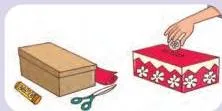
- Project Work — a gullak. Children make a piggy bank (gullak) from a spare box at home with the help of siblings or elders, and form different combinations for a given amount using play money.
Later pages add two more practice activities: filling or drawing an amount in different combinations using the given currency, and matching equal amounts by drawing a line. The chapter also carries a discussion prompt: “saving money is a good habit — discuss”.
Coins, Notes and Prices: The Money Ideas Here
These are the ideas behind every task in the chapter — if a child understands these five, the tasks take care of themselves.
- Every coin and note has a value. The value is how many rupees that one piece is worth.
- A denomination is the value written on the money. A coin with 5 written on it has the denomination ₹5.
- Counting money means adding values. A ₹10 note and a ₹5 coin together are \(10 + 5 = 15\) rupees.
- “Can we buy this?” means comparing. Your total is checked against the price — the money must be equal to or more than the price.
- “How much more?” means finding the difference. When the price is bigger than your money, subtract — the answer is how much more you need.
The amounts in this chapter stay small — prices of ₹10, ₹14 and ₹20, and a spending budget of ₹30 — so the adding and subtracting stays inside a young child’s counting range.
Reading the Coin and Note Pictures in the Chapter
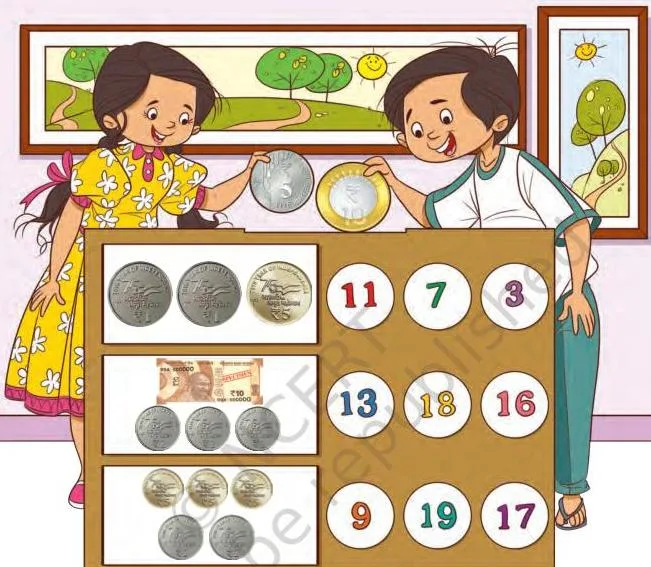
The first skill the chapter asks for is recognising each coin and note from its picture. Because the book is picture-led, the rule to teach is simple: read the number, and never guess by size or colour.
| Picture in the book | It is worth | Say it aloud as |
|---|---|---|
| Coin marked 1 | ₹1 | a one-rupee coin |
| Coin marked 2 | ₹2 | a two-rupee coin |
| Coin marked 5 | ₹5 | a five-rupee coin |
| Coin marked 10 | ₹10 | a ten-rupee coin |
| Note marked 10 | ₹10 | a ten-rupee note |
| Note marked 20 | ₹20 | a twenty-rupee note |
| Note marked 50 | ₹50 | a fifty-rupee note |
| Note marked 100 | ₹100 | a hundred-rupee note |
That is the full set of values the chapter uses: four coins and four notes. Teach the child to name each one aloud while pointing at the number — “a five-rupee coin” — because size and colour do not tell you the value reliably.
Money Words in Plain Language
The chapter uses a handful of money words. Here they are, in words a young child — and a parent who is not a maths specialist — can read without stopping.
- Coin — a round piece of metal money. The chapter shows coins of ₹1, ₹2, ₹5 and ₹10.
- Note — paper money. The chapter shows notes of ₹10, ₹20, ₹50 and ₹100.
- Denomination — the value written on a coin or note. It tells you how many rupees one piece is worth.
- Price — the money a shopkeeper asks for something. Rahim Kaka’s prices in this chapter are ₹10, ₹14 and ₹20.
- Total — the value you get when you add all the money together.
- Enough money — your total is equal to or more than the price.
- How much more — the difference you still need when the price is bigger than your money.
- Gullak — the Hindi word for a piggy bank, used in the Project Work.
Making One Amount in Different Ways
This is the chapter’s key idea: ten ₹1 coins and one ₹10 note are different pieces of money but exactly the same value. More pieces never means more money.
| Amount | Ways to make it with the chapter’s coins and notes |
|---|---|
| ₹10 | ten ₹1 coins, five ₹2 coins, two ₹5 coins, or one ₹10 coin or note |
| ₹20 | twenty ₹1 coins, ten ₹2 coins, four ₹5 coins, two ₹10 coins or notes, or one ₹20 note |
Read the table aloud with the child and let them see the pattern: a single ₹20 note and twenty ₹1 coins are the same amount. This is exactly the skill behind Let us Play (pay money in different combinations) and the Project Work (form different combinations for a given amount).
Is the Money Enough? A Step by Step Check
This is the question type where children most often go wrong — in “how much more?” questions they add when they should subtract. Three steps fix it.
- Add the money you have to find your total.
- Compare your total with the price.
- If the price is bigger, subtract the smaller number from the bigger one. The answer is how much more money is needed.
Worked example 1 — a ₹7 pencil: the child has two ₹5 coins.
Step 1: Find the total.
Two ₹5 coins: \(5 + 5 = 10\) rupees.
Step 2: Compare.
The total is 10 and the price is 7.
Ten is more than seven, so the money is enough.
Step 3: Find what is left over.
\(10 – 7 = 3\) rupees.
Answer: The money is enough, and the child gets ₹3 back.
Worked example 2 — a ₹12 crayon: the child has one ₹10 note.
Step 1: Compare.
The price (12) is bigger than the money (10).
Step 2: Subtract to find how much more is needed.
\(12 – 10 = 2\) rupees.
Answer: The child needs ₹2 more.
In both examples the wrong move would have been to add. Adding in example 2 gives \(12 + 10 = 22\), which is not an answer to “how much more” — subtraction always answers it when the price is bigger.
Common Money Mistakes Young Children Make
These five mistakes come straight out of this chapter’s task types. Naming the correction before the child meets the task stops the mistake before it happens.
| Mistake | Correct rule | How to check your answer |
|---|---|---|
| Judging a coin by size or colour instead of reading the number | Always read the number printed on the coin; that number is its value | Ask the child to point to the number on the coin and say the value aloud |
| Counting a ₹10 note as “one thing”, so it is treated as 1 rupee | The number on the note is its value — one ₹10 note is worth ten rupees | Ask: how many ₹1 coins make one ₹10 note? The answer is ten |
| Thinking more coins always means more money | More pieces is not more money; add the values first, then compare | Ask whether ten ₹1 coins (₹10) are worth more than one ₹20 note (₹20) — they are worth less |
| In “how much more?” questions, adding price and money instead of finding the difference | When the price is bigger than the money, subtract: deduct the smaller from the bigger | For the ₹14 car, the answer is \(14 – 10 = 4\), not \(14 + 10 = 24\) |
| Choosing toys in Task E without first adding the total | Add every chosen toy’s price, then compare the total with ₹30 and tick only if it fits | Make the child say the total aloud before ticking: “this toy costs this much, plus this much, so the total is…” |
A Home Shopping Game (No Printing Needed)
Let us Play works just as well at home as in the classroom, with things every house already has. Here is a five-minute version with no printing needed.
- Write values on paper slips to make play money — a few each of ₹1, ₹2, ₹5, ₹10 and ₹20.
- Price five to ten small household objects at amounts under ₹20.
- One person is the shopkeeper and the other is the customer, as in the chapter’s classroom game.
- Ask the customer to pay in at least two different ways, and to say whether the money is enough before buying.
The Project Work adds the saving side: a gullak (piggy bank) made from a spare box with the help of siblings or elders. Making it opens the saving habit, and the chapter also carries the prompt “saving money is a good habit — discuss” — a good five-minute conversation at home.
How Class 1 Money Work Is Usually Checked
Class 1 maths is assessed by the school, not by a board exam, so the chapter’s skills are checked through classroom activity and observation. The chapter’s own tasks are the typical checks: naming a coin or note, making one amount in different combinations, and answering “how much more”.
Note that textbook contents and the examinable syllabus are not always identical — check the current official syllabus on the CBSE website before planning school work.
At home, practise three things: reading coin and note values, making ₹10 and ₹20 in two different ways, and the “is the money enough?” question. These three cover everything the chapter asks a child to do.
Quick Recap: What to Remember From Chapter 12
A night-before review of Chapter 12, in six lines.
- The chapter’s money set: coins of ₹1, ₹2, ₹5 and ₹10; notes of ₹10, ₹20, ₹50 and ₹100.
- The value of money comes from adding coins and notes, not from counting pieces.
- The same amount can be made in different ways — ten ₹1 coins or one ₹10 note.
- Compare your total with the price to see if the money is enough.
- If the price is bigger, subtract to find how much more money is needed.
- Money can be saved in a gullak, and saving money is a good habit.
Related NCERT Class 1 Resources
This listing is maintained for the 2026-27 academic session using the NCERT textbook information available to us. NCERT remains the authority for confirming the latest edition.
Chapter 12 sits inside the NCERT Class 1 Joyful Mathematics book. These pages cover the rest of the class’s work.
- Class 1 Joyful Mathematics book page — the whole book, chapter by chapter.
- Class 1 hub — the starting point for this site’s Class 1 notes.
- CBSE notes home — the main notes index on this site.
- Reading the book in order? Go to the Class 1 Joyful Mathematics Chapter 11 page for the chapter before this one, and the Class 1 Joyful Mathematics Chapter 13 page for the chapter after it.
Sources and Data Verification
The descriptions on this page are based on the NCERT Joyful Mathematics textbook for Class 1 (English), official edition on ncert.nic.in, and cover Chapter 12 — How Much Can We Spend ? — only, not the whole book.
NCERT settles textbooks, editions and PDFs; CBSE settles the curriculum and examinations. Textbook contents and the examinable syllabus are not always identical, so check the current official syllabus before planning school work.
Reference: NCERT Class 1 Mathematics (Joyful Mathematics) textbook, chapter 12, official edition on ncert.nic.in.
Frequently Asked Questions
Which coins and notes are used in How Much Can We Spend ? Class 1 chapter 12?
The chapter shows four coins — ₹1, ₹2, ₹5 and ₹10 — and four notes — ₹10, ₹20, ₹50 and ₹100. Riya counts the coins and Sahil counts the notes, and children write the denomination under each picture.
How many different ways can you make ₹20 with coins and notes?
Five ways using the chapter’s coins and notes: twenty ₹1 coins, ten ₹2 coins, four ₹5 coins, two ₹10 coins or notes, or one ₹20 note. Any mixture adds to the same value, and mixing is exactly what “pay in different combinations” asks for.
What is a gullak and why does the chapter ask children to make one?
A gullak is the Hindi word for a piggy bank. The Project Work asks children to make one from a spare box at home with the help of siblings or elders, so the chapter ends by opening the habit of saving — its pages include the prompt “saving money is a good habit — discuss”.
How do I explain ‘how much more money is needed’ to a Class 1 child?
Use the chapter’s own example: the toy car costs ₹14 and Riya has ₹10, so she needs ₹4 more. Say it as a comparison — “₹14 is ₹4 more than ₹10” — and only then show the subtraction. If the price is bigger than the money, the difference is how much more is needed.
Does Class 1 Maths have a board exam?
No. Class 1 is assessed by the school through classroom activities and observation, not by any board exam. NCERT’s textbook contents and the examinable syllabus are not always identical, so check the current official syllabus.
What does denomination mean for a Class 1 child?
Denomination is the value written on a coin or note — the number that tells how many rupees that piece is worth. A note with 10 written on it has the denomination ₹10 and is worth ten rupees.
Explore Class 1 Mathematics Books
- Previous: How Many Times?
- Next: So Many Toys
Related chapters:
- Finding the Furry Cat!
- What is Long?
- Mango Treat