
Looking for the official Making 10 Class 1 chapter? This page gives you the NCERT Class 1 Joyful Mathematics Chapter 4 PDF and explains, in plain words, what the chapter teaches — so you can sit with a child and work through it together.
The chapter is story-driven and full of hands-on games, and the official PDF is published free by NCERT. Everything below is a parent-and-child guide to what is inside it.
Download the official Making 10 Class 1 PDF
NCERT publishes the whole Joyful Mathematics Class 1 book as one official PDF, and Chapter 4 sits inside it. Open the NCERT Class 1 Joyful Mathematics Chapter 4 Making 10 PDF from the official NCERT textbooks portal — it is the published English edition, and it is the only file you need to work through this chapter.
Chapter 4 at a glance: what the NCERT file contains
The table below lists what Chapter 4 holds — its sections, figures, tables and activities — so you can see the chapter’s size at one glance. It describes this NCERT textbook chapter, not the CBSE syllabus.
| What the chapter holds | Count | Where it is used |
|---|---|---|
| Printed pages | 15 | |
| Figures with NCERT captions | 11 | |
| Tables | 7 | |
| Activities | 2 | |
| Official NCERT PDF | Download the chapter PDF | the chapter exactly as NCERT publishes it |
Below the table, the chapter’s sections in the order they appear:
- Dotty Bug and her Designs
- Vanishing Buttons
- Tenth Birthday — the story of Aastha’s tenth birthday, where she is 9 years old now and will be 10 after one more year
- Let us Do (first block — bead strings and ten frames)
- The Handy Five and Ten
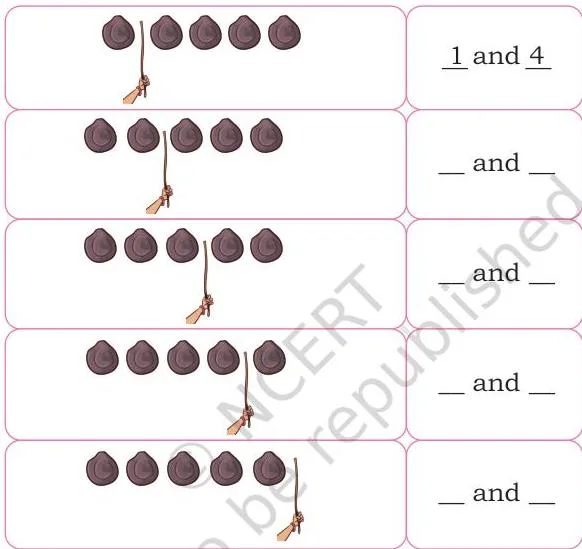
- Number Pairs of 10
- Number Cards (Sets of 0 to 10)
- Counting up to 20
- Count and Write
- Let us Do (second block — smallest, biggest, hidden numbers, towers)
- Project Work
Note that “Let us Do” appears twice in the chapter, at two different points: the first block has the bead-string and ten-frame tasks, and the later block has the smallest-and-biggest tasks.
What Making 10 covers: from dot patterns to counting up to 20
This section maps the whole chapter so you can see where a child is going before any single activity starts. The chapter follows one clear learning order:
- Recognise dot patterns first — Dotty Bug trains instant recognition of numbers 1 to 9 without counting.
- Count down to zero — Gola monkey’s shirt loses its buttons one by one, 4, 3, 2, 1, 0.
- Make pairs of 5 on one hand — The Handy Five and Ten.
- Make pairs of 10 on two hands — Number Pairs of 10 and the card game.
- Count and compare up to 20 — one group of ten plus leftovers.
Aastha’s birthday story makes the turning point: she is 9 years old now, and after 1 more year she will be 10. 9 and 1 more makes 10. The orange-box story extends the same idea — a box holds 10 oranges, so 11 is 10 and 1, 15 is 10 and 5, and 20 is 10 and 10.
The chapter closes with tasks that compare, order and estimate numbers up to 20 — circling the smallest and biggest numbers, writing numbers biggest to smallest, and guessing how many seeds or buttons are in a handful before counting. Throughout, the book teaches through stories and games rather than printed exercise sets.
It is worth saying plainly: the Making 10 Class 1 chapter is a hands-on chapter — there is nothing to memorise, only things to do.
The key ideas behind the Making 10 activities
Class 1 children understand numbers through objects, fingers and pictures, not abstract rules. That is why this chapter is activity-heavy — every activity hides one maths idea underneath it.
| Activity | The maths idea | One thing to watch |
|---|---|---|
| Dotty Bug and her Designs | Subitising — seeing how many dots at a glance, without counting. The book’s teacher note calls this “subitization”. | Flash a dot card briefly and ask “how many?” before the child counts. |
| Vanishing Buttons | Zero is a number like one and two, and counting backwards from 4 to 0. | A child may treat zero as “nothing to write” — the book’s note says to accept zero as a real number. |
| The Handy Five and Ten | Number pairs of 5 first (one hand), then of 10 (two hands). | Ask “3 and how many more make 5?” — the answer is the folded fingers. |
| Number Pairs of 10 | Complements of 10 — the pairs of numbers that add up to 10. | Ask “4 and how many more make 10?” and expect the instant answer 6. |
| Counting up to 20 | A group of ten plus leftovers — every number 11 to 20 is “10 and something”. | Count the full ten first, then the leftovers; avoid counting one-by-one through 15. |
| Count and Write | Comparing by “how many more”, not by how the numbers look. | The book’s note: 15 is bigger than 11 because it is 4 more. |
| Counting up to 20 (teacher note) | Guess-then-check estimation — guess a handful, then group and count. | Ask “how close was your guess?” and let the child explain the reason. |
Five of the chapter’s games need nothing but hands and small objects, so they work with no printing:
- Dot cards — show a card of dots, name the number without counting.
- Dice grid — roll the die, recognise the pips, colour the matching box.
- Finger game — child shows 3 fingers, partner shows 7 to make 10.
- Vanishing buttons — count the buttons backwards 4, 3, 2, 1, 0 as each one pops off.
- Number card game — two players, cards face down, pairs that make 10 win the cards.
Number pairs of 10: the finger game and the complete list
A number pair of 10 is two numbers that together make 10, like 9 and 1. The chapter practises pairs of 5 first on one hand, because one hand has 5 fingers, and then pairs of 10 on both hands.
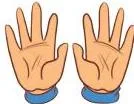
In the finger game, one child shows some fingers. The partner shows the fingers that are folded — the ones that complete ten.
| Fingers shown | Fingers folded | They make |
|---|---|---|
| 0 | 10 | 10 |
| 1 | 9 | 10 |
| 2 | 8 | 10 |
| 3 | 7 | 10 |
| 4 | 6 | 10 |
| 5 | 5 | 10 |
| 6 | 4 | 10 |
| 7 | 3 | 10 |
| 8 | 2 | 10 |
| 9 | 1 | 10 |
| 10 | 0 | 10 |
That is the complete list, from 0 and 10 up to 10 and 0. Zero appears at both ends: showing no fingers needs the partner to show all ten, and showing ten fingers needs zero folded.
Worked example with new numbers — the book’s own example uses 9 and 1, so try these instead:
If the child shows 3 fingers, the partner must show 7. Check by counting on from 3 to 10: 4, 5, 6, 7, 8, 9, 10 — that is 7 more, so \(3 + 7 = 10\).
If the child shows 6 fingers, the partner shows 4. Count on from 6: 7, 8, 9, 10 — 4 more, so \(6 + 4 = 10\).
The chapter’s number-card game turns the same pairs into a card game. Make 5 sets of cards numbered 1 to 10 — 50 cards in all — and keep them face down.
One child turns up a card, and the second child turns up another. If the pair makes 10, the second child takes both cards, and the turn passes back to the first child. The child holding more cards at the end wins.
The book’s teacher note suggests the same drill aloud: when working with partitions of 10, if one child says 4, the other should answer 6.
Counting up to 20: a box of 10 oranges and what is left over
This is the place-value seed of the whole chapter. Past 10, the book never asks a child to count one-by-one only: it groups a ten first, then counts what is left over.
The story: Simran, who lives in Nagpur, helps her father pack oranges. A box holds 10 oranges. Ten loose oranges fill one box, 11 oranges are one full box and 1 outside it, and the pattern runs all the way to 20:
| Pattern | Number | Say it as |
|---|---|---|
| 10 and 1 | 11 | one ten and one |
| 10 and 2 | 12 | one ten and two |
| 10 and 3 | 13 | one ten and three |
| 10 and 4 | 14 | one ten and four |
| 10 and 5 | 15 | one ten and five |
| 10 and 6 | 16 | one ten and six |
| 10 and 7 | 17 | one ten and seven |
| 10 and 8 | 18 | one ten and eight |
| 10 and 9 | 19 | one ten and nine |
| 10 and 10 | 20 | two tens |
The “Say it as” column is the one to practise aloud, because it makes the structure of the number visible. For example, 13 is 10 and 3 — one ten and three — and this idea of a ten plus leftovers is where place value begins.
Two naming quirks to expect: eleven and twelve do not sound like “ten and one” and “ten and two”, and in thirteen to nineteen the ones digit is written after the 1 (13, not 31). The book’s teacher note adds the principle beneath the whole count: there is always a number one more than the previous number.
The chapter’s supporting tasks around this idea: writing 11 to 20, colouring ten frames to show a number, filling missing numbers in sequences, encircling a group of ten in a picture, and finding hidden numbers “under the paw” in a sequence such as 15, 16, __, 18.
Picture activities in the chapter and what each one trains






The pictures in this book do the teaching — they have no captions of their own, so this section explains what each picture is asking. One line per activity on what the child practises:
- The dotty bugs (Dotty Bug and her Designs) — count the dots on each ladybug, then make your own dot designs with tamarind seeds, pebbles, buttons or bindis. This trains instant recognition without counting — subitising — for dot patterns of 1 to 9.
- The dice-and-colour grid — roll the dice, recognise the pip count at a glance, and colour the box with the same number of dots. The child with more coloured boxes wins.
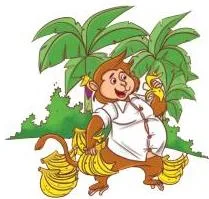
- The shirt buttons (Vanishing Buttons) — Gola monkey’s shirt starts with 4 buttons, then 3, 2, 1, and ends with 0. The child counts backwards to zero.
- The birthday objects (Tenth Birthday) — diyas, beads, laddoos, crayons, bananas and leaves, each to be counted and written.
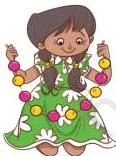
- The ten frames and bead strings (the first Let us Do) — count and draw beads to make a string of exactly 10, and draw buttons to fill a ten frame. This practises filling 10.
- The orange boxes and block towers — count the oranges in boxes, then look at the block towers: tick the tallest, find the tower with the most blocks and the tower with the least blocks, and write the block count for each.
- The project (Project Work) — find things around the house that come in groups of 10, and make number cards 10 to 20 from old cardboard.
Definitions a Class 1 child meets in this chapter
Six words are worth knowing before you start, each in one line:
- Subitising — seeing how many at a glance without counting. The book’s teacher note calls it “subitization”.
- Zero — the number that means none. Gola monkey ends with 0 buttons.
- Number pair (of 10) — two numbers that together make 10, like 3 and 7.
- Ten frame — a frame of ten boxes a child fills with buttons to see the number 10.
- Group of ten — ten objects taken together, like one full box of oranges.
- Count backwards — counting down instead of up: 5, 4, 3, 2, 1, 0.
Common mistakes when learning to make 10
Mistakes at this age are normal, and the chapter’s games are designed to bring them out. Each one below comes with a correction, marked with its source — the book’s own teacher note, or plain teaching advice.
| Mistake | Correct rule | How to check your answer |
|---|---|---|
| Leaving the count blank for zero, because “nothing” seems not worth writing | Zero is a number like one and two — write the numeral 0 (book’s teacher note, Vanishing Buttons). | End the shirt-button count with a clear written 0, never an empty box. |
| In the finger game, the partner shows any handful of fingers instead of the ones that finish ten | The partner shows the folded fingers only — the number that completes ten (book’s game rule). | Ask “3 and how many more make 10?” before any fingers move (teaching advice). |
| Counting objects past 10 one-by-one and losing the count | Group a ten first, then count the leftovers (book, Counting up to 20). | Encircle a group of ten in the picture before counting, as the chapter’s task asks. |
| Deciding which number is bigger by looking at the digits or the picture | Compare by “how many more” — 15 is bigger than 11 because it is 4 more (book’s note, Count and Write). | Count on from 11 to 15 and count the steps — 12, 13, 14, 15 is 4 more, so 15 is the bigger number. |
| Writing teen numbers back to front, such as 14 as 41 | Say “one ten and four” while the child writes the 1, then the 4 (teaching advice). | Read the written number aloud as “one ten and …” and listen for whether the digits match. |
| Expecting eleven and twelve to behave like “ten one” and “ten two” | Eleven and twelve have their own names; the “10 and …” pattern holds for 13 to 19 (teaching advice). | Practise aloud “10 and 1 is 11, 10 and 2 is 12” until the names feel normal. |
How this chapter is checked in Class 1
This is a Class 1 chapter, so no mark promises belong on this page. Understanding is shown by doing the chapter’s own activities aloud: recognising a dot pattern without counting, completing 10 with fingers, counting a handful of objects up to 20 accurately, and comparing two numbers by counting on.
The book builds these checks into its games and discussion prompts — the dice grid, the finger game, the guess-then-count seed activity — rather than into a test at the end. Textbook contents and the examinable syllabus are not always identical, so check the current official CBSE syllabus for what is examined this session.
Skills to check before leaving Chapter 4
This chapter closes with activities and project work, not a printed summary. Use this list as the parent-and-child checklist instead — each item is a task the book itself sets:
- Recognise dot patterns of 1 to 9 without counting (Dotty Bug’s bugs and the dot cards).
- Count backwards from 9 to 0, and write 0 for none (Vanishing Buttons).
- Make pairs for 5 on one hand — for example, 3 and 2 (The Handy Five and Ten).
- Make pairs for 10 on two hands — for example, 3 and 7, and 6 and 4 (Number Pairs of 10).
- Count and write 11 to 20 as a group of ten plus leftovers — 13 is 10 and 3 (Counting up to 20).
- Order numbers up to 20 — circle the smallest, circle the biggest, write a row biggest to smallest (the second Let us Do).
- Compare by “how many more” — 15 is 4 more than 11 (Count and Write).
- Find groups of 10 around the house for the project, and make number cards 10 to 20 (Project Work).
Related resources: the Class 1 Joyful Mathematics book
This listing is maintained for the 2026-27 academic session using the NCERT textbook information available to us. NCERT remains the authority for confirming the latest edition.
Keep the whole book and the neighbouring chapters close while working through Chapter 4.
- Class 1 Joyful Mathematics book page — all chapters of this book in one place.
- Class 1 NCERT books hub — the other NCERT Class 1 books.
- Chapter 3, Mango Treat — the chapter before this one.
- Chapter 5, How Many? — the chapter that follows.
- CBSE notes hub — study material across classes and subjects.
All chapter files come from the official NCERT textbooks portal, where NCERT publishes every textbook PDF.
Reference: NCERT Class 1 Joyful Mathematics textbook, chapter 4, official edition on ncert.nic.in.
Sources and data verification
Four plain facts about what this page describes:
- The details above describe NCERT’s Class 1 Mathematics textbook, Joyful Mathematics, Chapter 4 “Making 10”, English edition published by NCERT.
- This page covers the Class 1 Mathematics NCERT book only — not other subjects, and not the wider CBSE scheme.
- The listing is maintained for the current academic session using the NCERT edition available on ncert.nic.in.
- NCERT settles textbooks, editions and PDFs; CBSE settles curriculum, syllabus and examinations.
Frequently asked questions about Making 10, Class 1
Short answers to the questions parents most often search for about this chapter.
Which NCERT book contains Chapter 4 Making 10 for Class 1?
The NCERT Class 1 Mathematics book is called Joyful Mathematics. Chapter 4, “Making 10”, sits inside this book, and the whole book is published as one official PDF on ncert.nic.in.
What does a Class 1 child learn in the Making 10 chapter?
Number sense for 0 to 20: instant recognition of dot patterns, zero as a real number, pairs of 5 and pairs of 10, counting 11 to 20 as a group of ten plus leftovers, and comparing numbers by “how many more”.
How do I teach a child the number pairs that make 10?
Use the finger game: one child shows some fingers, and the partner shows the folded fingers that complete ten. Then say the pattern aloud — “3 and how many more make 10?” — and practise with the full pair list from 0 and 10 up to 10 and 0.
Does Chapter 4 also teach counting beyond 10?
Yes, up to 20. Every number from 11 to 20 is taught as one group of ten plus leftovers: 11 is 10 and 1, 15 is 10 and 5, 20 is 10 and 10.
Is Making 10 part of the current CBSE Class 1 syllabus?
The chapter is in the current NCERT textbook. Textbook contents and the examinable syllabus are not always identical, so check the current official CBSE syllabus for the session’s requirements.
Where can I download the official NCERT Class 1 Joyful Mathematics PDF?
From the official NCERT textbooks portal. Choose Class 1, Mathematics, Joyful Mathematics, and open Chapter 4.
Explore Class 1 Mathematics Books
- Previous: Mango Treat
- Next: How Many?
Related chapters:
- Finding the Furry Cat!
- What is Long?
- Vegetable Farm