
This page gives you the official NCERT Joyful Mathematics Class 1 textbook chapter, How Many?, and a plain-language guide to what it teaches. The How Many? Class 1 chapter runs 16 pages and introduces addition and subtraction through play — park scenes, dice, beads and a number strip. The official chapter PDF is right below, ready to open or print.
Download the official How Many? Class 1 chapter PDF
The chapter sits inside NCERT’s Joyful Mathematics Class 1 book, and NCERT makes the whole textbook freely available on its official website. Open the How Many? Class 1 NCERT Maths Chapter 5 PDF to read the full chapter on screen or print it — the PDF keeps the original pictures, games and rhymes that the explanations below refer to.
Chapter at a glance
The table below lists the chapter’s sections, activities and other counts, as recorded from the official NCERT edition.
| What the chapter holds | Count | Where it is used |
|---|---|---|
| Printed pages | 16 | |
| Figures with NCERT captions | 9 | |
| Tables | 4 | |
| Activities | 4 | |
| Official NCERT PDF | Download the chapter PDF | the chapter exactly as NCERT publishes it |
What this chapter covers: from park scene to number strips
The chapter is built as a sequence of play tasks, and each task quietly teaches one maths idea. This walk-through names the activities in order so you know what to expect on each page.
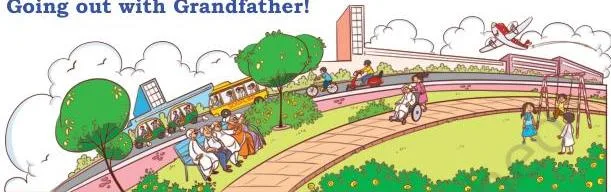
- The park scene opens the chapter: children talk about what people do in the park, how many children are playing and how many joined them — an early “how many altogether?” question before any symbols appear.
- “Tell How many Altogether? Fill in the Blanks” joins two groups of objects — children, tops, ants and pencils — each written as a picture sentence and then as \(4 + 2 =\) style sums.
- “Add and Draw” and “Let us Count” move the same idea to balls, fingers and family members.
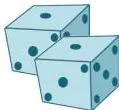
- The dice game has children roll two dice, add the dots and compare totals with a friend; Kishore and Nitya’s scoreboard follows as a Let us Do page.
- “Beads and String”, “Hop and Find the Sum” and “Add in Your Own Way” give different tools for the same sums — coloured beads, hops on a strip, and two children adding in different styles.
- Number-pair wheels from the Konark Sun Chariot, an add-and-match page and a cards project (arrange cards so their sum is 9) keep addition practice varied.
- Addition stories about shells, marbles and coconuts, a “what’s in our bags?” pair activity and a “Think and Do” number table carry the same sums into real situations.
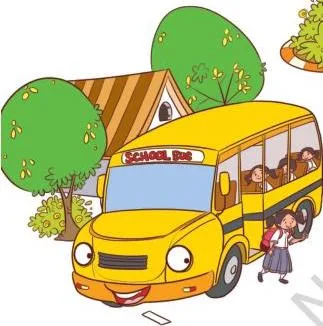
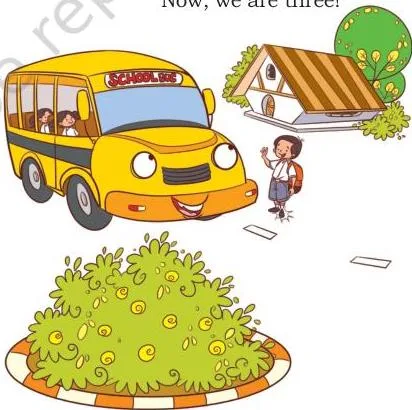
- “Five Little Children”, a rhyme, switches the chapter to subtraction: one child steps out of the bus each verse.
- “How Many Left?” turns removal into sums — frogs that jumped away, balloons that flew away, bananas taken away, broken pots, eaten ladoos and lost balls.
- The chapter closes with the ten-dot hiding game and hopping backwards on a number strip, so subtraction is seen as movement as well as counting.
The middle of the chapter switches from adding to taking away. “Five Little Children” is a rhyme about children on a bus; at every stop one child steps out, and the count falls by one each time. The table below reads the rhyme as the subtraction series it really is.
| Verse | Children at the start | Children removed | Children left | Subtraction sentence |
|---|---|---|---|---|
| 1 | 5 | 1 steps out | 4 | \(5 – 1 = 4\) |
| 2 | 4 | 1 steps out | 3 | \(4 – 1 = 3\) |
| 3 | 3 | 1 steps out | 2 | \(3 – 1 = 2\) |
| 4 | 2 | 1 steps out | 1 | \(2 – 1 = 1\) |
| 5 | 1 | 1 steps out | 0 | \(1 – 1 = 0\) |
Key ideas: adding, taking away, and the tools the chapter uses
Everything in this chapter comes down to two actions — putting groups together and taking some away — and the counting tools that make those actions visible. The tools are fingers, dice, beads, picture objects and the number strip.
Addition: two ways to make a total
The teaching note inside the chapter tells the adult to practise two kinds of addition. Aggregation means combining two separate groups; augmentation means adding more objects to a group that is already there.
- Aggregation: 4 children and 2 children are made into one group of 6 children. The chapter’s examples include 3 tops and 1 top making 4 tops.
- Augmentation: start with one group, such as 3 ants, and 2 more ants arrive, giving 5 ants. The chapter pairs this with 4 pencils and 3 more pencils making 7.
Both actions end in the same written form — a number sentence such as \(4 + 2 = 6\). The picture shows the objects, the \( + \) sign stands for “put together”, and \( = \) stands for “makes” or “altogether”.
Dice example: add two rolls and compare totals
The dice page asks children to roll two dice, find the total of the dots, and compare whose total is bigger. Here is a round with new numbers, worked step by step.
Step 1: You roll a 4 and a 3. Count the dots on the first die — four — then the dots on the second die — three.
Step 2: Count all the dots together: \(4 + 3 = 7\).
Step 3: Your friend rolls a 5 and a 2: \(5 + 2 = 7\).
Step 4: Compare the totals: \(7 = 7\). The totals are equal, so the round is a draw.
Play another round to practise unequal totals — for example \(6 + 1 = 7\) against \(4 + 4 = 8\), where your friend’s total of 8 is greater than your 7. The child who can say which total is bigger has understood that \( + \) combines two counts.
Subtraction: taking away and counting what is left
Subtraction in this chapter is always a story of things leaving: frogs jump away, balloons fly away, bananas are taken away. The child counts what stays, and the number that stays is “left”.
Worked example from the frog page: 6 frogs sit in a pond, 2 jump away. Count the frogs still there: 4. So \(6 – 2 = 4\). The sentence reads “6 frogs, 2 jumped away, 4 left”.
The number strip method for subtraction turns the same idea into movement. To find \(8 – 3\), place your finger on 8 and hop 3 steps back: \(8 \rightarrow 7 \rightarrow 6 \rightarrow 5\), so \(8 – 3 = 5\). Landing on a number smaller than the start is the sign that subtraction worked.
Story problems tell you which operation
Once children can add and subtract with objects, the chapter gives word problems in picture form: shells owned by Raghav and Sarita, marbles in Ranjeet’s and Meenakshi’s hands, coconuts in two bags. Each question carries a signal word — altogether, in total, in all, left, flew away or took away — and that word tells the child whether to add or subtract.
The table in “Words that matter” sorts these signal words by the operation they cue.
Hidden dots: a total splits into two parts
The ten-dot card activity is the chapter’s quiet introduction to the part–part–whole model. A card shows 10 dots; some are hidden by a hand or handkerchief and some remain visible.
If 4 dots are visible, the hidden dots must be the rest of the 10, so \(10 – 4 = 6\) hidden. The chapter’s table lists each row of ten dots as a hidden count plus a visible count — 0 hidden and 10 visible, and so on — so every row splits into two parts: hidden + visible = 10.
Picture-based tasks in the chapter

This chapter has no numbered, captioned figures to read — the pictures themselves are the counting material. Each scene or strip gives a child something to point at and count, so every sum has real things behind it.
- Park scene: counting children already playing and children who join them.
- Two dice: counting the dots on both dice, adding them, comparing totals.
- Beads on a string: colouring 3 + 4, 4 + 2 and similar sums bead by bead, then counting the coloured beads.
- Number strip: hopping forward to find a sum, backwards to subtract.
- Ten-dot card: hiding some dots and working out how many are hidden.
Use the pictures actively: ask the child to touch each object once while counting. A picture of 4 pencils and 3 pencils becomes a sum only when the child counts all seven pencils — the picture is what makes \(4 + 3\) mean real objects, not just digits.
Words that matter: altogether, total, left
The same small set of words decides whether a child adds or subtracts, so the chapter uses them again and again. Here is what each word means in this chapter’s sums.
- Altogether — the combined count of two or more groups; a signal to add. “4 children and 2 children altogether make 6.”
- Total — the result of combining groups; “in total” works exactly like “altogether”.
- In all — another way to say the combined count, as in the coconuts-in-two-bags story.
- Sum — the result of an addition, the number you land on after adding.
- Left — the number remaining after some are removed; a signal to subtract. When the chapter says “6 frogs, 2 jumped away, 4 left”, left means the 4 that remain.
- Jumped away / flew away / took away — the removing action; the number attached to it is what you subtract.
The chapter’s teaching note adds that children should first connect the word “make” with \( + \) and “altogether” with \( = \), saying the sentences aloud with real material before they write symbols. A signal-words table keeps the matching straight:
| Word or phrase | What it tells the child | Chapter example |
|---|---|---|
| altogether | add the groups | 4 children and 2 children altogether make 6 |
| in total | add the groups | 3 marbles and 6 marbles in total |
| in all | add the groups | coconuts in two bags counted in all |
| left | subtract: count what remains | 6 frogs, 2 jumped away → \(6 – 2 = 4\) left |
| flew away | subtract: remove that many | 7 balloons, 2 flew away → \(7 – 2 = 5\) left |
| took away | subtract: remove that many | 9 bananas, 6 took away → \(9 – 6 = 3\) left |
Common mistakes in How Many? and how to fix them
The activities in this chapter are designed to catch a few typical errors. Meeting them at home, before the page is marked, is the fastest way to fix them.
| Mistake | Correct rule | How to check your answer |
|---|---|---|
| Adding when the question asks how many are left | “Left” means what remains after removal, so subtract: 7 balloons, 2 flew away, \(7 – 2 = 5\) left. | Read the question aloud; the word “left” is the subtraction signal. |
| Counting the objects that were taken away instead of those that remain | After removal, count only the objects still there. | Cover the removed objects with a hand and count what is uncovered. |
| Counting extra objects for zero in \(4 + 0\) | Adding zero adds nothing: \(4 + 0 = 4\). | Lay out 4 counters and add no counters — the count still ends at 4. |
| Hopping forward on the number strip when told to hop backwards | Backwards means moving to smaller numbers on the strip. | Check the landing number is smaller than the start, e.g. \(8 – 3 = 5\). |
| Counting one group twice when combining | Count one group, then the other, then all together. | Touch each object exactly once; counting an object twice gives a wrong total. |
The zero mistake deserves its own note because it shows up in \(4 + 0 = \) on the finger-counting page. A child sees a group of zero and searches for extra objects to count for it.
Put nothing on the table and ask: four objects plus no objects — how many are there? Four. An empty group must not add to the count, so \(4 + 0 = 4\), and the answer can never be bigger than 4.
Practice notes: what to check at home
The teaching notes printed inside the chapter tell the adult what to look for. These are classroom and home habits, not exam predictions.
- Use real objects before symbols. The note on the first addition page says children need plenty of practice with concrete objects — beads, buttons, pencils — before written sums.
- Say addition sentences aloud. “4 children and 2 children altogether make 6 children” links the spoken words to \(4 + 2 = 6\).
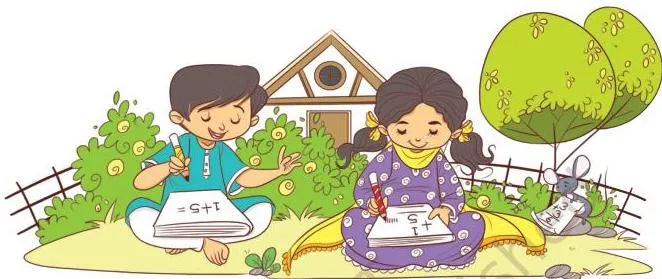
- Let the child describe their own strategy. The beads page says to focus on the process and discuss the strategies children use; “Add in Your Own Way” shows two children adding the same numbers differently.
- Use the dice game to compare totals. Rolling two dice, adding the dots and comparing with a friend builds addition and number comparison in one game.
- Use hidden dots to show parts of a total. A card of 10 dots with some hidden teaches that every total splits into two parts — the hidden count plus the visible count make the whole.
- Extend the pattern hunt. The project work asks children to make an 8-dot frame, hide some dots and look for a pattern in the hidden and visible numbers.
Quick recap for the night before
A one-minute check of what the chapter expects a Class 1 child to be able to do.
- Joining two groups and counting all of them gives a total — that is addition.
- Adding more objects to one group also gives a total; the chapter calls both kinds of addition problems.
- Taking some away and counting what remains is subtraction; the amount left is the answer.
- The signal words — altogether, total and in all for addition; left, flew away and took away for subtraction — tell a child which operation to use.
- Fingers, dice, beads, picture objects and the number strip are the counting tools the chapter uses.
- A total can split into hidden and visible parts: hidden + visible = the whole card of dots.
Related resources: Class 1 Maths and the official NCERT book
This listing is maintained for the 2026-27 academic session using the NCERT textbook information available to us. NCERT remains the authority for confirming the latest edition.
How Many? is Chapter 5 of Joyful Mathematics, so it sits between the early counting chapters and the number work that follows. Browse the whole book on the Joyful Mathematics Class 1 book page, or start at the Class 1 hub for everything this site holds for the grade.
The chapters that follow in the same book — Making 10 and the Vegetable Farm chapter — give children more of the same adding and taking-away practice, and every set of notes is reachable from the CBSE notes home.
Reference: NCERT Class 1 Mathematics textbook, chapter 5, official edition on ncert.nic.in.
Sources and data verification
- The chapter details above describe the NCERT Joyful Mathematics Class 1 textbook, Chapter 5, “How Many?”, and its official PDF as available on ncert.nic.in.
- This page covers the Class 1 Mathematics NCERT textbook only; it does not list other Class 1 subjects.
- This listing is maintained for the current academic session using the NCERT information available to us.
- NCERT settles textbooks, editions and PDFs; CBSE settles curriculum, syllabus and examinations. Textbook contents and the examinable syllabus are not always identical — check the current official syllabus.
Frequently asked questions about How Many? Class 1
How many pages is the How Many? Class 1 chapter?
The chapter runs 16 pages in the NCERT Joyful Mathematics Class 1 book.
What does Chapter 5 How Many? teach in Joyful Mathematics Class 1?
It teaches addition — both joining two groups and adding more to one group — and then introduces subtraction as taking away and counting what is left. Children practise with fingers, dice, beads, picture stories, a number strip and the Five Little Children rhyme.
How do I help my child understand the difference between altogether and left?
Use objects. Put 4 pencils and 2 pencils together and ask how many altogether — 6. Then take 2 away and ask how many are left — 4. Altogether means combine and count everything; left means count only what remains after removing some.
What activities are inside the How Many? chapter?
The chapter moves through a park counting scene, fill-in-the-blank addition, an add-and-draw page and finger counting. It then offers a two-dice game with a scoreboard, coloured bead strings, number-strip hops, number-pair wheels and a cards project for sums of 9. Later activities add picture stories, a bag-counting pair game, the Five Little Children rhyme, How Many Left?
drawings, a hidden-dots card game and backwards hops on the strip.
Where is the official How Many? Class 1 PDF available?
NCERT publishes the full Joyful Mathematics Class 1 textbook free on its official website, ncert.nic.in — open the How Many? Class 1 NCERT Maths Chapter 5 PDF from the textbook page.
Explore Class 1 Mathematics Books
- Previous: Making 10
- Next: Vegetable Farm
Related chapters:
- Finding the Furry Cat!
- What is Long?
- Mango Treat