
Here is the official So Many Toys Class 1 Chapter 13 PDF from NCERT’s Joyful Mathematics book, with a plain-language tour of what is inside it. This is the final activity chapter of the Class 1 book, and the whole chapter is built around pictures, projects and puzzles.
This is the official NCERT chapter file — open the So Many Toys Class 1 Chapter 13 PDF (Joyful Mathematics) when you want the same pages the class is using, to read on screen or print for practice.
Chapter 13 at a glance: what is inside So Many Toys
This is a hands-on chapter: every part is a task, a picture or a game. The chapter moves through named parts — So Many Toys, Colourful Flowers, True or False, Project Work and Puzzles.
| What the chapter holds | Count | Where it is used |
|---|---|---|
| Printed pages | 11 | |
| Figures with NCERT captions | 3 | |
| Tables | 2 | |
| Official NCERT PDF | Download the chapter PDF | the chapter exactly as NCERT publishes it |
The first parts practise counting and comparing sets of objects. The puzzle set at the end — Puzzles A to U — revises the same skills as games, so the chapter is meant to be worked through with the book open, not read like a story.
What the five parts of the chapter ask your child to do
None of the five sections is a standard lesson. Each one is a task that asks the child to count, compare, check or build something.
| Part | What the child does | Skill it builds |
|---|---|---|
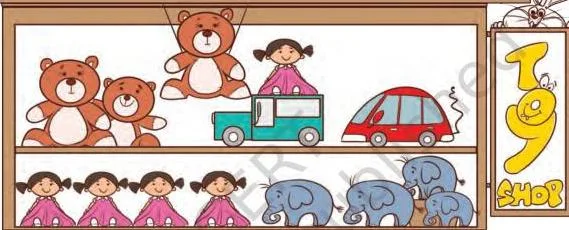
| So Many Toys | Counts elephants, teddy bears, cars and dolls in one picture, then completes sentences using more than, less than or equal to. | Counting and comparing sets |
| Colourful Flowers | Counts blue, orange, red and purple flowers in a garden picture, then names the colour with the least flowers and the colour with the most. | Counting and comparing groups |
| True or False | Judges two statements about the flower counts. | Checking a comparison carefully |
| Project Work | Makes a card with a border of colourful flowers, and surveys the class for name lengths — 3 letters, 4 letters, or more. | Counting and early data collection |
| Puzzles | Plays games A to U covering number recognition, sums, patterns, shapes and logic arrangements. | Revision of the chapter’s skills |
Why so many puzzles? The final part is meant to be played, not drilled. A child who plays those games comfortably has met the counting, comparing and early addition skills the chapter practises.
The number skills So Many Toys builds
This chapter introduces no new formal maths. It practises, through pictures and games, the skills a Class 1 child is already meeting: counting, comparing and simple addition.
- Counting objects in a mixed picture — the opening activity with elephants, teddy bears, cars and dolls.
- Comparing quantities using more than, less than and equal to — the opening activity and True or False.
- Recognising the numbers one to ten as words — Puzzle D.
- Simple addition and subtraction, including missing numbers and balancing sums — Puzzles E, Q, R and T.
- Continuing a pattern — Puzzle C with Zarina’s glasses.
- Logic arrangements with shapes and objects — Puzzles G and H.
- Money totals — Puzzle S.
An example to try together
Use a fresh set of objects — 7 balloons, 4 kites, 9 balls and 2 dolls — and complete comparisons the way the book does.
- The number of kites is less than the number of balls. Reason: \(4\) is a smaller count than \(9\).
- The number of balloons is more than the number of dolls. Reason: \(7\) is a bigger count than \(2\).
- The dolls and the kites together are equal to the balloons without one. Reason: \(2 + 4 = 6\) and \(7 – 1 = 6\).
A new Who am I set, worked out
Use the same clue-by-clue method on any Who am I riddle: list the possible numbers first, then test each clue against them.
- I am between 4 and 8. Read upside down, I become 9. Possible numbers are 5, 6 and 7. Of these, only 6 turns into 9 when flipped. Answer: 6.
- I am 2 less than 10 and 1 more than 7. \(10 – 2 = 8\) and \(7 + 1 = 8\). Both clues give 8. Answer: 8.
- Add 6 to me and you get 15. Work backwards: \(15 – 6 = 9\). Answer: 9.
Walking through the picture puzzles
In this chapter the pictures are the lesson, so keep the book open while working through them. Each picture asks for a different kind of careful looking.
- The toy picture — count four kinds of toy: elephants, teddy bears, cars and dolls.
- The garden flowers picture — count flowers by colour, then name the least and the most.
- The bowls puzzle — number cards are hidden under bowls, and the child recognises a number from the part that is still visible.
- The logs — the question asks whether there are 3 logs or 4 logs, so the child must look twice before answering.
- Zarina’s glasses — extend the row by continuing the pattern.
- The mirror puzzle — the hint says a mirror can help; the child uses a mirror to read the number.
- The shadow puzzle — find and encircle the identical shadow image.
- The missing pot piece — find the piece that completes the pot.
The upside-down trick matters here: a 6 read upside down becomes 9, which is three more. This unlocks riddle J(i) — between 5 and 10 are 6, 7, 8 and 9, and only 6 turns into 9 when flipped, so the answer is 6.
More than, less than, equal to — the words this chapter uses
A Class 1 child can often do the maths but trip on the words. These are the few comparison words the whole chapter depends on.
| Word | What it means for a child | Where it appears |
|---|---|---|
| more than | A bigger count | So Many Toys and True or False |
| less than | A smaller count | So Many Toys and True or False |
| equal to | Exactly the same count | So Many Toys |
| row | A line going across | Puzzles G and H |
| column | A line going up and down | Puzzles G and H |
| sum | The total you get by adding | Puzzles E and N |
| mirror image | What a number looks like in a mirror | Puzzle I |
| identical | Exactly the same | Puzzle O |
| missing | The piece that is not there | Puzzle L |
Where children slip in these puzzles (and how to fix it)
The puzzles look playful, but each one hides a common slip. Catch these before your child makes them.
| Mistake | Correct the habit | How to check your answer |
|---|---|---|
| Counting one toy twice in the busy toy picture | Point at each toy and count aloud, or tick each one as it is counted. | Count again in a different order; the total should stay the same. |
| Writing less than where more than belongs because the sentence reads in a different order | Read the sentence aloud and act it out with two small piles. | After writing, read the finished sentence back and check the bigger pile is on the side that says more than. |
| Answering True or False without re-checking which two colours are compared | Underline the two colour names in the statement before counting. | Find those two colours in the flower picture and count only those. |
| Hunting for digits in the number-word grid | Look for number words, not numerals — the grid hides words such as eight, five, two, nine, six and seven. | Say the number word aloud and trace its first letter with a finger. |
| Guessing in the bowls puzzle instead of using the visible part | Say what number the visible part could be before lifting the bowl. | Cover the card with your hand and name the number from the visible strip. |
| Repeating a shape twice in one row or column in Puzzles G and H | Check every row first, then check every column. | Name the shapes across one row aloud, then down one column. |
| Writing 5 for the subtract-5-from-25 question without reading the wording | Read it literally: after one subtraction, 25 becomes 20, so there is no 25 left to subtract from again. | Ask: is there still a 25 to subtract 5 from? If no, the literal answer is once. |
For the subtract puzzle, both readings are worth knowing. Literally, the answer is once, because after the first subtraction \(25 – 5 = 20\), there is no 25 left. If the question is read as repeated subtraction until nothing remains, the count is five: \(25 – 5 – 5 – 5 – 5 – 5 = 0\). The wording is the trick.
In the Who am I riddles, the same careful reading matters. Skipping the clue read upside down loses the 6-to-9 trick, and answering without testing every clue can give the wrong number.
How So Many Toys is used in Class 1 maths
Class 1 does not end with a board examination; assessment at this stage is school based, so this chapter’s worth is in the doing. Textbook contents and the examinable syllabus are not always identical, so check the current official syllabus for what is assessed.
The Puzzles A to U set is the chapter’s revision. A child who can play those games comfortably has the counting, comparing and simple addition the chapter practises. Project Work is the chapter’s only data-collection task, and it is designed to be done with classmates.
A suggested order for the puzzles
This is a parent-friendly order from warm-up to challenge, not a fixed rule. The reason for the order is that each step adds one new kind of thinking.
| Order | Puzzles | Why it works |
|---|---|---|
| 1 | A (bowls), C (glasses) | Quick recognition and pattern work need almost no reading. |
| 2 | D (word grid), F (Gillu) | These practise number words and one simple operation. |
| 3 | E, Q, R (sums and missing numbers) | The child now uses numbers in small sums. |
| 4 | G, H (shape and object grids) | A clear rule — every shape or object once per row and column. |
| 5 | I, J (Who am I), M (subtract trick) | Word-play and trick questions need careful reading. |
| 6 | K, L, O (matchstick, pot, shadow) | Observation puzzles with no calculation. |
| 7 | N, S, T, U (seeds, coins, apples, balls) | Multi-step totals combine several skills, so they work best last. |
Quick check: what your child should be able to do after Chapter 13
The chapter prints no summary, so this checklist is drawn from what the activities practise. It is our checklist, not NCERT’s — use it to see which part to return to.
- Count a mixed picture of up to four kinds of toy. — Return to So Many Toys.
- Compare two counts using more than, less than and equal to. — Return to So Many Toys and True or False.
- Say which colour has the most flowers and which has the least. — Return to Colourful Flowers.
- Recognise the words one to ten. — Return to Puzzle D.
- Balance two sides of a small sum. — Return to Puzzle E.
- Continue a pattern of glasses. — Return to Puzzle C.
- Place shapes so each appears once per row and column. — Return to Puzzles G and H.
- Solve simple Who am I clues. — Return to Puzzle J.
Related resources for Class 1 Mathematics
This listing is maintained for the 2026-27 academic session using the NCERT textbook information available to us. NCERT remains the authority for confirming the latest edition.
Use these pages to move around the book and the Class 1 section of this site.
- Class 1 Joyful Mathematics book page — the full set of chapters in this book.
- Class 1 hub — chapters and notes for Class 1.
- How Much Can We Spend — another Joyful Mathematics chapter page.
- All CBSE notes on this site — the wider library.
For the official file, NCERT’s site is the source: the current Chapter 13 PDF lives at ncert.nic.in, and the NCERT home page hosts all current textbook editions.
Sources and data verification
- The description of Chapter 13 on this page comes from the NCERT Class 1 Mathematics — Joyful Mathematics textbook, Chapter 13, So Many Toys, as listed on ncert.nic.in.
- This page covers Chapter 13 of that book only. It does not list other chapters in the book or other subjects.
- We maintain this listing for the NCERT edition currently shown on ncert.nic.in. Textbook editions can be revised, so check the official site for any newer edition.
- NCERT settles the textbook, its editions and its PDFs. CBSE settles the curriculum, syllabus and examinations. A chapter in the textbook may not be identical to the examinable syllabus, so check the current official CBSE syllabus as well.
So Many Toys Class 1 — common questions
Where can I download the official So Many Toys Class 1 PDF?
The official file is on NCERT’s website: So Many Toys Class 1 Chapter 13 PDF (Joyful Mathematics). If the direct link ever changes, search the NCERT textbook page for Class 1 Joyful Mathematics and choose Chapter 13.
What does Chapter 13, So Many Toys, teach in Class 1?
Chapter 13 is the final activity chapter of Joyful Mathematics. It practises counting objects in a picture, counting flowers by colour, comparing counts with more than, less than and equal to, and then revises those skills through Puzzles A to U.
What is the answer to the subtract 5 from 25 puzzle in So Many Toys?
Read literally, the answer is once, because after the first subtraction \(25 – 5 = 20\), there is no 25 left to subtract from. If the question is read as repeated subtraction until zero, the count is five. Both readings are acceptable; the wording is the trick.
How do you solve the Who am I riddles in So Many Toys?
Read each clue separately and test it against a short list of possible numbers. Example: I am between 4 and 8. Read upside down, I become 9. The possible numbers are 5, 6 and 7; only 6 becomes 9 when flipped, so the answer is 6. The mirror puzzle hint tells the child to use a mirror to read the number.
How do I help my child with the number word grid in Puzzle D?
Puzzle D hides number words, not digit numerals. Tell your child to look for word shapes — eight, five, two, nine, six and seven run through the rows and columns. Reading the rows aloud and tracing the first letter of each number word helps the child spot them.
Is So Many Toys part of the Class 1 maths exam?
Class 1 has no board examination; the chapter is assessed through school work. Textbook contents and the examinable syllabus are not always identical, so check the current official CBSE syllabus for what is assessed at this stage.
Reference: NCERT Class 1 Mathematics (Joyful Mathematics) textbook, chapter 13, official edition on ncert.nic.in.
Explore Class 1 Mathematics Books
- Previous: How Much Can We Spend ?
Related chapters:
- Finding the Furry Cat!
- What is Long?
- Mango Treat