
This page carries the official Mango Treat Class 1 PDF — Chapter 3 of the NCERT Joyful Mathematics textbook for Class 1 — in the current NCERT edition for the 2026–27 academic session. The chapter teaches counting from 1 to 9 through a story in which one more bird joins a mango tree each time, then practises the idea with finger games, drawing and number puzzles.
Use the download link for the PDF itself, and the section tour below it to know what each activity expects of your child before you start.
Download the Mango Treat Class 1 PDF (official NCERT download) to read, print or share the exact chapter text and pictures as published in the Joyful Mathematics Class 1 textbook, straight from the publisher on ncert.nic.in.
Chapter at a glance
The table below shows how much of the book this chapter holds — its sections, illustrations and pages — counted from the NCERT edition, so you can see the size of the file before opening it.
What Mango Treat covers: a counting story and ten activities
Mango Treat is picture-led: one continuous counting story opens the chapter, and ten short activity sections follow it. The table maps each section, what the child actually does, and the number skill it builds — enough to decide what to practise at home.
| Chapter section | What children do | Skill it builds |
|---|---|---|
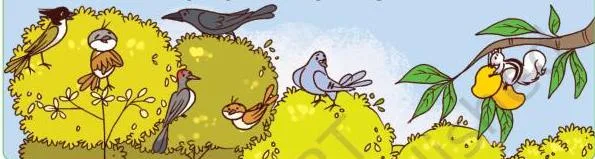
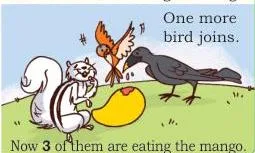
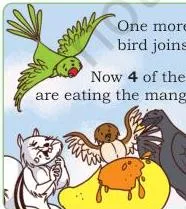
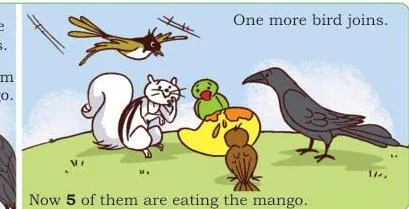
| Let us Read | A squirrel eats a mango while birds watch; one bird joins each time until 9 birds and animals share it. | Counting 1 to 9 by adding one at a time. |
| Let us Talk | Children name the birds, say how many joined each time, answer ‘1 more than…’ up to 9, and match birds to fingers. | Number names and the one-more idea in words. |
| Let us Play – Mime with Fingers | Show 3 fingers; a friend shows 3 a different way; find the different ways to show 4 on one hand. | Same number, several finger patterns. |
| Let us Play Outside | Children sing in a circle; one calls a number up to 9 and the class forms groups of that size, with left-out children counting each group. | Forming and counting groups. |
| My Drawing Day | On Ekta Diwas (31 October), children pair each object with one child by a line, then tick more, less or same; the class discusses sharing. | Comparing one to one; the habit of sharing. |
| Let us Do | Tick the group that is more in number, then the group that is less, in different pictures. | Comparing quantities. |
| Let us Play – Finger Game | Show fewer fingers than a number, then more; draw shapes around groups of 1 to 9 objects and write the numeral; write in sand; guess a number on the back; meet Saptarshi. | Numerals 1 to 9, comparison, writing practice. |
| Count and Colour | Colour exactly 8 stars, 5 flowers and 6 balls. | Counting to a precise number. |
| Join the Numbers in a Order | Draw the 1-to-9 path without crossing lines; order the monkey’s shuffled cards; fill the missing numbers; count jamuns, sheep, fruits, umbrellas, cups and spoons. | Ordering, sequencing and careful counting. |
| Project Work | Make number cards 1 to 9, sticking or drawing the matching number of objects on each card. | Consolidating the chapter’s skills. |
Key concepts: what counting 1 to 9 really asks of a child
This chapter has no formulas; its ideas are number skills, and each activity exists to build one of them. Four ideas carry the whole chapter, and an adult who can name them can teach it without the teacher’s manual.
One more than: the idea the whole story runs on
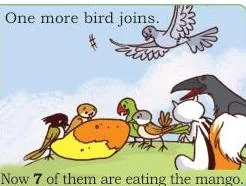
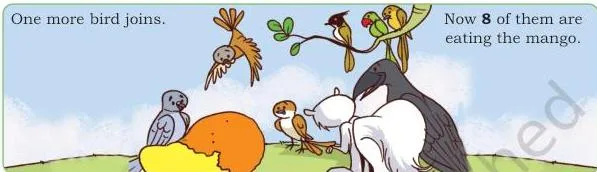
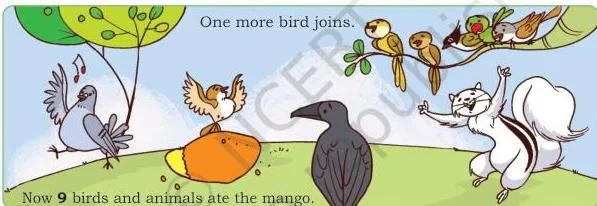
The mango story runs on exactly one rule: one more bird joins each time, so the crowd grows \(1, 2, 3, \dots, 9\) (NCERT, Let us Read). Let us Talk turns the story into the question ‘what is 1 more than 1, 1 more than 2… up to 9?’ (NCERT, Let us Talk).
Why it matters: ‘one more than’ is the first step of addition. A child who answers ‘6’ to ‘1 more than 5’ without recounting from 1 has understood that every number sits one step ahead of the last. At home, bring out five objects, add one, and only then ask the question again — the object does the teaching.
More, less and equal: comparing by matching, not by size
The chapter never asks a child to compare two groups by counting both first. In My Drawing Day, a line is drawn from each object to one child, and the child ticks whether the objects are more, less or the same as the number of children (NCERT, My Drawing Day).
Let us Do repeats the same judgement in simpler pictures where the child only ticks the group that is more in number, then the group that is less (NCERT, Let us Do).
Matching comes first because six-year-olds are easily fooled by size: three big mangoes can look ‘more’ than five small ones. When every object is paired with exactly one other, the group with a leftover is plainly the larger one — so more and less are taught by matching objects one to one before any counting is asked.
Number order 1 to 9: putting the numerals in sequence
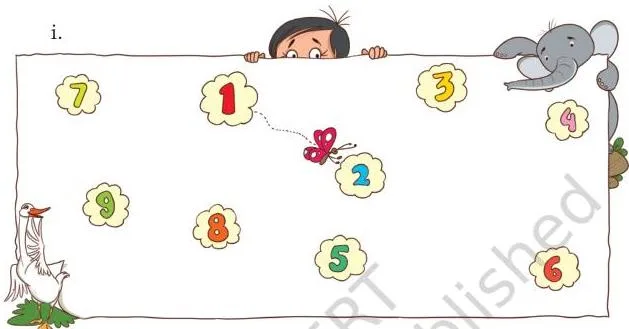
Ordering is tested as a puzzle, not a recitation. Children draw a path from 1 to 9 and the lines must not cross — a rule that forces them to find each next number inside a jumbled grid instead of following a dotted trail (NCERT, Join the Numbers in a Order).
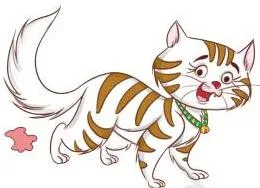
The naughty monkey’s shuffled number cards ask for the same order from smallest to largest, and the cat’s muddy footprints have gaps to fill in. Three layouts for one sequence catch the child who has memorised the counting rhyme but cannot apply it.
Numerals and number names: reading and writing 1 to 9
The Finger Game ties each quantity to its numeral and its name: circle the objects that are two in number and write 2 below, on through nine objects and 9 below, with names one to nine (NCERT, Let us Play – Finger Game).
Writing practice is deliberately pressure-free — numerals traced in sand, then a number scribbled on a friend’s back for the friend to guess.
Why sand: a wrong stroke in sand is wiped away without an eraser or a cross mark, so a six-year-old practises the shape of a numeral without fear of a mistake.
Definitions a Class 1 child needs for this chapter
The words below are the terms a child meets in Mango Treat, and here is each one the way you would say it aloud to a six-year-old.
| Term | What it means here | Where it appears |
|---|---|---|
| One more than | The number you reach when exactly one is added: 1 more than 1 is 2, up to 1 more than 8 is 9. | Let us Read; Let us Talk |
| More | The group with the larger count, found by matching one object to one child. | My Drawing Day; Let us Do |
| Less | The group with the smaller count, found the same way. | My Drawing Day; Let us Do |
| Equal / same as | The same count as another group — for example, the same as the number of children. | My Drawing Day |
| Saptarshi or Big Dipper | The group of seven stars that can be seen in the night sky; the chapter uses it to anchor the number 7. | Let us Play – Finger Game |
| Ekta Diwas | 31 October, the day of the drawing event, used to open a conversation about sharing. | My Drawing Day |
What the pictures in the chapter do



Mango Treat is picture-led — the illustrations are not decoration, each one carries a counting task. For every picture, one thing to point at is enough to turn it into a lesson.
- The mango tree with the squirrel (Let us Read): the birds watch a squirrel eat a mango, and one more joins each time. Point at the newest bird and ask ‘how many now?’ — that single question teaches one more.
- Birds matched to fingers (Let us Talk): a line pairs the number of birds with a number of fingers, one example already done. Point at the matched pairs and say ‘one bird, one finger’ so the one-to-one rule is heard as well as seen.
- Finger patterns (Let us Play – Mime with Fingers; Finger Game): the same number looks different on different hands. Point at two patterns for the same number and ask for a third, so the child learns no number has only one shape.
- Objects to group and circle (Finger Game): pictures hold one, two, three … nine objects scattered together. Point at a scattered group and have the child touch each object once while counting aloud, so nothing gets counted twice.
- The Saptarshi stars (Finger Game): a group of seven stars that can be seen in the night sky, named Saptarshi or Big Dipper. Point at the seven-star pattern and count it with the child, linking the numeral 7 to a real sky shape.
- The Ekta Diwas drawing scene (My Drawing Day): objects are matched to children with drawn lines. Point at a single line — it pairs exactly one object with one child, the matching rule behind more and less.
- The monkey’s shuffled cards and the cat’s trail (Join the Numbers in a Order): the monkey drops number cards out of order and the cat’s footprints hide missing numbers. Point at the 1 card first, because every ordering puzzle starts from the smallest number.
- Counting pictures for jamuns, sheep, fruits, umbrellas, cups and spoons (Colour the Biggest Number): each question names two groups to compare. Point at the two groups the question names and let the child count each aloud before encircling.
Common mistakes when children count 1 to 9
Five counting errors are so common in Class 1 that the chapter’s games are built to expose them. Each fix below comes from the section named in the row — this is teaching guidance drawn from the activities, not a list printed in the book.
| Mistake | How it shows up | The fix from this chapter |
|---|---|---|
| Counting the same object twice | In a crowded picture one object gets two taps while another is skipped, so the count comes out wrong. | Use touch-and-count one to one, the habit My Drawing Day builds; to check, recount and move each counted object to a new pile. |
| Calling a group ‘more’ because its objects look bigger | Three large mangoes are called more than five small balls, though five is the larger count. | Match one to one before judging, as the Let us Do tick tables force; the group with a leftover is the one that is more. |
| Losing the sequence on ‘1 more than 5’ | The child restarts from 1, or guesses 7 instead of 6. | Retell the story with one more bird joining each time (Let us Read), then ask the question again (Let us Talk). |
| Treating one finger pattern as the only way to show a number | The child shows 4 only as four fingers together and cannot show it any other way. | Use Mime with Fingers: show a number, then ask for the same number in a different way; check with 4 on one hand. |
| Skipping numbers on the join-the-numbers path | The drawn lines jump from 1 to 3 to 5, or a card in the middle is left out. | Find 1 first, then 2, then 3 in order before drawing; the no-crossing rule in Join the Numbers in a Order exposes any skip. |
How this chapter is assessed (there is no Class 1 board exam)
Class 1 has no board exam, so nothing in Mango Treat carries ‘board weightage’. What matters is what the teacher observes while the activities run.
During the finger games and number puzzles, teachers watch whether the child can count up to 9 objects without skipping or double-counting, answer ‘1 more than’ questions up to 9, compare groups as more, less or equal, recognise and write numerals 1 to 9, and order numbers from smallest to largest.
Count and Colour is the quickest formal check in the book — colour exactly 8 stars, 5 flowers and 6 balls — because it asks for a precise number, no more and no less.
Textbook contents and the examinable syllabus are not always identical. For Class 1, that means checking your school’s plan and the current official syllabus rather than assuming every page is examined.
Revision summary: five skills your child should leave with
After Mango Treat, a child should be able to do five things. Each one maps to a section of the chapter, so the five-minute check below covers the whole chapter.
- Count up to 9 objects by touching each one once (Count and Colour).
- Say what is 1 more than any number from 1 to 8 (Let us Read; Let us Talk).
- Compare two groups and say more, less or equal (My Drawing Day; Let us Do).
- Recognise numerals 1 to 9 and their names one to nine (Let us Play – Finger Game).
- Order numbers from smallest to largest and follow the 1-to-9 path without crossing lines (Join the Numbers in a Order).
Five-minute check: show 4 fingers and ask the child to show fewer, then more. The same comparison question the chapter uses in the Finger Game tests skills 2 and 3 in one gesture.
End the review with the chapter’s own consolidation task: Project Work asks the child to make number cards 1 to 9 with the matching number of objects stuck or drawn on each card (NCERT, Project Work). Nine hand-made cards fold the whole chapter into one finish line.
Related resources for Class 1 Mathematics
This listing is maintained for the 2026-27 academic session using the NCERT textbook information available to us. NCERT remains the authority for confirming the latest edition.
Mango Treat is Chapter 3 of the Joyful Mathematics Class 1 book. To read the whole book chapter by chapter, open the Joyful Mathematics Class 1 book page, or start at the Class 1 hub, which lists the NCERT books this site indexes for the class.
The chapters next to Mango Treat both have their own notes: the previous chapter (What is Long?) and the next chapter (Making 10). For quick revision notes, the Class 1 mathematics notes page, the Class 1 notes hub and the main CBSE notes index gather the chapters and subjects this site covers.
Sources and data verification
- The activity and picture descriptions on this page come from Chapter 3, Mango Treat, of the NCERT Joyful Mathematics textbook for Class 1 (English), in the edition published on ncert.nic.in.
- This page covers only Chapter 3 of that book — not the whole textbook, and not the whole CBSE Class 1 scheme.
- It is maintained for the current academic session using the NCERT information available to us.
- NCERT settles textbook content, editions and official PDFs; CBSE settles the curriculum, syllabus and examinations.
| What the chapter holds | Count | Where it is used |
|---|---|---|
| Printed pages | 15 | |
| Figures with NCERT captions | 14 | |
| Tables | 3 | |
| Activities | 1 | |
| Official NCERT PDF | Download the chapter PDF | the chapter exactly as NCERT publishes it |
Reference: NCERT Class 1 Mathematics textbook, chapter 3, official edition on ncert.nic.in.
Frequently asked questions about Mango Treat
What does Mango Treat teach my Class 1 child in maths?
Counting from 1 to 9, the idea of one more than, comparing groups as more, less or equal, and recognising, naming and writing the numerals 1 to 9 — all delivered through the mango-tree story, finger games, drawing tasks and number puzzles.
How do I practise the one-more-than story from Mango Treat at home?
Use nine small objects as the birds. Start with one bird, add one, and ask ‘what is 1 more than 1?’; keep adding one bird at a time up to ‘1 more than 8 is 9’, exactly as the story and Let us Talk do. Acting the story out makes the sequence physical instead of memorised.
How does the chapter teach more, less and equal without writing?
By matching: a line is drawn from each object to one child in My Drawing Day, and any leftover object shows which group is more. Let us Do then asks the child to tick the more or less group in simple pictures. No counting is asked for until the matching has been done.
Is Mango Treat part of the official Class 1 syllabus?
Mango Treat is Chapter 3 of the NCERT Joyful Mathematics Class 1 textbook. Textbook contents and the examinable syllabus are not always identical, so for Class 1 check your school’s plan and the current official syllabus.
Where can I download the Mango Treat chapter PDF?
The official chapter PDF is published on ncert.nic.in as part of the Joyful Mathematics Class 1 textbook; use the download link near the top of this page to open it.
Explore Class 1 Mathematics Books
- Previous: What is Long?
- Next: Making 10
Related chapters:
- Finding the Furry Cat!
- How Many?
- Vegetable Farm