
This page gives you Chapter 6 of NCERT’s Joyful Mathematics textbook for Class 1 — the Vegetable Farm chapter — with the official eight-page PDF right here. Vegetable Farm Class 1 teaches children to add and subtract amounts up to 18 through vegetable baskets, pencils, laddoos and bus rides.
It walks a parent or teacher through what each part of the chapter asks a child to do, in step with the current NCERT edition.
Download Vegetable Farm Class 1 PDF
Download the NCERT Class 1 Mathematics Chapter 6 Vegetable Farm PDF from the official NCERT textbook portal — the same free, current edition your child’s school follows, published on ncert.nic.in.
| What the chapter holds | Count | Where it is used |
|---|---|---|
| Printed pages | 8 | |
| Figures with NCERT captions | 6 | |
| Tables | 1 | |
| Activities | 3 | |
| Official NCERT PDF | Download the chapter PDF | the chapter exactly as NCERT publishes it |
Chapter 6 Vegetable Farm at a glance
The count table above this section shows how much the chapter holds. This section maps each named part of the chapter to what it asks the child to do, so you know what is inside the file before you open it.
| Part of the chapter | What it asks the child to do |
|---|---|
| Opening basket story | Count the vegetables in two baskets together: \(7 + 5 = 12\), \(9 + 4 = 13\) and \(8 + 8 = 16\). |
| Project Work | Plant a vegetable sapling at home, school or a nearby place, watch it grow, and share the experience with the family. |
| Add in your own way | Add \(12 + 6\) pencils, \(8 + 6\) laddoos and \(12 + 6\) bangles using the child’s own method, then discuss “Can you do it differently?” |
| Let us Do | Draw the eatables you would take on a picnic and write the total number in the space given. |
| Subtraction | Subtract, starting from \(15 – 9 = 6\), with a practice table of eight sums that includes \(15 – 0\). |
| Hop and Jump | Play a hopping and jumping game so that moves along a number strip model adding and subtracting. |
| Add, Subtract and Match | Solve mixed addition and subtraction questions using the child’s own strategies. |
| Problem Stories | Read five word problems — diyas, bus stops, bus seats, toffees and bananas — and write the answers in the boxes. |
What Vegetable Farm teaches and how it fits the Class 1 book
Vegetable Farm is Chapter 6 of Joyful Mathematics. Its job in the book is simple: move a Class 1 child from counting things one by one to adding and subtracting within about 20, using scenes from everyday life — vegetables, pencils, laddoos, bangles, a bus, toffees and bananas.
The chapter’s largest number is 18, the bus seats in Problem Story C. The order of the pages is the teaching order:
- count two groups together (the baskets),
- add “in your own way” so the child builds a personal strategy,
- add more freely (the picnic drawings),
- subtract, starting from \(15 – 9 = 6\),
- check every answer by jumping on a number strip,
- then read full stories and solve them.
“Add in your own way” is the heart of the chapter. The book does not push one fixed method: Sapna counts on, Gauri splits 12 into 10 and 2, and the page asks, “Can you do it differently?” A child who can explain their own way of adding understands the maths better than one who copies a memorised sum.
The Project Work page — plant a sapling and watch it grow — is the chapter’s bridge from maths to the world. It asks the child to care for something over time, an activity that pairs naturally with the counting and adding the rest of the chapter practises.
Key maths ideas in Vegetable Farm
Why strategy matters: a child who adds \(12 + 6\) by recounting every object from 1 gets the right answer but slowly, and loses track on bigger sums. The chapter’s five ideas give the child faster, more reliable ways.
- Counting on. Sapna counted 12 and then 6 more to reach 18. Instead of starting from 1, start from the bigger number and count forward.
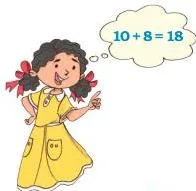
- Splitting into tens and ones. Gauri’s way: \(12 + 6 = 10 + 2 + 6 = 10 + 8 = 18\). The ten inside 12 stays untouched; only the ones are added.
- Take-away subtraction. \(15 – 9 = 6\): start with 15, take 9 away, 6 are left.
- Missing-part subtraction. The toffee story (\(14 – ? = 6\)) and banana story (\(12 – ? = 5\)) ask what was shared or eaten — the missing part — not what is left.
- Subtracting zero. The practice table includes \(15 – 0\); taking nothing away leaves the number unchanged, so \(15 – 0 = 15\).
Worked example with fresh numbers — 11 + 6 by counting on.
Put 11 in your head.
Count six more out loud: 12, 13, 14, 15, 16, 17.
Each count is one more pencil.
\[ 11 + 6 = 17 \]
13 − 4 by counting back on the strip.
Stand on 13, then hop back four places, naming the landings: 12, 11, 10, 9.
\[ 13 – 4 = 9 \]
Check: \(9 + 4 = 13\), so the subtraction is correct.
Picture walkthrough: the baskets and the number strip



Most pages of this chapter teach through pictures the child can point at. Here is what each picture is for, so you can teach straight from the book with no extra materials.
- The two baskets (opening page). The picture shows Rumi’s basket and Shami’s basket as two separate groups of vegetables. First count each basket alone — 7 tomatoes, then 5 tomatoes — and then count the two groups together to make 12. Do the same for 9 carrots with 4, and 8 radishes with 8. The picture turns “7 + 5” into a real basket of vegetables.
- Add in your own way pictures. Sapna’s 12 pencils and Gauri’s 6 pencils; Aman’s 8 laddoos and Charanjeet’s 6 laddoos; Sheena’s 12 bangles with 6 more from her sister. The child points at each group and joins them, which is exactly what “add” means.
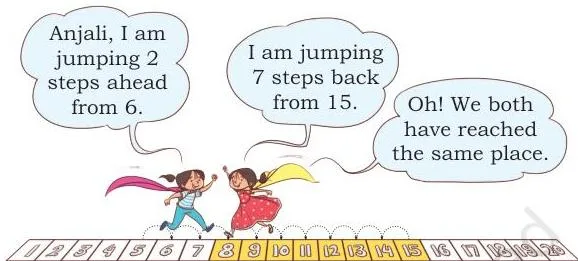
- The Hop and Jump strip. Anjali and Renu play a hopping and jumping game, and the activity below the picture asks the child to make a number strip at home or in the playground and find different ways to reach the same number. A forward jump adds, a backward jump subtracts — the chapter’s built-in way to check answers.
Child-friendly definitions: add, subtract and the story words
Read these words aloud to the child before the chapter, so the symbols are familiar when they appear in the sums.
- Add — put two groups together and find how many altogether.
- Subtract — take some away and find what is left, or find the part that is missing.
- Equals — “is the same amount as”.
- Plus sign (+) — “join these groups together”.
- Minus sign (−) — “take away”.
- Equals sign (=) — “is the same as”.
Story words are the chapter’s quiet instruction manual. When a problem says one of these words, the child knows whether to add or subtract:
| Story words | What they mean for the sum |
|---|---|
| more, altogether, in all, boarded | Add the two amounts — e.g. “8 more children board” means \(6 + 8\). |
| sold, left, ate, shared, got down | Subtract — something is being taken away. |
| how many more can sit | Subtract — 18 seats with 9 already sitting means \(18 – 9 = 9\). |
The one word to watch is more: “8 more children board” means add (\(6 + 8\)), but “how many more children can sit” asks for the part of 18 that is still empty, so it is subtraction.
Micro-example to say aloud: “The potter sold 5 diyas.” Sold means take away, so the first step of that story is \(9 – 5 = 4\).
Common mistakes in Vegetable Farm addition and subtraction
These are the five slips Class 1 children actually make in this chapter. Each row names the mistake before it happens, why it happens, and a one-line fix.
| Mistake | Why it happens and the correct rule | How to check |
|---|---|---|
| Adding \(12 + 6\) by counting everything from 1 | Recounting is always safe, so children fall back on it — but it is slow and easy to lose track. Count on from 12 instead: 13, 14, 15, 16, 17, 18. | Ask “Which number did you start from?” It must be 12, not 1. |
| Counting the starting square as the first jump on the strip | The child thinks “one more” starts where they are standing. Stand on 12 first; only then does each hop land on the next number. | Do \(13 – 4\) on a strip and name the landings: 12, 11, 10, 9. |
| Writing \(15 – 0 = 0\) | “Take away zero” sounds like “take nothing”, and 0 is a familiar worksheet answer. Subtracting zero leaves the number unchanged, so \(15 – 0 = 15\). | Read it as a story: “15 vegetables left, none sold” — the answer is still 15. |
| Treating every “more” as addition, so \(18 – 9\) becomes 27 | “More” usually signals adding, but “how many more can sit” asks for the missing part of the 18 seats. When the story already gives the total, subtract. | Ask “Does the story give the whole?” 18 seats is the whole, so \(18 – 9 = 9\). Check with \(9 + 9 = 18\). |
| Solving the potter or bus story in one jump | Two events happen in each story and children merge them into one sum. Do the events in order: \(9 – 5 = 4\), then \(4 + 7 = 11\); and \(6 + 8 = 14\), then \(14 – 7 = 7\). | Retell the story in two sentences and match one sum to each sentence. |
Practice notes: what to check before a class test
This is a home check-up list built from the chapter’s own activities — run through it before a class test or worksheet.
- Count a set accurately to 18 — the chapter’s largest amount is the bus with 18 seats.
- Add within 18, using counting on (\(12 + 6\)) or a tens-and-ones split (\(10 + 2 + 6\)).
- Subtract within 17 — try \(16 – 4\), \(12 – 5\), \(14 – 7\) and \(17 – 9\) from the chapter’s own practice table.
- Decide add or subtract from the story words, including the “more” trap.
- Solve a two-step story in order — the potter and the bus.
- Jump forward and backward on a number strip to check each answer.
One honest note: textbook contents and the examinable syllabus are not always identical — check the current official syllabus for what is assessable this session. Class 1 mathematics is checked through classroom activities and worksheets, not a board examination, so the goal of this chapter is confident counting and clear thinking rather than exam technique.
For a quick revision companion, the Class 1 mathematics notes page is the natural next stop, with the Class 1 hub above it and the CBSE notes library behind everything. Notes for the chapter just before this one and notes for the chapter just after it are in the same set.
What your child should be able to do by the end of Vegetable Farm
The chapter ends with activity-style pages rather than a printed summary, so this checklist is built from what the pages actually ask the child to do — use it the night before a check-up.
- Add two basketfuls together: \(7 + 5 = 12\), \(9 + 4 = 13\), \(8 + 8 = 16\).
- Add \(12 + 6\) by counting on from 12, or by splitting 12 into \(10 + 2 + 6\).
- Subtract like \(15 – 9 = 6\), and handle the zero case \(15 – 0 = 15\).
- Read a short story and decide whether to add or subtract.
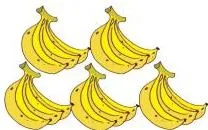
- Solve the potter story (\(9 – 5\), then \(+ 7\)) and the bus story (\(6 + 8\), then \(- 7\)) in two steps.
- Use a number strip to check each answer by hopping forward for addition and backward for subtraction.
Related resources
This listing is maintained for the 2026-27 academic session using the NCERT textbook information available to us. NCERT remains the authority for confirming the latest edition.
- Joyful Mathematics Class 1 book page — the full book, chapter by chapter.
- Class 1 hub — everything this site indexes for Class 1.
- Previous chapter and next chapter of Joyful Mathematics.
- Official NCERT source: NCERT’s textbook portal publishes the current Joyful Mathematics Class 1 PDF free — the same edition the download at the top of this page points to.
Reference: NCERT Class 1 Mathematics textbook (Joyful Mathematics), chapter 6, official edition on ncert.nic.in.
Sources and data verification
- The description on this page refers to NCERT’s Joyful Mathematics textbook for Class 1, in its current NCERT edition.
- This page covers Chapter 6, “Vegetable Farm”, only — it is not a map of the whole CBSE Class 1 scheme.
- The listing is maintained for the current academic session using NCERT’s published textbook information.
- NCERT settles textbooks, editions and PDFs; CBSE settles curriculum, syllabus and examinations.
Vegetable Farm Class 1: FAQs
Which NCERT book is the Vegetable Farm chapter in?
NCERT’s Joyful Mathematics textbook for Class 1. Vegetable Farm is Chapter 6 of that book.
What maths does Vegetable Farm Class 1 teach?
Adding and subtracting within about 20 — adding two groups such as \(12 + 6\), subtracting such as \(15 – 9\), and reading short stories to decide which operation to use. The largest number in the chapter is 18, the bus seats.
How many pages does the Vegetable Farm chapter have?
Eight pages in the official NCERT PDF.
How can I help my child with “Add in your own way” at home?
Let the child choose the method and ask “Can you do it differently?”, exactly as the book does. Use real objects — pencils, bangles, laddoos — so the child can point, count and check. The aim is a method the child can explain, not a single “correct” one.
What should my child know before starting Vegetable Farm?
Count a small group of objects one by one up to at least 18, and recognise the written numbers from 0 to 18 that appear in the chapter’s sums. The chapter itself teaches the adding and subtracting from there.
Do the Vegetable Farm activities count towards marks or exams?
Class 1 work is checked through classroom activities and worksheets, not a board examination. Also, textbook contents and the examinable syllabus are not always identical — check the current official syllabus for what is assessable this session.
Explore Class 1 Mathematics Books
- Previous: How Many?
- Next: Lina's Family
Related chapters:
- Finding the Furry Cat!
- What is Long?
- Mango Treat