
Looking for the How Many Times? Class 1 Joyful Mathematics Chapter 11 PDF? This page carries the official NCERT chapter — a four-page, picture-led lesson that turns an amusement-park visit, a bus journey and a home project into equal groups and repeated addition.
The official PDF is right below; the rest of this page walks through every scene, the sums to practise and the closing project.
Download How Many Times? Class 1 Chapter 11 PDF
The official chapter file is published on the NCERT e-book portal at ncert.nic.in; open the NCERT Class 1 Mathematics Chapter 11 How Many Times? PDF there to see the full-colour park scenes and to read the sums exactly as printed in the textbook.
Chapter 11 at a Glance
This is a short, picture-led Class 1 chapter whose four pages follow a group of children through an amusement park, a journey in the bus, a shop where they buy erasers, pencils and apples, and a closing cycle-wheel project. The table below lists how much the chapter holds — its sections, figures and sums.
| What the chapter holds | Count | Where it is used |
|---|---|---|
| Printed pages | 4 | |
| Figures with NCERT captions | 6 | |
| Official NCERT PDF | Download the chapter PDF | the chapter exactly as NCERT publishes it |
What ‘How Many Times?’ Teaches: Park, Bus and Project Work
The whole chapter does one thing: it turns pictures of equal groups into repeated addition, then reads that addition with the word ‘times’. Each scene asks the same three questions — how many groups, how many in one group, how many altogether.
| Story | What the picture shows | Repeated addition | Read-aloud language | Total |
|---|---|---|---|---|
| Horse swing | Four horses, two children each | \(2+2+2+2\) | 4 times 2 | 8 |
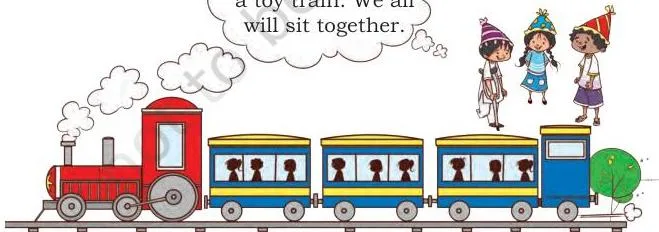
| Toy train | Three bogies, three children each | \(3+3+3\) | 3 times 3 | 9 |
| Big wheel | Five compartments, four children each | \(4+4+4+4+4\) | 5 times 4 | 20 |
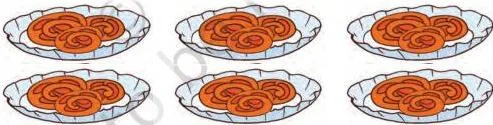
| Jalebis | Six plates, three pieces each | \(3+3+3+3+3+3\) | 6 times 3 | 18 |
| Bus people | Nine groups of two people | \(2+2+2+2+2+2+2+2+2\) | 9 times 2 | 18 |
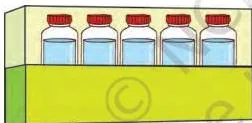
| Water-bottle crates | Four crates, five bottles each | \(5+5+5+5\) | 4 times 5 | 20 |
| Erasers | Four packs of two | \(2+2+2+2\) | 4 times 2 | 8 |
| Pencils | Five packs of three | \(3+3+3+3+3\) | 5 times 3 | 15 |
| Apples | Three packs of three | \(3+3+3\) | 3 times 3 | 9 |
One caution on the big wheel: the printed sum on the page shows a row of blank boxes, while the story says five compartments with four children each. Use the story numbers — five groups of four — and the total 20.
After the ride and bus scenes, the chapter ends with a Project Work page: draw a cycle wheel, count the cycles at home and find the total wheels. That project gets its own section below.
The Key Idea: Equal Groups and Repeated Addition
Before any formula, here is what the whole chapter is for: every scene shows groups that are equal, meaning the same number sits inside every group, and the chapter adds those groups again and again.
- Equal groups — the same count inside every group. On the horse swing, every horse carries the same two children.
- Repeated addition — writing the same number again and again. \(2+2+2+2\) means four groups of two.
- The word ‘times’ — a short way of saying ‘added again and again’. So ‘4 times 2’ is another way of saying \(2+2+2+2\).
- The three-question routine — for each picture, count the groups, count what is inside one group, then add them all. The book itself suggests asking, for every activity, how many children are in the picture, how many sit in each compartment, and the total on the ride.
Worked example, new numbers: three boats carry children across a river, five children in each boat.
Step 1: Count the groups — three boats.
Step 2: Count one group — five children in a boat.
Step 3: Add five once per boat.
\[5+5+5 = 15\]
Final answer: 15 children altogether, read aloud as ‘3 times 5’.
Why the book never prints the multiplication sign. The chapter deliberately teaches words before symbols. ‘6 times 3’ states the story — six plates of three jalebis means 3 added six times — so children learn the language of multiplication first. The symbol comes later, once that language is firm. That is why every sum here stays as addition or as words, never with \(\times\).
Reading the Pictures in the Chapter


The chapter’s meaning lives in its pictures, and none of the illustrations are reproduced on this page — open the PDF to see them. Here is how to read each scene with the three-question routine.
- Horse swing — children sit in pairs on four horses. Point at one horse, count its two children, then count the horses: four groups of two.
- Toy train — three filled bogies, three children in each. The picture makes ‘3 times 3’ visible: three groups, three inside each.
- Big wheel — five compartments, four children per compartment. Count the compartments first, so the picture of ‘5 times 4’ is set before any adding.
- Jalebis — six plates, three pieces each. The picture repeats the same three pieces across six plates: 3 added six times.
- Bus and crates — nine groups of two people, and four crates of five bottles. These are the hardest pictures because there are many groups; counting in twos — 2, 4, 6, 8, 10, 12, 14, 16, 18 — keeps the count safe.
Ask the three questions in the same order every time — groups first, inside one group second, total third. That order is what stops a child from guessing the answer.
Words to Know in Chapter 11
The book never stops to define its words, so a parent may need them in one line each. These are plain-language explanations, not textbook definitions.
| Word | Plain meaning | Example from the chapter |
|---|---|---|
| Group | A set of things counted together | The children sitting on one horse form one group |
| Times | A short way of saying ‘added again and again’ | ‘6 times 3’ means 3 added six times |
| Total (also ‘altogether’) | The answer after adding every group | ‘Total number of children can sit in the swing’ — 20 children on the big wheel |
Common Mistakes Children Make Here
This chapter is only four pages long, but it has one classic error worth naming before it happens: pointing at the groups and forgetting the children inside them. The table below gives the fixes.
| Mistake | Correct rule | How to check your answer |
|---|---|---|
| Counting the groups instead of the members inside them — a child points at four horses and says ‘4 children’ | Touch one group, count what is inside it, then add across all the groups | Point at a single horse and count the children on it before counting horses |
| Swapping the story order of ‘times’ — reading ‘6 times 3’ as six jalebis on three plates | The first number names the groups (the plates); the second names what sits inside each (the pieces) | Say the full story aloud: six plates of three jalebis |
| Losing the count when there are many groups, as on the bus page with nine 2s | Touch and count each person once, or count in twos | Count aloud in twos: 2, 4, 6, 8, 10, 12, 14, 16, 18 |
| Jumping to the multiplication sign because the word ‘times’ appears | The chapter deliberately uses the word without the symbol; keep writing the full addition | Write \(2+2+2+2+2+2+2+2+2\) before writing ‘9 times 2’ |
Notice that swapping the order — three plates of six instead of six plates of three — still totals 18, so the number alone cannot catch the error. The real check is always to say the story aloud.
How Teachers Check This Chapter
Class 1 has no board exam, and in most schools this chapter is checked through oral and picture work rather than written sums. The typical check is simple: the teacher points to a scene and asks the three questions — how many groups, how many in each group, how many altogether.
A two-minute check at home works the same way. After any page, ask the three questions in order, then let the child write the addition. Correct the order of the questions, not just the final number — a total can be right while the story behind it is muddled.
One honest boundary: textbook contents and the examinable syllabus are not always identical — check the current official syllabus. This page describes what the NCERT book teaches; it makes no promise about exam weightage.
Chapter 11 in One Page
The chapter is short enough that one small table holds all of it — a thirty-second answer check for a parent or teacher.
| Scene | Total children or objects |
|---|---|
| Horse swing | 8 |
| Toy train | 9 |
| Big wheel | 20 |
| Jalebis | 18 |
| Bus people | 18 |
| Water bottles | 20 |
| Erasers | 8 |
| Pencils | 15 |
| Apples | 9 |
| Project work: cycles at home | 2 wheels each |
Every story is the same idea — equal groups added again and again, read with the word ‘times’. If a total in this table matches the child’s work, the picture was read correctly.
Project Work: Counting Cycle Wheels at Home
The chapter ends with a project rather than a problem set: draw a cycle wheel, find out how many cycles are at home, and find the total number of wheels. Each cycle has 2 wheels, so the total is 2 added once per cycle.
Step 1: Count the cycles at home.
Step 2: Each cycle has 2 wheels, so add 2 once per cycle.
\[2+2+2 = 6\]
Final answer: three cycles give 6 wheels, read aloud as ‘3 times 2’.
The same equal-groups structure extends to other household objects. These are home ideas, not part of the book’s project:
- Pairs of shoes in a rack — every pair is a group of 2; add 2 once per pair.
- Windows in a row — count them one by one, or in pairs.
- Eggs in a tray — each row holds the same number of eggs; add row by row.
- Chairs around a table — the same number per side; add side by side.
Related Chapters and Resources
This listing is maintained for the 2026-27 academic session using the NCERT textbook information available to us. NCERT remains the authority for confirming the latest edition.
This chapter is one of the story-based chapters in the Class 1 Joyful Mathematics book. For the full book, see the NCERT Class 1 Joyful Mathematics book page or the Class 1 NCERT books hub.
For practice beyond the PDF, the Class 1 Mathematics notes page collects chapter-wise help, and the CBSE notes index covers every class. The chapters beside this one — How Do I Spend My Day? and How Much Can We Spend? — each have their own notes pages under the Class 1 notes hub.
The official publisher, NCERT, publishes every textbook chapter on its e-book portal at ncert.nic.in.
Sources and Data Verification
The description on this page is based on the NCERT Class 1 Joyful Mathematics textbook (English medium), Chapter 11, in its current official edition, available from ncert.nic.in. This page covers one chapter of one book and does not describe the full CBSE Class 1 scheme.
The page is maintained for the current academic session using the NCERT information available to us. NCERT settles textbooks, editions and PDFs; CBSE settles the curriculum, syllabus and examinations.
Reference: NCERT Class 1 Joyful Mathematics textbook, chapter 11, official edition on ncert.nic.in.
Frequently Asked Questions
Quick answers to the questions parents most often ask about this particular chapter.
What does Class 1 Maths Chapter 11, How Many Times?, teach?
It teaches equal groups and repeated addition through picture scenes: children on the horse swing, toy train and big wheel, jalebis on six plates, people in the bus, and packs of erasers, pencils and apples. Every scene is read as a number added again and again and said with the word ‘times’, with totals up to 20.
Why does the chapter say 6 times 3 instead of using the multiplication sign?
Because the language of multiplication comes before its symbol. ‘6 times 3’ names the story — six plates of three jalebis — and children learn that meaning first. The multiplication sign is introduced later, once the idea is firm.
How can I help my child with the cycle wheel Project Work?
Count the cycles at home, then add 2 wheels for each cycle — three cycles give \(2+2+2 = 6\). For extra practice, extend the same routine to pairs of shoes, rows of windows and eggs in a tray.
Does this chapter have sums to solve at the end?
No separate exercise set — the chapter closes with Project Work. The sums live inside the story pages themselves: each scene carries its own addition and its ‘times’ line to complete.
Is How Many Times? part of the current Class 1 syllabus?
It appears in the current NCERT Joyful Mathematics textbook. Textbook contents and the examinable syllabus are not always identical, so check the current official syllabus to see what is examinable this session.
Explore Class 1 Mathematics Books
- Previous: How do I Spend my Day?
- Next: How Much Can We Spend ?
Related chapters:
- Finding the Furry Cat!
- What is Long?
- Mango Treat